2016 AUDI A3 CABRIOLET fuel
[x] Cancel search: fuelPage 207 of 272
Bead
means the part of the tire that is
made of steel wires, wrapped or
reinforced by ply cords and that is
shaped to fit the rim.
Bead separation
means a breakdown of the bond
between components in the bead.
Cord
means the strands forming the
plies in the tire.
Cold tire inflation pressure
means the tire pressure recom
mended by the vehicle manufac
turer for a tire of a designated size that has not been driven for
more than a couple of miles (kilo
meters) at low speeds in the
three hour period before the tire pressure is measured or adjusted .
Curb weight
means the weight of a motor ve
hicle with standard equipment in
c luding the maximum capacity of
fuel, oi l, and coolant, air condi
tioning and add itional weight of
optional equipment.
E xtra load ti re
<( a:,
~ means a tire designed to operate
N
~ at higher loads and at higher in
s: a:,
Tires and wheels
flation pressures than the corre
sponding standard tire . Extra load
tires may be identified as "XL",
" xl", "EXTRA LOAD", or "RF" on
the sidewall.
Gross Axle Weight Rating ( " GAWR")
means the load -carrying capacity
of a single axle system, measured
at the tire-ground interfaces .
Gross Vehicle Weight Rating
("GVWR ")
means the max imum total loaded
weight of the vehicle.
Groove
means the space between two ad
jacent tread ribs .
Load rating (code)
means the maximum load tha t a
tire is rated to carry for a given in
flat ion pressure . You may not find
this informat ion on all tires be
cause it is not requ ired by law.
Maximum load rating
means the load rating for a tire at
the maximum permissible infla
tion pressure for that tire.
Maximum loaded vehicle
weight
means the sum of:
2 0 7
..
Page 215 of 272

<( a:, ... N .... N ... 0
s: a:,
A WARNING
Always adapt the tire pressure
to your driving style and vehicle load.
-Overloading can lead to loss of
vehicle control and increase the risk of an accident. Read
and follow the important safe
ty precautions in¢
page 216,
Tires and vehicle load limits.
-The tire must flex more if the
tire pressure is too low or if
the vehicle speed or load are
too high. This heats the tire up
too much. This increases the risk of an accident because it
can cause the tire to burst and result in loss of vehicle con
trol.
-Incorrect tire pressure in creases tire wear and has a
Tire pressure table
Please note that the information
contained in the following table
was correct at the time of print
ing, and the information is sub
ject to change. If there are differ
ences between this information
and the tire pressures specified
on the label on the driver's side B pillar, always follow the specifica-
Tires and wheels
negative effect on driving and
braking behavior, which in
creases the risk of an accident.
Replace lost valve caps to re
duce the risk of damage to the
tire valves.
@ For the sake of the environment
Tire pressure that is too low in
creases fuel consumption.
(1) Tips
Audi recommends using the
tire pressure specified for a normal load ¢
table on
page 216
or for a full load
when the vehicle is partially
loaded.
tion on the B-pillar label
¢ page 214, fig. 170.
Make sure that the tire designa
tion on your tire matches the des ignation on the tire pressure label
and the tire pressure table.
The following table lists recom mended tire pressures in cold
215
Page 217 of 272

Your safety and that of your passengers also depends on making
sure that load limits are not ex
ceeded. Vehicle load includes ev
erybody and everything in and on
the vehicle. These load limits are
technically referred to as the vehi
cle's
Gross Vehicle Weight Rat
ing
("GVWR").
The "GVWR" includes the weight
of the basic vehicle, all factory in
stalled accessories, a full tank of
fuel, oil, coolant and other fluids
plus maximum load. The maxi
mum load includes the number of
passengers that the vehicle is in
tended to carry ("seating capaci
ty") with an assumed weight of
150 lbs. (68 kg) for each passen
ger at a designated seating posi
tion and the total weight of any luggage in the vehicle. If you tow
a trailer, the weight of the trailer
hitch and the tongue weight of
the loaded trailer must be includ
ed as part of the vehicle load.
The
Gross Axle Weight Rating
("GAWR") is the maximum load
that can be applied at each of the
vehicle's two axles .
; The fact that there is an upper
N
~ limit to your vehicle's Gross Vehi-
o
s: a:,
Tires and wheels
cle Weight Rating means that the
total weight of whatever is being
carried in the vehicle (including
the weight of a trailer hitch and
the tongue weight of the loaded
trailer) is limited. The more pas
sengers in the vehicle or passen
gers who are heavier than the
standard weights assumed mean
that less weight can be carried as
luggage.
The Gross Vehicle Weight Rating
and the Gross Axle Weight Rating
are listed on the safety compli
ance sticker label located on the driver's side B-pillar
9page 214,
fig. 170.
A WARNING
Overloading a vehicle can cause
loss of vehicle control, a crash
or other accident, serious per
sonal injury, and even death.
-Carrying more weight than your vehicle was designed to carry will prevent the vehicle
from handling properly and increase the risk of the loss of
vehicle control.
-The brakes on a vehicle that
has been overloaded may not
be able to stop the vehicle
within a safe distance.
217
Page 222 of 272

Tires and wheels
Tire pressure monitoring
indicator
CD General notes
Applies to: ve hicles w ith tire p ressu re monitoring system
Each tire, including the spare (if provided),
should be checked monthly when cold and inflat
ed to the inflation pressure recommended by the
vehicle manufacturer on the vehicle placard or tire inflation pressure label. (If your vehicle has
tires of a different size than the size indicated on
the vehicle placard or tire inflation pressure la
bel, you should determine the proper tire infla
tion pressure for those tires) .
As an added safety feature, your vehicle has been
equipped w ith a tire pressure monitoring system
(TPMS) that illuminates a low tire pressure tell
tale when one or more of your t ires is significant
ly under-inflated. Accordingly, when the low tire
pressure telltale illuminates, you should stop and
check your tires as soon as possible , and inflate
them to the proper pressure. Driving on a signifi
cantly under-inflated tire causes the tire to over
heat and can lead to tire failure. Under-inflation
also reduces fuel efficiency and tire tread life,
and may affect the vehicle's handling and stop
ping ability .
Please note that the TPMS is not a substitute for
proper tire maintenance, and it is the driver's re
sponsib ility to ma intain correct tire pressure,
even if under-inflation has not reached the level
to tr igger illum inat ion of the TPMS low tire pres
sure telltale.
Your veh icle has also been equipped w ith a TPMS
malfunct ion indicator to indicate when the sys
tem is not operat ing properly. The TPMS mal
function indicator is combined w ith the low tire
pressure telltale. When the system detects a
malfunction, the telltale will flash for approxi
mately one minute and then remain continuous ly
illuminated. This sequence will continue upon
subsequent vehicle start-ups as long as the mal
function exists .
When the malfunction indicator is illuminated,
the system may not be able to detect or signal low tire pressure as intended . TPMS malfunctions
222
may occur for a variety of reasons, including the
installation of replacement or alternate tires or
wheels on the veh icle that prevent the TPMS
from functioning properly. Always check the
TPMS malfunction telltale after replacing one or more tires or wheels on your vehicle to ensure
that the replacement or alternate tires and
whee ls allow the TPMS to continue to function
properly.
If the Tire Pressure Monitoring System
indicator appears
Appl ies to: vehicles wit h Tire Pressure Mo nito rin g System in
dica tor
The tire pressure indicator in the instrument
cluster informs you if the tire pressure is too low
or if there is a system malfunction.
Using the ABS sensors, the tire pressure monitor
i ng system compares the tire tread c ircumfer
ence and vibration characteristics of the individu
al tires. If the pressure changes in one or more
tires , this is indicated in the instrument cluster
display with an
Ii] indicator light and a message.
If only one tire is affected, the location of that
tire will be indicated. The message turns
off after
a few minutes. You can display the message
again
,=;, page 25.
The tire pressures must be stored in the menu
display again each time the pressures change
(switching between partial and full load pres
sure) or after changing or replacing a tire on your
vehicle
c;, page 223. The tire pressure mon itor
ing system on ly monitors the tire pressure you
have stored . You can find the recommended tire
pressures for your vehicle on the label on the
driver's door pillar
q page 214 .
Tire tread circumference and vibrat ion character
i stics can change and cause a tire pressure warn
i ng if:
-If the tire pressure in one or more t ires is too
low,
- the tire has structural damage,
- The tire was replaced or the tire pressure
changed and it was not stored again
,=;, page 223.
- the spare tire is installed.
Page 226 of 272

Care and cleaning
Component Situation Solution
Power top
Deposits Clean water, power top cleaning product , if necessary.
Clean with the grain of the fabric using a soft brush and al- low to air dry.
Wind deflector Deposits Water, mild soap solution,
if necessaryal
Decorative parts/ Deposits Mild soap solution a>, a cleaning solution suitable for stain-
Trims less steel, if necessary
Paint Paint damage Refer to the paint number on the vehicle data label, repair
with touch up paint
r:!) page 250
Spilled fuel Rinse with water immediately
Surface r ust Rust remover, then protect with hard wax; for questions,
consult an authorized Audi dealer or authorized Audi Serv-
ice Facility.
Corrosion H
ave it removed by an authorized Aud i dealer or author-
ized Audi Service Facility.
Water no longer Protect with hard wax (at least twice per year)
beads on the surface
of clean paint
No shine even though Treat with suitable polish; then apply paint protectant if
paint has been pro- the polish that was used does not contain any protectant
tected/pa int looks
poor
Deposits such as in- Dampen with water immediately and remove with a micro-
sects, bird droppings,
fiber cloth
tree sap and road salt
Grease-based con- Remove
immediately with a mild soap solution a) and a
taminants such as soft cloth
cosmetics or sunblock
Carbon parts Deposits clean the same way as painted parts ~ page 224
Decorative decals Deposits Soft
sponge with a mild soap solution al
a) Mild soap so lution: maxim um two tablespoons of neutral soap in l quar t (l lite r) of water
Internal cleaning
Component Situation Solution
Windows
Deposits Glass cleaner, then wipe dry
Decorative parts/ Deposits Mild
soap solutiona )
Trims
Plastic parts
Deposits Damp cloth
Heavier deposits Mild soap so lution a>, detergent-free p lastic clean ing solu -
tion, if necessary
Displays Deposits Soft cloth with LCD cleaner
Controls Deposits Soft
brush, then a soft cloth with a mild soap so lutional
Safety belts Deposits Mild soap so lution a>, allow to dry before letting them re-
tract
226
Page 242 of 272

Fuses and bulbs
No . Equipment
F48 Exterior sound actuator
F49 Starter, clutch sensor, headlight relay coil,
high-voltage
battery
FS3 Rear window defogger
The power seats* are protected via
circuit break
ers
that automatically switch on after a few sec
onds after the overload has been reduced.
(D Tips
Note that the following table was accurate at
the time of printing and is subject to change.
Left engine compartment fuse assignment
Fig . 189 Engine compartment: fuse assignment
No. Equipment
Fl ESC control module
F2 ESC control module
F3 Engine control module (gaso line/diesel)
Engine cooling, engine components, auxili-
F4 ary heater coil relay (1+2), secondary air injection pump relay
FS Engine components,
tank system
F6 Brake light sensor
F7 Engine components, water
pumps
242
No. Equipment
F8 Oxygen sensor
F9 Engine
components, exhaust door, glow
time control module, SU LEV valve
FlO Fuel injectors, fuel control module
Fll Auxiliary heater heat ing element 2
F12 Auxiliary heater heating element 3
F13 Automatic transmiss ion control module
FlS Horn
F16 Ignition coil/ power electronics
F17 ESC control module, engine control mod-
ule
F18 Terminal 30 (reference voltage)
F19 Windshie ld w ipers
F20 Horn
F22 Terminal SO diagnosis
F23 Starter
F24 Auxiliary heater heating element
1, brake
booster
F31 Vacuum pump/ water pump
F32 LED headlights
F33 Brake booster reservoir
F34 Brake booster control
F3S Relay
@ Tips
Note that the following tab le was accurate at
the time of printin g and is subject to change.
Bulbs
Replacing light bulbs
For your safety, we recommend that you have
your authorized Audi dealer replace burned out bulbs for you.
It i s becom ing increasingly more and more diffi
cult to replace vehicle light bulbs since in many
cases, other parts of the car must first be re
moved before you are ab le to get to the bulb.
This applies especially to the light bulbs in the
front of your car which you can only reach
through the engine compartment .
Page 250 of 272
Technical data
Technical data
Vehicle identification
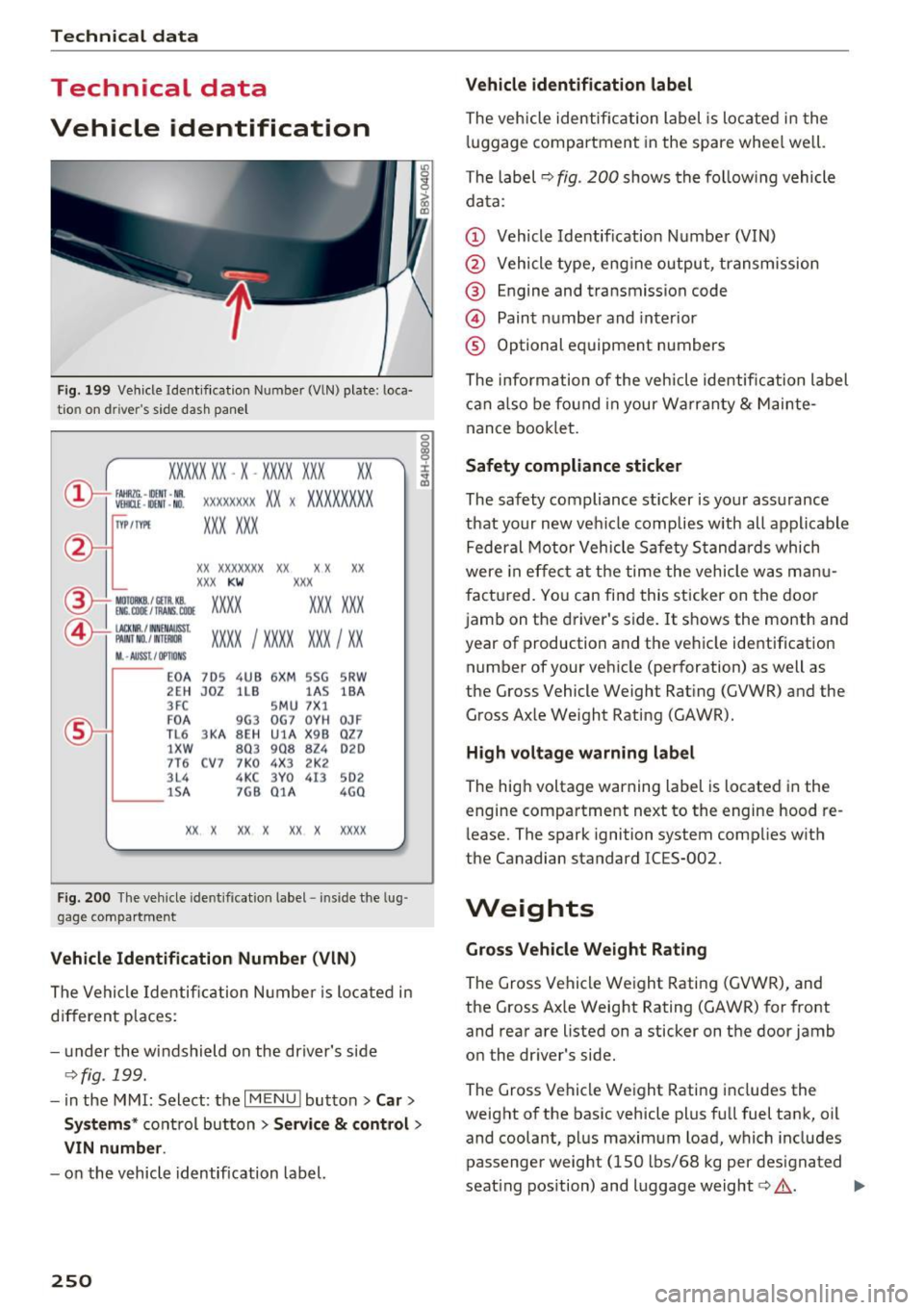
Fig. 199 Vehicle Ident if ication Numbe r (VlN) plate : loca·
tio n on d river 's side dash panel
XXXXX XX -X -XX XX XXX XX
@-+ ~J:~t::1 ::: xxxxxxxx xx x xxxx xxx x
IYP lf'VPE XXX X XX
XX XXXXXXX XX X X XX
XXX KW XXX
\YT IM:.COll/fAANS ,COOE XXX XXX 15\_L I MOIOlll
@-+ ~~
1
:tr:~i XXXX I XXXX XXX I XX
II. -AUSST . / OPTIO NS
E0 A 7D5 4UB 6X
M SSG SR W
2EH JOZ lLB lAS
lBA
3FC SM U 7 X1
F0 A
9G3 0
G7 0Y H
0JF
TL 6 3 KA 8EH UlA X 9B Q
Z7
1 XW
803 908
824 020
7T6 C V7 7 K0 4X3 2K2
3L4 4KC 3Y0 413
502
lS A 7GB 01A
4G0
XX X XX X
XX X xxxx
Fig. 200 The vehicle ide ntifi cat ion l abel - inside t he lug ·
gage compartment
Vehicle Identification Number (VlN)
The Vehicle Identification Number is located in
different places :
- under the windshield on the driver's side
¢fig . 199.
- in the MMI: Select: the I MENU I button> Car>
Systems*
control button > Service & control >
VIN number .
-on the vehicle identification label.
250 Vehicle
identification label
The vehicle identification label is located in the
luggage compartment in the spare wheel well.
The label
9 fig. 200 shows the follow ing vehicle
data:
(D Vehicle Identif ication Number (VIN)
@ Vehicle type, engine output, transmission
@ Engine and transmission code
@ Paint number and interior
® Optional equipment numbers
The information of the vehicle identification label
can also be found in your Warranty
& Mainte ·
nance booklet.
Safety compliance sticker
The safety compliance sticker is your assurance
that your new veh icle complies with all applicable
Federal Motor Vehicle Safety Standards which
were in effect at the time the vehicle was manu
factured. Yo u can find this sticker on the door
jamb on the driver's side. It shows the month and
year of production and the vehicle identification
number of your vehicle (perforation) as well as
the Gross Vehicle Weight Rating (GVWR) and the Gross Axle We ight Rating (GAWR).
High voltage warning label
The high voltage warning label is located in the
engine compartment next to the engine hood re
lease. The spark ignition system complies w ith
the Canadian standard ICES-002.
Weights
Gross Vehicle Weight Rating
The Gross Vehicle Weight Rating (GVWR), and
the Gross Axle Weight Rating (GAWR) for front
and rear are listed on a sticker on the door jamb
on the driver 's side.
The Gross Vehicle Weight Rating includes the
weight of the basic vehicle plus full fuel tank, oil
and coolant, plus maximum load, which includes
passenger weight (150 lbs/68 kg per designated
seat ing position) and luggage weight¢,&. . .,.
Page 251 of 272

<( co .... N ,.__
N .... 0 ,.__
> co
Gross Axle Weight Rating
The G ross Axle We igh t Rating is the max imum
l oad that can be applied at each axle of the vehi
cle ~.& .
Vehicle capacity weight
The vehicle capac ity we ight (max. load) is listed
e ithe r o n the dr iver's side B-pillar o r inside the
f u el fi ller flap.
& WARNING
- The actual Gross Ax le Weight Rating at the
front and rear axles sho uld not exceed the
permissible weights, and their comb inat ion
must not exceed the Gross Vehicle We ight
Rat ing.
Dimensions
The dimens io ns can vary depending on the model
a nd equipment.
Length
Width
Width across the m irrors
He igh t at c urb we ightal
a ) T he he ight of the veh icle depen ds on the tire s a nd su sp en sio n.
W hen driv ing on poor roads, by cu rbs and on
steep ramps, make s ure that low-lying compo-
n ents such as the spo ile r and ex haust system do
Capacities
Fuel ta nk
Front wheel drive
all wheel drive
Windsh ield washer system
Techn ical data
- Exceeding permissible weight ratings can
res ult in vehicle damage, accidents and per
sonal injury.
(D Note
- The vehi cle capacity weig ht figu res apply
when the load is d istributed evenly in the
vehicle (passengers and luggage) . When
transport ing a heavy load in the luggage
compartment, ca rry the load as near to the
rear axle as possib le so that t he veh icle's
hand ling is no t impaired .
- Do not exceed the maximum perm iss ible
ax le loads or the maximum gross vehicle
we igh t. Always remember that the veh icle's
han dling will be affe cted by the extra load.
Th erefore, adjust your spee d accordingly.
- Always observe local regulations.
in (mm) 175.3 (4,456)
i n (mm)
70.5 (1,793)
in (mm) 77 .1 (1,960)
i n (mm) 55.4 (1,409)
not come into contact w ith th ese o r they could be
damaged . This applies especially when the vehi
cl e is fully loaded.
gal ( l)
approximately 13.2
gal ( l) (50.0)
app roxima tely 1 4.5
(55.0)
qt (l) approximately 3. 2 (3 .1)
251