2015 Peugeot 208 stop start
[x] Cancel search: stop startPage 177 of 341
175
208_en_Chap08_Informations-pratiques_ed01-2015
Bonnet
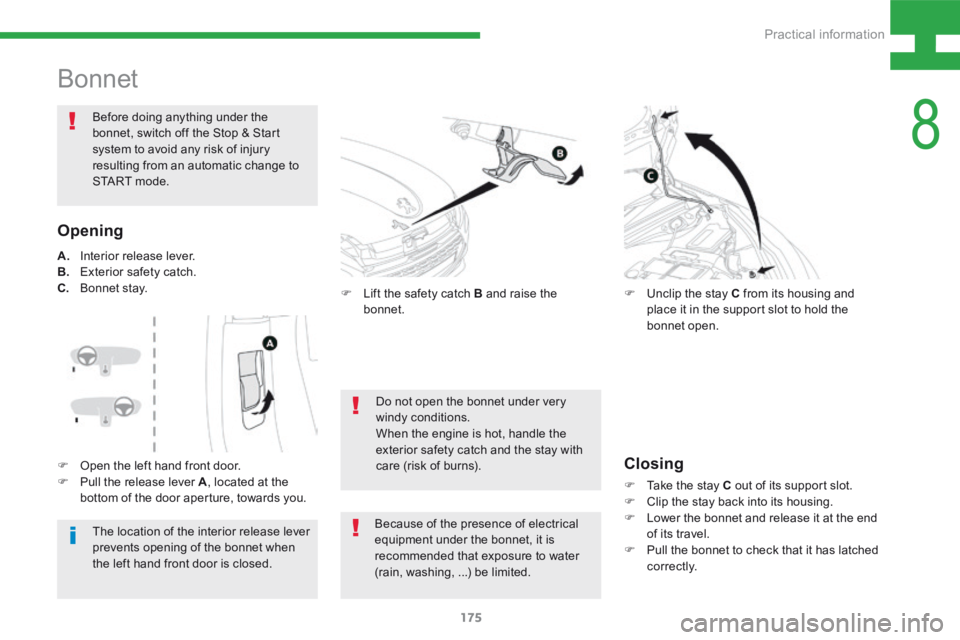
The location of the interior release lever
prevents opening of the bonnet when
the left hand front door is closed.
Before doing anything under the
bonnet, switch off the Stop & Start
system to avoid any risk of injury
resulting from an automatic change to
S TA R T m o d e .
Closing
F
Take the stay C out of its support slot.
F Clip the stay back into its housing.
F Lower the bonnet and release it at the end
of its travel.
F Pull the bonnet to check that it has latched
c o r r e c t l y.
F
Unclip the stay C from its housing and
place it in the support slot to hold the
bonnet open.
Do not open the bonnet under very
windy conditions.
When the engine is hot, handle the
exterior safety catch and the stay with
care (risk of burns).
Opening
F Lift the safety catch B and raise the
bonnet.
A.
Interior release lever.
B. Exterior safety catch.
C. B o n n et st ay.
Because of the presence of electrical
equipment under the bonnet, it is
recommended that exposure to water
(rain, washing, ...) be limited.
F
Open the left hand front door.
F Pull the release lever A , located at the
bottom of the door aperture, towards you.
8
Practical information
Page 182 of 341
180
208_en_Chap08_Informations-pratiques_ed01-2015
Low fuel level
When the low fuel level is reached
this warning lamp comes on in the
instrument panel. There remains
approximately 5 litres of fuel in
the tank. When the warning lamp
flashes, there is ver y little fuel left .
The key cannot be removed from the
lock until the cap is refitted.
Removing the filler cap may cause an
inrush of air. This vacuum is per fectly
normal and results from the sealing of
the system.
Fuel tank
Fuel
Fuel tank capacity: approximately 50 litres.Refuelling
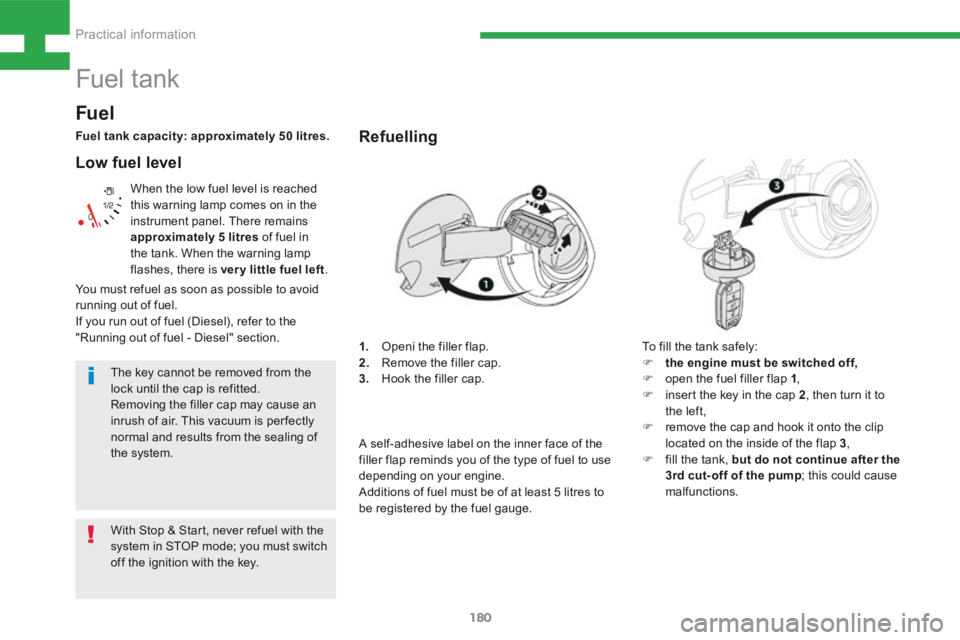
To fill the tank safely:
F the engine must be switched off,
F open the fuel filler flap 1 ,
F insert the key in the cap 2 , then turn it to
the left,
F remove the cap and hook it onto the clip
located on the inside of the flap 3 ,
F fill the tank, but do not continue after the
3rd cut- off of the pump ; this could cause
malfunctions.
With Stop & Start, never refuel with the
system in STOP mode; you must switch
off the ignition with the key.
You must refuel as soon as possible to avoid
running out of fuel.
If you run out of fuel (Diesel), refer to the
"Running out of fuel - Diesel" section.
A self-adhesive label on the inner face of the
filler flap reminds you of the type of fuel to use
depending on your engine.
Additions of fuel must be of at least 5 litres to
be registered by the fuel gauge.
1.
Openi the filler flap.
2. Remove the filler cap.
3. Hook the filler cap.
Practical information
Page 188 of 341
186
208_en_Chap08_Informations-pratiques_ed01-2015
Advice
While the quantity of AdBlue® in the additive
tank is sufficient, no information is displayed.
On the other hand, once the additive level
drops to the quantity needed for a range of
1 500 miles (2 400 km) driving, you are warned
by different temporary signals (warning lamp,
message, audible signal).
When the AdBlue
® tank is empty, restarting
becomes impossible. Different levels of alert are triggered according
to the remaining driving range threshold.
You will be informed as each mileage threshold
is reached and the alerts will change from
temporary to permanent.
-
The 1
st alert is triggered at a remaining
driving range of 1 500 miles (2 400 km).
- The 2
nd alert is triggered at a remaining
driving range of 375 miles (600 km).
Up to 0 miles, at which point it will be
impossible to restart the engine after a stop.
Range indicators
It is strongly recommended that you do
not wait for the successive alerts before
topping-up the AdBlue
® tank, but do this
as soon as possible.
Driving range
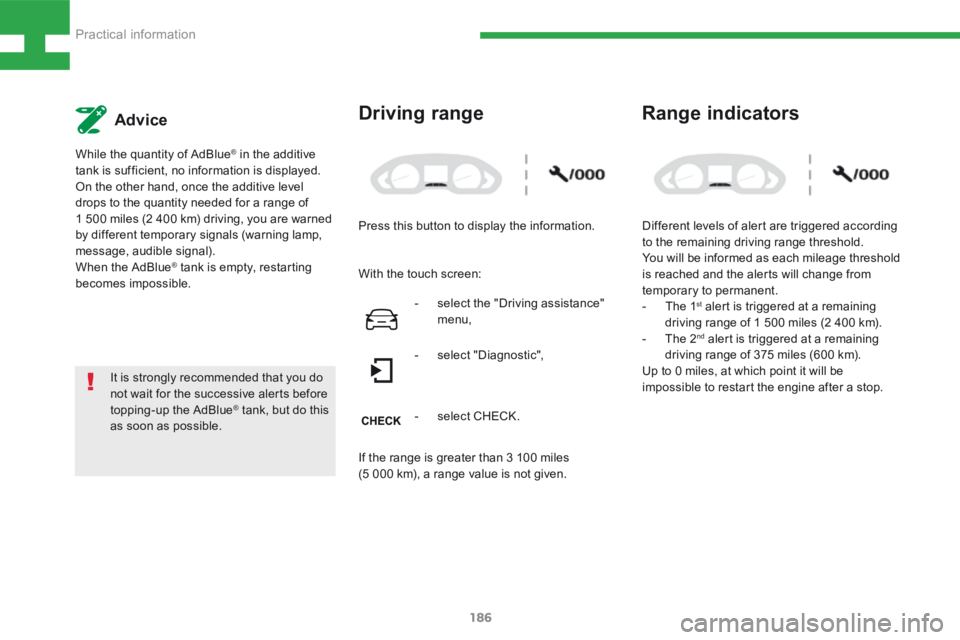
Press this button to display the information.
With the touch screen:
If the range is greater than 3 100 miles
(5 000 km), a range value is not given. -
select the "Driving assistance"
menu,
- select "Diagnostic",
- select CHECK.
Practical information
Page 190 of 341

188
208_en_Chap08_Informations-pratiques_ed01-2015
Filling
F Pour the contents of the bottle into your
vehicle's AdBlue® tank.
Important : if your vehicle's AdBlue
®
tank is completely empty - which is
confirmed by the alert messages and
the impossibility of starting the engine,
you must add at least 3.8 litres (so two
1.89 litre bottles).
If any additive is split or splashed, wash
immediately with cold water or wipe with
a damp cloth.
If the additive has crystallised, clean it
off using a sponge and hot water.
F
Wipe away any spillage around the tank
filler using a damp cloth.
Closing
F Refit the blue cap to the tank and turn it
a 6th of a turn clockwise, to its stop.
F Refit the black cap and turn it a quarter of
a turn clockwise without pressing. Ensure
that the indicator on the cap lines up with
the indicator on the support.
F Depending on equipment, return the spare
wheel and/or the storage box to the bottom
of the boot.
F Refit the boot carpet and close the tailgate.
Access
F For access to the AdBlue® tank, raise the
boot carpet then, depending on equipment,
lift out the spare wheel and/or the storage
box.
Opening
F Without pressing, turn the black cap a
quarter turn anti-clockwise and lift it off.
F Turn the blue cap a 6
th of a turn anti-
clockwise.
F Lift off the cap.
Practical information
Page 192 of 341
190
208_en_Chap08_Informations-pratiques_ed01-2015
Battery
The presence of this label indicates
the use of a 12 V lead-acid battery with
special technology and specification, for
which the involvement of a PEUGEOT
dealer or qualified workshop is required
when replacing or disconnecting the
battery.
Failure to observe this recommendation
may cause premature wear of the
battery.
After refitting the battery, the Stop &
Start system will only be active after
several hours depending on the climatic
conditions and the state of charge of
the battery (up to about 8 hours).F
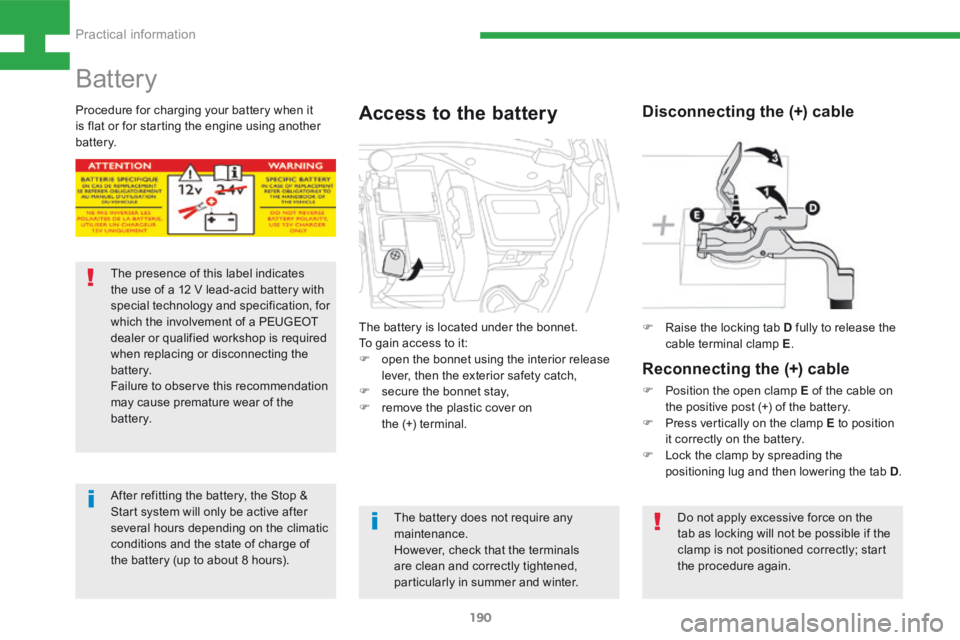
Raise the locking tab D fully to release the
cable terminal clamp E .
Disconnecting the (+) cable
Reconnecting the (+) cable
F Position the open clamp E of the cable on
the positive post (+) of the battery.
F Press vertically on the clamp E to position
it correctly on the battery.
F Lock the clamp by spreading the
positioning lug and then lowering the tab D .
Do not apply excessive force on the
tab as locking will not be possible if the
clamp is not positioned correctly; start
the procedure again.
Procedure for charging your battery when it
is flat or for starting the engine using another
battery.
The battery is located under the bonnet.
To gain access to it:
F open the bonnet using the interior release
lever, then the exterior safety catch,
F secure the bonnet stay,
F remove the plastic cover on
the (+) terminal.
Access to the battery
The battery does not require any
maintenance.
However, check that the terminals
are clean and correctly tightened,
particularly in summer and winter.
Practical information
Page 194 of 341
192
208_en_Chap08_Informations-pratiques_ed01-2015
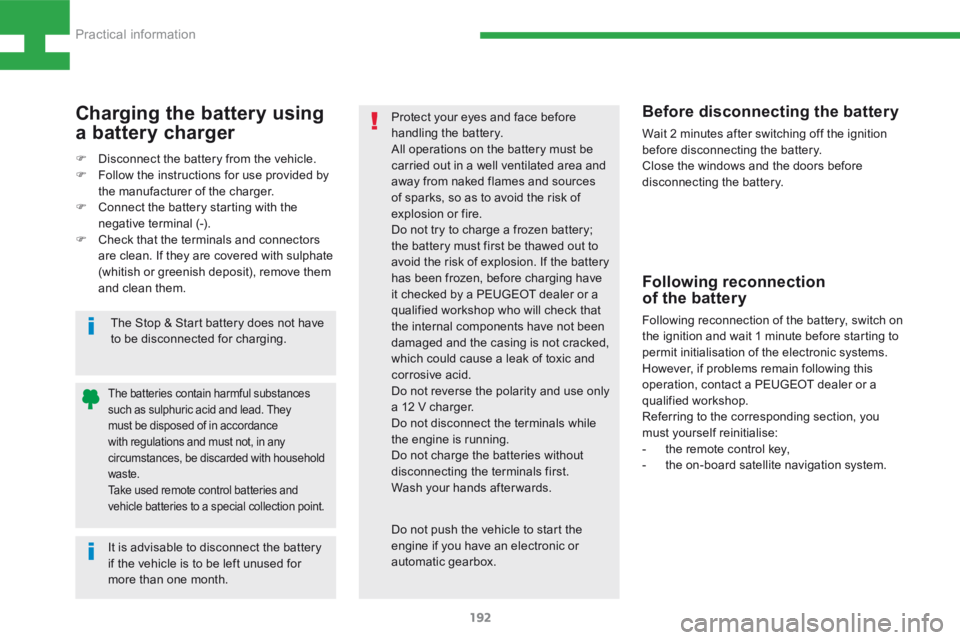
It is advisable to disconnect the battery
if the vehicle is to be left unused for
more than one month.
The batteries contain harmful substances
such as sulphuric acid and lead. They
must be disposed of in accordance
with regulations and must not, in any
circumstances, be discarded with household
waste.
Take used remote control batteries and
vehicle batteries to a special collection point.
Protect your eyes and face before
handling the battery.
All operations on the battery must be
carried out in a well ventilated area and
away from naked flames and sources
of sparks, so as to avoid the risk of
explosion or fire.
Do not try to charge a frozen battery;
the battery must first be thawed out to
avoid the risk of explosion. If the battery
has been frozen, before charging have
it checked by a PEUGEOT dealer or a
qualified workshop who will check that
the internal components have not been
damaged and the casing is not cracked,
which could cause a leak of toxic and
corrosive acid.
Do not reverse the polarity and use only
a 12 V charger.
Do not disconnect the terminals while
the engine is running.
Do not charge the batteries without
disconnecting the terminals first.
Wash your hands afterwards.
Do not push the vehicle to start the
engine if you have an electronic or
automatic gearbox.Before disconnecting the battery
Wait 2 minutes after switching off the ignition
before disconnecting the battery.
Close the windows and the doors before
disconnecting the battery.
Following reconnection
of the battery
Following reconnection of the battery, switch on
the ignition and wait 1 minute before starting to
permit initialisation of the electronic systems.
However, if problems remain following this
operation, contact a PEUGEOT dealer or a
qualified workshop.
Referring to the corresponding section, you
must yourself reinitialise:
- the remote control key,
- the on-board satellite navigation system.
The Stop & Start battery does not have
to be disconnected for charging.
Charging the battery using
a battery charger
F
Disconnect the battery from the vehicle.
F Follow the instructions for use provided by
the manufacturer of the charger.
F Connect the battery starting with the
negative terminal (-).
F Check that the terminals and connectors
are clean. If they are covered with sulphate
(whitish or greenish deposit), remove them
and clean them.
Practical information
Page 231 of 341
229
208_en_Chap9b_SMEGplus_ed01-2015
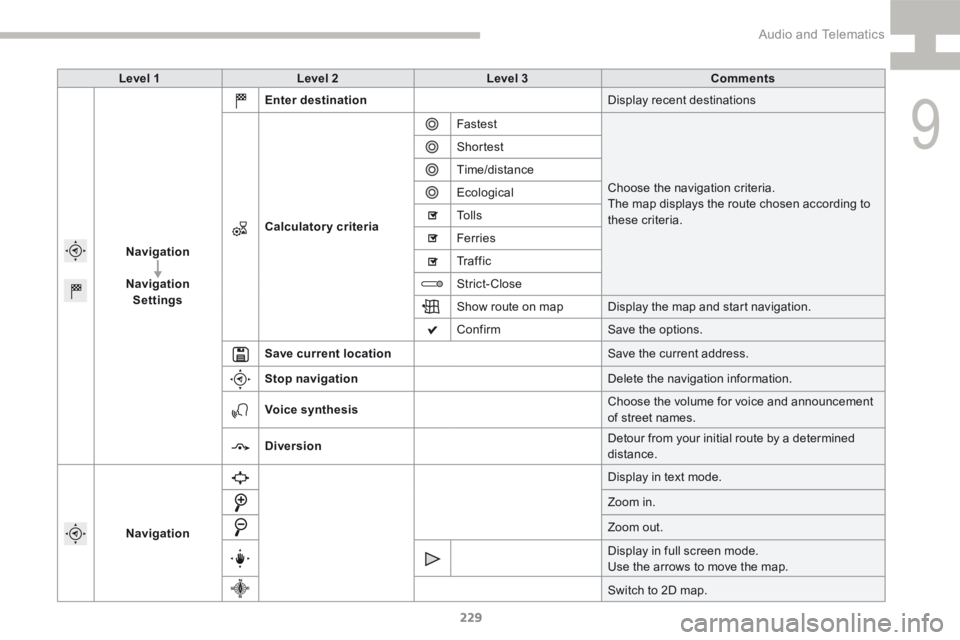
Level 1Level 2 Level 3 Comments
Navigation
Navigation Settings Enter destination
Display recent destinations
Calculatory criteria Fastest
Choose the navigation criteria.
The map displays the route chosen according to
these criteria.
Shortest
Time/distance
Ecological
To l l s
Ferries
Tr a f f i c
Strict-Close
Show route on map
Display the map and start navigation.
Confirm Save the options.
Save current location Save the current address.
Stop navigation Delete the navigation information.
Voice synthesis Choose the volume for voice and announcement
of street names.
Diversion Detour from your initial route by a determined
distance.
Navigation Display in text mode.
Zoom in.
Zoom out.
Display in full screen mode.
Use the arrows to move the map.
Switch to 2D map.
9
Audio and Telematics
Page 238 of 341
236
208_en_Chap9b_SMEGplus_ed01-2015
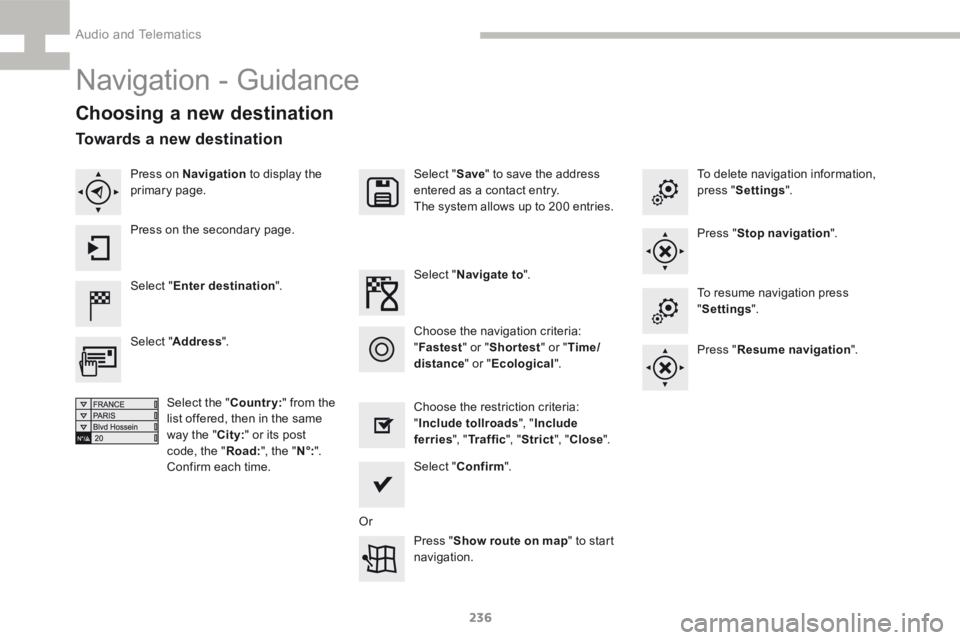
Navigation - Guidance
Choosing a new destination
Select "Enter destination ". Select "
Save" to save the address
entered as a contact entry.
The system allows up to 200 entries.
Select " Confirm ".
Press " Show route on map " to start
navigation.
Select "
Address ".
Select the " Country:" from the
list offered, then in the same
way the " City:" or its post
code, the " Road:", the " N°:".
Confirm each time. Select "
Navigate to ".
Choose the restriction criteria:
" Include tollroads ", "Include
ferries ", "Tr a f f i c ", "Strict ", "Close ".
Choose the navigation criteria:
"
Fastest " or "Shortest " or "Time/
distance " or "Ecological". To delete navigation information,
press "
Settings ".
Press " Stop navigation ".
To resume navigation press
" Settings ".
Press " Resume navigation ".
Press on Navigation
to display the
primary page.
Press on the secondary page.
Towards a new destination
Or
Audio and Telematics