2015 MERCEDES-BENZ GLE SUV missing
[x] Cancel search: missingPage 203 of 453
The following driving systems are specially
adapted to off-road driving:
R the Offroad drive program (vehicles without
Off-Road Engineering package)
(Y page 254)
R Offroad andOffroad Plus drive programs
(vehicles with Off-Road Engineering pack-
age) . (Y page 254)
R LOW RANGE offroad gear (vehicles with the
Off-Road Engineering package)
(Y page 255)
R Differential lock (vehicles with the Off-Road
Engineering package) (Y page 255)
R Off-road ABS (Y page 71)
R Offroad 4ETS (Y page 76)
R Offroad ESP ®
(Y page 77)
R AIRMATIC package (vehicle level)
(Y page 220)
R DSR (Downhill Speed Regulation)
(Y page 252)
Observe the following notes:
R Stop the vehicle before driving off-road. If
necessary, select the offroad program
(Y page 254) or shift to the LOW RANGE off-
road gear (Y page 255).
R Select a vehicle level suitable for the off-road
terrain. To avoid damaging the vehicle, make sure there is always sufficient ground clear-
ance.
R Make sure that items of luggage and loads are
stowed safely and are well secured
(Y page 355).
R Always keep the engine running and in gear
when driving on a downhill gradient. Activate
DSR (Y page 252).
R Drive slowly and evenly, if necessary at walk-
ing pace.
R Ensure that the wheels are in contact with the
ground at all times.
R Drive with extreme care on unknown off-road
routes where visibility is poor. For safety rea-
sons, get out of the vehicle first and survey
the off-road route.
R Look out for obstacles such as rocks, holes,
tree stumps and furrows.
R Take care when turning on an uphill or down-
hill slope or when driving across a slope. The
vehicle could otherwise tip over. R
Always keep the doors, the tailgate and the
sliding sunroof closed while the vehicle is in
motion.
R Do not stray from marked routes or paths.
R Observe the notes on off-road fording
(Y page 198).
i Information about retrofitting special all-ter-
rain tyres is available from any qualified spe-
cialist workshop.
i Do not use the HOLD function when driving
off-road, on steep uphill or downhill gradients or on slippery or loose surfaces. The HOLD
function cannot hold the vehicle on such sur-faces.
Checklist before driving off-road X
Engine oil level: check the engine oil and top
it up if necessary.
When driving on steep gradients, the oil level must be sufficiently high to ensure a correct
oil supply in the vehicle.
X AdBlue ®
tank (BlueTEC vehicles): check
the level and top up if necessary
(Y page 180).
X Tyre-change tool kit: check that the jack is
working and make sure you have the wheel
wrench, a robust tow cable and a folding
spade in the vehicle.
X Wheels and tyres: check the tyre tread
depth and tyre pressure.
X Check for damage and remove any foreign
objects, e.g. small stones, from the wheels/
tyres.
X Replace any missing valve caps.
X Replace dented or damaged wheels.
X Wheels: dented or bent wheels can lead to a
loss of tyre pressure and damage to the tyre
bead. Before driving off-road, check the
wheels and replace them if necessary.
Checklist after driving off-road !
If you detect damage to the vehicle after
driving off-road, have the vehicle checked
immediately at a qualified specialist work-
shop.
Driving over rough terrain places greater
demands on your vehicle than driving on normal
roads. After driving off-road, check the vehicle.
This allows you to detect damage promptly and 200
Driving tipsDriving and parking
Page 335 of 453
Display messages
Possible causes/consequences and
M
MSolutions Wheel sensor(s)
Wheel sensor(s)
missing missing There is no signal from the tyre pressure sensor of one or several
wheels. The pressure of the affected tyre is not displayed in the mul-
tifunction display.
X Have the faulty tyre pressure sensor replaced at a qualified spe-
cialist workshop. Tyre Tyre
press.
press. monitor
monitor
inoperative No
inoperative No
wheel sensors wheel sensors The wheels fitted do not have suitable tyre pressure sensors. The tyre
pressure monitor is deactivated.
X Fit wheels with suitable tyre pressure sensors.
The tyre pressure monitor is activated automatically after driving for
a few minutes. Tyre Tyre
press.
press. monitor
monitor
inoperative
inoperative The tyre pressure monitor is faulty.
X Consult a qualified specialist workshop. Vehicle
Display messages
Possible causes/consequences and
M
MSolutions To start engine,
To start engine,
shift to either P shift to either P
or N or N You have attempted to start the engine with the transmission in posi-
tion Ror D.
X Shift the transmission to position Por N. Apply
Apply
brake
braketo
todese‐
dese‐
lect Park (P) posi‐
lect Park (P) posi‐
tion tion You have attempted to shift the transmission to position
D,Ror N
without depressing the brake pedal.
X Depress the brake pedal. To shift out of P
To shift out of P
or or
N,
N,depress
depress brake
brake
and start engine
and start engine With the engine switched off, you have attempted to shift the trans-
mission out of position Por Ninto another transmission position.
X Depress the brake pedal.
X Start the engine. Risk of vehicle
Risk of vehicle
rolling Transmis‐ rolling Transmis‐
sion not in P sion not in P The driver's door is open/not fully closed and the transmission is in
position R,Nor D.
A warning tone also sounds.
G WARNING
The vehicle may roll away.
There is a risk of an accident.
X Shift the transmission to position P.
X Secure the vehicle against rolling away (Y page 191).
X Close the driver's door fully. Only select Park Only select Park
(P) (P)
when
when vehicle
vehicle is
is
stationary
stationary The vehicle is moving.
X
Stop the vehicle safely as soon as possible, paying attention to road
and traffic conditions.
X Shift the transmission to position P.332
Display
messagesOn-board computer and displays
Page 379 of 453
G
WARNING
If engine oil comes into contact with hot com- ponents in the engine compartment, it may
ignite. There is a risk of fire and injury.
Make sure that engine oil does not spill out
over the filler neck. Allow the engine to cool
down and thoroughly clean the components
that have come into contact with engine oil
before you start the engine. H
Environmental note
When topping up the oil, take care not to spill
any. If oil enters the soil or waterways, it is
harmful to the environment.
! Only use engine oils and oil filters that have
been approved for vehicles with a service sys-
tem. You can obtain a list of the engine oils
and oil filters tested and approved in accord-
ance with the Mercedes-Benz Specifications
for Service Products at any Mercedes-Benz
Service Centre.
Damage to the engine or exhaust system is
caused by the following:
R using engine oils and oil filters that have not
been specifically approved for the service
system
R changing the engine oil and oil filter after
missing the change interval required by the
service system
R using engine oil additives
! Do not add too much oil. Topping up with too
much engine oil can result in damage to the
engine or to the catalytic converter. Have
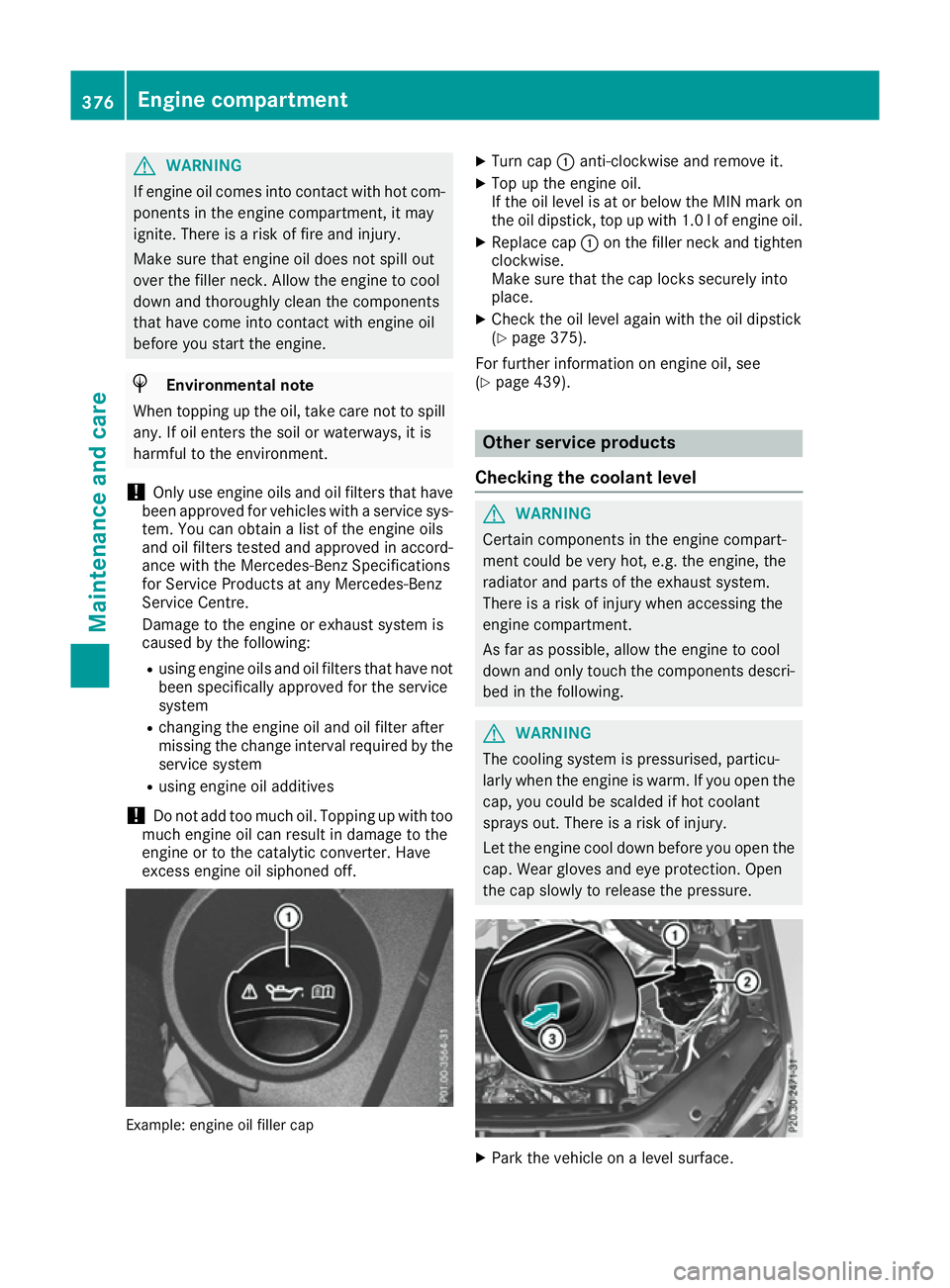
excess engine oil siphoned off. Example: engine oil filler cap X
Turn cap :anti-clockwise and remove it.
X Top up the engine oil.
If the oil level is at or below the MIN mark on
the oil dipstick, top up with 1.0 lof engine oil.
X Replace cap :on the filler neck and tighten
clockwise.
Make sure that the cap locks securely into
place.
X Check the oil level again with the oil dipstick
(Y page 375).
For further information on engine oil, see
(Y page 439). Other service products
Checking the coolant level G
WARNING
Certain components in the engine compart-
ment could be very hot, e.g. the engine, the
radiator and parts of the exhaust system.
There is a risk of injury when accessing the
engine compartment.
As far as possible, allow the engine to cool
down and only touch the components descri- bed in the following. G
WARNING
The cooling system is pressurised, particu-
larly when the engine is warm. If you open the cap, you could be scalded if hot coolant
sprays out. There is a risk of injury.
Let the engine cool down before you open the
cap. Wear gloves and eye protection. Open
the cap slowly to release the pressure. X
Park the vehicle on a level surface. 376
Engine compartmentMaintenance and care
Page 389 of 453
Useful information
i This Owner's Manual describes all models,
series and optional equipment for your vehi-
cle that were available at the time of going to
press. National variations are possible. Note
that your vehicle may not be equipped with all
of the functions described. This is also the
case for systems and functions relevant to
safety.
i Read the information on qualified specialist
workshops: (Y page 28). Where will I find...?
Warning triangle
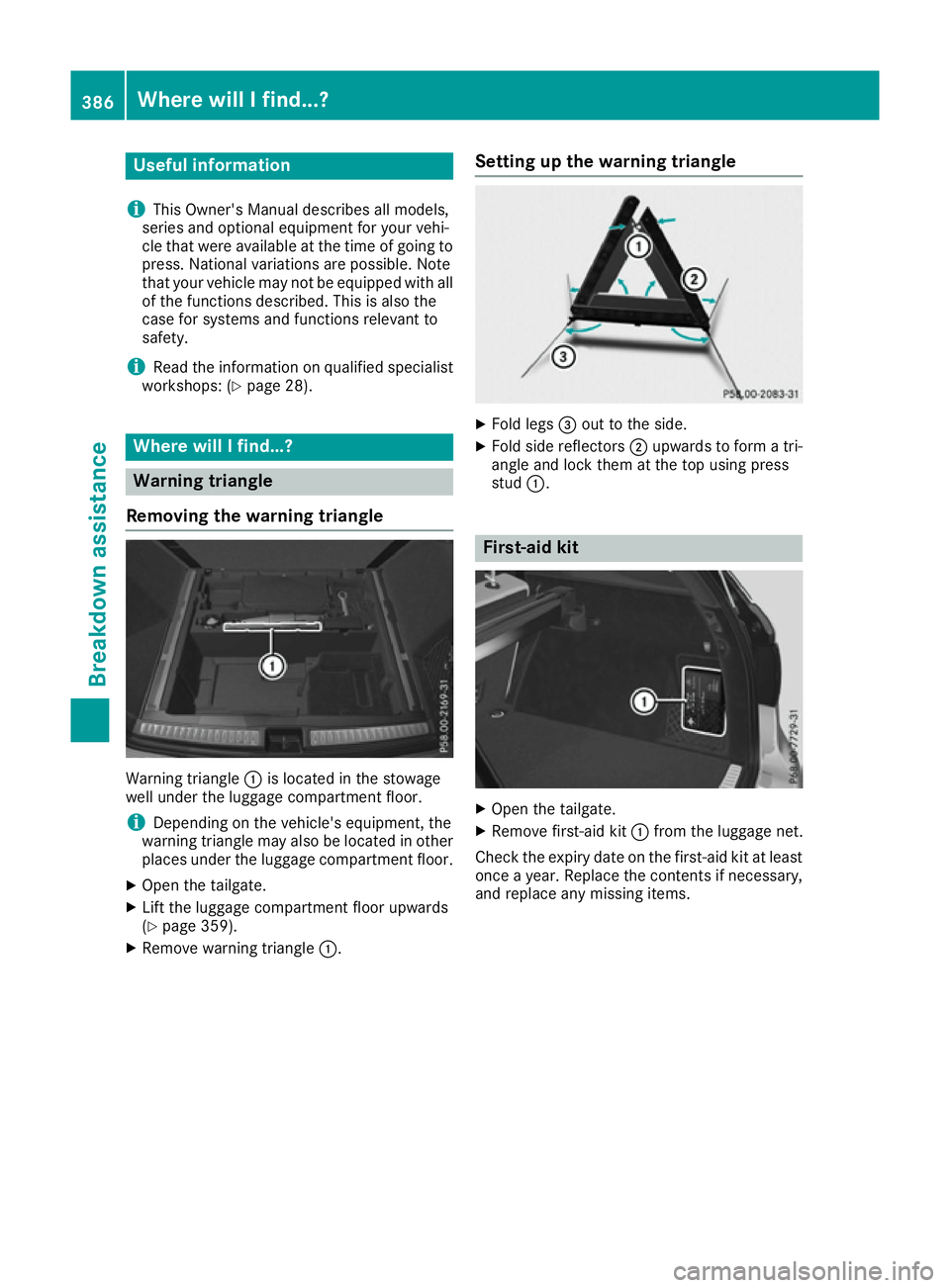
Removing the warning triangle Warning triangle
:is located in the stowage
well under the luggage compartment floor.
i Depending on the vehicle's equipment, the
warning triangle may also be located in other
places under the luggage compartment floor.
X Open the tailgate.
X Lift the luggage compartment floor upwards
(Y page 359).
X Remove warning triangle :.Setting up the warning triangle X
Fold legs =out to the side.
X Fold side reflectors ;upwards to form a tri-
angle and lock them at the top using press
stud :. First-aid kit
X
Open the tailgate.
X Remove first-aid kit :from the luggage net.
Check the expiry date on the first-aid kit at least once a year. Replace the contents if necessary,and replace any missing items. 386
Where will I find...?Breakdown assistance
Page 439 of 453
You can identify service products approved by
Mercedes-Benz by the following inscriptions on
the container:
R MB-Freigabe (e.g. MB-Freigabe 229.51)
R MB-Approval (e.g. MB-Approval 229.51)
Other designations or recommendations indi-
cate a level of quality or a specification in
accordance with an MB Sheet Number (e.g. MB 229.5). They have not necessarily been
approved by Mercedes-Benz.
Other identifications, for example:
R 0 W-30
R 5 W-30
R 5 W-40
Further information can be obtained from any
Mercedes-Benz Service Centre or on the Inter-
net at http://bevo.mercedes-benz.com. Fuel
Important safety notes G
WARNING
Fuel is highly flammable. If you handle fuel
incorrectly, there is a risk of fire and explo-
sion.
You must avoid fire, naked flames, creating
sparks and smoking. Switch off the engine
and, if applicable, the auxiliary heating before refuelling. G
WARNING
Fuels are poisonous and hazardous to health. There is a danger of injury.
Do not swallow fuel or let it come into contact
with skin, eyes or clothing. Do not inhale fuel
vapours. Keep fuels out of the reach of chil-
dren.
If you or others come into contact with fuel,
observe the following:
R Wash the fuel off any affected areas of skin
with water and soap immediately.
R If you get fuel in your eyes, rinse them thor-
oughly with clean water immediately. Seek immediate medical attention. R
If fuel is swallowed, seek immediate medi-
cal attention. Do not induce vomiting.
R Change any clothing that has come into
contact with fuel immediately.
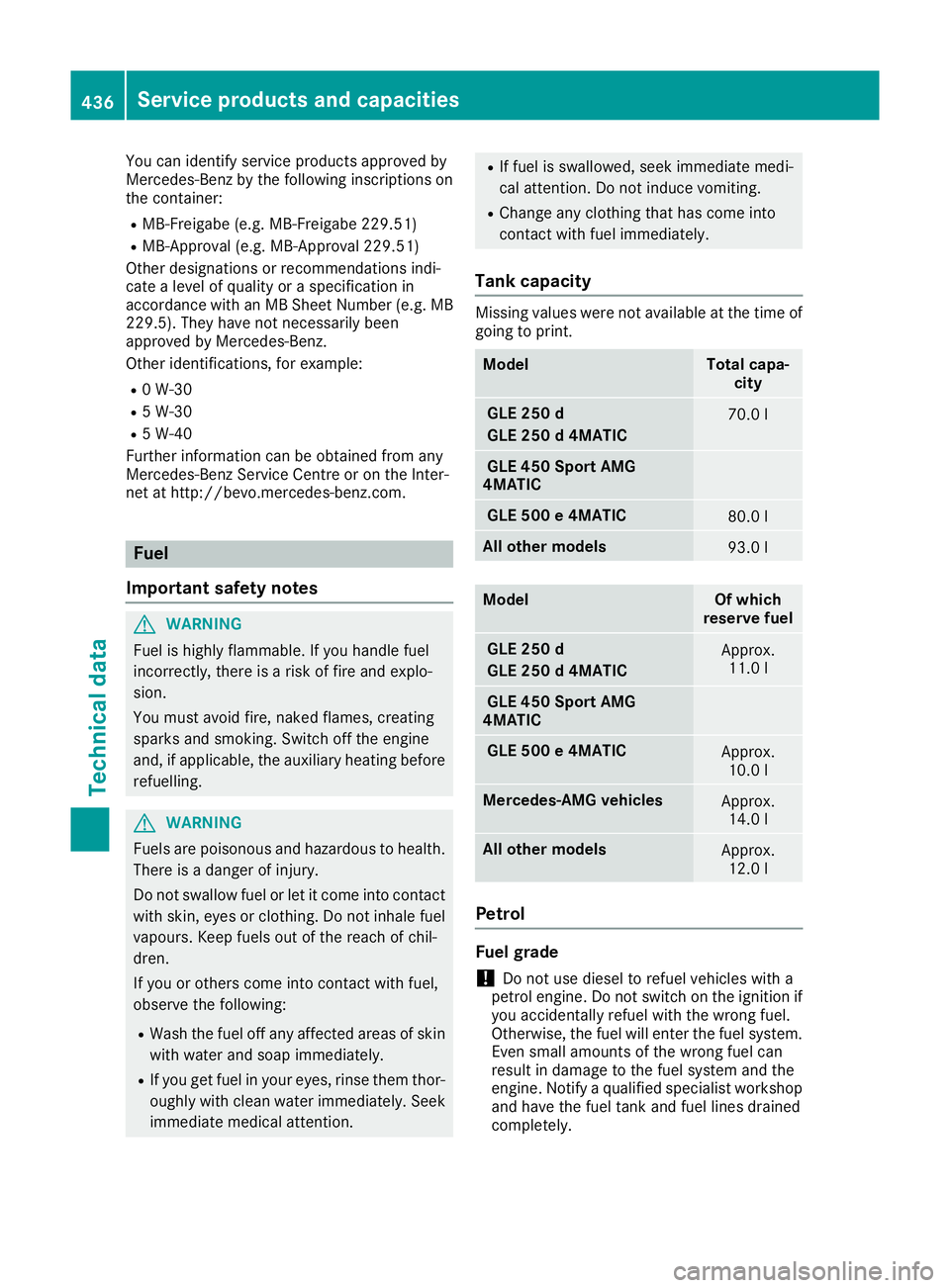
Tank capacity Missing values were not available at the time of
going to print. Model Total capa-
city GLE 250 d
GLE 250 d 4MATIC
70.0 l
GLE 450 Sport AMG
4MATIC GLE 500 e 4MATIC
80.0 l
All other models
93.0 l
Model Of which
reserve fuel GLE 250 d
GLE 250 d 4MATIC
Approx.
11.0 l GLE 450 Sport AMG
4MATIC GLE 500 e 4MATIC
Approx.
10.0 l Mercedes-AMG vehicles
Approx.
14.0 l All other models
Approx.
12.0 l Petrol
Fuel grade
!
Do not use diesel to refuel vehicles with a
petrol engine. Do not switch on the ignition if
you accidentally refuel with the wrong fuel.
Otherwise, the fuel will enter the fuel system. Even small amounts of the wrong fuel can
result in damage to the fuel system and the
engine. Notify a qualified specialist workshop
and have the fuel tank and fuel lines drained
completely. 436
Service products and capacitiesTechnical data
Page 443 of 453
Further information on tested and approved
engine oils can be obtained from any Mercedes-
Benz Service Centre. Mercedes-Benz recom-
mends that you have the oil change carried out
at a qualified specialist workshop. Mercedes-
Benz approval is indicated on the oil container
by the inscription "MB-Freigabe" or "MB-
Approval" and the corresponding designation,
e.g. MB-Freigabe or MB-Approval 229.51.
You can call up an overview of approved engine oils on the Internet at
http://bevo.mercedes-benz.com by entering
the designation, e.g. 229.5.
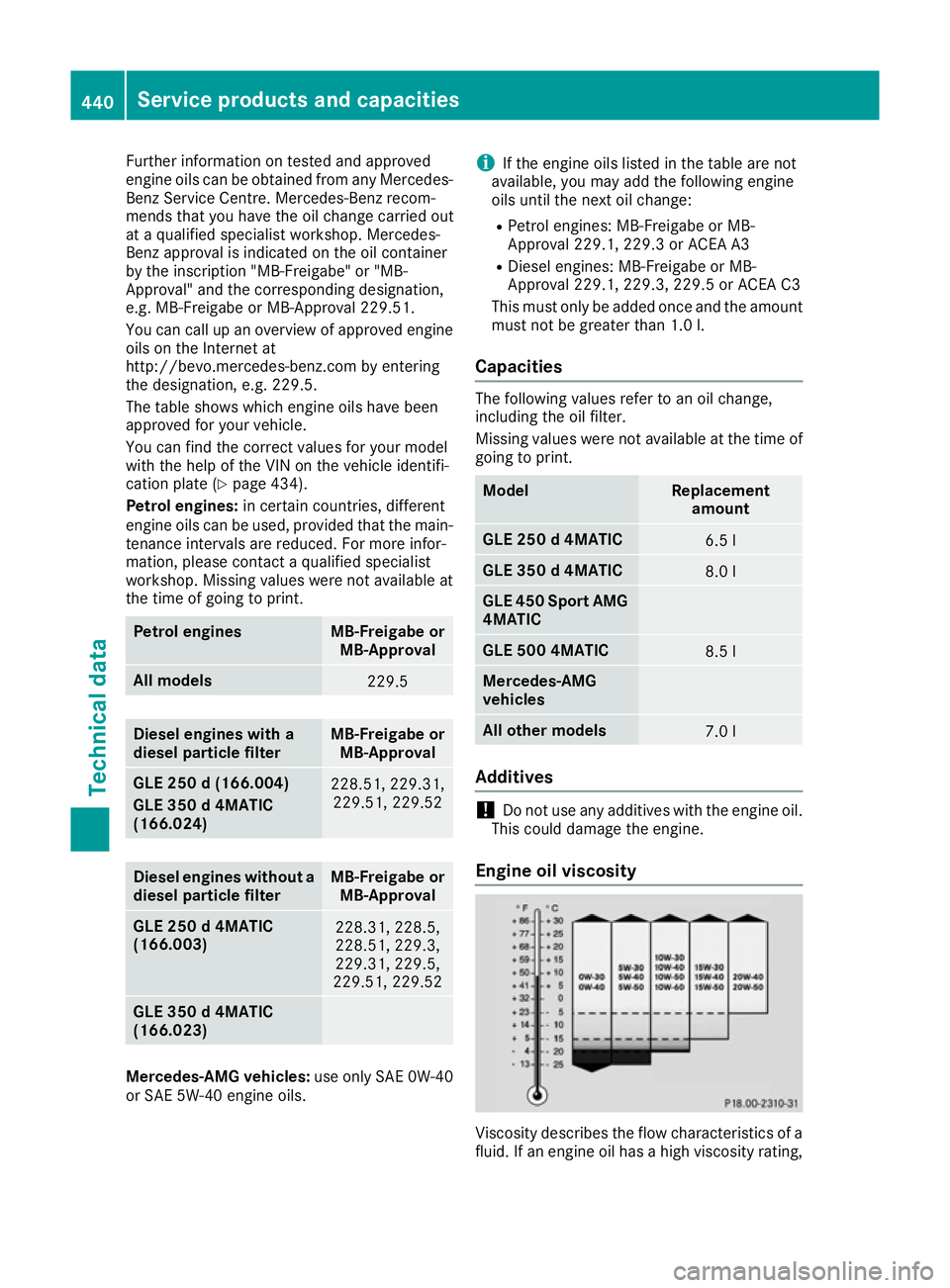
The table shows which engine oils have been
approved for your vehicle.
You can find the correct values for your model
with the help of the VIN on the vehicle identifi-
cation plate (Y page 434).
Petrol engines: in certain countries, different
engine oils can be used, provided that the main-
tenance intervals are reduced. For more infor-
mation, please contact a qualified specialist
workshop. Missing values were not available at
the time of going to print. Petrol engines MB-Freigabe or
MB-Approval All models
229.5
Diesel engines with a
diesel particle filter MB-Freigabe or
MB-Approval GLE 250 d (166.004)
GLE 350 d 4MATIC
(166.024)
228.51, 229.31,
229.51, 229.52 Diesel engines without a
diesel particle filter MB-Freigabe or
MB-Approval GLE 250 d 4MATIC
(166.003)
228.31, 228.5,
228.51, 229.3,
229.31, 229.5,
229.51, 229.52 GLE 350 d 4MATIC
(166.023)
Mercedes‑AMG vehicles:
use only SAE 0W-40
or SAE 5W-40 engine oils. i
If the engine oils listed in the table are not
available, you may add the following engine
oils until the next oil change:
R Petrol engines: MB-Freigabe or MB-
Approval 229.1, 229.3 or ACEA A3
R Diesel engines: MB-Freigabe or MB-
Approval 229.1, 229.3, 229.5 or ACEA C3
This must only be added once and the amount
must not be greater than 1.0 l.
Ca pacities The following values refer to an oil change,
including the oil filter.
Missing values were not available at the time of going to print. Model Replacement
amount GLE 250 d 4MATIC
6.5 l
GLE 350 d 4MATIC
8.0 l
GLE 450 Sport AMG
4MATIC GLE 500 4MATIC
8.5 l
Mercedes-AMG
vehicles
All other models
7.0 l
Additives
!
Do not use any additives with the engine oil.
This could damage the engine.
Engine oil viscosity Viscosity describes the flow characteristics of a
fluid. If an engine oil has a high viscosity rating, 440
Service products and capacitiesTechnical data
Page 446 of 453
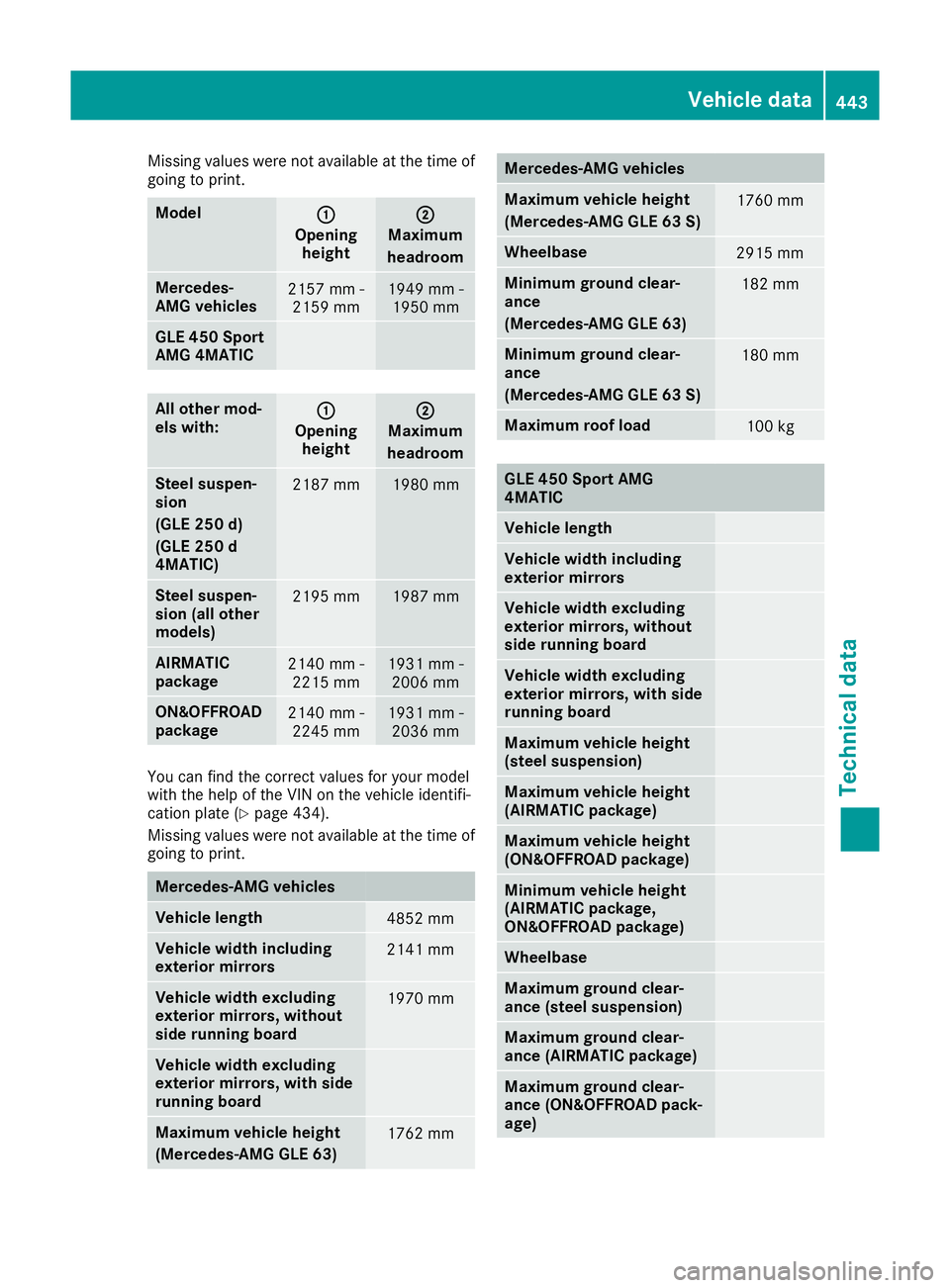
Missing values were not available at the time of
going to print. Model
:
:
Opening height ;
;
Maximum
headroom Mercedes-
AMG vehicles
2157 mm -
2159 mm 1949 mm -
1950 mm GLE 450 Sport
AMG 4MATIC
All other mod-
els with:
: :
Opening height ;
;
Maximum
headroom Steel suspen-
sion
(GLE 250 d)
(GLE 250 d
4MATIC)
2187 mm 1980 mm
Steel suspen-
sion (all other
models)
2195 mm 1987 mm
AIRMATIC
package
2140 mm -
2215 mm 1931 mm -
2006 mm ON&OFFROAD
package
2140 mm -
2245 mm 1931 mm -
2036 mm You can find the correct values for your model
with the help of the VIN on the vehicle identifi-
cation plate (Y page 434).
Missing values were not available at the time of
going to print. Mercedes-AMG vehicles
Vehicle length
4852 mm
Vehicle width including
exterior mirrors
2141 mm
Vehicle width excluding
exterior mirrors, without
side running board
1970 mm
Vehicle width excluding
exterior mirrors, with side
running board
Maximum vehicle height
(Mercedes-AMG GLE 63)
1762 mm Mercedes-AMG vehicles
Maximum vehicle height
(Mercedes-AMG GLE 63 S)
1760 mm
Wheelbase
2915 mm
Minimum ground clear-
ance
(Mercedes-AMG GLE 63)
182 mm
Minimum ground clear-
ance
(Mercedes-AMG GLE 63 S)
180 mm
Maximum roof load
100 kg
GLE 450 Sport AMG
4MATIC
Vehicle length
Vehicle width including
exterior mirrors
Vehicle width excluding
exterior mirrors, without
side running board
Vehicle width excluding
exterior mirrors, with side
running board
Maximum vehicle height
(steel suspension)
Maximum vehicle height
(AIRMATIC package)
Maximum vehicle height
(ON&OFFROAD package)
Minimum vehicle height
(AIRMATIC package,
ON&OFFROAD package)
Wheelbase
Maximum ground clear-
ance (steel suspension)
Maximum ground clear-
ance (AIRMATIC package)
Maximum ground clear-
ance (ON&OFFROAD pack-
age) Vehicle data
443Technical data Z
Page 447 of 453
GLE 450 Sport AMG
4MATIC Minimum ground clear-
ance (AIRMATIC package,
ON&OFFROAD package)
Maximum roof load
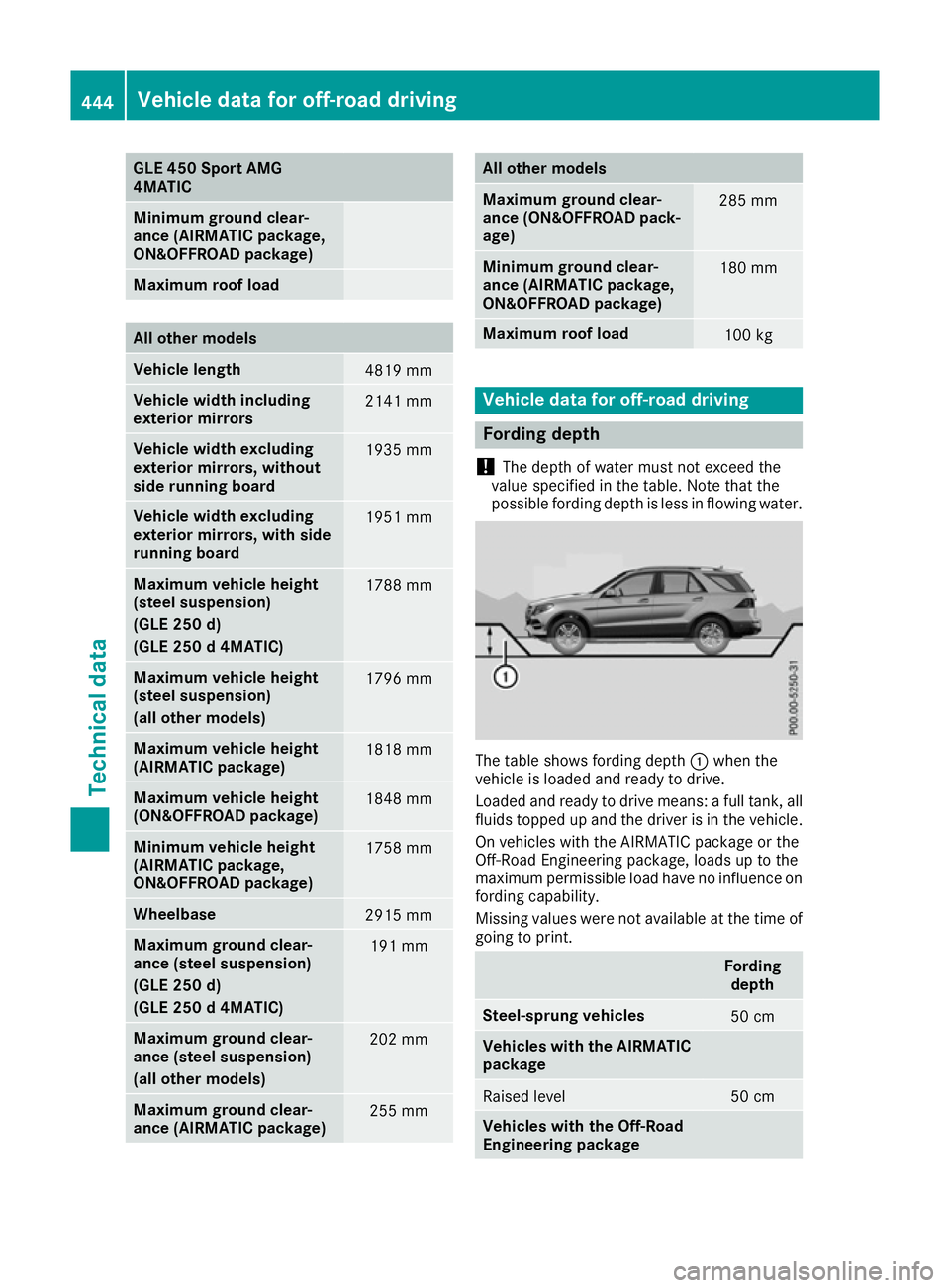
All other models
Vehicle length
4819 mm
Vehicle width including
exterior mirrors
2141 mm
Vehicle width excluding
exterior mirrors, without
side running board
1935 mm
Vehicle width excluding
exterior mirrors, with side
running board
1951 mm
Maximum vehicle height
(steel suspension)
(GLE 250 d)
(GLE 250 d 4MATIC)
1788 mm
Maximum vehicle height
(steel suspension)
(all other models)
1796 mm
Maximum vehicle height
(AIRMATIC package)
1818 mm
Maximum vehicle height
(ON&OFFROAD package)
1848 mm
Minimum vehicle height
(AIRMATIC package,
ON&OFFROAD package)
1758 mm
Wheelbase
2915 mm
Maximum ground clear-
ance (steel suspension)
(GLE 250 d)
(GLE 250 d 4MATIC) 191 mm
Maximum ground clear-
ance (steel suspension)
(all other models) 202 mm
Maximum ground clear-
ance (AIRMATIC package)
255 mm All other models
Maximum ground clear-
ance (ON&OFFROAD pack-
age)
285 mm
Minimum ground clear-
ance (AIRMATIC package,
ON&OFFROAD package)
180 mm
Maximum roof load
100 kg
Vehicle data for off-road driving
Fording depth
! The depth of water must not exceed the
value specified in the table. Note that the
possible fording depth is less in flowing water. The table shows fording depth
:when the
vehicle is loaded and ready to drive.
Loaded and ready to drive means: a full tank, all fluids topped up and the driver is in the vehicle.
On vehicles with the AIRMATIC package or the
Off-Road Engineering package, loads up to the
maximum permissible load have no influence on fording capability.
Missing values were not available at the time of
going to print. Fording
depth Steel-sprung vehicles
50 cm
Vehicles with the AIRMATIC
package Raised level 50 cm
Vehicles with the Off-Road
Engineering package444
Vehicle data for off-road drivingTechnical data