2015 AUDI TT ROADSTER oil
[x] Cancel search: oilPage 171 of 244

Checking the engine oil level
Fig . 12 9 Illust rat ion of principle 1: Ma rkers on o il dip
st ick
F ig . 13 0 Illust rat io n of principle 2: Markers o n oil dip·
st ic k
Before you check anything in the engi ne com
partment,
always read and heed all WARN
INGS ¢ A in Working in the engine compart
ment on page 164.
Determining oil level
• Park your vehicle on a level surface.
• While at operati ng state temperature, brief
l y let the eng ine run at id le and then shut it
off .
• Wait approx. two minutes.
• Pullout the oil dipstick. Wipe off the oil d ip
stick with a clean cloth, and slide it back in
as far as it wi ll go.
• Pu ll it bac k out and read off the oil level
¢ fig. 1 29 or ¢ fig. 130 . Top off the engine
oi l, if app licable ¢
page 169.
Oil level within range~
• Do not add o il.
Oil level with in range @
• You can add oil. Afterwards, the o il level
shou ld be w ith in range @.
Checking and filling 169
Oil level within range 0
• Yo u must add oil. Af terwards, the oil leve l
should be wi thin range @.
T he oil leve l needs to be checked at regu lar in
terva ls. The best t ime s to do th is are w henev
er yo u ref uel and p rior to long trips.
Depend ing on the way the vehicle is dr iven
and the ope rat ing cond it ions, oi l consumption
c a n be up to 1/ 2 quart per 6 00 miles (0. 5 lite r
per 1,000 km) . Cons umption m ay be highe r
wi thin the first 3,000 miles (5,000 km) .
Adding engine oil ci::,,.
0 N ;.
>< (D m
Fig . 131 Engine compa rtment: cover on the engi ne oil
filler neck
Before you check anyth ing in the engine com
partment,
alw ays read and heed all WARN
INGS ¢ A in Working in the engine compart
ment on page 164.
• Shut the eng ine off.
• Unscrew the cap
"f:7. to the engine o il filling
hole
¢ page 166, fig . 128.
• Carefully top off with 0 .5 quarts (0 .5 liters)
of the appropr iate oil
¢ page 166.
• Check the oil level aga in aft er two minutes
¢ page 169, Che cking the engine oil level.
• Top off the oil again, if necess ary.
• Sc rew the cap back on the filling hole and
slide the oil dips tick in as far as it wi ll go.
..&_ WARNING
-W hile topping off, the o il m ust not come
in contact with hot e ngine parts -fire
hazard ! .,.
Page 172 of 244

170 Checking and filling
-The oil filler cap must be properly se
cured to prevent oil from being sprayed
on the hot engine and exhaust system
when the engine is running -fire hazard!
- If your skin has come in contact with the
engine oil, you must subsequently
cleanse it thoroughly .
(D Note
-The oil level must not be above range G)
-danger of converter or engine damage!
Contact an authorized Audi dealer to
draw off oil, if necessary.
-Audi does not recommend the use of oil
additives. They may damage the engine
and adversely affect your New Vehicle
Warranty.
@ For the sake of the environment
- Under no circumstances can the oil come
in contact with the sewage network or
the soil.
- Observe and follow legal regulations
when disposing of empty oil containers.
Changing the engine oil
We recommend that have your oil changed by
an authorized Audi dealer or a qualified serv
ice station .
Before you check any thing in the engine com
partment,
always read and heed all WARN
INGS ~ .& in Working in the engine compart
ment on page 164 .
The engine oil mus t be changed according to
the intervals specified in your Warranty
&
Maintenance booklet. This is very important
because the lubricating properties of oil di
minish gradually during normal vehicle use .
Under some circumstances the engine oil
should be changed more frequently . Change
oil more often if you drive mostly short dis
tances , operate the vehicle in dusty areas or
under predominantly stop-and-go traffic con
ditions , or have your vehicle where tempera- tu
res remain below freezing for extended pe
riods.
Detergent additives in the oil will make fresh
oil look dark after the engine has been run
ning for a short time. This is normal and is not
a reason to change the oil more often than
recommended.
Because of the problem of proper disposal,
along with the special tools and necessary ex
pertise required, we strongly recommend that
you have your oil changed by an authorized
Audi dealer or a qualified service station.
If you choose to change your oil yourself ,
please note the following important informa
tion:
A WARNING
To reduce the risk of personal injury if you
must change the engine oil in your vehicle
yourself:
- Wear eye protection.
- To reduce the risk of burns from hot en-
gine oil, let the engine cool down to the
touch.
- When removing the oil drain plug with
your fingers, stay as far away as possible.
Always keep your forearm parallel to the ground to help prevent hot oil from run
ning down your arm.
- Drain the oil into a container designed
for this purpose, one large enough to hold at least the total amount of oil in
your engine .
- Engine oil is poisonous. Keep it well out
of the reach of children.
- Continuous contact with used engine oil
is harmful to your skin. Always protect
your skin by washing oil off thoroughly
with soap and water.
(D Note
Never mix oil additives with your engine
oil. These additives can damage your en
gine and adversely affect your Audi Limit
ed New Vehicle Warranty.
Page 173 of 244

@ For the sake of the environment
-Before changing your oil, first make sure
you know where you can properly dispose
of the used o il.
- Always dispose of used engine oil proper
l y. Do not dump it on garden soi l, wood
ed areas, into open streams or down
sewage dra ins.
- Recycle used engine oil by taking it to a
used engine oil collection facility in your
area, or contact a service station .
Engine cooling system
Coolant
The engine coolant performs two functions: it
keeps the engine from overheating and it pro tects the engine from freezing in the winter.
The cooling system is sea led and generally re
q uir es lit tle atten tion .
The cooling system has been filled at the fac
tory with a pe rmanent coo lant which does not
need to be c hanged. The coolant consists of a
mixture o f spec ial ly conditioned water and the
manuf acturer 's glyco l-basedcoolan t addi -
tiv e G13 antifreeze with ant icorros ion addi
tives (50% for USA models ; 60% for Canadian
mod els) . This mixture both assures the neces
sary
frost protection and p rotects metal com
ponents in the engine's coo ling system from
corrosion and scaling . It a lso raises the boil
i ng point of the coolant .
Do not reduce the concentration o f the coo l
ant in the summer by adding plain water.
The
proportion of coolant add it ive must be at
l e a st 50 % but not mor e than 60 %
to main
tain antifreeze protection and coo ling efficien
cy .
If the coolant frost protect io n is too low,
the coolant cou ld free ze and dam age the veh i
cle heating and eng ine cooling system.
For yea r-round driving, antifreeze is added at
the fac to ry for tempera tures down to:
-- 31°F( -35°C)USA
- -40 °F ( -40 °C) Canada.
Checkin g and fillin g 171
If you must add coo lant, use a mixture of wa
ter and coolant additive . Mix ing the coo lant
additive with distilled water is recommended.
_& WARNING
Before you c heck anything in the engine
compartment, always read and heed a ll
WARNINGS
c> .& in Working in the engine
comportment on page 164.
Q) Note
- Before winter sets in, have the coo lant
checked to see if the coolant additive in
your vehicle is sufficient to meet the cli mate condi tions. This is especi ally impor
tan t if you live i n a region wher e th e win
ter is ex treme ly co ld . If necessary, i n
crease t he p ropo rtion of coo lant add itive
to 60% .
- Whe n ad ding coolant additive t o yo ur
c ooling sys tem, reme mbe r:
- We recommend using on ly coolant ad
d itive G12++ or G13 for your vehicle .
This coolant additive is availab le at au
thor ized Audi dealers . O ther types of
a ntifreeze can s ignifica ntly reduc e cor
rosion prote ction. The result ing cor ro
sion can cau se a loss o f coolan t and se
rio us engine d amage .
- Do not add any ty pe of rad iator leak seal
a nt to yo ur vehicle 's engine c oolant .
A dd ing radia tor repair fl uid may adverse
ly affect the f unction and pe rformance of
your coolin g system and co uld resu lt in
damage not covered by your New Ve hicle
L imited Warranty.
-
•
•
Page 176 of 244

17 4 Che cking and filling
Brake fluid
Checking brake fluid level
Fig . 133 Engine compa rtment: cove r on the brake fluid
reservo ir
Before you check anything in the engine com
partment,
a lw ays read and h eed all WA RN
ING S ¢&. in Working in the engine compart
ment on page 164.
,.. Read the brake fluid level from the brake
fluid reservoir¢
page 166, fig . 128. T he
brake flu id leve l must be between the "MIN"
and "MAX" markings.
The brake flu id rese rvo ir is located behind the
rear part ition of the eng ine compartment o n
the left side ¢
page 166.
The fluid level may drop slightly after some
time due to the automatic adjustment of the b rake pads . This is not cause for alarm.
If the brake fluid level falls
considerably be
low the "MIN" mark, the brake warning/indi
cator light (U.S. models: . , Canadian mod
e ls: . ) w ill come on
¢page 14. Do not con
tinue to operate the vehicle. The comp lete
brake system shou ld be thoroughly checked
by an authorized A udi dealer or other quali
fied facility and the cause corrected.
If the
brake fluid level is too low, the brake warn ing/
indicator light w ill illuminate. Contact an au
thor ized Audi dealer
imm ediatel y.
Changing brake fluid
Have the brake fluid changed by an experi
enced technician .
Brake fluid absorbs moisture from the air. If
the water content in the brake fluid is too high, corrosion in the brake system may result
after a period of time . The boiling point of the
brake flu id will also decrease conside rably and
decrease braking pe rformance.
Therefore, the brake fluid must be changed
eve ry two y ears. Always use new brake flu id
which conforms to Federal Motor Veh icle
Standard "F MVSS 116 DOT 4".
The brake fluid reservoir can be diff icult to
reach, therefore, we recommend that you
have the brake fluid changed by your author
ized
Audi dealer . Your dealer has the correct
tools, the right brake fl uid and the know -how
to do this for you.
A WARNING
- Brake fluid is poisonous . It must be stor
ed only in the closed original container
out of the reach of children!
- Brake failure can resu lt from o ld or inap
propriate brake flu id. Observe these pre
cautions:
- Use only brake f luid that meets SA E
specifica tion
J 1 7 03 and conforms to
Federa l Moto r Ve hicl e Standard 1 16.
Always check with yo ur authorized Aud i
dealer to make sure yo u are using the
correct brake fluid. The correct type of brake f lu id is also ind icated on the
brake flu id reservoir.
- The brake fluid must be new. Heavy use
of the brakes can cause a vapor lock if
the brake fluid is left in the system too
l ong. This can seriously affect the effi
c iency of the brakes as well as your
safety. This cou ld resu lt in an accident.
(D Note
Brake fluid will damage the paint of your
vehicle .
Page 193 of 244
A WARNING
Sudden tire failure can lead to loss of con
trol, a crash and serious personal injury!
- Never drive a vehicle when the tread on
any tire is worn down to the wear indica
tors.
- Worn tires are a safety hazard, they do
not grip well on wet roads and increase
your risk of "hydroplaning" and loss of
control.
- Always keep chemicals that can cause
tire damage, such as grease, oil, gasoline
and brake fluid away from t ires.
- Tires age even if they are not be ing used
and can fail suddenly, especially at high
speeds . Tir es that are more than 6 years
old can only be used in an emergency
and then with special care and at lower
speeds.
- Never mount used tires on your vehicle if
you are not sure of their" previous histo
ry ." Old used tires may have been dam
aged even though the damage cannot be
seen that can lead to sudden tire failure
and loss of vehicle control.
Tires and wheels 191
New tires and replacing tires and wheels
New tires and wheels have to be broken in .
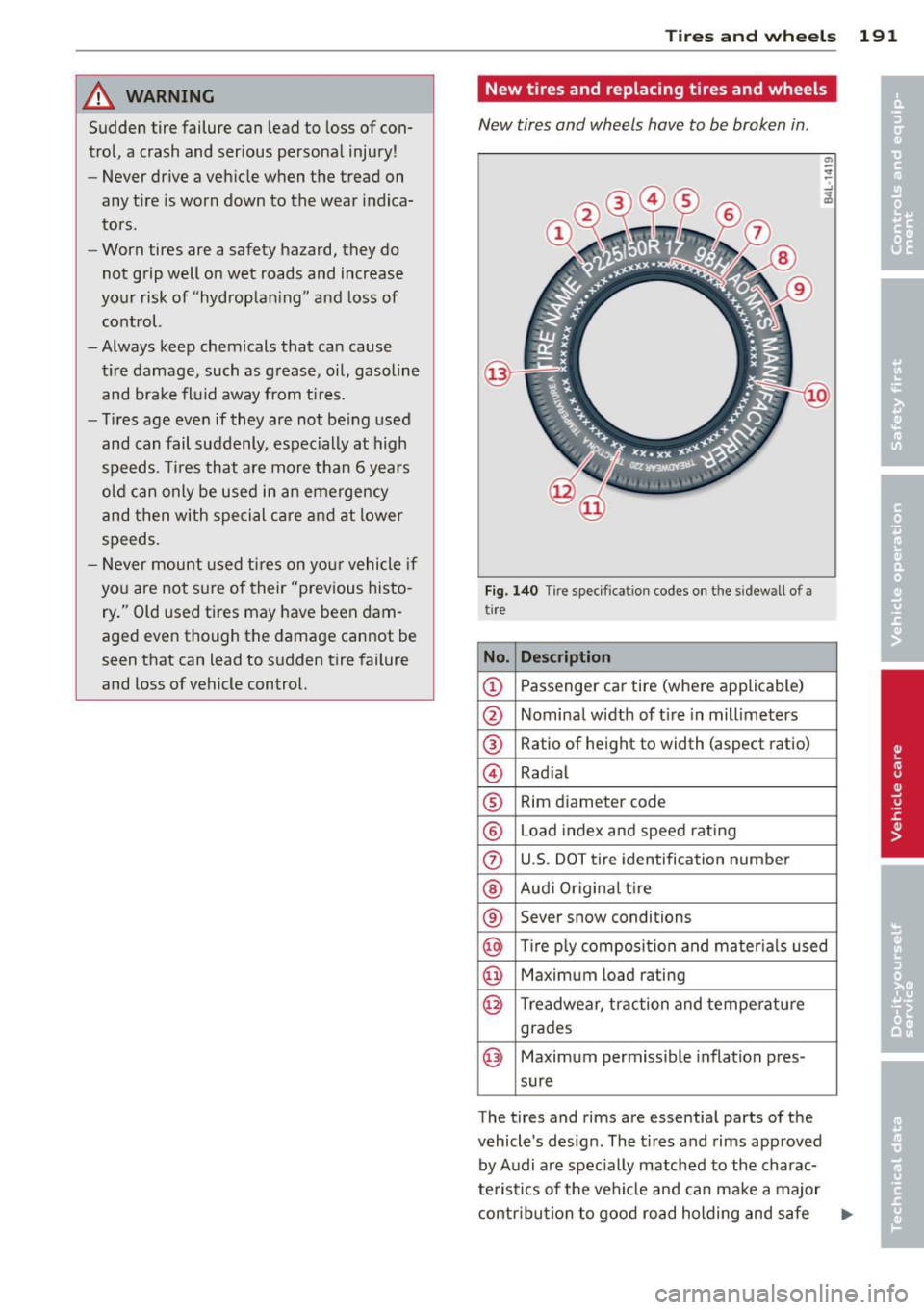
Fig. 140 Tir e specificat ion codes on t he s idewall o f a
tire
No. Description
@ Passenger car tire (where applicable)
@ Nominal width of tire in millimeters
@ Ratio of height to width (aspect ratio)
© Radial
® Rim diameter code
® Load index and speed rating
0 U.S. DOT tire identification number
® Audi Original tire
® Sever snow conditions
@ Tire ply composition and mater ials used
@ Maximum load rating
@ Treadwear, traction and temperature
grades
@ Maximum permissible inflation pres-
sure
The tires and rims are essential parts of the
vehicle's design . The tires and rims approved
by Audi are spec ially matched to the charac
teristics of the vehicle and can make a major
contribution to good road holding and safe .,.
Page 199 of 244
snow c hains are suitably cove red . Check
the position of the snow chains after
driving a few yards and correct if neces
sary. Follow the instructions from the
snow cha in manufacturer when doing so.
Where snow cha ins are mandatory oncer
tain roads, this normally also applies to
veh icles with all-wheel dr ive.
Wheel bolts
Wheel bolts must always be tightened to the
correct torque.
The design of whee l bolts is matched to the
factory insta lled r ims . If different rims are fit
ted, the correct wheel bo lts with the right
length and correctly shaped bolt heads must
be used. This ensures t hat wheels are fitted
securely and that the brake system functions
correctly .
In certain circumstances, you may not use
wheel bo lts from a different vehicle -even if it
i s the same model
¢ page 227.
A WARNING
Imprope rly tig htened or maintained wh eel
bolts can become loose ca using loss of
con trol, a collision and serious person al in
jury.
- Always keep the w heel bolts and the
threads in the wheel hubs clea n so the
wheel bolts can tu rn easily and be p rop
er ly tightened .
- Never grease or oil the wheel bo lts and
the threads in the wheel hubs. They can become loose w hile driving if greased or
o iled, even if tig htened to the specif ied
torque.
- Only use whee l bolts that belong to the
rim being installed.
- Never use different whee ls bolts on your
vehicle.
- Always maintai n the co rrect tig htening
torq ue fo r the wheel bo lts to reduce the
risk of a wheel loss. If the tightening tor-
Tire s an d wheel s 197
que of t he whee l bolts is too low, they
can loosen and come out when the vehi
cle is mov ing. If the tig htening torq ue is
too high, the wheel bolts and threads
can be damaged and the whee l can be
come loose.
(D Note
The specified torque for the whee l bolts is
90 ft lb (120 Nm) with a tolerance of± 7,4
ft lb(± 10 Nm). Torq ue whee l bolts diago
nally. After changing a whee l, the tor que
must be checked as soon as possible with a
torq ue w rench -prefe rably by an au thor
iz ed A udi de aler or qu alified workshop .
Low aspect ratio tires
Your Audi is factory -eq uipped w ith low aspect
r atio tires . These tires have been tho roughly
tested and been se lected specifically for your
model for their superb performance, road fee l
and handli ng under a var iety of driving condi
tions . Ask your authorized Audi dealer for
more d etails.
The low aspect ratio of these t ires is ind icated
by a numeral of
55 or less in the tire's s ize
designation . The numeral represents the ratio
of the t ire's sidewa ll height in relation to its
t read width exp ressed in pe rce ntage. Conven
t iona l tires have a he ight/w idth rat io of 60 or
more.
The performanc e of low-a spect-ratio tire s is
particularly sensitive to impr oper inflation
pre ssure .
It is therefore important that low
a spect ratio tire s are inflated to the specified
pres sure and that the inflation pressure is
regularly checked and maintained. Tire pre s
sures should be checked at least once a month and always befo re a long trip
¢ page 186, Checking tire pressure.
What you can do to avoid tire and rim
damage
Low aspect ratio tires can be damaged mo re
easily by impact w it h potholes, curbs, gul lies ..,.
•
•
Page 215 of 244

Fuse Location, Instrument Panel left
0
Fig. 161 Fuse carrier behind the instrument panel end
face, cover removed
Some of the eq u i prnent items listed a re op
tional or only available on certain model con
f igurations.
Note that the following table is accurate at
the time of going to press and is subject to
change. In the event of d iscrepancies, the la
bel on the in side of the cover always takes
precedence .
The power seats are protected by circuit
breakers ,
which automatically reset after a
few seconds after the overload has been rem
ed ied.
No. Equipment Amps
Engine relay, fuel tank cont ro l
1
unit, A irbag Off light, light
10 switch (sw itch illumi nation), di-
agnostic connector
2
ABS, ASR, ESC, brake light
5 switch
3 AFS headlight (left) 5
No.
4
5
6
7
8
9
10
11
12
13
14
15
16
17
18
19
20
21 22
23
Fuses and bulbs 213
Equipment Amps
Oil level sensor (extended main-
tenance interval)
(WIV), t ir e
press ure monitoring system,
sw itch for Electron ic Stabiliza-
5 tion Control (ESC), AFS head-
lights (control unit), A/C system
(pressure sensor), backup light
sw itch
Automatic headlight range con- trol, AFS headlight (right) /
5/10
manual headlight range con-
trol, halogen headlights
Control unit for CAN data trans-
fer (gateway), electrornechani-
5 cal steering, automatic trans-
miss ion shift gate
Acoustic Park Assist, automatic
d ip ping interior rear
view rnir-
ror, garage door opener, heata-
5 ble windshield washer nozzles,
washer pump, w ind deflector
relay (Roadster)
H aldex clutch/Ha ldex clutch
5/10 (TTS)
Control un it Audi magnetic ride
5
A irbag contro l unit 5
Mass airflow sensor, crankcase 5/10
heating
Door control unit (central lock -
10 ing driver/passenger)
Diagnostic connector
10
Rain sensor, automatic trans-
5 miss ion sh ift gate
Roof light (interior lighting)
5
A/C system (contro l unit) 10
Tire pressure monitoring sys -
5 tern (control un it)
Not used
Not used
Not used
Fuel injectors (gasoline eng ine)
10
Wind deflector (Roadster) 30
Horn 20
Page 216 of 244

214 Fuses and bulb s
No. Equipment
24 Transmi ssion (contro l un it)
25 Heate
r rear window Coupe /
heated rear window Roadster
26 Driver'
s side power window
27 Passenger's s ide power window
28 No
t used
29 Washer pump
30 Cigarette lighter
31 Start er
32 Steering column module
33 Instrument clust er
34 Radio navigation system , radio
35 Aud io amplifi er
36 Engine (control un it)
37 CAN (Gat
eway)
38 Ciga
rette lighter
39 Not us ed
40 Not used
4 1 Not u sed
42 Not used
43 No t used
44 Not used
45 No
t used
46 Not used
47 SOARS tuner, cell phone pack-
age,
TV tuner
48 VOA interface
49 Not used
Fuse location, left side of engine
compartment Amps
15
30/ 20
30 30
15
20
40 5
5
20/15
30 10
5
20
5 5
Fi g. 162 Ill ustra tion of fus e ho lde r on l eft side o f en·
gi ne compar tment: fuse s (withou t fuse c over)
Some of the equipment items listed are op
tiona l or only avai lable on c ertain mod el con
figurations.
Note tha t the foll owing table i s ac cur ate at
the time of going to pre ss and is subject to
change .
Fus e holder (bla ck )
No . Equipment Amps
1 Not used
2 Not used
3 Not used
4 No t used
Anti- theft warning system (sen -
5 sor), ant
i-theft warn ing system
5
(horn)
6 Headlamp washer system
30
7 Elec
tric fuel pumps (supp ly)
15
8 W
indshield wipers
30
9 H
eat ed seats (dr iver and pas-
25
senger)
10 L
umbar support (d river and
10
passenger)
11 Not u sed
12 Vent ilation blower 40
Fus e holder (brown )
No. Equipment Amps
1 Not used
2 Not used
3 Not used
4 Not used
5 Relay coil
relay volume cont ro l
5
va lve
6 02
sensors
10
7 P
ositioning valves pre-wired en-
10
gine harness
8 Ignition coi ls 20
9 Eng
in e (cont rol unit)
25
10 Water pump de layed-off 10
1 1 F
e e d (brak e pedal)
5
1 2 Activated charcoal filter/charge
10
p ress ure control va lve