2015 AUDI Q5 seats
[x] Cancel search: seatsPage 186 of 302
Child safet y
-Always make sure the seat backrest to which
the chi ld restraint is installed is in an up
right position and secure ly latched into
place and cannot fold forward. Otherw ise,
the seatback with the ch ild safety seat at
tached to it co uld fly forward in the event of
an accident or other emergency sit uat ion.
- Always read and heed all WARN INGS when
ever using a child restrained in a vehicle is
being used ¢
page 172. Special precautions
apply when installing a child safety seat on
the front passenger seat¢
page 153, Child
restraints on the front seat -some impor
tant things to know.
Deactivating the convertible locking
retractor
The convertible locking retractor for child re
straints will be deactivated automatically when
the belt is wound all the way back into the re
tractor .
~ Press the red button on the safety be lt buck le.
Th@ belt tongue will pop out of the buckle.
~ Guide the safety belt all the way back into its
stowed position .
A lways let the safety belt retract complete ly into
its stowed position . The safety belt can now be
used as an ordinary safety be lt without the con
vertible locking retractor for child restra ints .
If the convert ible locking retractor should be ac
tivated inadvertently, the safety belt must be un
fastened and guided completely back into its
stowed position to deact ivate this feature .
If the
convert ible locking retractor is not deactivated,
the safety belt wi ll gradua lly become t ighter and
uncomfo rtable to wear.
_& WARNING
Imprope rly installed child safety seats in
crease the risk of serious persona l injury and
death in a collision .
-
-Never unfasten the sa fety belt to deac tivate
the convertible locking retractor for child re
straints while the vehicle is moving. You
184
wou ld not be restrained and could be seri
ously inj ured in an accident.
- Always read and heed a ll WARNINGS when
ever us ing a child restrained in a vehicle is
be ing used
¢page 172. Special precaut ions
apply when installing a child safety seat on
the front passenger seat
r=> page 153, Child
restraints on the front seat -some impor
tant things to know.
LATCH system (Lower
anchorages and tethers
for children)
' Child Restraint System anchors and how
are they related to child safety
To provide a simpler and more practicable way to
attach the ch ild restraint on the vehicle seat, Fed
eral regulat ions require spec ial lower anchorages
i n vehicles and devices on new child restraints to
attach to the vehicle anchorages.
The combination of the tether anchorages and
the lower anchorages is now generally called the
LATCH system for " Lower Anchorages and
Tethers for C hildren ."
Forward-facing chi ld restraints manufactured af
ter September 1, 1999, are required by U.S. fed eral regulat ions to comp ly w ith new ch ild head
movement performance requirements . These
new performance requirements make a tether
necessary on most new child seats .
Installing a ch ild restraint that requires a top
tether without one can seriously impair the per
formance of the ch ild restra int and its ability to
protect the ch ild in a collision . Install ing a chi ld
r est raint that requi res a top tether w it h out t he
top tether m ay be a v io la tion of state law.
Child rest raint manufacturers offer LATCH lower
anchorages on the ir chi ld seats with hook-on or
push-o n connectors attached to adjustable
straps.
In add ition to the LATCH lower anchorages, these
c hi ld restra int systems usually requ ire the use of
tethe r straps to he lp keep the ch ild restrai nt
firmly i n place. .,.
Page 187 of 302
M N
co ~ co
rl I.O
"' N
"' rl
,&_ WARNING
Improper insta llation of chi ld restraints will
increase the risk of injury and death in a crash.
- Always follow the instructions prov ided by
the manufacturer of the child restraint you intend to install in your vehicle.
- Never install a child restraint witho ut a
properly attached top tether strap if the
child restraint manufacturer's instructions
requ ire the top tether strap to be used.
- Improper use of child restraint LATCH lower
anchorage points can lead to injury in a colli
sion. The LATCH lower anchorage po ints are
designed to withstand only those loads im
posed by correctly fitted ch ild restraints.
- Never mount two child restraint systems on
one LATCH lower anchorage point .
- Never secure or attach any luggage or other
item to the LATCH lower anchorages.
(D Tips
- In Canada, the terms "top tether" with
"lower universa l anchorages" (or "lower uni
versal anchorage bars") are used to describe
the system.
- In other countries, the term "ISO FIX" is used to describe the lower anchorages.
Location
i
"' m
Fig . 178 Schematic overview : LATCH anc ho rage point loca
tions
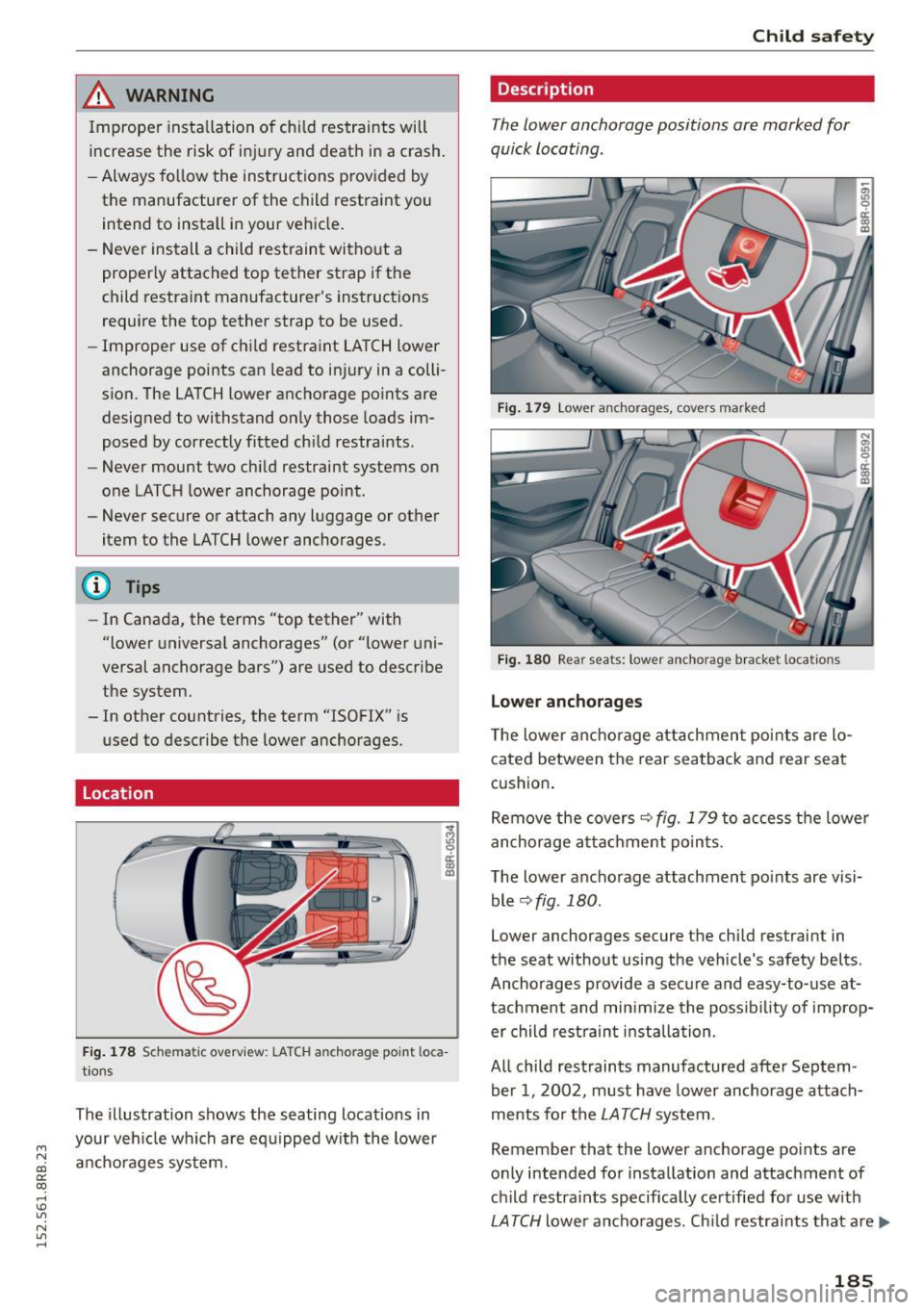
The illustration shows the seating locations in
your ve hicle which are eq uipped w ith the lower
anchorages system.
Chil d sa fe ty
Description
The lower anchorage positions are marked for
quick locating .
Fig. 179 Lower anchorages, cove rs m arked
Fig . 1 80 Rea r seats: lower ancho rage bracket locat ions
Lower anch orages
The lower a nch o rage attachmen t po ints are lo
cated between the rear seatback and rear seat
cushion .
Remove the covers
Q fig . 179 to access the lowe r
anchorage a ttac hment po in ts.
The lower anchorage attachment points are visi ble
9 fig. 180.
Lower anchorages secure the child restraint in
the seat without using the vehicle's safety belts.
Anchorages provide a secure and easy-to-use at
tachment and min imize the poss ibi lity of improp
er child restrain t installation.
All child restraints manufactured after Septem ber 1, 2002, must have lower anchorage attach
ments for the
LATCH system .
Remember that the lower anchorage points are
only intended fo r installation and attachment of
ch ild restra ints specifically certified for use w ith
LATCH lower anchorages. Ch ild restra ints that are..,_
185
Page 188 of 302
Child safety
not equipped with the lower anchorage attach
ments can still be installed in compliance with
the child restraint manufacturer's instructions on
using vehicle safety bel ts .
A WARNING
Improper use of LATCH lower anchorages can
cause serious personal injury in an accident.
- Always carefully follow the child restraints
manufacturer's instructions for proper in
stallation of the child restraint and proper
use of the lower anchorages or safety belts
in your vehicle.
- Never secure or attach any luggage or other
items to the
LATCH lower anchorages.
-Always read and heed the important infor
mation about child restraints in this chapter
and WARNINGS
¢ page 172, Child safety.
Installing a child restraint with LATCH
lower anchorages
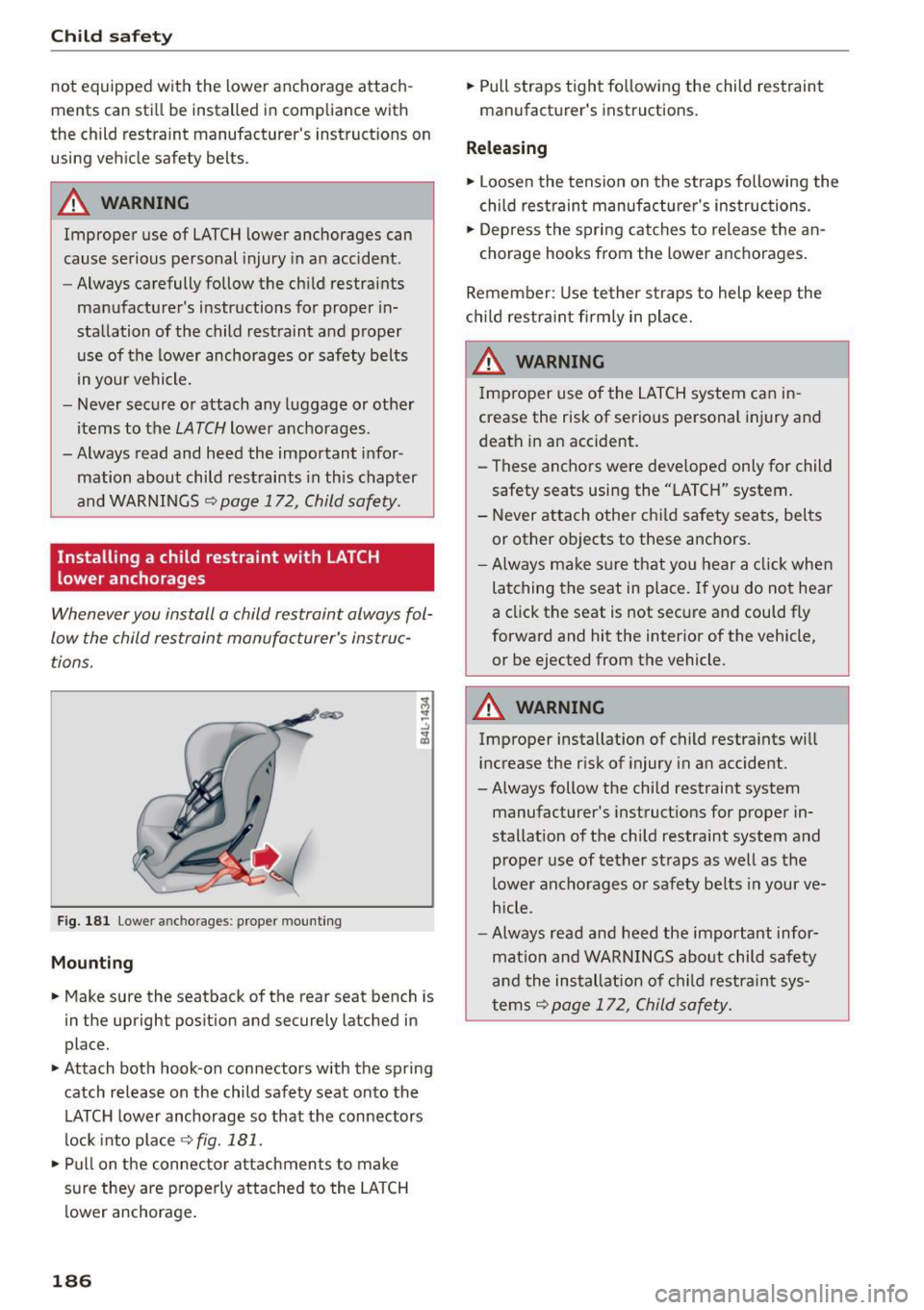
Whenever you install a child restraint always fol
low the child restraint manufacturer's instruc tions.
Fig. 181 L owe r an ch orages : proper mounting
Mounting
~ Make sure the seatback of the rear seat bench is
in the uprigh t position and securely latched in
place.
~ Attach both hook-on connectors with the spring
catch release on the child safety seat onto the
LATCH lower anchorage so that the connectors
lock into place
¢fig. 181.
~ Pull on the connector attachments to make
sure they are properly attached to the LATCH
lower anchorage.
186
~ Pull straps tight following the child restraint
manufacture r's instructions.
Releasing
~ Loosen the tension on the straps following the
child restraint manufacturer's instructions.
~ Depress the spring catches to release the an
chorage hooks from the lower anchorages.
Remember : Use tether straps to help keep the
child restraint firmly in place.
A WARNING
Improper use of the LATCH system can in
crease the risk of serious personal injury and
death in an accident .
-
-These anchors were developed only for child
safety seats using the "LATCH" system.
- Never attach other child safety seats, belts
or other objects to these anchors.
- Always make sure that you hear a click when
latching the seat in place. If you do not hear
a click the seat is not secure and could fly
forward and hit the interior of the vehicle, or be ejected from the vehicle.
A WARNING
Improper installation of child restraints will increase the risk of injury in an accident.
- Always follow the child restraint system manufacturer's instructions for proper in
stallation of the child restraint system and
proper use of tether straps as well as the
lower anchorages or safety belts in your ve
hicle .
- Always read and heed the important infor
mation and WARNINGS about child safety
and the installation of child restraint sys
tems
~ page 172, Child safety.
Page 189 of 302
M N
co ~ co
rl I.O
"' N
"' rl
Tether anchors and tether straps
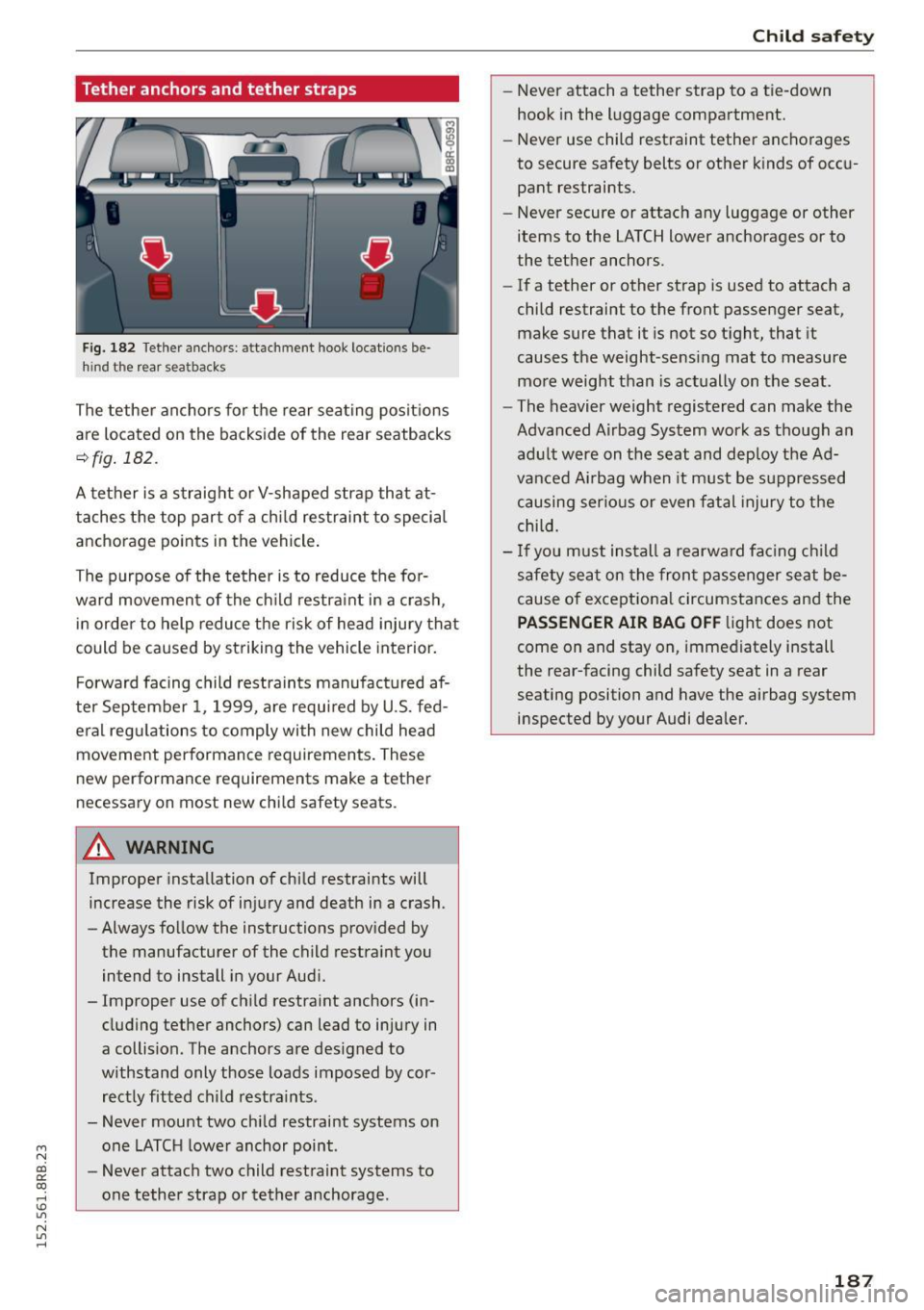
Fig. 182 Tether ancho rs: attach ment hook locatio ns be·
h ind t he rear sea tbacks
The tethe r anchors for the rear seating posit ions
are located on the backside of the rear seatbacks
¢ fig . 182 .
A tether is a s traig ht or V-shaped strap that at
taches the top part o f a ch ild restraint to special
anchorage points in the vehicle .
The purpose of the tether is to reduce the fo r
ward movemen t of the ch ild restra int in a crash ,
i n orde r to help reduce the ris k of head injury that
could be caused by striking the vehicle interior.
F orward facing child restra ints manufact ured af
ter September 1, 1999, are requ ired by U.S. fed
eral reg ulations to comply with new child head
movement performance requirements . These
new performance requirements make a tether
necessary on most new chi ld safety seats.
A WARNING
Improper installation of chi ld restraints will
increase the risk of i nju ry and death in a crash.
- Always fo llow the instructions prov ided by
the manufacturer of the child restra int you
intend to install in your Aud i.
- Improper use of ch ild restraint anchors (in
cluding tether anchors) can lead to injury in
a collision . The anchors are des igned to
withstand only those loads imposed by cor
rectly fitted child restra ints .
- Never mount two chi ld restraint systems on
one LATC H lower anchor point .
- Never attach two child restraint systems to
one tether strap or tether anchorage .
Child sa fe ty
- Never attach a tether strap to a tie-down
hook in the luggage compa rtment.
- Never use child restraint tether ancho rages
to secure safety belts or other k inds of occ u
pant restraints.
- Never secure or attach any luggage or other
items to the LATCH lower anchorages or to
the tether anchors.
- If a tether or other strap is used to attach a
child restraint to the front passenger seat,
make sure that it is not so t ight, that it
causes the weight -sens ing mat to measure
mo re weight than is actually on the seat .
- The heavier weight registered can make the
Advanced A irbag System work as though an
adult were on the seat and dep loy the Ad
vanced Ai rbag when it must be suppressed
causing ser ious or even fatal injury to the
child.
- If you m ust ins tall a rearwa rd fa cing c hild
safety sea t on the fron t passenger se at be
cause of except iona l circumstances and the
PASSENGER AIR BAG OFF light does not
come on and stay on , immediately install
the rear-facing child safety seat in a rear
seating position and have the airbag system
inspected by your Audi dealer.
187
Page 190 of 302
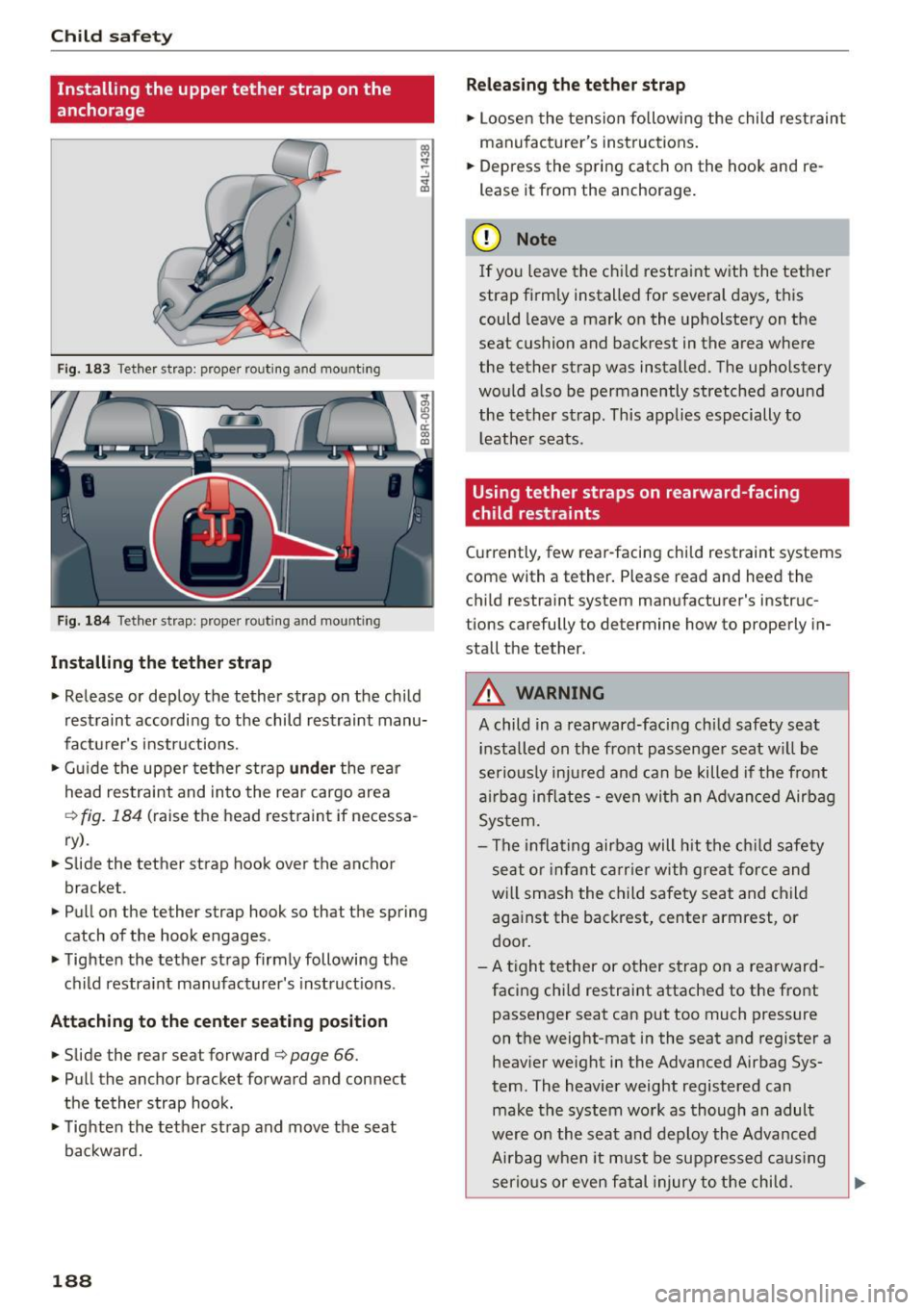
Child safety
Installing the upper tether strap on the
anchorage
F ig . 183 Tether strap: proper routing and mounting
F ig . 18 4 Tether st rap: proper routing and mounting
Installing the tether strap
• Release or dep loy the tether strap on the child
restraint according to the child restraint manu
factu rer's instr uctions.
• Gui de the upper te ther strap
under the rear
head restraint and into the rear cargo area
¢ fig. 184 (raise the head restraint if necessa
ry).
• Slide the tether strap hook over the anchor
bracket.
• Pull on the tether strap hook so that the spring
catch of the hook engages .
• Tighte n the tether st rap firmly following the
c h ild restra int manufac turer's inst ruct ions .
Attaching to the center seating position
• Slide the rear seat forward ¢ page 66.
• Pull the anchor bracket forward and connect
the tether strap hook .
• Tig hte n the tet her strap and move the seat
backward.
188
Releasing the tether strap
• Loosen the tension fo llow ing the child rest raint
manu fact urer's inst ructions.
• Depress the spring catch on the hook and re
lease it from the anchorage .
(D Note
If you leave the ch ild restraint with the tet her
strap fi rm ly installed fo r several days, t his
could leave a mark on the upholstery on the
seat cushion and backrest in the area where
the tether strap was installed. The upholstery
would a lso be permanently stretched around
the tether s trap . This applies especially to
l ea ther seats.
Using tether straps on rearward-facing
child restraints
Curre ntly, few rear -facing chi ld restraint systems
come with a tether. Please read and heed the
ch ild restra int system manufacturer's instr uc
tions carefully to determine how to properly in
stall the tether.
A WARNING
A child in a rearward-facing ch ild safety sea t
i nstalled on the fro nt pass enge r seat w ill be
seriously inju red and can be killed if the front
air bag in flates - even with an A dvan ced Air bag
Sys tem.
- The infla ting airbag will h it the c hild safety
seat o r infant carrier with great force and
w ill smash the child safety seat and child
aga inst the backrest, center armrest, or
door.
- A t igh t tether or other s trap on a rearward
facing chi ld restraint attached to the front
passenger seat can put too much pressure
on t he weight-mat in the seat and register a
heav ier weight in the Advanced Airbag Sys
tem. The heavier weight registered can
ma ke the system wo rk as though an adult
were o n the seat and deploy the Advanced
Airbag when it must be suppressed ca us ing
ser io us or even fat al injury to t he child.
~
Page 199 of 302

M N
co
a:
co
,...., \!) ..,.,
N ..,., ,....,
electrical energy is not being used than is being
generated and ensures an optimal state of
charge for the battery.
(D Tips
- But even energy management cannot neg
ate the limits of physics. Consider that the power and life of a battery are limited.
- If starting ability is threatened, the indica
tor light (•] appears ~
page 33.
What you should know
The highest priority is given to maintaining start
ing capability.
The battery is severely taxed in short-distance
driving, in city traffic and during the co ld time of
year. Abundant electrical energy is required, but
only a little is generated. It is also critical if the
engine is not running and electrical components
are turned on. In this instance energy is being
consumed but none is being generated.
It is in precisely these situations that you wi ll no
tice energy management actively regulating the
d istribution of energy.
Vehicl e stands fo r an e xte nded p eriod
If you do not drive your vehicle over a period of
several days or weeks , e lectrica l components are
gradually cut back or switched off . This reduces
energy consumption and maintains starting ca
pability over a longer period . Some of the con
ve nience funct ions may not operate, such as the
interior lights or the power seat adjustment. The
conven ience functions wi ll be available again
when you switch on the ignit io n and start the en
g ine.
With the engine turned off
If you listen to the radio, for example, with the
engine turned off or use other MMI* functions ,
the battery is being d ischarged .
If starting capability is jeopardized due to energy
consumption, a message appears in the radio or MMI* display . The message indicates that the
system w ill be switched off automatically in a
Smart T echno log y
moment . If you wish to continue using the func
tions, you have to start the engine.
With the engin e running
Although electrical energy is generated when the
vehicle is be ing driven, the battery can become
discharged . This happens mostly when litt le en
ergy is being generated and a great dea l con
s u med and the batte ry's state of charge is not
opt imal.
T o bring the energy ba lance back into equilibri
u m, consumers which require especially large
amounts of ene rgy are temporarily cut back or
switched off. Heating systems in particu lar re
quire a great deal of energy. If you notice, for ex
amp le, that the heated seats* or the heated rear
window are not heating, they have been tempo
rar ily cut back or switched off . These systems w il l
be available again as soon as the energy ba lance
has been restored.
You w ill also notice that engi ne idle speed has
been increased slightly . T h is is normal and not a
cause for concern. By increasing eng ine idle
speed the additional energy requi red is generated
and the battery is ch arged .
197
Page 239 of 302

® Mud and snow capability
"M/S" or "M+S" indicates the tire
has characte ris tics that make it
suitable for driving on mud and snow .
& indica tes a winter tire.
@ Composition of the tire cord
and materials
T he number of plies indicates the
number of rubber ized fabric lay
ers in the tire . In general: the
more layers, the more weight a
tire can carry. Tire manufacturers
must also specify the mater ials
used in the ti re. These include
stee l, nylon, polyester and other
materials.
@ Maximum permitted load
This number indicates the maxi
mum load in kilograms and
pounds that the tire can carry .
@ Uniform tire quality grade
standards for treadwear,
traction and temperature resistance
Treadwear , traction and tempera
ture ranges
c::::> page 251 .
@Running direction
The arrows ind icate the running
direction of unidirect ional tires.
You must always follow the speci- fied running direction
c::::> page 264.
€3) Ma
ximum permitted
inflation pressure
Whe els
This number indicates the maxi
mum pressure to which a tire can
be inflated unde r normal operat
ing conditions .
Glossary of tire and loading
terminology
Accessory weight
means the combined weight (in
excess of those standard items
which may be replaced) of auto matic transmission, power steer
ing, power brakes, power win
dows, power seats, radio, and
heater, to the extent that these
items are available as factory-in
stalled equipment (whether in
stalled or not).
Aspect ratio
means the ratio of the height to
the width of the tire in percent. Numbers of 55 or lower indicate a
low s idewall for improved steer
ing response and better overall
handling on dry pavement . .,.
237
Page 288 of 302

Index
Automatic driv ing light contro l . . . . . . . . . . . 52
Automatic Sh ift Lock (ASL) . . . . . . . . . . . . . 124
Automatic transmission . . . . . . . . . . . . . . . . 123
Automatic Shift Lock (ASL) . . . . . . . . . . . . 124
Driving ...... .................. ... . 125
Emergency mode . . . . . . . . . . . . . . . . . . . . 127
Emergency release . . . . . . . . . . . . . . . . . . . 128
H ill descent control . . . . . . . . . . . . . . . . . . 126
Kick -down . . . . . . . . . . . . . . . . . . . . . . . . . . 127
Manual sh ift program . . . . . . . . . . . . . . . . 127
Remova l lock (ignition key) . . . . . . . . . . . . . 84
Selector lever . . . . . . . . . . . . . . . . . . . . . . . 123
Shift paddles . . . . . . . . . . . . . . . . . . . . . . . 127
Automatic wipe/wash system . . . . . . . . . . . . 57
Auto Safety Hotline . . . . . . . . . . . . . . . . . . . 142
AUTO (climate control) . . . . . . . . . . . . . . . . . . 81
Average speed . . . . . . . . . . . . . . . . . . . . . . . . . 22
Avoid damaging the vehicle . . . . . . . . . . . . . 199
B
Bass box . . . . . . . . . . . . . . . . . . . . . . . . . . . . 256
Battery . . . . . . . . . . . . . . . . . . . . . . . . . . . . . 230
Battery locat ion inside the luggage compa rt-
ment .............................. 231
Charge level . . . . . . . . . . . . . . . . . . . . . . . . 196
Charging . . . . . . . . . . . . . . . . . . . . . . . 105, 232
Energy management . . . . . . . . . . . . . . . . . 196
Important warnings when working on the
battery . . . . . . . . . . . . . . . . . . . . . . . . . . . . 231
Jump starting . . . . . . . . . . . . . . . . . . . . . . . 271
Replacing the battery . . . . . . . . . . . . . . . . 233
Voltage . . . . . . . . . . . . . . . . . . . . . . . . . . . . . 33
W inte r operation . . . . . . . . . . . . . . . . . . . . 230
Working on the battery . . . . . . . . . . . . . . . 231
Before driving . . . . . . . . . . . . . . . . . . . . . . . . 135
Belt tensioners . . . . . . . . . . . . . . . . . . . . . . . 150
B io-ethanol (Fue l) . . . . . . . . . . . . . . . . . . . . . 214
Blended gasoline . . . . . . . . . . . . . . . . . . . . . 213
Blower (climate control) . . . . . . . . . . . . . . . . . 81
Booster seats . . . . . . . . . . . . . . . . . . . . . . . . 180
Brake fl uid
Changing the brake flu id . . . . . . . . . . . . . . 230
Checking the brake fluid level . . . . . . . . . . 229
Brake system Anti-lock brake system . . . . . . . . . . . . . . . . 17
Brake booster . . . . . . . . . . . . . . . . . . . . . . . 193
286
Brake fluid . . . . . . . . . . . . . . . . . . . . . . . . . 229
Brake fluid specifications for refill and re
placement . . . . . . . . . . . . . . . . . . . . . . . . . 230
Brake light defective . . . . . . . . . . . . . . . . . . 32
Brakes . . . . . . . . . . . . . . . . . . . . . . . . . . . . . 193
E lectromechanical parking brake . . . . . . . . 89
Fluid reservo ir . . . . . . . . . . . . . . . . . . . . . . 229
Malfunction . . . . . . . . . . . . . . . . . . . . . . . . . 28
Wa rning/indicator lights . . . . . . . . . . . . . . . 18
Worn b ra ke pads symbo l . . . . . . . . . . . . . . . 32
Brak ing
Brake assist . . . . . . . . . . . . . . . . . . . . . . . . 191
Braking guard ..... .. .. ... . .... ... 107, 113
Messages . . . . . . . . . . . . . . . . . . . . . . . . . . 114
Settings . . . . . . . . . . . . . . . . . . . . . . . . . . . 114
Switching on and
off . . . . . . . . . . . . . . . . . 114
Break-in period Brake pads . . . . . . . . . . . . . . . . . . . . . . . . . 193
Tires . . . . . . . . . . . . . . . . . . . . . . . . . . . . . . 198
B reak ing in . . . . . . . . . . . . . . . . . . . . . . . . . . 198
New tires . . . . . . . . . . . . . . . . . . . . . . . . . . 242
B reakover angle . . . . . . . . . . . . . . . . . . . . . . 202
Bul bs . . . . . . . . . . . . . . . . . . . . . . . . . . . . . . . 269
C
Californ ia Proposition 65 Warning . . . . . . . 222
Battery specific . . . . . . . . . . . . . . . . . . . . . 232
Capacities . . . . . . . . . . . . . . . . . . . . . . . . . . . 278
AdBlue ... .. .... .. .. .. ........... .. 218
Engine oi l . . . . . . . . . . . . . . . . . . . . . . . . . . 223
Care . . . . . . . . . . . . . . . . . . . . . . . . . . . . . . . . 208
Cargo area
refer to Loading the l uggage compart-
ment..... .. .... .. .. .. ........... .. 140
Cargo floor . . . . . . . . . . . . . . . . . . . . . . . . . . . 71
Catalytic converter . . . . . . . . . . . . . . . . . . . . 198
Center armrest
Adjusting . . . . . . . . . . . . . . . . . . . . . . . . . . . 68
Storage compar tment . . . . . . . . . . . . . . . . . 68
Central locking . . . . . . . . . . . . . . . . . . . . . . . . 38
Certification . . . . . . . . . . . . . . . . . . . . . . . . . 284
Chang ing
Engine oil . . . . . . . . . . . . . . . . . . . . . . . . . . 226
Checking Engine coolant level . . . . . . . . . . . . . . . . . . 227