2015 AUDI Q5 seats
[x] Cancel search: seatsPage 79 of 302

M N
co ~ co
rl I.O
"' N
"' rl
.. Remove the cigarette lighter when it pops out.
The c igarette lighter should only be used as a
power source for the compressor from the i nflat
able spare tire/tire repair kit* when absolutely
necessary.
A WARNING
The cigarette lighter only works when the ig
nition is switched on. Incorrect usage can lead
to serious injuries or burns. For this reason,
children should never be left unattended in
the vehicle because this increases the risk of
injury .
12-volt sockets
Electrical accessories can be connected to every
12-volt socket.
Fig . 91 Sect io n of the trim panel of t he luggage com part·
ment : 12-vo lt socket
Fig. 92 Ce nter console: 12-volt socket
.. Open the socket cover¢ fig. 91 or¢ fig. 92.
.. Insert the plug of the electrical device into the
socket.
The 12-volt sockets can be used for electrical ac
cessories . The power input must not exceed 120
watts .
Seats and storage
There is an additional 12 -volt socket in the center
console .
Before you purchase any accessories, always read
and follow the information in¢
page 283, Addi
tional accessories and parts replacement.
A WARNING
The power outlets and therefore the electrical
accessories connected to them operate only
with the ignition on . Improper use of the out
lets or of electrical accessories can lead to se
rious injuries or cause a fire . For this reason,
children should never be left unattended in
the veh icle -they could be injured!
(D Note
To avoid damaging the socket, only use plugs
that fit properly.
(D Tips
When the engine is off and accessories are
still plugged in and are on, the vehicle battery
can still be drained .
Storing
General overview
There are numerous places to store items in your
vehicle .
Glove compartment ¢page 78
Cooling box in glove compart-¢page 78
ment
Storage compartment in the roof
¢page 79
Coat hooks ¢page 79
Storage in the door panels
Storage net in footwell
Storage net in the front seat- backs
Storage net in luggage com part- ment
77
Page 80 of 302

Seats and storag e
_& WARNING
-Always remove objects from the instrument
panel. Any items not put away could slide
around inside the vehicle while dr iving or
when accelerating or when applying the brakes or when dr iv ing aro und a corner .
- When you are driving make sure that any
thi ng you may have placed in the cente r con
so le or other storage loca tions cannot fall
o ut into the footwells. I n case of sudden
braking you would not be able to brake or
acce lerate .
- Any pieces of cloth ing that you have hung
up must not interfere with the driver's view .
The coat hooks are designed only for light
weight cloth ing . Never hang any clothing
with hard, pointed or heavy objects in the
pockets on the coat hooks. During sudden
braking or in an acc ident -especially if the
airbag is deployed -these objects could in
jure any passengers ins ide the veh icle.
Glove compartment
The glove comportment is illuminated and con
be locked .
C
Fig. 93 Glove compar tmen t
To open glov e compartment
,.. Pu ll t he hand le in the d ire ct io n of the arrow
¢
fig. 93 and swing the cover down to open .
To close glove compartment
.,. Push the glove compartment lid upward until
the lock engages .
There are holders for a pen and a pad of paper in the glove compartment lid .
78
On the right side in the glove compartment is a
ho lder with the key body into which the emergen
cy key must be clipped to be able to start the ve
hicle.
_& WARNING
To reduce the risk of personal inj ury in an acci
dent or sudde n stop, always keep the glove
compartmen t closed while dr iv ing .
Cooling box in glove compartment
The cooling box works only when the air-condi
tioning is in cooling mode.
Fig . 9 4 Glove box w it h coo li ng box ope n and s wit c hed on
.,. Open the glove compartment¢ page 78,
fig.
93 .
.,. Turn the rotary switch @counter-clockwise to
switch the cooling on . The symbo ls on the rota
r y switch must be displayed ¢
fig. 94 accord
ing ly .
.,. Turn the ro tary switch @clockw ise to switch
the cooling off .
The cooling box works only in the cooling mode.
If the climate con trol is in t he heat ing mode, we
recommend switch ing the cooling box off .
Page 81 of 302

M N
co ~ co
rl I.O
"' N
"' rl
Storage compartment in the roof
""'
11111
'~-
8 G
o . . o
~
Fig. 95 Storage pocket in the roof
.. To open the lid you have to touch the bar
Q fig. 95 (Arrow) . The lid opens automatically .
.. To close the lid, push it up until it engages .
.&, WARNING
Always keep the lid closed while driving to re
duce the risk of injury dur ing a sudden brak
ing maneuver or in the event of an accident.
Coat hook s
Fig. 96 Coat hooks at rear doors
_& WARNING
-Hang clothes in such a way that they do not
impair the driver's vision.
- The coat hooks must only be used for light
weight clothing. Do not leave any heavy or
sharp edged objects in the pockets which
may interfere with the s ide curtain airbag
deployment and can cause personal injury in
a crash.
- Do not use coat hangers for hanging cloth
ing on the coat hooks as this can interfere
Seats and storage
with proper deployment of the side curtain
airbags in an accident.
- Do not hang heavy objects on the coat
hooks, as they could cause personal injury in
a sudden stop.
79
Page 84 of 302
![AUDI Q5 2015 Owners Manual Warm and cold
[i] Adjusting seat heating*
Pressing the but ton switches the seat heating on
at the highest setting (level 3). The LEDs indicate
the temperat ure leve l. To red](/manual-img/6/57635/w960_57635-83.png "AUDI Q5 2015 Owners Manual Warm and cold
[i] Adjusting seat heating*
Pressing the but ton switches the seat heating on
at the highest setting (level 3). The LEDs indicate
the temperat ure leve l. To red")
Warm and cold
[i] Adjusting seat heating*
Pressing the but ton switches the seat heating on
at the highest setting (level 3). The LEDs indicate
the temperat ure leve l. To red uce the tempera
ture, press the button again. To switch the seat heating off, press the button repeatedly until the
LED turns off.
After
10 minutes, the seat heating automatica lly
switches from leve l
3 to leve l 2.
lil Adjusting seat ventilation*
Press ing the button switches the seat ventilation
on at the highest setting ( leve l
3). The LEDs ind i
cate the venti lation level. To reduce the venti la
tion level, press the button aga in. To switch the
seat ventilation off, press the button repeatedly
until the L ED turns off.
l(;I> FRONT I S w itch the d efroster on/off
The windshield and s ide windows are defrosted
or cleared of condensation as quickly as possible.
The maximum amo unt of air flows mainly from
the vents below the windshield. Recirculation
mode switches off. The temperature should be
set to 72 °F (22 °C) or higher. The temperature is
cont ro lled automatically .
The
IAUTOI button switches the defroster off.
I Qiil REAR I Switching rear window heater on /
o ff
The rear window heater only operates when the
engine is running. It switches off automatically
after a few m inutes, depending on the outs ide
temperature .
To prevent the rear window heater from switch
ing off automatically, press and hold the
!lliD REARI
button for more than 2 seconds. This rema ins
stored unt il the ignition is switched off.
Air vent s
You can open and close the center and rea r air
vents using the thumbwheels. The levers adjust
the direction of the airflow from the vents .
You can adjust the air temperatu re in the rear by
turning the thumbwheel toward the red side to
82
make it wa rmer or towa rd the blue side to make
it coo ler .
A WARNING
- Do not use the recircu lation for extended
periods of time. The windows could fog up
since no fresh air can enter the vehicle. If
the windows fog up, press the air rec ircula
tion button again immed iately to sw itch off
the air recircu lation function or se lect de
frost.
- Individuals w ith reduced sensitivity to pain
or temperatu re could develop burns when
using the seat heating* function . T o reduce
the r isk of in ju ry, these indiv iduals should
no t use seat hea ting.
(D Note
To avoid damage to the heat ing e lements* in
the seats, do not kneel on the sea ts or place
h eavy loads on a sma ll are a of the seat .
Setup
-
The basic climate control settings can be adjust
ed in the radio or MMI".
"'Select : !CAR I function button> A/C control but
ton. O r
"' Sele ct:
I CAR I function b utton > Car sy stem s*
cont ro l bu tton
> A /C.
Automatic recirculation
When switched on, automat ic recirculation con
trols the recirculation mode automatically . If the
windows fog up , p ress the!@
F RON T! butto n.
Synchronization
When synchronization is switched on, the same
settings are applied to both the driver and front passenger, except for the seat heating/ventila
t ion* . Synchron izat ion switches off when you ad
just the settings on the front passenge r's side.
You can also switch synchronization on by press -
i ng and holding the knob on t he d river 's side . ..,_
Page 137 of 302

M N
co
a:
co
Driving safety
Basics
Safe driving habits
Please remember -safety first!
This chapter contains important information,
tips, instructions and warnings that you need to
read and observe for your own safety, the safety
of your passengers and others . We have summar
ized here what you need to know about safety
belts, airbags , chi ld restraints as well as child
safety. Your safety is for us
priority number 1. Al
ways observe the informat ion and warn ings in
this section - for your own safety as well as that
of your passengers .
The information in this section app lies to all
model ve rsions of your vehicle . Some of the fea
tures described in this sections may be standard
equipment on some models, or may be optional
eq uipment on others .
If you are not sure, ask
your authorized Audi dealer.
A WARNING
- Always make sure that you follow the in
struct ions and heed the WARNINGS in this
Manual. It is in your interest and in the in
terest of your passengers.
- Always keep the complete Owne r's Litera
ture in your Aud i when you lend or sell your
vehicle so that this important info rmation
will always be ava ilable to the driver and
passenge rs.
-
- Always keep the Owner's literature handy so
that you can find it easily if you have ques
tions.
Safety equipment
The safety features are part of the occupant re
straint system and work together to help reduce the risk of injury in a wide variety of accident sit
uations.
Your safety and the safety of your passenge rs
should not be left to chance. Advances in tec h-
; nology have made a var iety of fea tures available
~ to help reduce the r isk o f injury in an accident. ,....,
Dr ivin g sa fet y
The following is a list of just a few of the sa fety
features in your A udi:
- sophisticated s afety be lts fo r drive r and a ll pas-
senger seat ing pos itions,
- be lt fo rce limi ters for the front seats,
- belt pretensioners for the seats,
- be lt he ight adjustment for the front seats,
- head restra ints for each seating posit ion,
- front airbags,
- side airbags in the front seats and outer rear
seats *,
- side curtain airbags,
- specia l LATCH anchorages for child rest raints,
- adjustab le steering colum n.
These ind iv idual safety features, can work to
gether as a system to help protect you and your
passengers in a w ide range of accidents . T hese
features cannot work as a system if they are not always cor rect ly adjusted and co rrectly used.
S afet y is ev erybod y's re sponsibil it y !
Important things to do before driving
Safety is everybody 's job! Vehicle and occupant
safety always depends on the informed and care
ful driver .
For your safety and the safety of your passen
gers,
before driv ing alway s:
.,. Make s ure that all lights and signals are operat
ing correctly .
.,. Make sure that the tire pressure is correct .
.,. Make sure that all windows are clean and afford
good vis ibility to the outs ide .
.,. Secure all luggage and other items carefully
Q page 77 .
.,. Ma ke s ure that nothing can inte rfere wi th the
peda ls .
.,. Adjust front seat, head restraint and mirrors
correctly for your height.
.,. Instruct passengers to adjust the head re
straints according to the ir height.
.,. Make sure to use the r ight child restraint cor
rectly to protect ch ildren
Q page 172, Child
safety.
1 3 5
Page 139 of 302

M N
co
a:
co
,...., \!) ..,.,
N ..,., ,....,
For detai led information on how to adjust the
driver's seat, see ¢
page 64.
A WARNING
Drivers who are unbelted, out of position or
too close to the airbag can be ser ious ly in
jured by an airbag as it unfolds. To help re
duce the risk of serious personal injury:
- Always adjust the driver's seat and the
steering wheel so that there are at least
10 inches (25 cm) between your breastbone
and the steering wheel.
- Always hold the steering wheel on the out
side of the steering wheel rim with your
hands at the 9 o'clock and 3 o'clock posi
tions to he lp reduce the risk of personal in
jury if the dr iver's a irbag inflates.
- Never hold the steer ing whee l at the
12 o'cloc k posit ion or with your hands at
other pos it ions inside the steering wheel
rim or on the steering wheel hub. Holding
the steering wheel the wrong way can cause
serious injuries to the hands, arms and head
if the driver's airbag deploys.
- Pointing the steering whee l toward your
face decreases the ability of the supp lemen
tal driver's a irbag to protect you in a colli
sion.
- Always s it in an upright position and never
lean against or place any part of your body
too close to the area where the airbags are located .
- Before driv ing, a lways adjust the front seats
and head restraints properly and make sure
that all passengers are properly restrained.
- Never adjust the seats while the vehicle is
moving . Your seat may move unexpectedly
and you could lose control of the vehicle.
- Never drive with the backrest recl ined or
t ilted far back! The farther the back rests are
t il ted back, the greater the ris k of injury due
to incorrect pos ition ing of the sa fety belt
and improper seating posit ion.
- Children must always ride in child safety
seats¢
page 172 . Special precautions ap
ply when installing a ch ild safe ty seat on the
front passenger seat ¢
page 152.
Drivin g s afet y
Proper seating position for the front
passenger
The proper front passenger seating position is
important for safe, relaxed driving.
Fo r yo ur own safety and to reduce the risk of in
jury in the event of an accident, we recommend
t h at you adjust the sea t for the front passenger
to the fo llow ing pos ition:
"' Adj ust the angle of the seatback so that it is in
an upright position and your back comes in full
contact w ith it wheneve r th e vehi cle is moving.
"' Ad just the head rest ra in t so the upper edge is
as even as possib le w ith the top of your head. If
that is not possib le, try to adj ust the head re
straint so that it is as close to this position as
possible
¢ page 138.
"' Keep both feet flat on the floor in front of the
front passenger seat.
"' Fasten and wear safety belts correct ly
¢ page 147.
For detailed information on how to adjust the
front passenger's seat, see ¢
page 63.
A WARNING
--
Front seat passengers who are unbelted, out
of position or too close to the airbag can be
se riously in ju red o r killed by the a irbag as i t
unfo lds. To help reduce the risk of serious per
sona l injury :
- Passenge rs must always si t in an upright po
sition and never le an aga inst or place any
pa rt of their body too close to the area
where the airbags are located .
- Passengers who are unbelted, ou t of posi
tion or too close to the airbag can be seri
ously injured by an airbag as it unfo lds with
great force in the blink of an eye.
- Always make sure that there are at least
10 inches (25 cm) between the front pas
senger's breastbone and the instrument panel.
- Each passenger must always sit on a seat of
their own and proper ly fasten and wear the
safety belt be long ing to that seat .
- Before driving, always adjust the front pas
senger seat and head restraint properly.
1 37
Page 140 of 302
Driving safety
-Always keep your feet on the floor in front
of the seat. Never rest them on the seat, in
strument panel, out of the window, etc. The airbag system and safety belt will not be
able to protect you properly and can even in
crease the risk of injury in a crash .
- Never drive with the backrest reclined or tilted far back! The farther the backrests are
tilted back, the greater the risk of injury due
to incorrect positioning of the safety belt
and improper seating position.
- Children must always ride in child safety
seats r=;,
page 172. Spec ial precautions ap
ply when installing a child safety seat on the
front passenger seat r=;,
page 152.
Proper seating positions for passengers in
rear seats
Rear seat passengers must sit upright with both
feet on the floor consistent with their physical
size and be properly restrained whenever the ve hicle is in use.
To reduce the risk of injury caused by an incorrect
seating position in the event of a sudden braking
maneuver or an accident, your passengers on the
rear bench seat must always observe the follow
ing:
~ If there is a passenger on the rear center seat
ing position, slide the center head restraint up
ward at least to the next notch r=;,
page 67.
~ Make sure that the seatback is securely latched
in the upright position
r:=:>page 69 .
~ Keep both feet flat in the footwell in front of
the rear seat.
~ Fasten and wear safety belts properly
r:=:> page 147.
~ Make sure that children are always properly re
strained in a child restraint that is appropriate
for their size and age r=;,
page 172.
A WARNING
Passengers who are improperly seated on the
rear seat can be seriously injured in a crash.
- Each passenger must always sit on a seat of their own and properly fasten and wear the
safety belt belonging to that seat.
138
- Safety belts only offer maximum protection
when the seatback is securely latched in the
upright position and the safety belts are properly positioned on the body. By not sit
ting upright, a rear seat passenger increases
the risk of personal injury from improperly
positioned safety belts!
- Always adjust the head restraint properly so
that it can give maximum protection.
Proper adjustment of head restraints
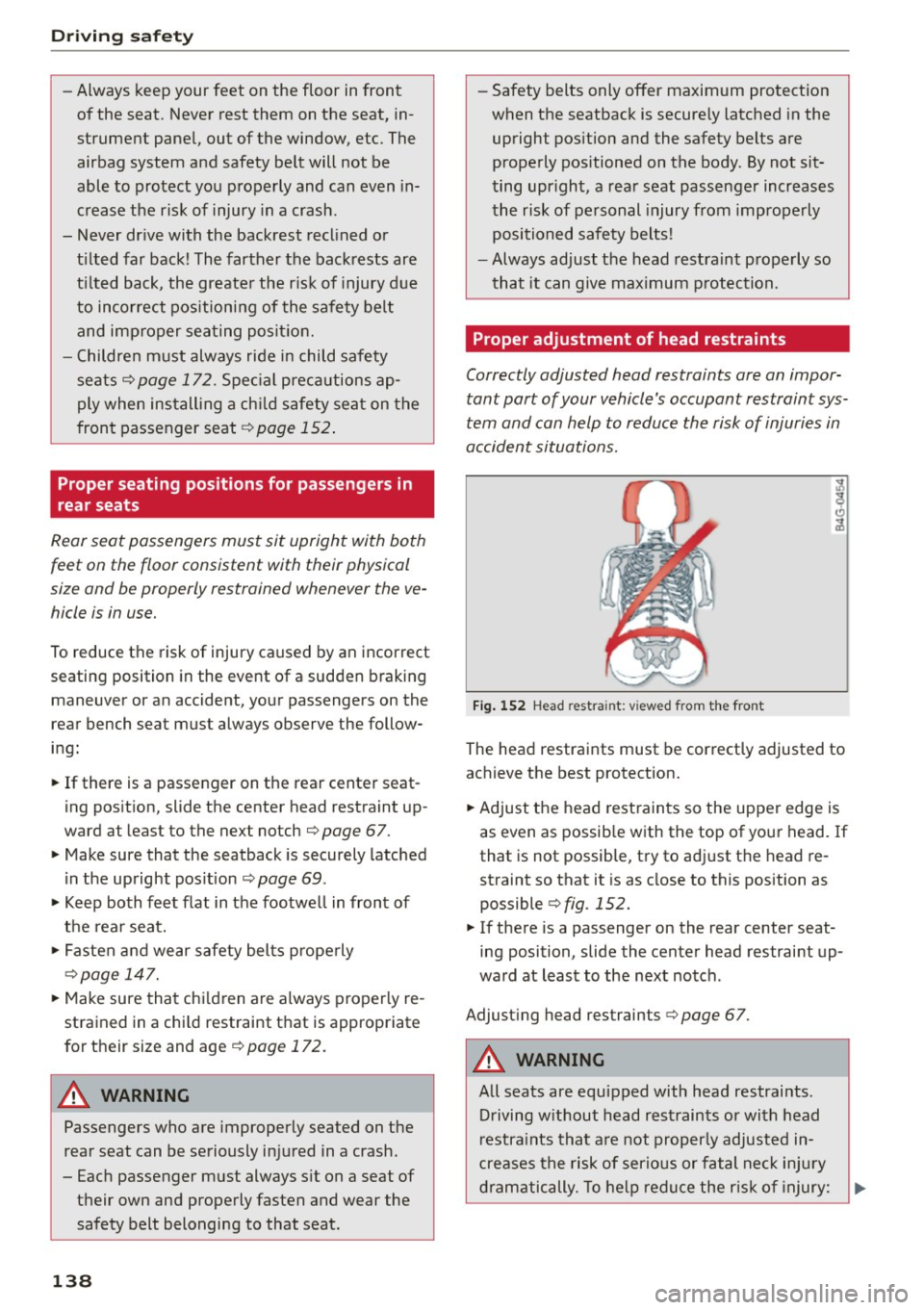
Correctly adjusted head restraints are an impor
tant part of your vehicle's occupant restraint sys
tem and can help to reduce the risk of injuries in
accident situations.
Fig. 152 Head rest ra in t: v iewed from the fro nt
The head restraints must be correctly adjusted to
achieve the best protection.
~ Adjust the head restraints so the upper edge is
as even as possible with the top of your head. If
that is not possible, try to adjust the head re
straint so that it is as close to this position as
possible r=;,
fig. 152.
~ If there is a passenger on the rear center seat
ing position, slide the center head restraint up
ward at least to the next notch .
Adjus ting head restraints r=;,
page 67.
A WARNING
All seats are equipped with head restraints.
Driving without head restraints or with head
restraints that are not properly adjusted in
creases the risk of serious or fatal neck injury
-
dramatically. To help reduce the risk of injury: ~
Page 141 of 302

M N
co
a:
co
,...., \!) 1.1"1
N 1.1"1 ,....,
-Always drive with the head restraints in
place and properly adjusted.
- Every person in the vehicle must have a
properly ad justed head restraint.
- Always make sure each person in the vehicle
properly adjusts their head restraint. Adjust
the head restraints so the upper edge is as even as possib le w ith the top of your head.
If that is not possib le, try to adjust the head
restraint so that it is as close to this position
as possib le.
- Never attempt to adjust head restraint
wh ile driving. If you have driven off and
must adjust the dr iver headrest for any rea
son, fi rst stop the veh icle safely before at
tempting to ad just the head restraint.
- Children must always be properly restrai ned
in a ch ild restraint that is appropria te fo r
their age and si ze
qpoge 172.
Examples of improper seating positions
The occupant restraint system con only reduce
the risk of injury if vehicle occupants ore properly
seated.
I mproper seat ing posit ions can ca use serious in
jury o r death . Safety be lts ca n only work when
they are prope rly positioned on t he body. Im
proper sea ting pos it ions reduce the effect iveness
of safety belts and wi ll even increase the risk of
in ju ry and death by moving the safety belt to cr it
i cal areas of the body. Improper seating positions
also increase the risk of serious injury and death
when an airbag deploys a nd strikes an occupant
who is not i n the proper seating position . A driver
i s responsible for the safety of all vehicle occu
pants and especia lly for children . Therefo re :
.. Never allow anyone to ass ume an incorrect
seat ing pos ition when the veh icle is being used
¢ ,&. .
The follow ing bulletins list only some sample po
sitions that will increase the risk of ser ious injury
and death. Our hope is that these examples will
make you more aware of seat ing pos itions that
are dangerous.
Dr ivin g s afet y
Therefore , whenever the vehicle is moving :
-never stand up in the vehicle
- never stand on the seats
- never kneel on the seats
- never ride w ith the seatback reclined
- never lie down on the rear seat
- never lean up against the instrument panel
- never sit on the edge of the seat
- neve r sit sideways
- neve r lean out t he window
- neve r put your feet out the window
- never put your feet on the instrument panel
- never rest your feet on the seat cush ion or back
of the seat
- never ride in the footwell
- never ride in the ca rgo a rea
A WARNING
Imp roper seating posit ions increase the risk
of ser ious personal in jury and death whenever
a veh icle is being used.
-Always make sure that all vehicle occupants stay in a proper seating position and are
properly restrained whenever the vehicle is
be ing used.
Pedal area
Pedals
The pedals must always be free to move and
must never be interfered with by a floor mot or
any other object .
Make sure that a ll peda ls move free ly without in
te rfe ren ce and t hat no thing prevents them from
re tu rning to t he ir o riginal posi tions.
Only use floor mats t hat leave the pedal a rea free
and can be secured with floor mat fastene rs.
If a brake circuit fa ils, increased brake pedal trav
el is required to bring the veh icle to a full stop .
A WARNING
-
Pedals that cannot move free ly can cause loss
of vehicle co ntrol and increase the risk of ser i-
ous injury.
~
1 39