Page 756 of 872

756 5-2. Steps to take in an emergency
SIENNA_OM_OM45483U_(U)
CAUTION
■If a blowout or sudden air leakage should occur
The tire pressure warning system may not activate immediately.
■Maintenance of the tires
Each tire, including the spare (if provided), should be checked monthly
when cold and inflated to the inflation pressure recommended by the
vehicle manufacturer on the vehicle placard or tire inflation pressure
label (tire and load information label). (If your vehicle has tires of a differ-
ent size than the size indicated on the vehicle placard or tire inflation
pressure label [tire and load information label], you should determine the
proper tire inflation pr essure for those tires.)
As an added safety feature, your vehicle has been equipped with a tire
pressure monitoring system (TPMS-ti re pressure warning system) that
illuminates a low tire pressure telltal e (tire pressure warning light) when
one or more of your tires is significantly under-inflated. Accordingly,
when the low tire pressu re telltale (tire pressure warning light) illumi-
nates, you should stop and check your tires as soon as possible, and
inflate them to the proper pressure. Driving on a significantly under-
inflated tire causes the tire to overheat and can lead to tire failure.
Under-inflation also reduces fuel effi ciency and tire tread life, and may
affect the vehicle’s handling and stopping ability.
Please note that the TPMS (tire pressure warning system) is not a sub-
stitute for proper tire main tenance, and it is the driver’s responsibility to
maintain correct tire pressure, even if under-inflation has not reached the
level to trigger illu mination of the TPMS low tire pressure telltale (tire
pressure warning light).
Page 792 of 872

792 5-2. Steps to take in an emergency
SIENNA_OM_OM45483U_(U)
CAUTION
■To prevent an accident or injury when inspecting under the hood of
your vehicle
● If steam is seen coming from under the hood, do not open the hood until
the steam has subsided. The engine compartment may be very hot, caus-
ing serious injuries such as burns.
● Keep hands and clothing (especially a tie, a scarf or a muffler) away from
the fan and belts. Failure to do so may cause the hands or clothing to be
caught, resulting in serious injury.
● Do not loosen the radiator cap or the coolant reservoir cap while the
engine and radiator are hot. Serious injury, such as burns, may result from
hot coolant and steam released under pressure.
NOTICE
■When adding engine coolant
Wait until the engine has cooled down before adding engine coolant.
When adding coolant, do so slowly. Adding cool coolant to a hot engine too
quickly can cause damage to the engine.
■ To prevent damage to the cooling system
Observe the following precautions:
●Avoid contaminating the coolant with foreign matter (such as sand or dust
etc.).
● Do not use commercially available coolant additives.
Page 820 of 872
820 6-1. Specifications
SIENNA_OM_OM45483U_(U)■
Temperature A, B, C
The temperature grades are A (the highest), B, and C, represent-
ing the tire’s resistance to the generation of heat and its ability to
dissipate heat when tested under controlled conditions on a speci-
fied indoor laboratory test wheel.
Sustained high temperature can cause the material of the tire to
degenerate and reduce tire life, and excessive temperature can lead
to sudden tire failure.
The grade C corresponds to a level of performance which all passen-
ger car tires must meet under the Federal Motor Vehicle Safety Stan-
dard No. 109.
Grades B and A represent higher levels of performance on the labo-
ratory test wheel than the minimum required by law.
Warning: The temperature grades of a tire assume that it is properly
inflated and not overloaded.
Excessive speed, underinflation, or excessive loading, either sepa-
rately or in combination, can cause heat buildup and possible tire fail-
ure.
Page 867 of 872
867
SIENNA_OM_OM45483U_(U)
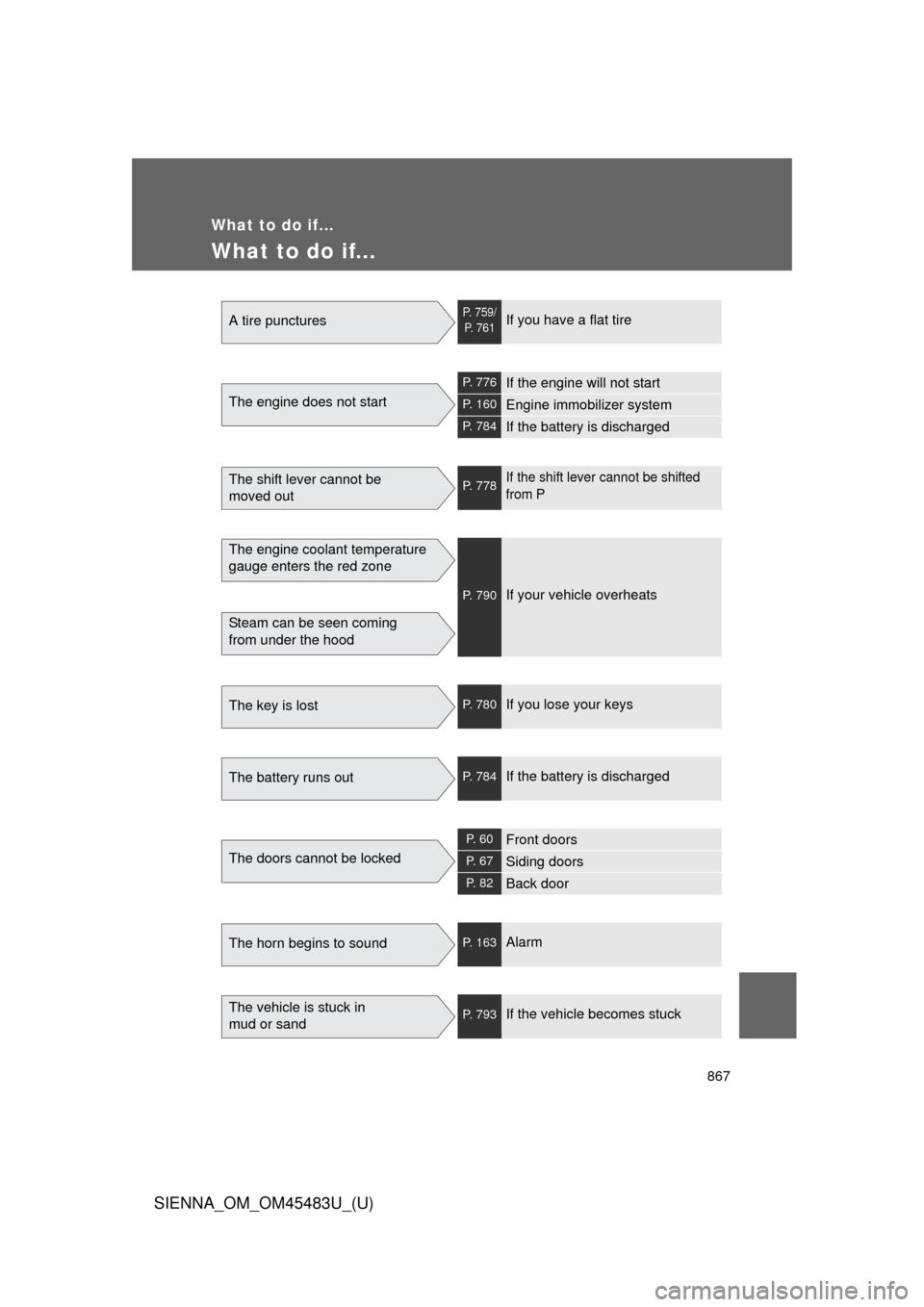
What to do if...
What to do if...
A tire puncturesP. 759/P. 7 6 1If you have a flat tire
The engine does not start
P. 776If the engine will not start
P. 160Engine immobilizer system
P. 784If the battery is discharged
The shift lever cannot be
moved outP. 778If the shift lever cannot be shifted
from P
The engine coolant temperature
gauge enters the red zone
Steam can be seen coming
from under the hood
P. 790If your vehicle overheats
The key is lostP. 780If you lose your keys
The battery runs outP. 784If the battery is discharged
The doors cannot be locked
P. 6 0Front doors
P. 6 7Siding doors
P. 8 2Back door
The horn begins to soundP. 163Alarm
The vehicle is stuck in
mud or sandP. 793If the vehicle becomes stuck