2014 SUBARU TRIBECA wheel
[x] Cancel search: wheelPage 324 of 426
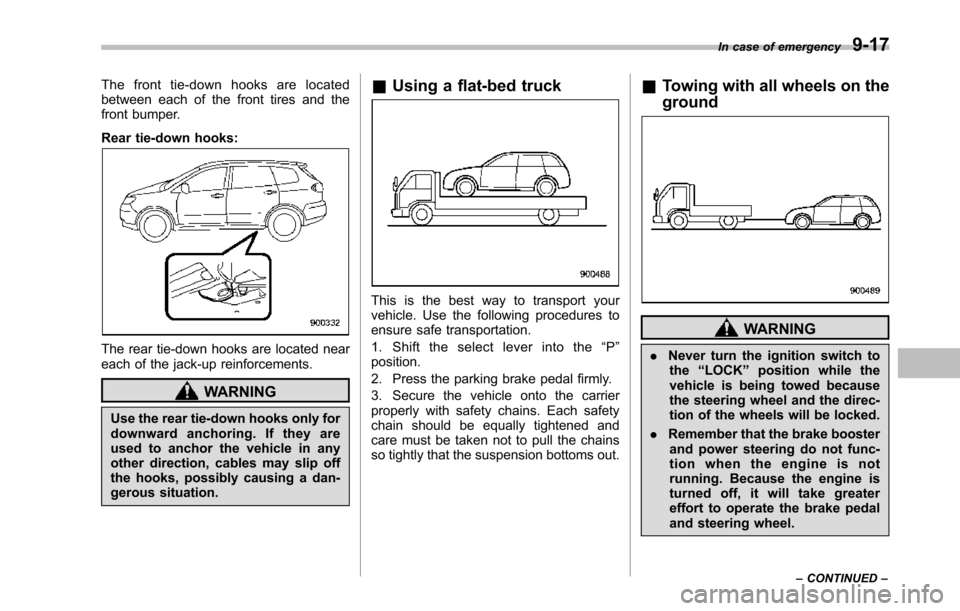
The front tie-down hooks are locatedbetween each of the front tires and thefront bumper.
Rear tie-down hooks:
The rear tie-down hooks are located neareach of the jack-up reinforcements.
WARNING
Use the rear tie-down hooks only fordownward anchoring. If they areused to anchor the vehicle in anyother direction, cables may slip offthe hooks,possibly causing a dan-gerous situation.
&Using a flat-bed truck
This is the best way to transport yourvehicle. Use the following procedures toensure safe transportation.
1. Shift the select lever into the“P”position.
2. Press the parking brake pedal firmly.
3. Secure the vehicle onto the carrierproperly with safety chains. Each safetychain should be equally tightened andcare must be taken not to pull the chainsso tightly that the suspension bottoms out.
&Towing with all wheels on the
ground
WARNING
.Never turn the ignition switch tothe“LOCK”position while thevehicle is being towed becausethe steeringwheel and the direc-tion of the wheels will be locked.
.Remember that the brake boosterand power steering do not func-tion when the engine is notrunning. Because the engine isturned off, it will take greatereffort to operate the brake pedaland steering wheel.
In case of emergency9-17
–CONTINUED–
Page 326 of 426
Maintenance tools
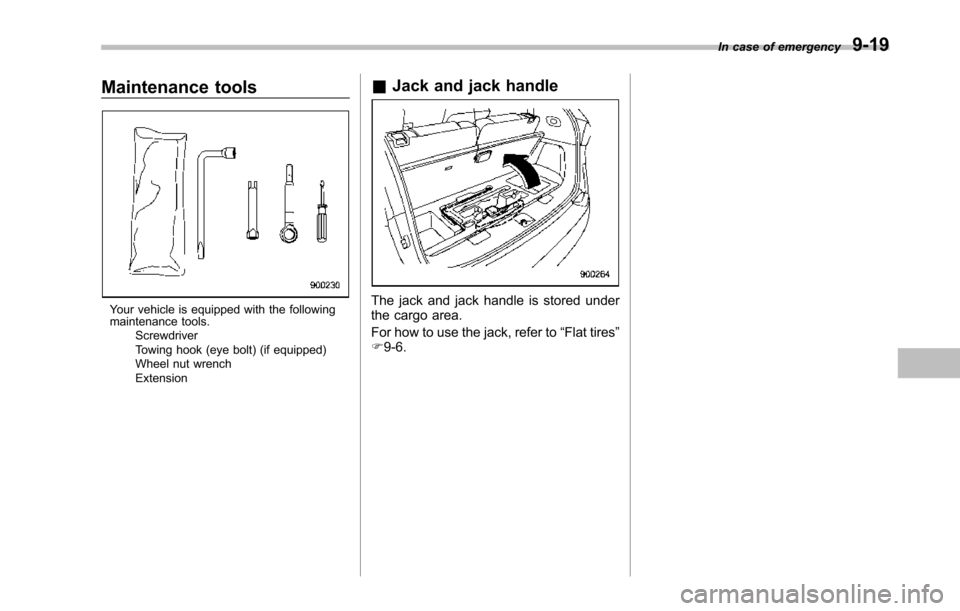
Your vehicle is equipped with the followingmaintenance tools.ScrewdriverTowing hook (eye bolt) (if equipped)Wheel nut wrenchExtension
&Jack and jack handle
The jack and jack handle is stored underthe cargo area.
For how to use the jack, refer to“Flat tires”F9-6.
In case of emergency9-19
Page 328 of 426
Exterior care....................................................... 10-2Washing............................................................. 10-2Waxing and polishing......................................... 10-3Cleaning aluminum wheels................................. 10-3
Corrosion protection.......................................... 10-4Most common causes of corrosion..................... 10-4To help prevent corrosion................................... 10-4
Cleaning the interior.......................................... 10-5Seat fabric......................................................... 10-5Leather seat materials........................................ 10-5Synthetic leather upholstery............................... 10-5Climate control panel, audio panel, instrumentpanel, console panel, switches, combinationmeter, and other plastic surface....................... 10-5Navigation monitor (if equipped)........................ 10-6
Appearance care
10
Page 330 of 426
nents.
!Using a warm water washer
.Keep a good distance of 12 in (30 cm)or more between the washer nozzle andthe vehicle.
.Do not wash the same area continu-ously.
.If a stain will not come out easily, washby hand. Some warm water washers areof the high temperature, high pressuretype, and they can damage or deform theresin parts such as mouldings, or causewater to leak into the vehicle.
&Waxing and polishing
Always wash and dry the vehicle beforewaxing and polishing.
Use a good quality polish and wax andapply them according to the manufac-turer’s instructions. Wax or polish whenthe painted surface is cool.
Be sure to polish and wax the chrome trim,as well as the painted surfaces. Loss ofwax on a painted surface leads to loss ofthe original luster and also quickens thedeterioration of the surface. It is recom-mended that a coat of wax be applied atleast once a month, or whenever thesurface no longer repels water.
If the appearance of the paint has dimin-
ished to the point where the luster or tonecannot be restored, lightly polish thesurface with a fine-grained compound.Never polish just the affected area, butinclude the surrounding area as well.Always polish in only one direction. ANo. 2000 grain compound is recom-mended. Never use a coarse-grainedcompound. Coarser grained compoundshave a smaller grain-size number andcould damage the paint. After polishingwith a compound, coat with wax to restorethe original luster. Frequent polishing withacompoundoranincorrectpolishingtechnique will result in removing the paintlayer and exposing the undercoat. Whenin doubt, it is always best to contact yourSUBARU dealer or an auto paint specia-list.
CAUTION
Do not use any agents with organicsolventson the surface of the bulbassembly cover. However, if a polishor wax with organic solvents isapplied to the cover surface, com-pletely wipe off the polish or wax.Otherwise, the cover surface may bedamaged.
NOTE
Be careful not to block the windshieldwasher nozzles with wax when waxingthe vehicle.
&Cleaning aluminum wheels
.Promptly wipethe aluminum wheelsclean of any kind of grime or agent. If dirtis left on too long, it may be difficult toclean off.
.Do not use soap containing grit toclean the wheels. Be sure to use a neutralcleaning agent, and later rinse thoroughlywith water. Do not clean the wheels with astiff brush or expose them to a high-speedwashing device.
.Clean the vehicle (including the alumi-num wheels) with water as soon aspossible when it has been splashed withsea water, exposed to sea breezes, ordriven on roads treated with salt or otheragents.
Appearance care10-3
Page 334 of 426

Maintenance schedule....................................... 11-3
Maintenance precautions................................... 11-3Before checking or servicing in the enginecompartment.................................................... 11-4When you do checking or servicing in the enginecompartment while the engine is running.......... 11-4
Engine hood....................................................... 11-4
Engine compartment overview.......................... 11-6
Engine oil............................................................ 11-7Checking the oil level......................................... 11-7Changing the oil and oil filter.............................. 11-8Recommendedgrade and viscosity.................... 11-9Synthetic oil....................................................... 11-9
Cooling system................................................ 11-10Hose and connections...................................... 11-10Engine coolant................................................. 11-11
Air cleaner element.......................................... 11-12Replacing the air cleaner element..................... 11-12
Spark plugs...................................................... 11-13Recommended spark plugs.............................. 11-13
Drive belts........................................................ 11-13
Automatic transmission fluid.......................... 11-14Checking the fluid level.................................... 11-14Recommended fluid......................................... 11-15
Front differential gear oil................................. 11-15Checking the oil level....................................... 11-15Recommended grade and viscosity.................. 11-16
Rear differential gear oil.................................. 11-16Recommended grade and viscosity.................. 11-16
Power steering fluid........................................ 11-16Checking the fluid level.................................... 11-16Recommended fluid......................................... 11-17
Brake fluid........................................................ 11-17Checking the fluid level.................................... 11-17Recommended brake fluid............................... 11-18
Brakebooster.................................................. 11-18
Brake pedal...................................................... 11-19Checking the brake pedal free play.................. 11-19Checking the brake pedal reserve distance....... 11-19
Replacement of brake pad and lining............ 11-19Breaking-in of new brake pads and linings....... 11-20
Parking brake stroke....................................... 11-20
Tires and wheels.............................................. 11-21Types of tires................................................... 11-21Tire pressure monitoring system (TPMS).......... 11-21Tire inspection................................................. 11-22Tire pressuresand wear.................................. 11-23Wheel balance................................................. 11-25Wear indicators............................................... 11-25Tire rotation direction mark.............................. 11-25Tire rotation..................................................... 11-26Tire replacement.............................................. 11-26Wheel replacement.......................................... 11-27
Aluminum wheels............................................ 11-27
Windshield washer fluid.................................. 11-28
Replacement of wiper blades......................... 11-29Windshield wiper blade assembly..................... 11-30Windshield wiper blade rubber ......................... 11-30Rear window wiper blade assembly.................. 11-31
Maintenance and service
11
Page 336 of 426
Maintenance schedule
The scheduled maintenance items re-quired to be serviced at regular intervalsare shown in the“Warranty and Main-tenance Booklet”.
For details of your maintenance schedule,read the separate“Warranty and Main-tenance Booklet”.
Maintenance precautions
When maintenance and service are re-quired, it is recommended that all work bedone by an authorized SUBARU dealer.
If you perform maintenance and serviceby yourself, you should familiarize yourselfwith the information provided in thissection on general maintenance andservice for yourSUBARU.
Incorrect or incomplete service couldcause improper or unsafe vehicle opera-tion. Any problems caused by impropermaintenance and service performed byyou are not eligible for warranty coverage.
WARNING
.Te s t i n g o f a n A l l - W h e e l D r i v emodel must NEVER be per-formed on a single two-wheeldynamometer or similar appara-tus. Attempting to do so willresult in transmission damageand in uncontrolled vehiclemovement and may cause anaccident or injuries to personsnearby.
.Always select a safe area whenperforming maintenance on yourvehicle.
.Always be very careful to avoidinjury when working on the vehi-cle. Remember that some of thematerials in the vehicle may behazardous if improperly used orhandled, for example, batteryacid.
.Your vehicle should only be ser-viced by persons fully competentto do so. Serious personal injurymay result to persons not experi-enced in servicing vehicles.
.Always use the proper tools andmake certain that they are wellmaintained.
.Never get under the vehicle sup-ported only by a jack. Always usea safety stands to support thevehicle.
.Never keep the engine running ina poorly ventilated area, such asa garage or other closed areas.
.Do not smoke or allow openflames around the fuel or battery.This will cause a fire.
.Because the fuel system is underpressure, replacement of the fuelfilter should be performed onlyby your SUBARU dealer.
.Wear adequate eye protection to
Maintenance and service11-3
–CONTINUED–
Page 353 of 426
11-20Maintenance and service
you apply the brake pedal, have the brakepads serviced by your SUBARU dealer assoon as possible.
&Breaking-in of new brake
pads and linings
When replacing the brake pad or lining,use only genuine SUBARU parts. Afterreplacement, the new parts must bebroken in as follows.
!Brakepad and lining
While maintaining a speed of 30 to 40mph (50 to 65 km/h), step on the brakepedal lightly. Repeat this five or moretimes.
!Parking brake lining
WARNING
A safe location and situation shouldbe selected for break-in driving.
CAUTION
Pressing the parking brake pedaltoo forcefully may cause the rearwheels to lock. To avoid this, becertain to press the pedal slowlyand gently.
1. Drive the vehicle at a speed ofapproximately 22 mph (35 km/h).
2. Depress the parking brake pedalSLOWLY and GENTLY. (Pressing with aforce of approximately 34 lbf [150 N, 15kgf].)
3. Drive the vehicle for approximately220 yards (200 meters) in this condition.
4. Wait 5 to 10 minutes for the parkingbrake to cool down. Repeat this proce-dure.
5. Check the parking brake stroke. If theparking brake stroke is out of the specifiedrange, adjust it by turning the adjusting nutlocated on the parking brake pedal.
Parking brake stroke:
5–6 notches / 67 lbf (300 N, 30 kgf)
Parking brake stroke
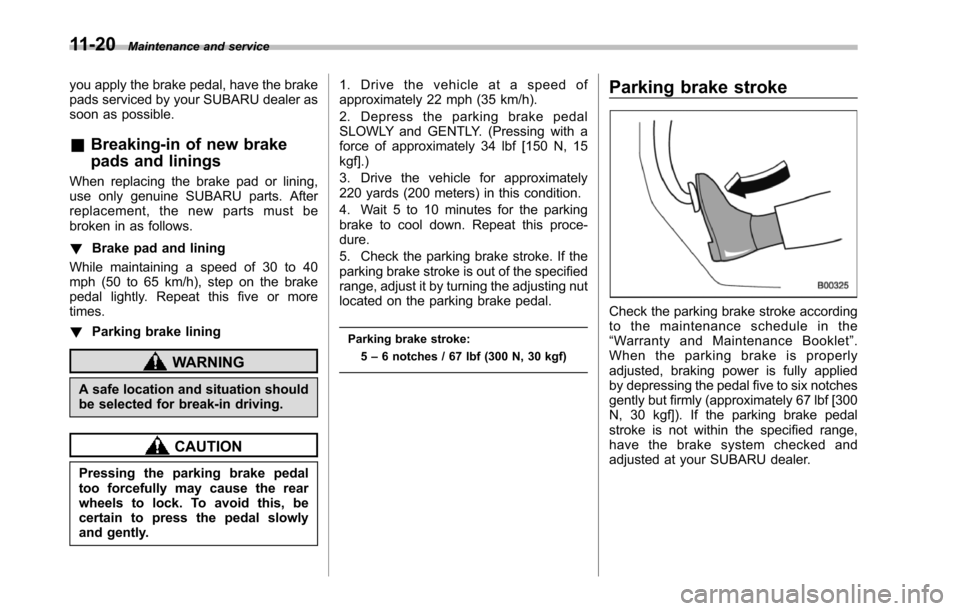
Check the parking brake stroke accordingto the maintenance schedule in the“Warranty and Maintenance Booklet”.When the parking brake is properlyadjusted, braking power is fully appliedby depressing the pedal five to six notchesgently but firmly (approximately 67 lbf [300N, 30 kgf]). If the parking brake pedalstroke is not within the specified range,have the brake system checked andadjusted at your SUBARU dealer.
Page 354 of 426
Tires and wheels
&Types of tires
You should be familiar with type of tirespresent on your vehicle.
!All season tires
The factory-installed tires on your newvehicle are all season tires.
All season tires are designed to providean adequate measure of traction, handlingand braking performance in year-rounddriving including snowy and icy roadconditions. However all season tires donot offer as much traction performance aswinter (snow) tires in heavy or loose snowor on icy roads.
All season tires are identified by“ALLSEASON”and/or“M+S”(Mud & Snow) onthe tire sidewall.
!Summer tires
Summer tires are high-speed capabilitytires best suited for highway driving underdry conditions.
Summer tires are inadequate for drivingon slippery roads such as on snow-covered or icy roads.
If you drive your vehicle on snow-coveredor icy roads, we strongly recommend theuse of winter (snow) tires.
When installing winter tires, be sure to
replace all four tires.
!Winter (snow) tires
Winter tires are best suited for driving onsnow-covered and icy roads. Howeverwinter tires do not perform as well assummer tires and all season tires on roadsother than snow-covered and icy roads.
&Tire pressure monitoring
system (TPMS)
The tire pressure monitoring system pro-vides the driver with a warning messageby sending a signal from a sensor that isinstalled in each wheel when tire pressureis severely low. The tire pressure monitor-ing system will activate only when thevehicle is driven. Also, this system maynot react immediately to a sudden drop intire pressure (for example, a blow-outcausedby running over a sharp object).
If you adjust the tire pressures in a warmgarage and will then drive the vehicle incold outside air, the resulting drop in tirepressures may cause the low tire pressurewarning light to illuminate. To avoid thisproblem when adjusting the tire pressuresin a warm garage, inflate the tires topressures higher than those shown on thetire placard. Specifically, inflate them by anextra 1 psi (6.9 kPa, 0.07 kgf/cm2) forevery difference of 108F (5.68C) between
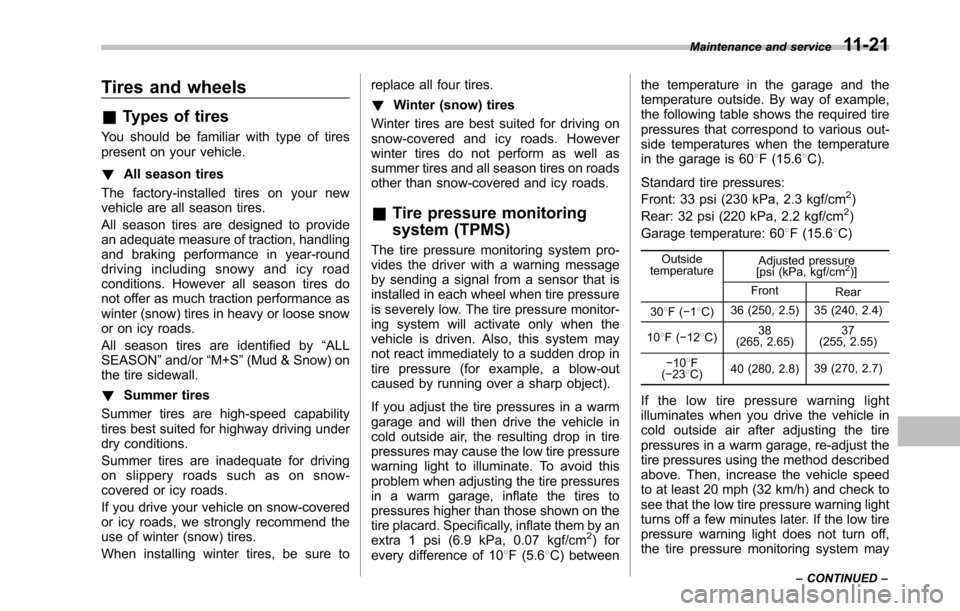
the temperature in the garage and thetemperature outside. By way of example,the following table shows the required tirepressures that correspond to various out-side temperatures when the temperaturein the garage is 608F (15.68C).
Standard tire pressures:
Front: 33 psi (230 kPa, 2.3 kgf/cm2)
Rear: 32 psi (220 kPa, 2.2 kgf/cm2)
Garage temperature: 608F (15.68C)
OutsidetemperatureAdjusted pressure[psi (kPa, kgf/cm2)]
FrontRear
308F(!18C)36 (250, 2.5) 35 (240, 2.4)
108F(!128C)38(265, 2.65)37(255, 2.55)
!108F(!238C)40 (280, 2.8)39 (270, 2.7)
If the low tire pressure warning lightilluminates when you drive the vehicle incold outside air after adjusting the tirepressures in a warm garage, re-adjust thetire pressures using the method describedabove. Then, increase the vehicle speedto at least 20 mph (32 km/h) and check tosee that the low tire pressure warning lightturns off a few minutes later. If the low tirepressure warning light does not turn off,the tire pressure monitoring system may
Maintenance and service11-21
–CONTINUED–