2014 SUBARU TRIBECA wheel
[x] Cancel search: wheelPage 300 of 426
Trailer towing
Your vehicle is designed and intended tobe used primarily as a passenger-carryingvehicle. Towing a trailer puts additionalloads on your vehicle’s engine, drivetrain,brakes, tires and suspension and has anadverse effect on fuel economy.
If you do decide to tow a trailer, your safetyand satisfaction depend upon proper useof correct equipment and cautious opera-tion of your vehicle. Seek the advice ofyour SUBARU dealer to assist you inpurchasing a hitch and other necessarytowing equipment appropriate for yourvehicle. In addition, be sure to follow theinstructionson correct installation and useprovided by the trailer and other towingequipment manufacturers.
SUBARUassumes no responsibility forinjuries or vehicle damage that result fromtrailer towing equipment, or from anyerrors or omissions in the instructionsaccompanying such equipment or for yourfailure to follow the proper instructions.
&Warranties and maintenance
SUBARU warranties do not apply tovehicle damage or malfunction causedby trailer towing. If you use your vehicle totow a trailer, more frequent maintenancewill be required due to the additional load.
(Refer to“Maintenance schedule undersevere driving conditions”in the“Warrantyand Maintenance Booklet”.)
Under no circumstances should a trailerbe towed with a new vehicle or a vehiclewith any new powertrain component (en-gine, transmission, differential, wheelbearings, etc.) for the first 1,000 miles(1,600 km) of driving.
&Maximum load limits
WARNING
Never exceed the maximum loadlimits explained in the following.Exceeding the maximum load limitscould cause personal injury and/orvehicle damage.
CAUTION
.Adequate size trailer brakes arerequired when the trailer and itscargo exceed1,000 lbs (453 kg)total weight.
.Before towing a trailer, check thetrailer total weight, GVW, GAWsand tongue load. Make sure theload and its distribution in yourvehicle and trailer are accepta-
ble.
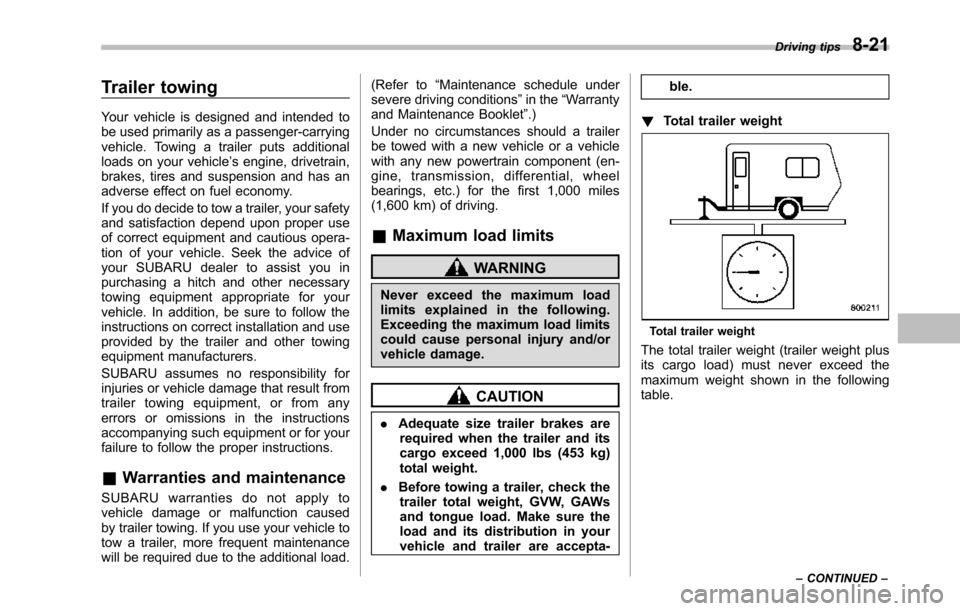
!Total trailer weight
Total trailer weight
The total trailer weight (trailer weight plusits cargo load) must never exceed themaximum weight shown in the followingtable.
Driving tips8-21
–CONTINUED–
Page 302 of 426
Certification label
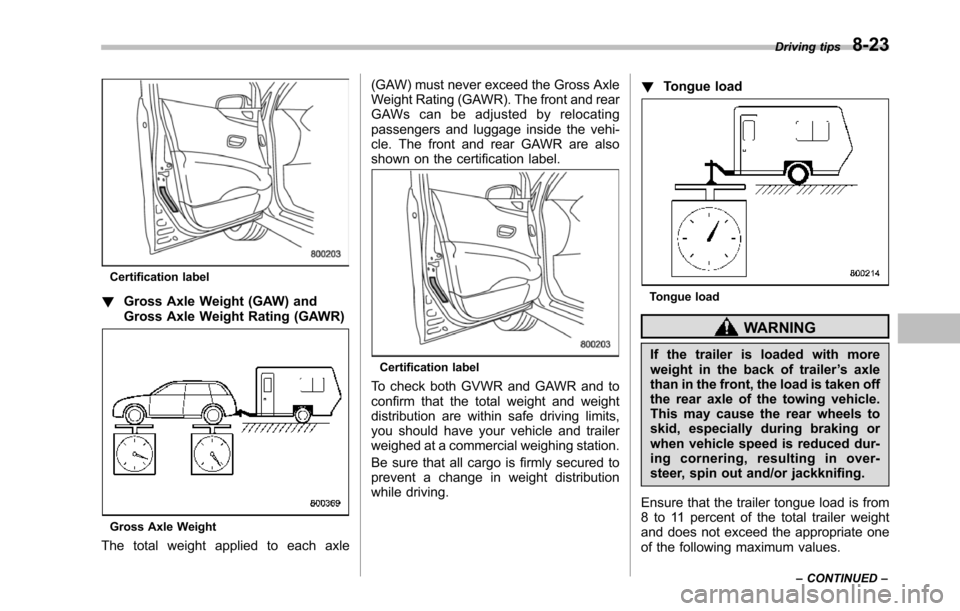
!Gross Axle Weight (GAW) andGross Axle Weight Rating (GAWR)
Gross Axle Weight
The total weight applied to each axle
(GAW) must never exceed the Gross AxleWeight Rating (GAWR). The front and rearGAWs can be adjusted by relocatingpassengers and luggage inside the vehi-cle. The front and rear GAWR are alsoshown on the certification label.
Certification label
To check both GVWR and GAWR and toconfirm that the total weight and weightdistribution are within safe driving limits,you shouldhave your vehicle and trailerweighed at a commercial weighing station.
Be sure that all cargo is firmly secured toprevent a change in weight distributionwhile driving.
!Tongue load
Tongue load
WARNING
If the trailer is loaded with moreweight in the back of trailer’s axlethan in the front, the load is taken offthe rear axle of the towing vehicle.This may cause the rear wheels toskid, especially during braking orwhen vehicle speed is reduced dur-ing cornering, resulting in over-steer, spin out and/or jackknifing.
Ensure that the trailer tongue load is from8 to 11 percent of the total trailer weightand does not exceed the appropriate oneof the following maximum values.
Driving tips8-23
–CONTINUED–
Page 303 of 426
8-24Driving tips
Vehicle without cooling kit: 200 lbs (90 kg)
Vehicle with cooling kit: 350 lbs (158 kg)
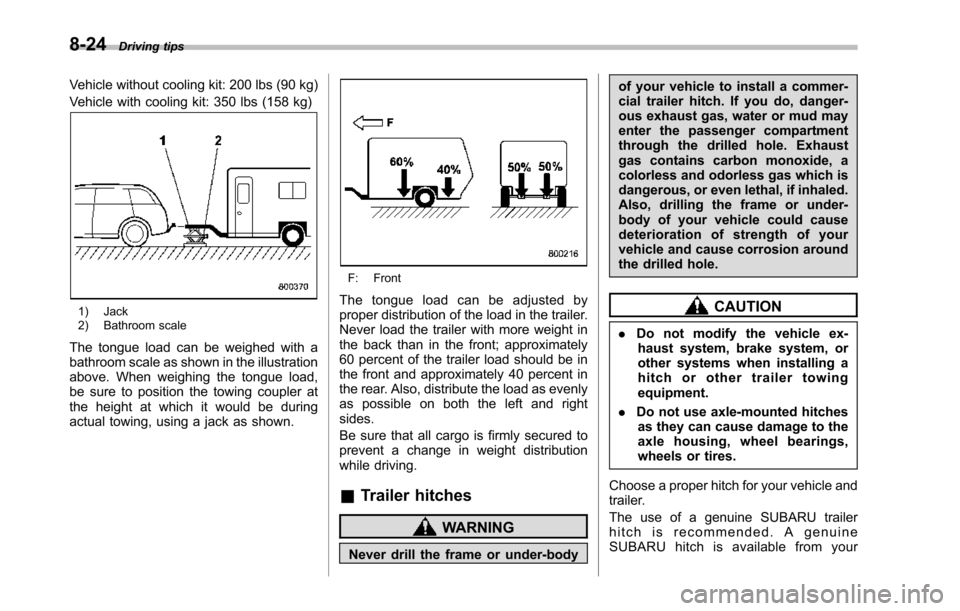
1) Jack2) Bathroom scale
The tongue load can be weighed with abathroomscale as shown in the illustrationabove. When weighing the tongue load,be sure to position the towing coupler atthe height at which it would be duringactual towing, using a jack as shown.
F: Front
The tongue load can be adjusted byproper distribution of the load in the trailer.Never load the trailer with more weight inthe back thanin the front; approximately60 percent of the trailer load should be inthe front and approximately 40 percent inthe rear. Also, distribute the load as evenlyas possible on both the left and rightsides.
Be sure that all cargo is firmly secured toprevent a change in weight distributionwhile driving.
&Trailer hitches
WARNING
Never drill the frame or under-body
of your vehicle to install a commer-cial trailer hitch. If you do, danger-ous exhaust gas, water or mud mayenter the passenger compartmentthrough the drilled hole. Exhaustgas contains carbon monoxide, acolorless and odorless gas which isdangerous, or even lethal, if inhaled.Also, drilling the frame or under-body of your vehicle could causedeterioration of strength of yourvehicle and cause corrosion aroundthe drilled hole.
CAUTION
.Do not modify the vehicle ex-haust system, brake system, orother systems when installing ahitch or other trailer towingequipment.
.Do not use axle-mounted hitchesas they can cause damage to theaxle housing, wheel bearings,wheels or tires.
Choose a proper hitch for your vehicle andtrailer.
The use of a genuine SUBARU trailerhitch is recommended. A genuineSUBARU hitch is available from your
Page 306 of 426
–all cargo in the trailer is securedsafely in position.–the side mirrors provide a goodrearward field of view without a sig-nificant blind spot..Sufficient time should be taken to learnthe“feel”of the vehicle/trailer combinationbefore starting out on a trip. In an area freeof traffic, practice turning, stopping andbacking up.
!Driving with a trailer
.You should allow for considerably morestopping distance when towing a trailer.Avoid sudden braking because it mayresult in skidding or jackknifing and loss ofcontrol.
.Avoid uneven steering, sharp turns andrapid lane changes.
.Slow down before turning. Make alonger than normal turning radius becausethe trailer wheels will be closer than thevehicle wheels to the inside of the turn. Ina tight turn, the trailer could hit yourvehicle.
.Crosswinds will adversely affect thehandling of your vehicle and trailer, caus-ing sway. Crosswinds can be due toweather conditions or the passing of largetrucks or buses. If swaying occurs, firmlygrip the steering wheel and slow downimmediately but gradually.
.When passing other vehicles, consid-erable distance is required because of theadded weight and length caused byattaching the trailer to your vehicle.
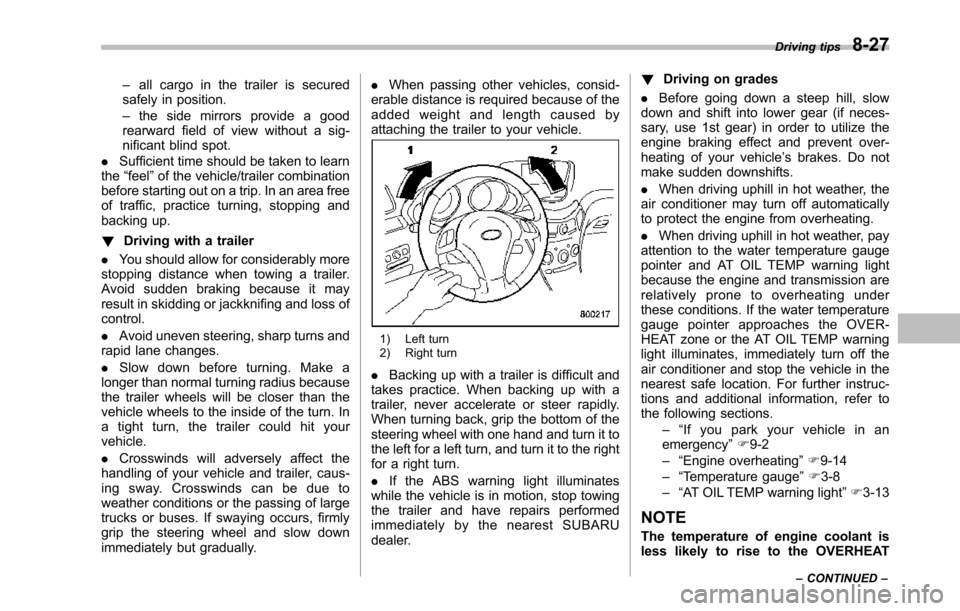
1) Left turn2) Right turn
.Backing up with a trailer is difficult andtakes practice. When backing up with atrailer, never accelerate or steer rapidly.When turning back, grip the bottom of thesteering wheel with one hand and turn it tothe left for a left turn, and turn it to the rightfor a right turn.
.If the ABS warning light illuminateswhile the vehicle is in motion, stop towingthe trailer and have repairs performedimmediately by the nearest SUBARUdealer.
!Driving on grades
.Before going down a steep hill, slowdown and shift into lower gear (if neces-sary, use 1st gear) in order to utilize theengine braking effect and prevent over-heating of your vehicle’s brakes. Do notmake sudden downshifts.
.When driving uphill in hot weather, theair conditioner may turn off automaticallyto protect the engine from overheating.
.When driving uphill in hot weather, payattention to the water temperature gaugepointer and AT OIL TEMP warning lightbecause the engine and transmission arerelatively prone to overheating underthese conditions. If the water temperaturegauge pointer approaches the OVER-HEAT zone or the AT OIL TEMP warninglight illuminates, immediately turn off theair conditioner and stop the vehicle in thenearest safe location. For further instruc-tions and additional information, refer tothe following sections.–“If you park your vehicle in anemergency”F9-2–“Engine overheating”F9-14–“Temperature gauge”F3-8–“AT OIL TEMP warning light”F3-13
NOTE
The temperature of engine coolant isless likely to rise to the OVERHEAT
Driving tips8-27
–CONTINUED–
Page 307 of 426
8-28Driving tips
zone in the“D”position than in themanual mode position.
.Avoid using the accelerator pedal tostay stationary on an uphill slope insteadof using the parking brake or foot brake.That may cause the transmission fluid tooverheat.
!Parking on a grade
Always block the wheels under bothvehicle and trailer when parking. Applythe parking brake firmly. You should notpark on a hill or slope. But if parking on ahill or slope cannot be avoided, youshould take the following steps.
1. Apply the brakes and hold the pedaldown.
2. Have someone place wheel blocksunder both the vehicle and trailer wheels.
3. When the wheel blocks are in place,release the regular brakes slowly until theblocks absorb theload.
4. Apply the regular brakes and thenapply the parking brake; slowly releasethe regular brakes.
5. Shift into“P”and shut off the engine.
Page 308 of 426
If you park your vehicle in an emergency......... 9-2
Spare tire............................................................. 9-2Removing the spare tire...................................... 9-3Re-storage of spare tire....................................... 9-4
Temporary spare tire........................................... 9-5
Flat tires............................................................... 9-6Changing a flat tire.............................................. 9-6Tire pressure monitoring system (TPMS) ............ 9-10
Jump starting..................................................... 9-11How to jump start............................................... 9-12
Engine overheating........................................... 9-14If steam is coming from the enginecompartment................................................... 9-14If no steam is coming from the enginecompartment................................................... 9-14
Towing................................................................ 9-14Towing and tie-down hooks................................ 9-15Using a flat-bed truck......................................... 9-17Towing with all wheels on the ground................. 9-17
Reargate–if the rear gate cannot beunlocked.......................................................... 9-18
Maintenance tools............................................. 9-19Jack and jack handle......................................... 9-19
In case of emergency
9
Page 310 of 426
carefully read“Temporary spare tire”F9-5for instructions and precautions.
&Removing the spare tire
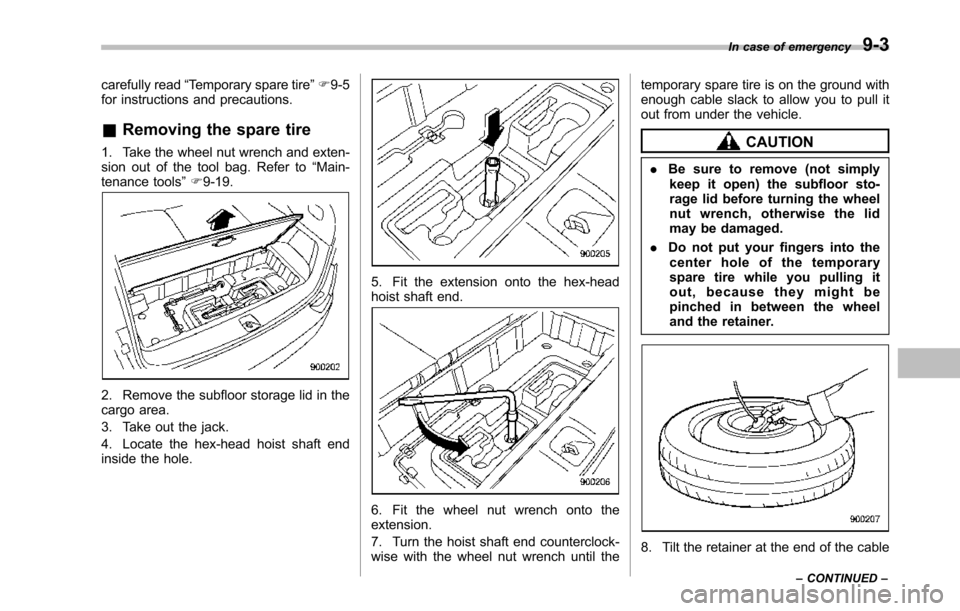
1. Take the wheel nut wrench and exten-sion out of the tool bag. Refer to“Main-tenance tools”F9-19.
2. Remove the subfloor storage lid in thecargo area.
3. Take out the jack.
4. Locate the hex-head hoist shaft endinside the hole.
5. Fit the extension onto the hex-headhoist shaft end.
6. Fit the wheel nut wrench onto theextension.
7. Turn the hoist shaft end counterclock-wise with the wheel nut wrench until the
temporary spare tire is on the ground withenough cable slack to allow you to pull itout from under the vehicle.
CAUTION
.Be sure to remove (not simplykeep it open) the subfloor sto-ragelid before turning the wheelnut wrench, otherwise the lidmay be damaged.
.Do not put your fingers into thecenter hole of the temporaryspare tire while you pulling itout, because they might bepinched in between the wheelandthe retainer.
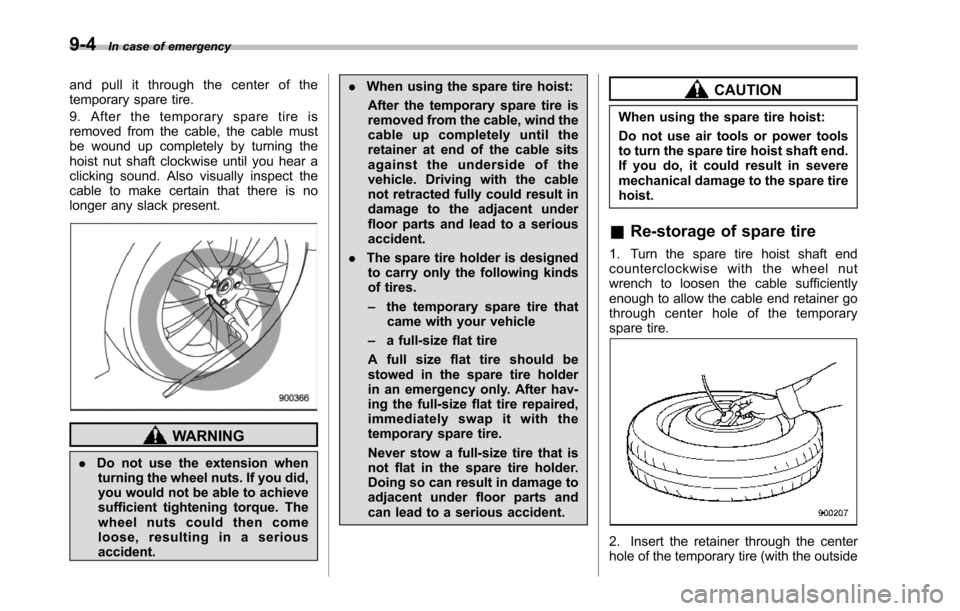
8. Tilt the retainer at the end of the cable
In case of emergency9-3
–CONTINUED–
Page 311 of 426
9-4In case of emergency
and pull it through the center of thetemporary spare tire.
9. After the temporary spare tire isremoved from the cable, the cable mustbe wound up completely by turning thehoist nut shaft clockwise until you hear aclicking sound. Also visually inspect thecable to make certain that there is nolonger any slack present.
WARNING
.Do not use the extension whenturning the wheel nuts. If you did,you would not be able to achievesufficient tightening torque. Thewheel nuts could then comeloose, resulting in a seriousaccident.
.When using the spare tire hoist:
After the temporary spare tire isremoved from the cable, wind thecable up completely until theretainer at end of the cable sitsagainst the underside of thevehicle. Driving with the cablenot retracted fully could result indamage to the adjacent underfloor partsand lead to a seriousaccident.
.The spare tire holder is designedto carry only the following kindsof tires.
–the temporaryspare tire thatcame with your vehicle
–a full-size flat tire
A full size flat tire should bestowed in the spare tire holderin an emergency only. After hav-ing the full-sizeflat tire repaired,immediately swap it with thetemporary spare tire.
Never stow a full-size tire that isnot flat in the spare tire holder.Doing so can result in damage toadjacent under floor parts andcan lead to a serious accident.
CAUTION
When using the spare tire hoist:
Do not use air tools or power toolsto turn the spare tire hoist shaft end.If you do, it could result in severemechanical damage to the spare tirehoist.
&Re-storage of spare tire
1. Turn the spare tire hoist shaft endcounterclockwise with the wheel nutwrench to loosen the cable sufficientlyenough to allow the cable end retainer gothrough center hole of the temporaryspare tire.
2. Insert the retainer through the centerhole of the temporary tire (with the outside