2014 SUBARU TRIBECA brake
[x] Cancel search: brakePage 337 of 426
11-4Maintenance and service
guard against getting oil or fluidsin your eyes. If something doesget in your eyes, thoroughlywash them out with clean water.
.Do not tamper with the wiring ofthe SRS airbag system or seat-belt pretensioner system, or at-tempt to take its connectorsapart, as that may activate thesystem or it can render it inop-erative. NEVER use a circuittester for these wiring. If yourSRS airbag or seatbelt preten-sioner needs service, consultyour nearest SUBARU dealer.
&Before checking or servicing
in the engine compartment
WARNING
.Always stop the engine and setthe parking brake firmly to pre-vent the vehicle from moving.
.Always let the engine cool down.Engine parts become very hotwhen the engine is running andremain hot for some time afterthe engine is stopped.
.Do not spill engine oil, enginecoolant, brake fluid or any other
fluid on hot engine components.This may cause a fire.
.Always remove the key from theignition switch. When the ignitionswitch is in the“ON”position,the cooling fan may operatesuddenly even when the engineis stopped.
&When you do checking or
servicing in the engine com-
partment while the engine is
running
WARNING
A running engine can be dangerous.Keep your fingers, hands, clothing,hair and tools away from the coolingfan, belts and any other movingengine parts. Removing rings,watches and ties is advisable.
Engine hood
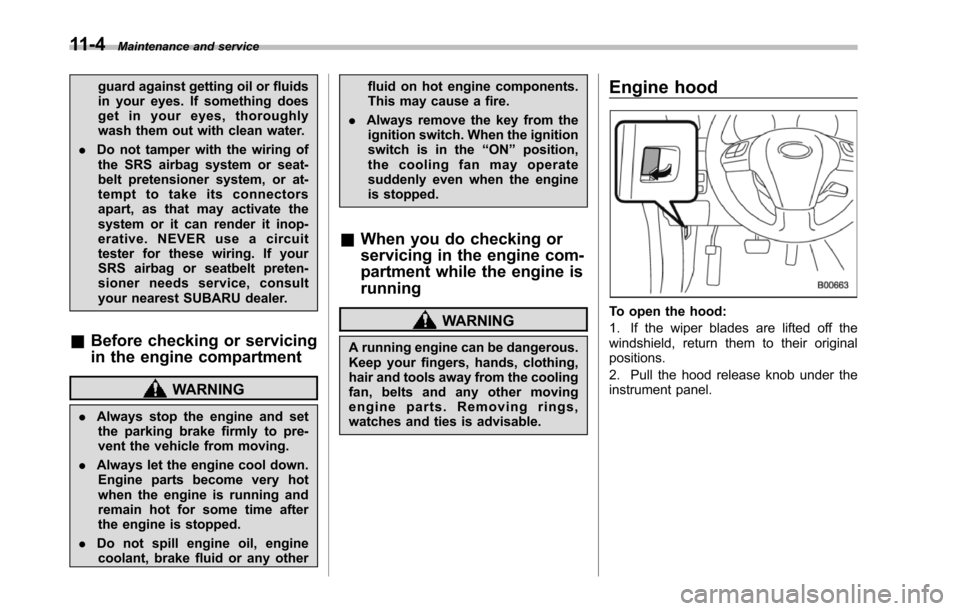
To open the hood:
1. If the wiper blades are lifted off thewindshield, return them to their originalpositions.
2. Pull the hood release knob under theinstrument panel.
Page 339 of 426
11-6Maintenance and service
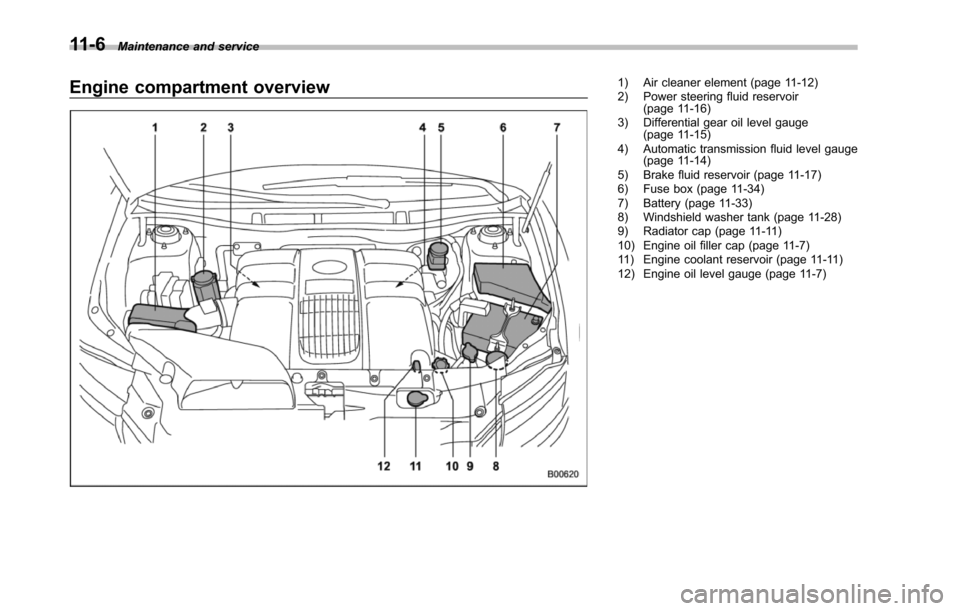
Engine compartment overview1) Air cleaner element (page 11-12)2) Power steering fluid reservoir(page 11-16)3) Differential gear oil level gauge(page 11-15)4) Automatic transmission fluid level gauge(page 11-14)5) Brake fluid reservoir (page 11-17)6) Fuse box (page 11-34)7) Battery (page 11-33)8) Windshield washer tank (page 11-28)9) Radiator cap (page 11-11)10) Engine oil filler cap (page 11-7)11) Engine coolant reservoir (page 11-11)12) Engineoil level gauge (page 11-7)
Page 347 of 426
11-14Maintenance and service
Automatic transmission fluid
&Checking the fluid level
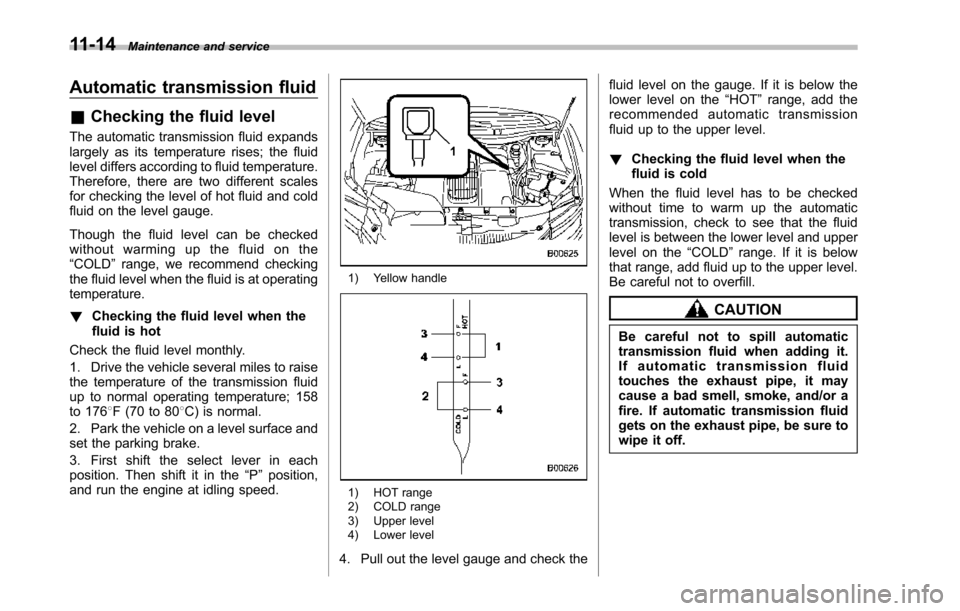
The automatic transmission fluid expandslargely as its temperature rises; the fluidlevel differs according to fluid temperature.Therefore, there are two different scalesfor checking the level of hot fluid and coldfluid on the level gauge.
Though the fluid level can be checkedwithout warming up the fluid on the“COLD”range, we recommend checkingthe fluid level when the fluid is at operatingtemperature.
!Checking the fluid level when thefluid is hot
Check the fluid level monthly.
1. Drive the vehicle several miles to raisethe temperature of the transmission fluidup to normal operating temperature; 158to 1768F (70 to 808C) is normal.
2. Park the vehicle on a level surface andset the parking brake.
3. First shift the select lever in eachposition. Then shift it in the“P”position,and run the engine at idling speed.
1) Yellow handle
1) HOT range2) COLD range3) Upper level4) Lower level
4. Pull out the level gauge and check the
fluid level on the gauge. If it is below thelower level on the“HOT”range, add therecommended automatic transmissionfluid up to the upper level.
!Checking the fluid level when thefluid is cold
When the fluid level has to be checkedwithout time to warm up the automatictransmission,check to see that the fluidlevel is between the lower level and upperlevel on the“COLD”range. If it is belowthat range, add fluid up to the upper level.Be careful not to overfill.
CAUTION
Be careful not to spill automatictransmission fluid when adding it.If automatic transmission fluidtouches the exhaust pipe, it maycause a bad smell, smoke, and/or afire. If automatic transmission fluidgets on the exhaust pipe, be sure towipe it off.
Page 350 of 426
power steering fluid touches theexhaust pipe, it may cause a badsmell, smoke, and/or a fire. Ifpower steering fluid gets on theexhaust pipe, be sure to wipe itoff.
The power steering fluid expands greatlyas its temperature rises; the fluid leveldiffers according to fluid temperature.Therefore, the reservoir tank has twodifferent checking ranges for hot and coldfluids.
Check the power steering fluid levelmonthly.
1. Park the vehicle on a level surface,and stop the engine.
2. Check the fluid level of the reservoirtank.
When the fluid is hot after the vehicle hasbeen run: Check that the oil level isbetween“HOT MIN”and“HOT MAX”onthe surface of the reservoir tank.
When the fluid is cool before the vehicle isrun: Check that the oil level is between“COLD MIN”and“COLD MAX”on thesurface of the reservoir tank.
3. If the fluid level is lower than theapplicable“MIN”line, add the recom-mended fluid as necessary to bring thelevel between the“MIN”and“MAX”line.
If the fluid level is extreme low, it mayindicate possible leakage. Consult yourSUBARU dealer for inspection.
&Recommended fluid
Refer to“Fluids”F12-7.
Brake fluid
&Checking the fluid level
WARNING
.Never let brake fluid contact youreyes because brake fluid can beharmful to your eyes. If brakefluid gets in your eyes, immedi-ately flush them thoroughly withclean water. For safety, whenperforming this work, wearingeye protection is advisable.
.Brake fluid absorbs moisturefrom the air. Any absorbed moist-ure can cause a dangerous lossof braking performance.
.If the vehicle requires frequentrefilling, there may be a leak. Ifyou suspecta problem, have thevehicle checked at your SUBARUdealer.
CAUTION
.When adding brake fluid, be care-ful not to allow any dirt into thereservoir.
.Never splash the brake fluid overpainted surfaces or rubber parts.
Maintenance and service11-17
–CONTINUED–
Page 351 of 426
11-18Maintenance and service
Alcohol contained in the brakefluid may damage them.
.Be careful not to spill brake fluidwhen adding it. If brake fluidtouches the exhaust pipe, it maycause a bad smell, smoke, and/ora fire. If brake fluid gets on theexhaust pipe, be sure to wipe itoff.
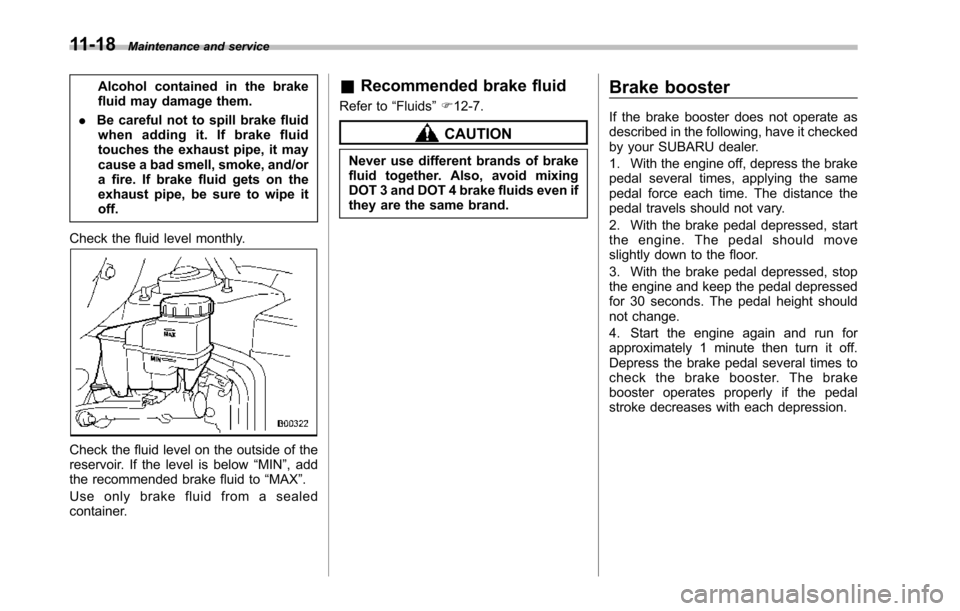
Check the fluid level monthly.
Check thefluid level on the outside of thereservoir. If the level is below“MIN”, addthe recommended brake fluid to“MAX”.
Use only brake fluid from a sealedcontainer.
&Recommended brake fluid
Refer to“Fluids”F12-7.
CAUTION
Never use different brands of brakefluid together. Also, avoid mixingDOT 3 and DOT 4 brake fluids even ifthey are the same brand.
Brake booster
If the brake booster does not operate asdescribed in the following, have it checkedby your SUBARU dealer.
1. With the engine off, depress the brakepedal several times, applying the samepedal force each time. The distance thepedal travels should not vary.
2. With the brake pedal depressed, startthe engine. The pedal should moveslightly down to the floor.
3. With the brake pedal depressed, stopthe engine and keep the pedal depressedfor 30 seconds. The pedal height shouldnot change.
4. Start the engine again and run forapproximately 1 minute then turn it off.Depress the brake pedal several times tocheck the brake booster. The brakebooster operates properly if the pedalstroke decreases with each depression.
Page 352 of 426
Brake pedal
Check the brake pedal free play andreserve distance according to the main-tenance schedule in the“Warranty andMaintenance Booklet”.
&Checking the brake pedal
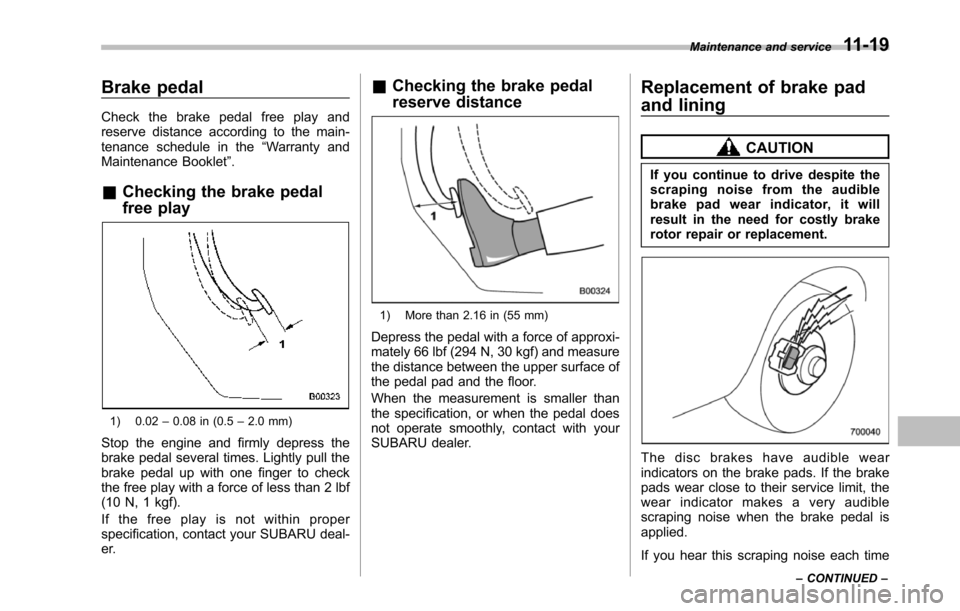
free play
1) 0.02–0.08 in (0.5–2.0 mm)
Stop the engine and firmly depress thebrake pedal several times. Lightly pull thebrake pedal up with one finger to checkthe free play with a force of less than 2 lbf(10 N, 1 kgf).
If the free play is not within properspecification, contact your SUBARU deal-er.
&Checking the brake pedal
reserve distance
1) More than 2.16 in (55 mm)
Depress the pedal with a force of approxi-mately 66 lbf (294 N, 30 kgf) and measurethe distance between the upper surface ofthe pedal pad and the floor.
When the measurement is smaller thanthe specification, or when the pedal doesnot operate smoothly, contact with yourSUBARU dealer.
Replacement of brake pad
and lining
CAUTION
If you continue to drive despite thescraping noise from the audiblebrake pad wear indicator, it willresult in the need for costly brakerotor repair or replacement.
The disc brakes have audible wearindicators on the brake pads. If the brakepads wear close to their service limit, thewear indicator makes a very audiblescraping noise when the brake pedal isapplied.
If you hear this scraping noise each time
Maintenance and service11-19
–CONTINUED–
Page 353 of 426
11-20Maintenance and service
you apply the brake pedal, have the brakepads serviced by your SUBARU dealer assoon as possible.
&Breaking-in of new brake
pads and linings
When replacing the brake pad or lining,use only genuine SUBARU parts. Afterreplacement, the new parts must bebroken in as follows.
!Brakepad and lining
While maintaining a speed of 30 to 40mph (50 to 65 km/h), step on the brakepedal lightly. Repeat this five or moretimes.
!Parking brake lining
WARNING
A safe location and situation shouldbe selected for break-in driving.
CAUTION
Pressing the parking brake pedaltoo forcefully may cause the rearwheels to lock. To avoid this, becertain to press the pedal slowlyand gently.
1. Drive the vehicle at a speed ofapproximately 22 mph (35 km/h).
2. Depress the parking brake pedalSLOWLY and GENTLY. (Pressing with aforce of approximately 34 lbf [150 N, 15kgf].)
3. Drive the vehicle for approximately220 yards (200 meters) in this condition.
4. Wait 5 to 10 minutes for the parkingbrake to cool down. Repeat this proce-dure.
5. Check the parking brake stroke. If theparking brake stroke is out of the specifiedrange, adjust it by turning the adjusting nutlocated on the parking brake pedal.
Parking brake stroke:
5–6 notches / 67 lbf (300 N, 30 kgf)
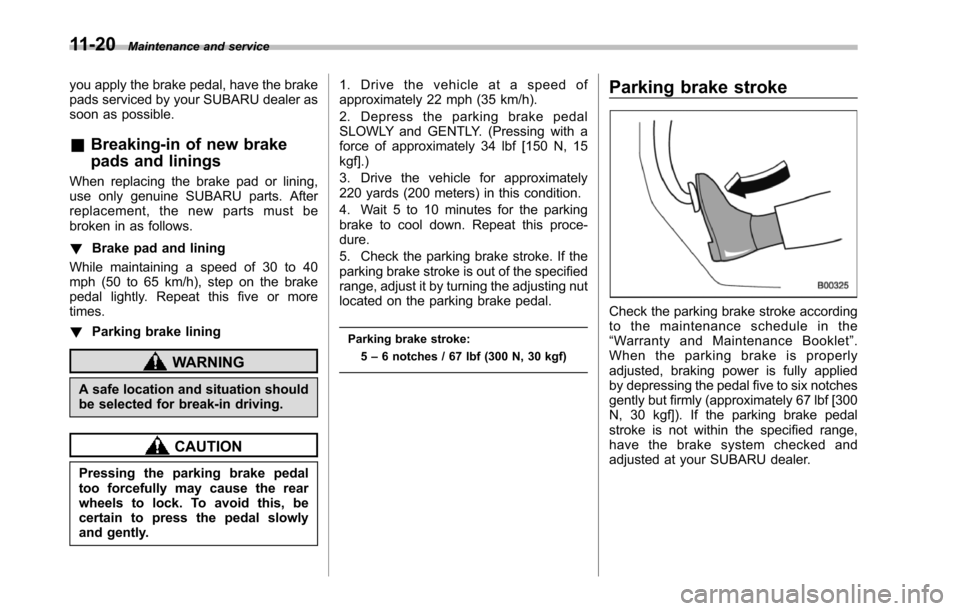
Parking brake stroke
Check the parking brake stroke accordingto the maintenance schedule in the“Warranty and Maintenance Booklet”.When the parking brake is properlyadjusted, braking power is fully appliedby depressing the pedal five to six notchesgently but firmly (approximately 67 lbf [300N, 30 kgf]). If the parking brake pedalstroke is not within the specified range,have the brake system checked andadjusted at your SUBARU dealer.
Page 355 of 426

11-22Maintenance and service
not be functioning normally. In this event,go to a SUBARU dealer to have thesystem inspected as soon as possible.
While the vehicle is driven, friction be-tween tires and the road surface causesthe tires to warm up. After illumination ofthe low tire pressure warning light, anyincrease in the tire pressures caused byan increase in the outside air temperatureor by an increase in the temperature in thetires can cause the low tire pressurewarning light to turn off.
System resetting is necessary when thewheels are changed (for example, aswitch to snow tires) and new TPMSvalves are installed on the newly fittedwheels. Have this work performed by aSUBARU dealer following wheel replace-ment.
It may not be possible to install TPMSvalves on certain wheels that are on themarket. Therefore, if you change thewheels (for example, a switch to snowtires), use wheels that have the same partnumber as the standard-equipmentwheels. Without four operational TPMSvalve/sensors on the wheels, the TPMSwill not fully function and the warning lightin the instrument panel will illuminatesteadily after blinking for approximatelyone minute.
When a tire is replaced, adjustments arenecessary to ensure continued normaloperation of the tire pressure monitoringsystem. As with wheel replacement, there-fore, you should have the work performedby a SUBARU dealer.
WARNING
If the low tire pressure warning lightdoes not illuminate briefly after theignition switch is turned ON or thelight illuminates steadily after blink-ing for approximately one minute,you shouldhave your Tire PressureMonitoring System checked at aSUBARU dealer as soon as possi-ble.
If this light illuminates while driving,never brake suddenly and keepdriving straight ahead while gradu-ally reducing speed. Then slowlypull off the road to a safe place.Otherwise an accident involvingserious vehicle damage and seriouspersonal injury could occur.
If this light still illuminates whiledriving after adjusting the tire pres-sure, a tire may have significantdamage and a fast leak that causesthe tire to lose air rapidly. If you havea flat tire, replace it with a spare tire
as soon as possible.
When a spare tire is mounted or awheel rim is replaced without theoriginal pressure sensor/transmitterbeing transferred, the low tire pres-sure warning light will illuminatesteadily after blinking for approxi-mately one minute. This indicatesthe TPMS is unable to monitor allfour road wheels. Contact yourSUBARU dealer as soon as possiblefor tire and sensor replacement and/or system resetting. If the lightilluminates steadily after blinkingfor approximately one minute,promptly contact a SUBARU dealerto have the system inspected.
&Tire inspection
Checkon a daily basis that the tires arefree from serious damage, nails, andstones. At the same time, check the tiresfor abnormal wear.
Contact your SUBARU dealer immedi-ately if you find any problem.
NOTE
.When the wheels and tires strikecurbs or are subjected to harsh treat-ment as when the vehicle is driven on arough surface, they can suffer damage