2014 SUBARU TRIBECA brake
[x] Cancel search: brakePage 360 of 426
WARNING
.When replacing a tire, you mustuse a tire that is of the same size,circumference, speed symboland load index as the originaltires listed on the tire placard.Using tires of other sizes, cir-cumferences or constructionsmay result in severe mechanicaldamage to the drive train of yourvehicle and may affect ride,handling, braking, speedometer/odometer calibration, and clear-ance betweenthe body and tires.It also may be dangerous andlead to loss of vehicle control.
.You must install four tires that areof the same size, circumference,construction, manufacturer,brand(tread pattern), degree ofwear, speed symbol and loadindex. Mixing tires of differenttypes, sizes or degrees of wearcan result in damage to thevehicle’spowertrain.Useofdifferent types or sizes of tirescan also dangerously reducecontrollability and braking per-formance and can lead to anaccident.
.Use only radial tires. Do not use
radial tires together with beltedbias tires and/or bias-ply tires.Doing so can dangerously re-duce controllability, resulting inan accident.
&Wheel replacement
When replacing wheels due, for example,to damage, make sure the replacementwheels match the specifications of thewheels that are fitted as standard equip-ment. Replacement wheels are availablefrom SUBARUdealers.
WARNING
Use only those wheels that arespecified for your vehicle. Wheelsnot meeting specifications couldinterfere with brake caliper opera-tion and may cause the tires to rubagainst the wheel well housing dur-ing turns. The resulting loss ofvehicle control could lead to anaccident.
Aluminum wheels
.Aluminum wheels can be scratchedand damaged easily. Handle them care-fully to maintain their appearance, perfor-mance, and safety.
.When any of the wheels are removedand replaced for tire rotation or to changea flat tire, always check the tightness ofthe wheel nuts after driving approximately600 miles (1,000 km). If any nut is loose,tighten it to the specified torque.–For the wheel nut tightening torque,refer to“Tires”F12-8.–For the wheel nut tightening proce-dure, refer to“Changing a flat tire”F9-6..Never apply oil to the threaded parts,wheel nuts, or tapered surface of thewheel.
.Never let the wheel rub against sharpprotrusions or curbs.
.When wheel nuts, balance weights, orthe center cap is replaced, be sure toreplace them with genuine SUBARU partsdesigned for the specific wheel.
Maintenance and service11-27
Page 384 of 426

&Fluids
FluidFluid type*1Fluid capacity*2Remarks*3
Automatic transmission fluid· SUBARU ATF· IDEMITSU ATF HP10.4 US qt (9.8 liters, 8.6 Imp qt)“Automatic transmission fluid”F11 -14
Power steering fluid
· SUBARU ATF· IDEMITSU ATF HP·“Dexron III”Type AutomaticTransmission Fluid
0.95 US qt (0.9 liters, 0.79 Imp qt)·“Power steering”F7-18·“Power steering fluid”F11-16
Brake fluidFMVSSNo. 116, fresh DOT 3 or DOT 4brake fluid–“Brake fluid”F11-17
*1: Use one of the indicated types of fluid.*2: The indicated fluid quantity is only a guideline. The necessary quantity for replacement may differ slightly depending on the temperature and otherfactors.*3: For moredetails about maintenance and service,referto the indicated section.
&Engine coolant
Coolant type Coolant capacity
SUBARU Super Coolant8.0 US qt (7.6 liters, 6.7 Imp qt)
The indicated coolant quantity is only a guideline. The necessary quantity for replacement may differ slightly depending on the temperature and otherfactors. For more details about maintenance and service, refer to“Cooling system”F11-10.
&Electrical system
Battery type and capacity (5HR) 75D23L (12V-52AH)
Alternator12V-130A
Spark plugsSILFR6C11 (NGK)
Specifications12-7
–CONTINUED–
Page 398 of 426
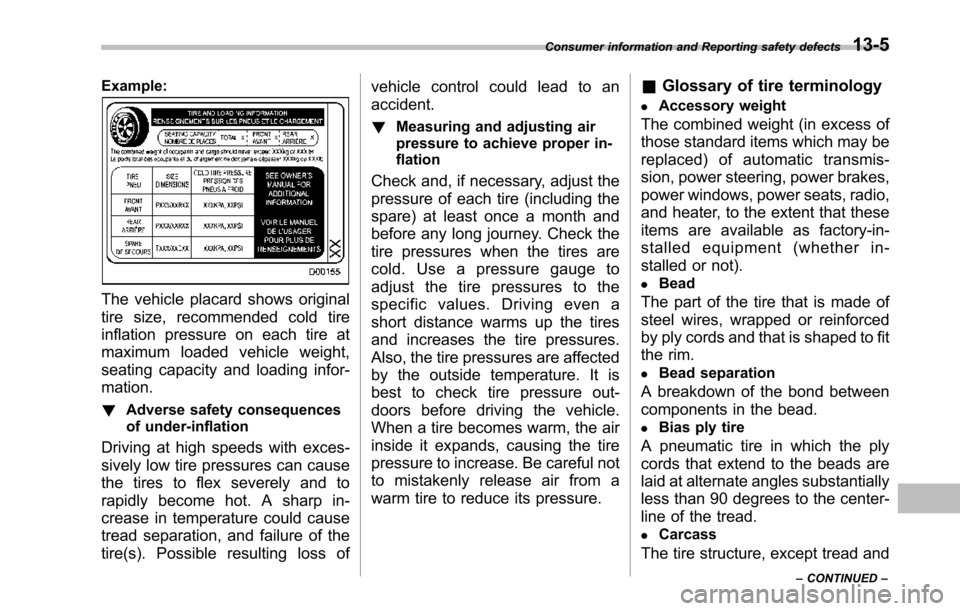
Example:
The vehicle placard shows original
tire size, recommended cold tire
inflation pressure on each tire at
maximum loaded vehicle weight,
seating capacity and loading infor-
mation.
!Adverse safety consequences
of under-inflation
Driving at high speeds with exces-
sively low tire pressures can cause
the tires to flex severely and to
rapidly become hot. A sharp in-
crease in temperature could cause
tread separation, and failure of the
tire(s). Possible resulting loss of
vehicle control could lead to an
accident.
!Measuring and adjusting air
pressure to achieve proper in-
flation
Check and, if necessary, adjust the
pressure of each tire (including the
spare) at least once a month and
before any long journey. Check the
tire pressures when the tires are
cold. Use a pressure gauge to
adjust the tire pressures to the
specific values. Driving even a
short distance warms up the tires
and increases the tire pressures.
Also, the tire pressures are affected
by the outside temperature. It is
best to check tire pressure out-
doors before driving the vehicle.
When a tire becomes warm, the air
inside it expands, causing the tire
pressure to increase. Be careful not
to mistakenly release air from a
warm tire to reduce its pressure.
&Glossary of tire terminology
.Accessory weight
The combined weight (in excess of
those standard items which may be
replaced) of automatic transmis-
sion, power steering, power brakes,
power windows, power seats, radio,
and heater, to the extent that these
items are available as factory-in-
stalled equipment (whether in-
stalled or not).
.Bead
The part of the tire that is made of
steel wires, wrapped or reinforced
by ply cords and that is shaped to fit
the rim.
.Bead separation
A breakdown of the bond between
components in the bead.
.Bias ply tire
A pneumatic tire in which the ply
cords that extend to the beads are
laid at alternate angles substantially
less than 90 degrees to the center-
line of the tread.
.Carcass
The tire structure, except tread and
Consumer information and Reporting safety defects13-5
–CONTINUED–
Page 400 of 426
.Measuring rim
The rim on which a tire is fitted for
physical dimension requirements.
.Normal occupant weight
150 lbs (68 kg) times the number of
occupants specified in the second
column of Table 1 that is appended
to the end of this section.
.Occupant distribution
Distribution of occupants in a vehi-
cle as specified in the third column
of Table 1 that is appended to the
end of this section.
.Open splice
Any parting at any junction of tread,
sidewall, or innerliner that extends
to cord material.
.Outer diameter
The overall diameter of an inflated
new tire.
.Overall width
The linear distance between the
exteriors of the sidewalls of an
inflated tire, including elevations
due to labeling, decorations, or
protective bands or ribs.
.Passenger car tire
A tire intended for use on passen-
ger cars, multipurpose passenger
vehicles, and trucks, that have a
gross vehicle weight rating (GVWR)
of 10,000 lbs (4,535 kg) or less.
.Ply
A layer of rubber-coated parallel
cords.
.Ply separation
Apartingofrubbercompound
between adjacent plies.
.Pneumatic tire
A mechanical device made of rub-
ber, chemicals, fabric and steel or
other materials, that, when
mounted on an automotive wheel,
provides the traction and contains
the gas or fluid that sustains the
load.
.Production options weight
The combined weight of those
installed regular production options
weighing over 5.1 lbs (2.3 kg) in
excess of those standard items
which they replace, not previously
considered in curb weight or acces-
sory weight, including heavy duty
brakes, ride levelers, roof rack,
heavy duty battery, and special
trim.
.Radial ply tire
A pneumatic tire in which the ply
cords that extend to the beads are
laid at substantially 90 degrees to
the centerline of the tread.
.Recommended inflation pres-
sure
The cold inflation pressure recom-
mended by a vehicle manufacturer.
.Reinforced tire
A tire designed to operate at higher
loads and at higher inflation pres-
sures than the corresponding stan-
dard tire.
.Rim
A metal support for a tire or a tire
and tube assembly upon which the
tire beads are seated.
.Rim diameter
Nominal diameter of the bead seat.
.Rim size designation
Rim diameter and width.
Consumer information and Reporting safety defects13-7
–CONTINUED–
Page 406 of 426
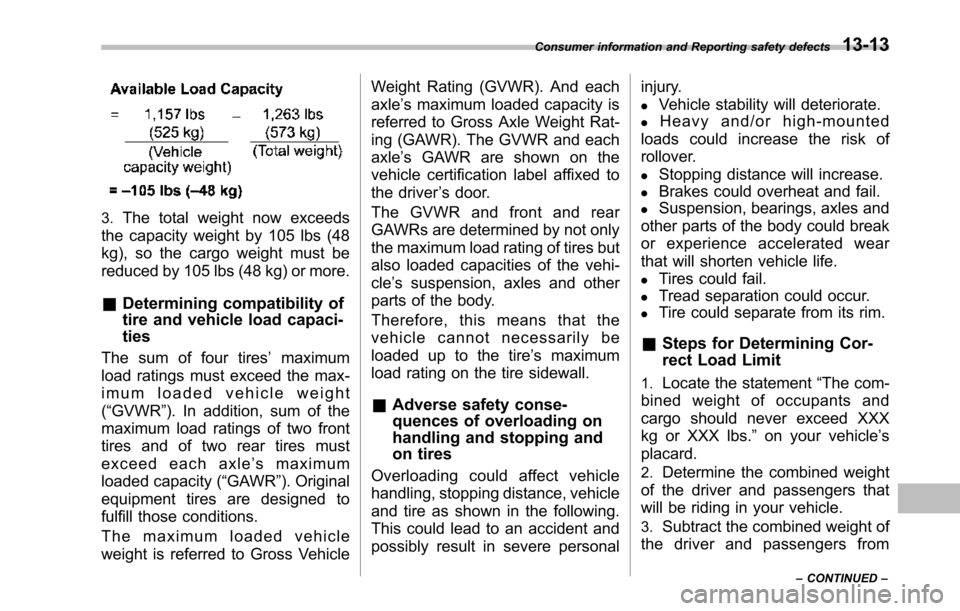
3.The total weight now exceeds
the capacity weight by 105 lbs (48
kg), so the cargo weight must be
reduced by 105 lbs (48 kg) or more.
&Determining compatibility of
tire and vehicle load capaci-
ties
The sum of four tires’maximum
load ratings must exceed the max-
imum loaded vehicle weight
(“GVWR”). In addition, sum of the
maximum load ratings of two front
tires and of two rear tires must
exceed each axle’smaximum
loaded capacity (“GAWR”). Original
equipment tires are designed to
fulfill those conditions.
The maximum loaded vehicle
weight is referred to Gross Vehicle
Weight Rating (GVWR). And each
axle’s maximum loaded capacity is
referred to Gross Axle Weight Rat-
ing (GAWR). The GVWR and each
axle’s GAWR are shown on the
vehicle certification label affixed to
the driver’s door.
The GVWR and front and rear
GAWRs are determined by not only
the maximum load rating of tires but
also loaded capacities of the vehi-
cle’s suspension, axles and other
parts of the body.
Therefore, this means that the
vehicle cannot necessarily be
loaded up to the tire’s maximum
load rating on the tire sidewall.
&Adverse safety conse-
quences of overloading on
handling and stopping and
on tires
Overloading could affect vehicle
handling, stopping distance, vehicle
and tire as shown in the following.
This could lead to an accident and
possibly result in severe personal
injury.
.Vehicle stability will deteriorate.
.Heavy and/or high-mounted
loads could increase the risk of
rollover.
.Stopping distance will increase.
.Brakes could overheat and fail.
.Suspension, bearings, axles and
other parts of the body could break
or experience accelerated wear
that will shorten vehicle life.
.Tires could fail.
.Tread separation could occur.
.Tire could separate from its rim.
&Steps for Determining Cor-
rect Load Limit
1.Locate the statement“The com-
bined weight of occupants and
cargo should never exceed XXX
kg or XXX lbs.”on your vehicle’s
placard.
2.Determine the combined weight
of the driver and passengers that
will be riding in your vehicle.
3.Subtract the combined weight of
the driver and passengers from
Consumer information and Reporting safety defects13-13
–CONTINUED–
Page 411 of 426
14-2Index
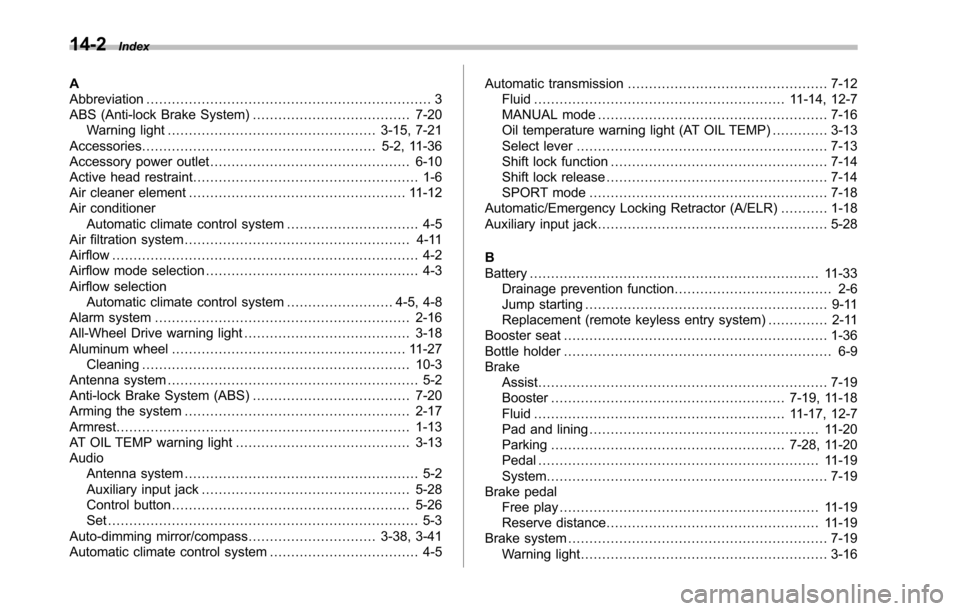
AAbbreviation................................................................... 3ABS (Anti-lock Brake System)..................................... 7-20Warning light................................................. 3-15, 7-21Accessories....................................................... 5-2, 11-36Accessory power outlet............................................... 6-10Active head restraint..................................................... 1-6Air cleaner element................................................... 11-12Air conditionerAutomatic climate control system............................... 4-5Air filtration system..................................................... 4-11Airflow........................................................................ 4-2Airflow mode selection.................................................. 4-3Airflow selectionAutomatic climate control system......................... 4-5, 4-8Alarm system............................................................ 2-16All-Wheel Drive warning light....................................... 3-18Aluminum wheel....................................................... 11-27Cleaning............................................................... 10-3Antenna system........................................................... 5-2Anti-lock Brake System (ABS)..................................... 7-20Arming the system..................................................... 2-17Armrest..................................................................... 1-13AT OIL TEMP warning light......................................... 3-13AudioAntenna system....................................................... 5-2Auxiliary input jack................................................. 5-28Control button........................................................ 5-26Set ......................................................................... 5-3Auto-dimming mirror/compass.............................. 3-38, 3-41Automatic climate control system................................... 4-5
Automatic transmission............................................... 7-12Fluid........................................................... 11-14, 12-7MANUAL mode...................................................... 7-16Oil temperature warning light (AT OIL TEMP)............. 3-13Select lever........................................................... 7-13Shift lock function................................................... 7-14Shift lock release.................................................... 7-14SPORT mode........................................................ 7-18Automatic/Emergency Locking Retractor (A/ELR)........... 1-18Auxiliary input jack...................................................... 5-28
BBattery.................................................................... 11-33Drainage prevention function..................................... 2-6Jump starting......................................................... 9-11Replacement (remote keyless entry system).............. 2-11Booster seat.............................................................. 1-36Bottle holder............................................................... 6-9BrakeAssist.................................................................... 7-19Booster....................................................... 7-19, 11-18Fluid........................................................... 11-17, 12-7Pad and lining...................................................... 11-20Parking....................................................... 7-28, 11-20Pedal.................................................................. 11-19System.................................................................. 7-19Brake pedalFree play............................................................. 11-19Reserve distance.................................................. 11-19Brake system............................................................. 7-19Warning light.......................................................... 3-16
Page 412 of 426
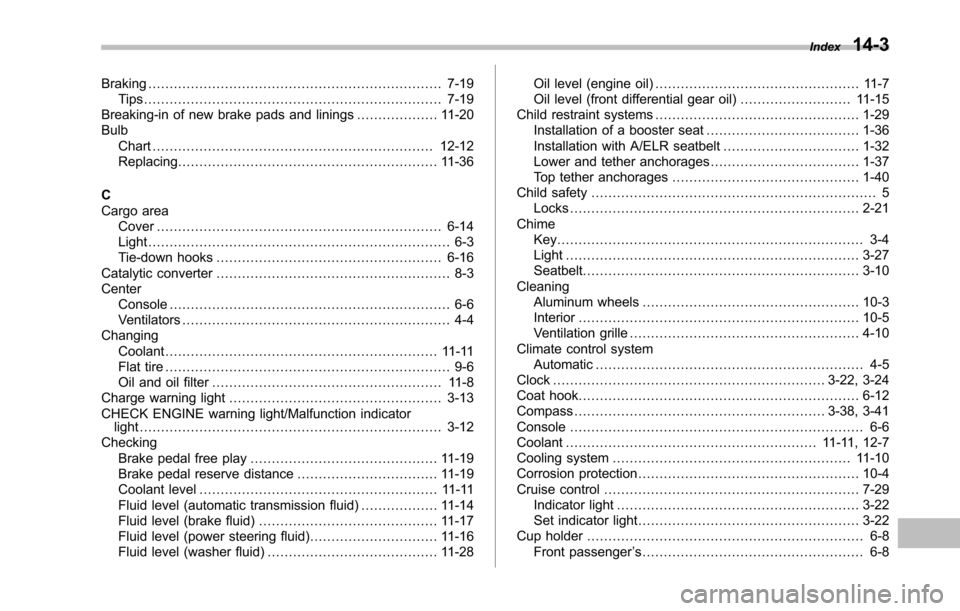
Braking..................................................................... 7-19Tips . . . . . . . . . . . . . . . . . . . . . . . . . . . . . . . . . . . . . . . . . . . . . . . . . . . . . . . . . . . . . . . . . . . . . . 7-19Breaking-in of new brake pads and linings................... 11-20BulbChart.................................................................. 12-12Replacing............................................................. 11-36
CCargo areaCover................................................................... 6-14Light....................................................................... 6-3Tie-down hooks..................................................... 6-16Catalytic converter....................................................... 8-3CenterConsole.................................................................. 6-6Ventilators............................................................... 4-4ChangingCoolant................................................................ 11-11Flat tire................................................................... 9-6Oil andoil filter...................................................... 11-8Charge warning light.................................................. 3-13CHECKENGINE warning light/Malfunction indicatorlight....................................................................... 3-12CheckingBrake pedal free play............................................ 11-19Brake pedal reserve distance................................. 11-19Coolant level........................................................ 11-11Fluid level (automatic transmission fluid).................. 11-14Fluid level (brake fluid).......................................... 11-17Fluidlevel (power steering fluid).............................. 11-16Fluid level (washer fluid)........................................ 11-28
Oil level (engine oil)................................................ 11-7Oil level (front differential gear oil).......................... 11-15Child restraint systems................................................ 1-29Installation of a booster seat.................................... 1-36Installation with A/ELR seatbelt ................................ 1-32Lower and tether anchorages................................... 1-37Top tether anchorages............................................ 1-40Child safety................................................................... 5Locks.................................................................... 2-21ChimeKey........................................................................ 3-4Light..................................................................... 3-27Seatbelt................................................................. 3-10CleaningAluminum wheels................................................... 10-3Interior.................................................................. 10-5Ventilation grille...................................................... 4-10Climate control systemAutomatic............................................................... 4-5Clock................................................................ 3-22, 3-24Coat hook.................................................................. 6-12Compass........................................................... 3-38, 3-41Console..................................................................... 6-6Coolant........................................................... 11-11, 12-7Cooling system........................................................ 11-10Corrosionprotection.................................................... 10-4Cruise control............................................................ 7-29Indicator light......................................................... 3-22Set indicator light.................................................... 3-22Cup holder................................................................. 6-8Front passenger’s.................................................... 6-8
Index14-3
Page 413 of 426
14-4Index
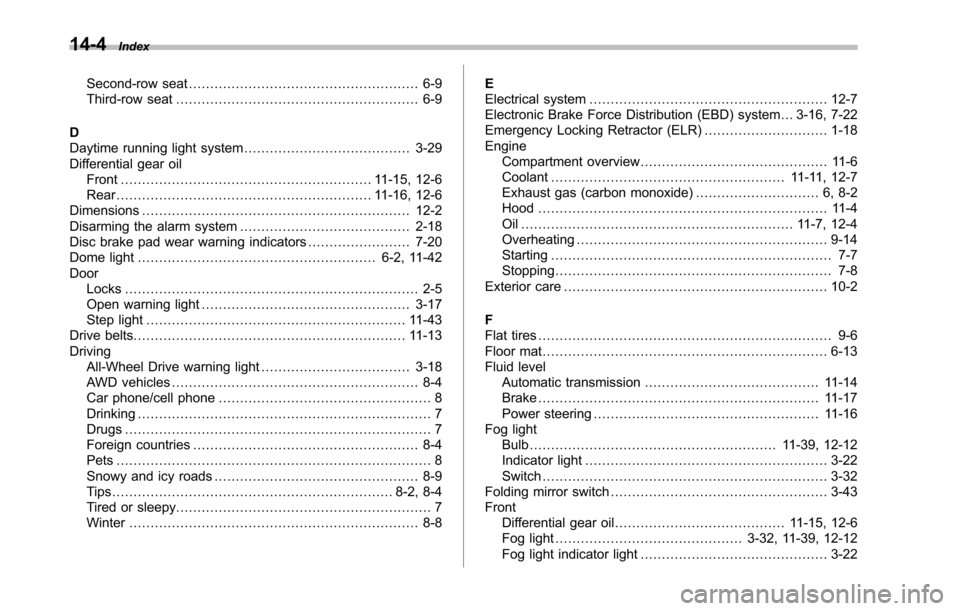
Second-row seat...................................................... 6-9Third-row seat......................................................... 6-9
DDaytime running light system....................................... 3-29Differential gear oilFront........................................................... 11-15, 12-6Rear............................................................ 11-16, 12-6Dimensions............................................................... 12-2Disarming the alarm system........................................ 2-18Disc brake pad wear warning indicators........................ 7-20Dome light........................................................ 6-2, 11-42DoorLocks..................................................................... 2-5Open warning light................................................. 3-17Step light............................................................. 11-43Drive belts................................................................ 11-13DrivingAll-Wheel Drive warning light................................... 3-18AWD vehicles.......................................................... 8-4Car phone/cell phone.................................................. 8Drinking..................................................................... 7Drugs........................................................................ 7Foreign countries..................................................... 8-4Pets.......................................................................... 8Snowy and icy roads................................................ 8-9Tips . . . . . . . . . . . . . . . . . . . . . . . . . . . . . . . . . . . . . . . . . . . . . . . . . . . . . . . . . . . . . . . . . . 8-2, 8-4Tired or sleepy............................................................ 7Winter.................................................................... 8-8
EElectrical system........................................................ 12-7Electronic Brake Force Distribution (EBD) system... 3-16, 7-22Emergency Locking Retractor (ELR)............................. 1-18EngineCompartment overview............................................ 11-6Coolant....................................................... 11-11, 12-7Exhaust gas (carbon monoxide)............................. 6, 8-2Hood.................................................................... 11-4Oil ................................................................ 11-7, 12-4Overheating........................................................... 9-14Starting.................................................................. 7-7Stopping................................................................. 7-8Exterior care.............................................................. 10-2
FFlat tires..................................................................... 9-6Floor mat................................................................... 6-13Fluid levelAutomatic transmission......................................... 11-14Brake.................................................................. 11-17Power steering..................................................... 11-16Fog lightBulb.......................................................... 11-39, 12-12Indicator light......................................................... 3-22Switch................................................................... 3-32Folding mirror switch................................................... 3-43FrontDifferential gear oil........................................ 11-15, 12-6Fog light............................................ 3-32, 11-39, 12-12Fog light indicator light............................................ 3-22