2014 SUBARU TRIBECA brake
[x] Cancel search: brakePage 313 of 426
9-6In case of emergency
CAUTION
Never use any temporary spare tireother than the original. Using othersizes may result in severe mechan-ical damage to the drive train of yourvehicle.
The temporary spare tire is smaller andlighter than a conventional tire and isdesigned for emergency use only. Re-move thetemporary spare tire and re-install the conventional tire as soon aspossible because the spare tire is de-signed only for temporary use.
Check the inflation pressure of the tem-porary spare tire periodically to keep thetire ready for use. The correct pressure is60 psi (420 kPa, 4.2 kgf/cm2).
When using the temporary spare tire, notethe following.
.Do not exceed 50 mph (80 km/h).
.Do not put a tire chain on the temporaryspare tire.Because of the smaller tire size,a tire chain will not fit properly.
.Do not use two or more temporaryspare tires at the same time.
.Do not drive over obstacles. This tirehas a smaller diameter, so road clearanceis reduced.
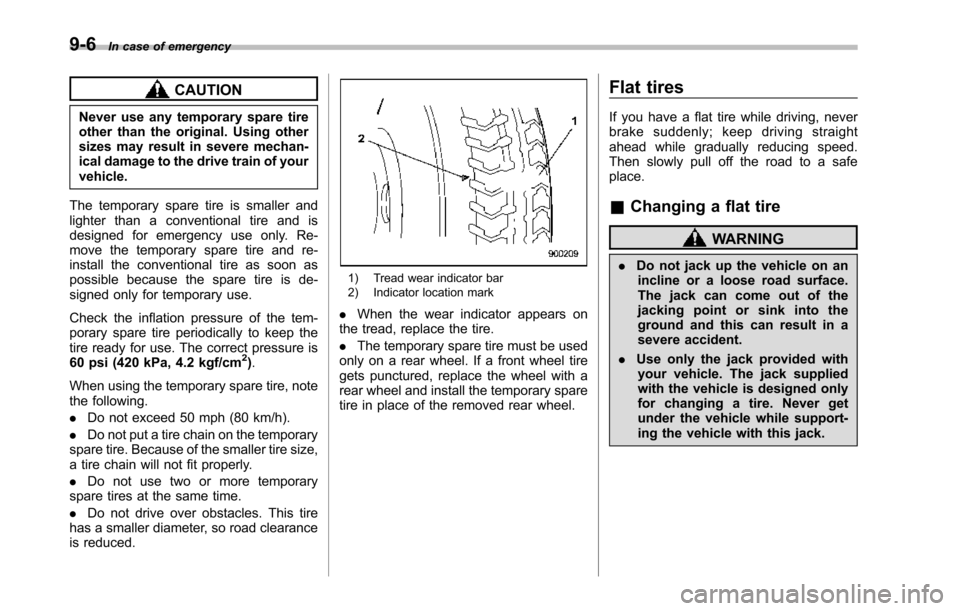
1) Tread wear indicator bar2) Indicator location mark
.When the wear indicator appears onthe tread, replace the tire.
.The temporary spare tire must be usedonly on a rear wheel. If a front wheel tiregets punctured, replace the wheel with arear wheel and install the temporary sparetire in place of the removed rear wheel.
Flat tires
If you have a flat tire while driving, neverbrake suddenly; keep driving straightahead while gradually reducing speed.Then slowly pull off the road to a safeplace.
&Changing a flat tire
WARNING
.Do not jack up the vehicle on anincline or a loose road surface.The jack can come out of thejacking point or sink into theground and this can result in asevere accident.
.Use only the jack provided withyour vehicle. The jack suppliedwith the vehicle is designed onlyfor changing a tire. Never getunder the vehicle while support-ing the vehicle with this jack.
Page 314 of 426
.Always turn off the engine beforeraising the flat tire off the groundusing the jack. Never swing orpush the vehicle supported withthe jack. The jack can come outof the jacking point due to a joltand this can result in a severeaccident.
1. Park on a hard, level surface, when-ever possible, then stop the engine.
2. Set the parking brake securely andshift in the“P”(Park) position.
3. Turn on the hazard warning flasherandhave everyone get out of the vehicle.
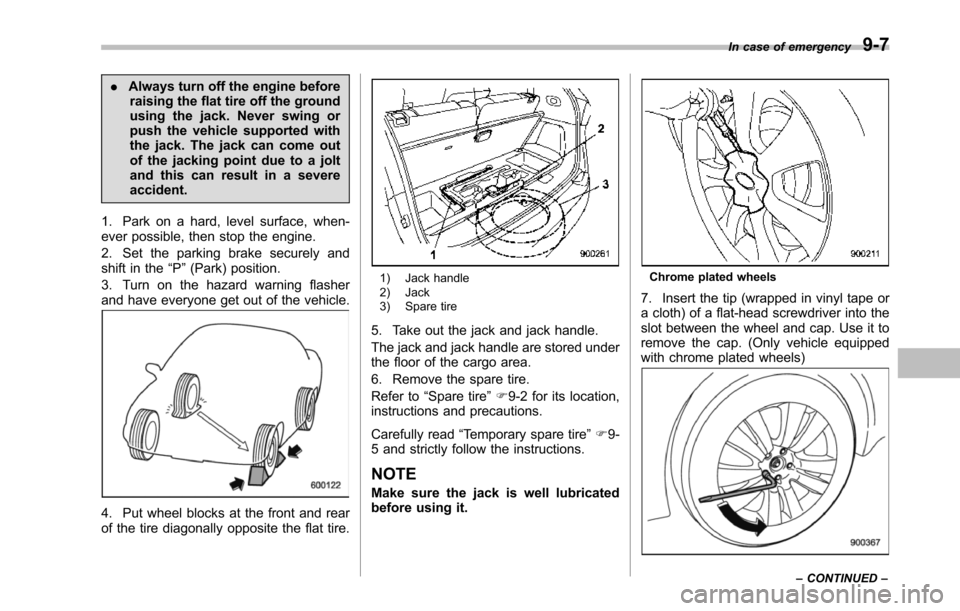
4. Put wheel blocks at the front and rearof the tire diagonally opposite the flat tire.
1) Jack handle2) Jack3) Spare tire
5. Take out the jack and jack handle.
The jack and jack handle are stored underthe floor of the cargo area.
6. Remove the spare tire.
Refer to“Spare tire”F9-2 for its location,instructions andprecautions.
Carefully read“Temporary spare tire”F9-5 and strictly follow the instructions.
NOTE
Make sure the jack is well lubricatedbefore using it.
Chrome plated wheels
7. Insert the tip (wrapped in vinyl tape ora cloth) of a flat-head screwdriver into theslot between the wheel and cap. Use it toremove the cap. (Only vehicle equippedwith chrome plated wheels)
In case of emergency9-7
–CONTINUED–
Page 317 of 426

9-10In case of emergency
holder.
Refer to“Spare tire”F9-2 for its location,instructions and precautions.
CAUTION
.When stowing a flat tire in thespare tire holder, turn the hoistshaft end only slowly. If it isturned quickly, the wheel disc ofthe flat tire could be damaged.
.Afull-sizeflattireshouldbestowed in the spare tire holderin an emergency only. After hav-ing the flat tire repaired, immedi-ately swap it with the temporaryspare tire.
.Remember that the tread width ofa flat tire is wider than that of thetemporary spare tire. When car-rying a flat tire stowed in thespare tire holder, make sure thetire does not touch any obsta-cles.
WARNING
Never place a tire or tire changingtools in the passenger compartmentafter changing wheels. In a suddenstop or collisions, loose equipment
could strike occupants and causeinjury. Store the tire and all tools inthe proper place.
&Tire pressure monitoring
system (TPMS)
The tire pressure monitoring system pro-vides the driver with the warning messageindicated by sending a signal from asensor that is installed in each wheelwhen tire pressure is severely low.
The tire pressure monitoring system willactivate only when the vehicle is driven.Also, this system may not react immedi-ately to a sudden drop in tire pressure (forexample, a blow-out caused running overa sharp object).
WARNING
If the low tire pressure warning lightilluminates while driving, neverbrake suddenly and keep drivingstraight ahead while gradually redu-cing speed. Then slowly pull off theroad to a safe place. Otherwise anaccident involving serious vehicledamageand serious personal injurycould occur.
Check the pressure for all four tiresand adjust the pressure to the COLDtire pressure shown on the vehicleplacard on the door pillar on thedriver’s side. If this light still illumi-nates while driving after adjustingthe tire pressure, a tire may havesignificant damage and a fast leakthat causes the tire to lose airrapidly. If you have a flat tire, replaceit with a spare tire as soon aspossible.
When a spare tire is mounted or awheel rim is replaced without theoriginal pressure sensor/transmitterbeing transferred, the low tire pres-sure warning light will illuminatesteadily afterblinking for approxi-mately one minute. This indicatesthe TPMS is unable to monitor allfour road wheels. Contact your
Page 324 of 426
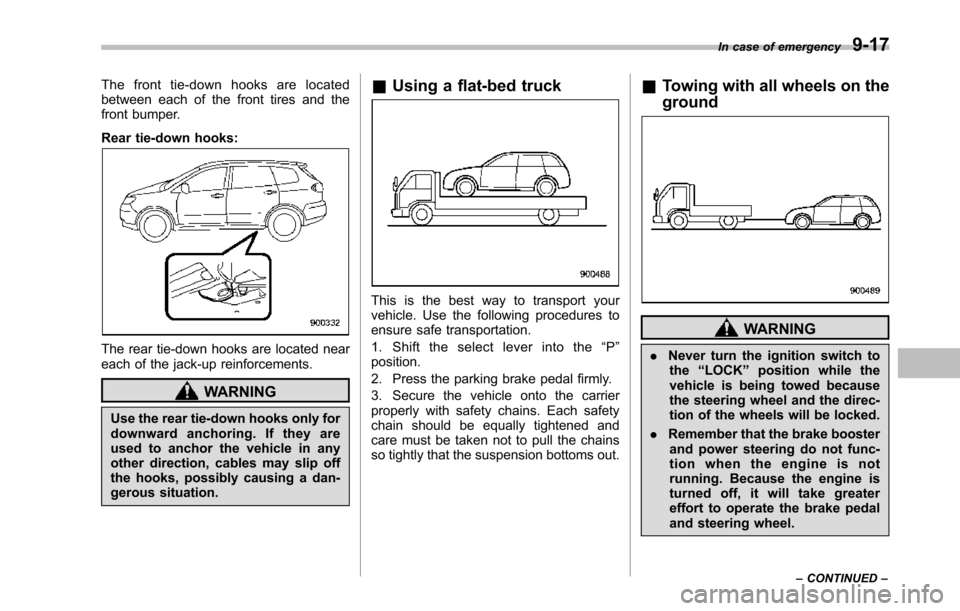
The front tie-down hooks are locatedbetween each of the front tires and thefront bumper.
Rear tie-down hooks:
The rear tie-down hooks are located neareach of the jack-up reinforcements.
WARNING
Use the rear tie-down hooks only fordownward anchoring. If they areused to anchor the vehicle in anyother direction, cables may slip offthe hooks,possibly causing a dan-gerous situation.
&Using a flat-bed truck
This is the best way to transport yourvehicle. Use the following procedures toensure safe transportation.
1. Shift the select lever into the“P”position.
2. Press the parking brake pedal firmly.
3. Secure the vehicle onto the carrierproperly with safety chains. Each safetychain should be equally tightened andcare must be taken not to pull the chainsso tightly that the suspension bottoms out.
&Towing with all wheels on the
ground
WARNING
.Never turn the ignition switch tothe“LOCK”position while thevehicle is being towed becausethe steeringwheel and the direc-tion of the wheels will be locked.
.Remember that the brake boosterand power steering do not func-tion when the engine is notrunning. Because the engine isturned off, it will take greatereffort to operate the brake pedaland steering wheel.
In case of emergency9-17
–CONTINUED–
Page 325 of 426
9-18In case of emergency
CAUTION
.If transmission failure occurs,transport your vehicle on a flat-bed truck.
.Do not run the engine while beingtowed using this method. Trans-mission damage could result ifthe vehicle is towed with theengine running.
.The traveling speed must belimited to less than 20 mph (30km/h) and the traveling distanceto less than 31 miles (50 km). Forgreater speeds and distances,transport your vehicle on a flat-bed truck.
1. Release the parking brake and put thetransmission in neutral.
2. The ignition switch should be in the“Acc”position whilethe vehicle is beingtowed.
3. Take up slack in the towline slowly toprevent damage to the vehicle.
Rear gate–if the rear gate
cannot be unlocked
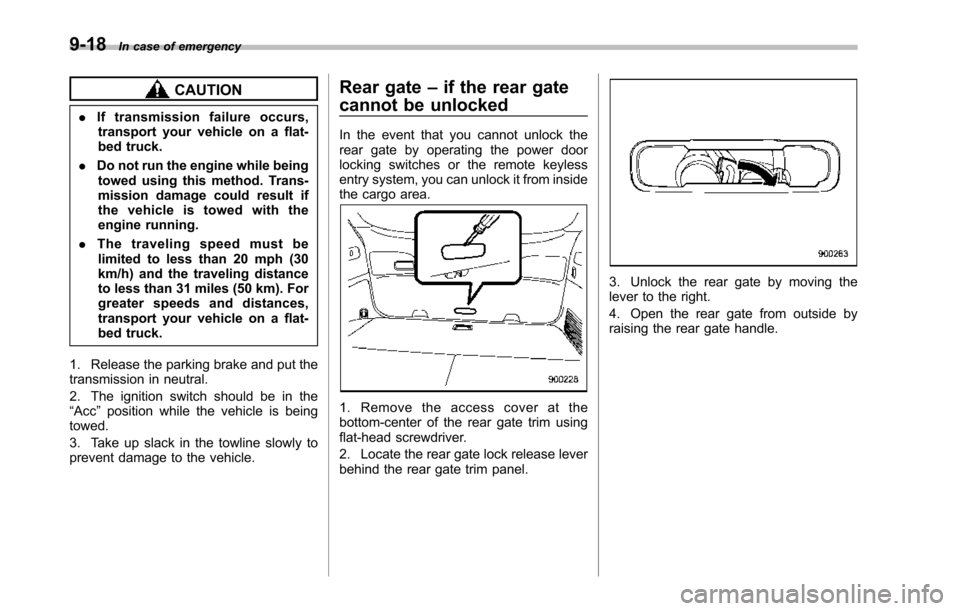
In the event that you cannot unlock therear gate by operating the power doorlocking switches or the remote keylessentry system, you can unlock it from insidethe cargo area.
1. Remove the access cover at thebottom-center of the rear gate trim usingflat-head screwdriver.
2. Locate the rear gate lock release leverbehind the reargate trim panel.
3. Unlock the rear gate by moving thelever to the right.
4. Open the rear gate from outside byraisingthe rear gate handle.
Page 329 of 426

10-2Appearance care
Exterior care
&Washing
CAUTION
.When washing the vehicle, thebrakes may get wet. As a result,the brake stopping distance willbe longer. To dry the brakes,drive the vehicle at a safe speedwhile lightly pressing the brakepedal to heat up the brakes.
.Do not wash the engine compart-ment and areas adjacent to it. Ifwater enters the engine air in-take, electrical parts or the powersteering fluid reservoir, it willcause engine trouble or a mal-functionof the power steering.
.Do not use any organic solventswhen washing the surface of thebulb assembly cover. However, ifa detergent with organic solventsis used to wash the cover sur-face, completely rinse off thedetergent with water. Otherwise,the cover surface may be da-maged.
.Since your vehicle is equippedwith a rear wiper, automatic car-wash brushes could become
tangled around it, damaging thewiper arm and other compo-nents. Ask the automatic car-wash operator not to let thebrushes touch the wiper arm orto fix the wiper arm on the rearwindow glass with adhesive tapebefore operating the machine.
NOTE
When having your vehicle washed inan automatic car wash, make surebeforehand that the car wash is ofsuitable type.
The best way to preserve your vehicle’sbeauty is frequent washing. Wash thevehicleat least once a month to avoidcontamination by road grime.
Wash dirt off with a wet sponge and plentyof lukewarm or cold water. Do not washthe vehicle with hot water and in directsunlight.
Salt, chemicals, insects, tar, soot, treesap, and bird droppings should be washedoff by using a light detergent, as required.If you use a light detergent, make certainthat it is a neutral detergent. Do not usestrong soap or chemical detergents. Allcleaning agents should be promptlyflushed from the surface and not allowed
to dry there. Rinse the vehicle thoroughlywith plenty of lukewarm water. Wipe theremaining water off with a chamois or softcloth.
!Washing the underbody
Chemicals, salts and gravel used fordeicing road surfaces are extremely cor-rosive, accelerating the corrosion of un-derbody components, such as the exhaustsystem, fuel and brake lines, brakecables, floor pan and fenders, and sus-pension.
Thoroughly flush the underbody and in-side of the fenders with lukewarm or coldwater at frequent intervals to reduce theharmful effects of such agents.
Mud and sand adhering to the underbodycomponents may accelerate their corro-sion.
Afterdriving off-road or muddy or sandyroads, wash the mud and sand off theunderbody.
Carefully flushthe suspension and axleparts, as they are particularly prone tomud and sand buildup. Do not use asharp-edged tool to remove caked mud.
NOTE
Be careful not to damage brake hoses,sensor harnesses, and other partswhen washing suspension compo-
Page 331 of 426
10-4Appearance care
Corrosion protection
Your SUBARU has been designed andbuilt to resist corrosion. Special materialsand protective finishes have been used onmost parts of the vehicle to help maintainfine appearance, strength, and reliableoperation.
&Most common causes of
corrosion
The most common causes of corrosionare:
1. The accumulation of moisture retain-ing dirt and debris in body panel sections,cavities,and other areas.
2. Damage to paint and other protectivecoatings caused by gravel and stonechips or minor accidents.
Corrosion is accelerated on the vehiclewhen:
1. It is exposed to road salt or dustcontrol chemicals, or used in coastalareas where there is more salt in the air,or in areas where there is considerableindustrial pollution.
2. It is driven in areas of high humidity,especially when temperatures range justabove freezing.
3. Dampness in certain parts of thevehicle remainsfor a long time, even
though other parts of the vehicle may bedry.
4. High temperatures will cause corro-sion to parts of the vehicle which cannotdry quickly due to lack of proper ventila-tion.
&To help prevent corrosion
Wash the vehicle regularly to preventcorrosion of the body and suspensioncomponents. Also, wash the vehiclepromptly after driving on any of thefollowing surfaces.
.roads that have been salted to preventthem from freezing in winter
.mud, sand, or gravel
.coastal roads
After the winter has ended, it is recom-mended that the underbody be given avery thorough washing.
Before the beginning of winter, check thecondition of underbody components, suchas the exhaust system, fuel and brakelines, brake cables, suspension, steeringsystem, floor pan, and fenders. If any ofthem are found to be rusted, they shouldbe given an appropriate rust preventiontreatment or should be replaced. Contactyour SUBARU dealer to perform this kindof maintenance and treatment if you need
assistance.
Repair chips and scratches in the paint assoon as you find them.
Check the interior of the vehicle for waterand dirt accumulation under the floor matsbecause that could cause corrosion.Occasionally check under the mats tomake sure the area is dry.
Keep your garage dry. Do not park yourvehicle in a damp, poorly ventilatedgarage. In such a garage, corrosion canbe caused by dampness. If you wash thevehicle in the garage or put the vehicleinto the garage when wet or covered withsnow, that can cause dampness.
If your vehicle is operated in cold weatherand/or in areas where road salts and othercorrosive materials are used, the doorhinges and locks, and hood latch shouldbe inspected and lubricated periodically.
Page 334 of 426

Maintenance schedule....................................... 11-3
Maintenance precautions................................... 11-3Before checking or servicing in the enginecompartment.................................................... 11-4When you do checking or servicing in the enginecompartment while the engine is running.......... 11-4
Engine hood....................................................... 11-4
Engine compartment overview.......................... 11-6
Engine oil............................................................ 11-7Checking the oil level......................................... 11-7Changing the oil and oil filter.............................. 11-8Recommendedgrade and viscosity.................... 11-9Synthetic oil....................................................... 11-9
Cooling system................................................ 11-10Hose and connections...................................... 11-10Engine coolant................................................. 11-11
Air cleaner element.......................................... 11-12Replacing the air cleaner element..................... 11-12
Spark plugs...................................................... 11-13Recommended spark plugs.............................. 11-13
Drive belts........................................................ 11-13
Automatic transmission fluid.......................... 11-14Checking the fluid level.................................... 11-14Recommended fluid......................................... 11-15
Front differential gear oil................................. 11-15Checking the oil level....................................... 11-15Recommended grade and viscosity.................. 11-16
Rear differential gear oil.................................. 11-16Recommended grade and viscosity.................. 11-16
Power steering fluid........................................ 11-16Checking the fluid level.................................... 11-16Recommended fluid......................................... 11-17
Brake fluid........................................................ 11-17Checking the fluid level.................................... 11-17Recommended brake fluid............................... 11-18
Brakebooster.................................................. 11-18
Brake pedal...................................................... 11-19Checking the brake pedal free play.................. 11-19Checking the brake pedal reserve distance....... 11-19
Replacement of brake pad and lining............ 11-19Breaking-in of new brake pads and linings....... 11-20
Parking brake stroke....................................... 11-20
Tires and wheels.............................................. 11-21Types of tires................................................... 11-21Tire pressure monitoring system (TPMS).......... 11-21Tire inspection................................................. 11-22Tire pressuresand wear.................................. 11-23Wheel balance................................................. 11-25Wear indicators............................................... 11-25Tire rotation direction mark.............................. 11-25Tire rotation..................................................... 11-26Tire replacement.............................................. 11-26Wheel replacement.......................................... 11-27
Aluminum wheels............................................ 11-27
Windshield washer fluid.................................. 11-28
Replacement of wiper blades......................... 11-29Windshield wiper blade assembly..................... 11-30Windshield wiper blade rubber ......................... 11-30Rear window wiper blade assembly.................. 11-31
Maintenance and service
11