11-22Maintenance and service
not be functioning normally. In this event,go to a SUBARU dealer to have thesystem inspected as soon as possible.
While the vehicle is driven, friction be-tween tires and the road surface causesthe tires to warm up. After illumination ofthe low tire pressure warning light, anyincrease in the tire pressures caused byan increase in the outside air temperatureor by an increase in the temperature in thetires can cause the low tire pressurewarning light to turn off.
System resetting is necessary when thewheels are changed (for example, aswitch to snow tires) and new TPMSvalves are installed on the newly fittedwheels. Have this work performed by aSUBARU dealer following wheel replace-ment.
It may not be possible to install TPMSvalves on certain wheels that are on themarket. Therefore, if you change thewheels (for example, a switch to snowtires), use wheels that have the same partnumber as the standard-equipmentwheels. Without four operational TPMSvalve/sensors on the wheels, the TPMSwill not fully function and the warning lightin the instrument panel will illuminatesteadily after blinking for approximatelyone minute.
When a tire is replaced, adjustments arenecessary to ensure continued normaloperation of the tire pressure monitoringsystem. As with wheel replacement, there-fore, you should have the work performedby a SUBARU dealer.
WARNING
If the low tire pressure warning lightdoes not illuminate briefly after theignition switch is turned ON or thelight illuminates steadily after blink-ing for approximately one minute,you shouldhave your Tire PressureMonitoring System checked at aSUBARU dealer as soon as possi-ble.
If this light illuminates while driving,never brake suddenly and keepdriving straight ahead while gradu-ally reducing speed. Then slowlypull off the road to a safe place.Otherwise an accident involvingserious vehicle damage and seriouspersonal injury could occur.
If this light still illuminates whiledriving after adjusting the tire pres-sure, a tire may have significantdamage and a fast leak that causesthe tire to lose air rapidly. If you havea flat tire, replace it with a spare tire
as soon as possible.
When a spare tire is mounted or awheel rim is replaced without theoriginal pressure sensor/transmitterbeing transferred, the low tire pres-sure warning light will illuminatesteadily after blinking for approxi-mately one minute. This indicatesthe TPMS is unable to monitor allfour road wheels. Contact yourSUBARU dealer as soon as possiblefor tire and sensor replacement and/or system resetting. If the lightilluminates steadily after blinkingfor approximately one minute,promptly contact a SUBARU dealerto have the system inspected.
&Tire inspection
Checkon a daily basis that the tires arefree from serious damage, nails, andstones. At the same time, check the tiresfor abnormal wear.
Contact your SUBARU dealer immedi-ately if you find any problem.
NOTE
.When the wheels and tires strikecurbs or are subjected to harsh treat-ment as when the vehicle is driven on arough surface, they can suffer damage
11-26Maintenance and service
the direction mark facing forward.
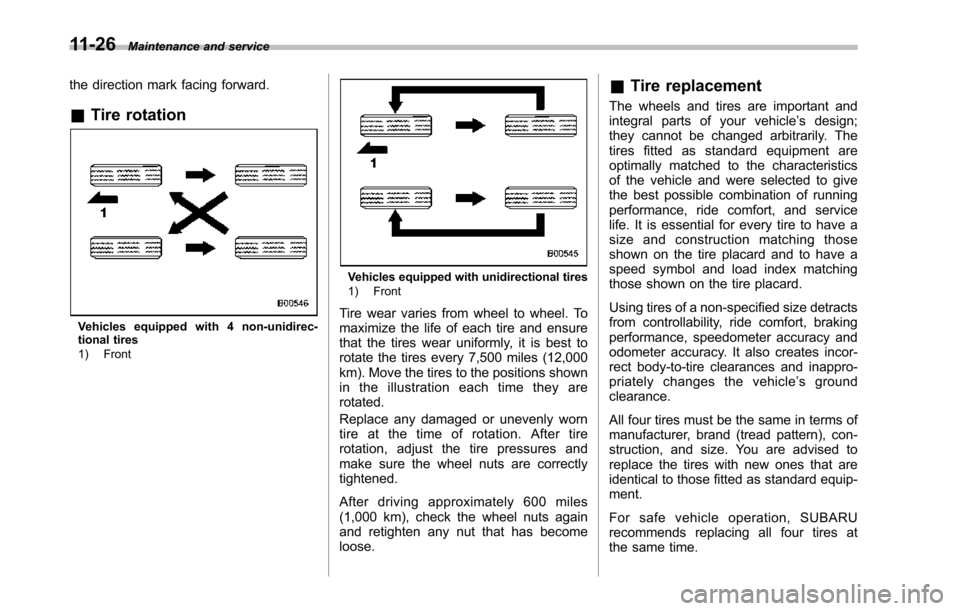
&Tire rotation
Vehicles equipped with 4 non-unidirec-tional tires1) Front
Vehicles equipped with unidirectional tires1) Front
Tire wear varies from wheel to wheel. Tomaximize the life of each tire and ensurethat the tires wear uniformly, it is best torotate the tires every 7,500 miles (12,000km). Move the tires to the positions shownin the illustration each time they arerotated.
Replace any damaged or unevenly worntire at the time of rotation. After tirerotation, adjust the tire pressures andmake sure the wheel nuts are correctlytightened.
After driving approximately 600 miles(1,000 km), check the wheel nuts againand retighten any nut that has becomeloose.
&Tire replacement
The wheels and tires are important andintegral parts of your vehicle’s design;they cannot be changed arbitrarily. Thetires fitted as standard equipment areoptimally matched to the characteristicsof the vehicle and were selected to givethe best possible combination of runningperformance, ride comfort, and servicelife. It is essential for every tire to have asize and construction matching thoseshown on the tire placard and to have aspeed symbol and load index matchingthose shown on the tire placard.
Usingtires of a non-specified size detractsfrom controllability, ride comfort, brakingperformance, speedometer accuracy andodometer accuracy. It also creates incor-rect body-to-tire clearances and inappro-priately changes the vehicle’sgroundclearance.
All four tires must be the same in terms ofmanufacturer, brand (tread pattern), con-struction, and size. You are advised toreplace the tires with new ones that areidentical to those fitted as standard equip-ment.
For safe vehicle operation, SUBARUrecommends replacing all four tires atthe same time.