2014 PEUGEOT 3008 warning
[x] Cancel search: warningPage 150 of 389
Safety
148
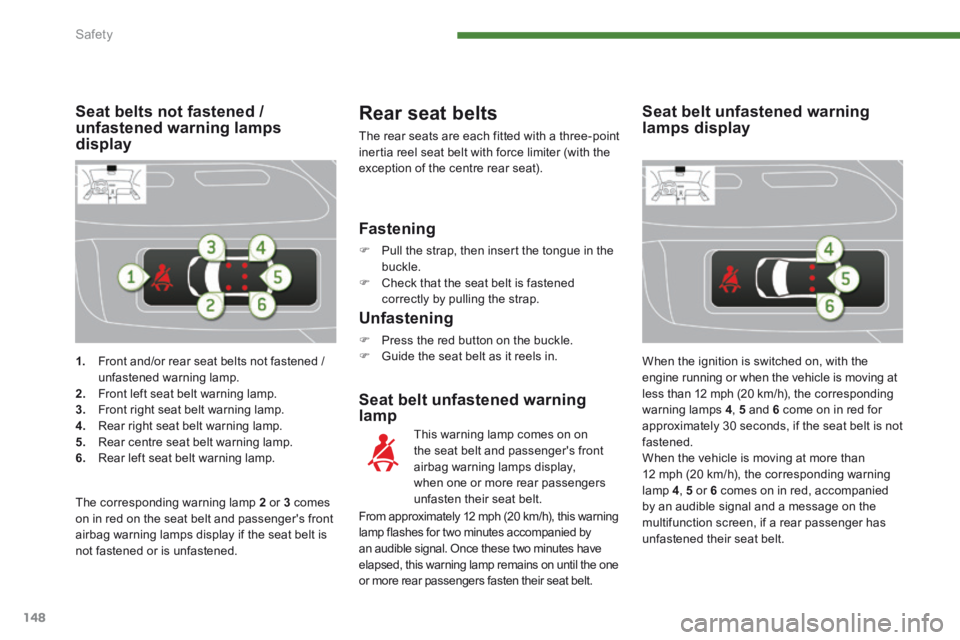
1. Front and/or rear seat belts not fastened / unfastened warning lamp. 2. Front left seat belt warning lamp. 3. Front right seat belt warning lamp. 4. Rear right seat belt warning lamp. 5. Rear centre seat belt warning lamp. 6. Rear left seat belt warning lamp.
Seat belts not fastened / unfastened warning lamps display
Rear seat belts
The rear seats are each fitted with a three-point inertia reel seat belt with force limiter (with the exception of the centre rear seat).
Seat belt unfastened warning lamp
This warning lamp comes on on the seat belt and passenger's front airbag warning lamps display, when one or more rear passengers unfasten their seat belt.
Fastening
Pull the strap, then insert the tongue in the buckle. Check that the seat belt is fastened correctly by pulling the strap.
Unfastening
Press the red button on the buckle. Guide the seat belt as it reels in.
The corresponding warning lamp 2 or 3 comes on in red on the seat belt and passenger's front airbag warning lamps display if the seat belt is not fastened or is unfastened.
When the ignition is switched on, with the engine running or when the vehicle is moving at less than 12 mph (20 km/h), the corresponding warning lamps 4 , 5 and 6 come on in red for approximately 30 seconds, if the seat belt is not fastened. When the vehicle is moving at more than 12 mph (20 km/h), the corresponding warning lamp 4 , 5 or 6 comes on in red, accompanied by an audible signal and a message on the multifunction screen, if a rear passenger has unfastened their seat belt.
Seat belt unfastened warninglamps display
From approximately 12 mph (20 km/h), this warning lamp flashes for two minutes accompanied by an audible signal. Once these two minutes have elapsed, this warning lamp remains on until the one or more rear passengers fasten their seat belt.
Page 151 of 389
8
Safety149
The driver must ensure that passengers use the seat belts correctly and that they are all restrained securely before setting off. Wherever you are seated in the vehicle, always fasten your seat belt, even for short journeys. Do not interchange the seat belt buckles as they will not fulfil their role fully. The seat belts are fitted with an inertia reel permitting automatic adjustment of the length of the strap to your size. The seat belt is stowed automatically when not in use. Before and after use, ensure that the seat belt is reeled in correctly. The lower part of the strap must be positioned as low as possible on the pelvis. The upper part must be positioned in the hollow of the shoulder. The inertia reels are fitted with an automatic locking device which comes into operation in the event of a collision, emergency braking or if the vehicle rolls over. You can release the device by pulling firmly on the strap and releasing it so that it reels in slightly.
In order to be effective, a seat belt must: - be tightened as close to the body as possible, - be pulled in front of you with a smooth movement, checking that it does not twist, - be used to restrain only one person, - not bear any trace of cuts or fraying, - not be converted or modified to avoid affecting its performance.
In the event of an impact
Depending on the nature and seriousness of the impact , the pretensioning device may be deployed before and independently of the airbags. Deployment of the pretensioners is accompanied by a slight discharge of harmless smoke and a noise, due to the activation of the pyrotechnic cartridge incorporated in the system. In all cases, the airbag warning lamp comes on. Following an impact, have the seat belts system checked, and if necessary replaced, by a PEUGEOT dealer or a qualified workshop.
Recommendations for children
Use a suitable child seat if the passenger is less than 12 years old or shorter than one and a half metres. Never use the same seat belt to secure more than one person. Never allow a child to travel on your lap.
In accordance with current safety regulations, for all repairs on your vehicle, go to a qualified workshop with the skills and equipment needed, which a PEUGEOT dealer is able to provide. Have your seat belts checked regularly by a PEUGEOT dealer or a qualified workshop, particularly if the straps show signs of damage.
Clean the seat belt straps with soapy water or a textile cleaning product, sold by PEUGEOT dealers. After folding or moving a seat or rear bench seat, ensure that the seat belt is positioned and reeled in correctly.
Page 153 of 389
8
Safety151
Operating fault
If this warning lamp comes on, accompanied by an audible warning and a message, contact a PEUGEOT dealer or a qualified workshop to have the system checked. The airbags may no longer be deployed in the event of a serious impact.
Reactivation
When you remove the child seat, with the ignition off , turn the switch to the ignition off , turn the switch to the ignition off"ON"position to reactivate the airbag and so assure the safety of your front passenger in the event of an impact.
When switching the ignition on, this warning lamp comes on in the seat belt and passenger's front airbag warning lamps display for approximately one minute, to signal that the passenger's front airbag is activated.
On switching on the ignition, this warning lamp comes on in the instrument panel and/or in the seat belt and passenger's front airbag warning lamps display. It stays on until the airbag is reactivated.
Deactivation
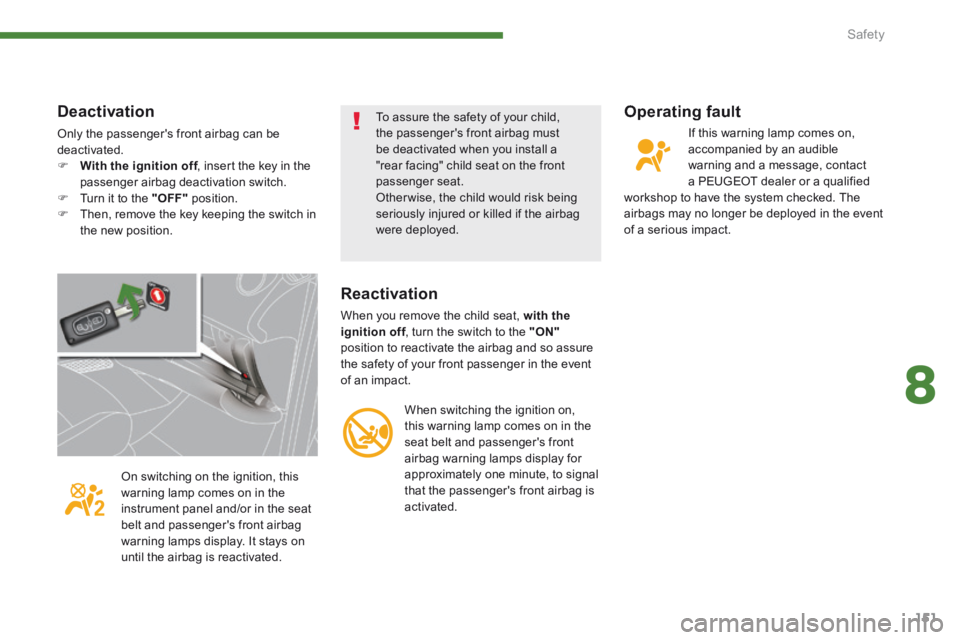
Only the passenger's front airbag can be deactivated. With the ignition off , insert the key in the With the ignition off , insert the key in the With the ignition offpassenger airbag deactivation switch. Turn it to the "OFF" position. Then, remove the key keeping the switch in the new position.
To assure the safety of your child, the passenger's front airbag must be deactivated when you install a "rear facing" child seat on the front passenger seat. Otherwise, the child would risk being seriously injured or killed if the airbag were deployed.
Page 154 of 389
Safety
152
Lateral airbags
System which protects the driver and front passenger in the event of a serious side impact in order to limit the risk of injury to the chest. Each lateral airbag is fitted in the front, in the outer side of the seat back frame.
Deployment
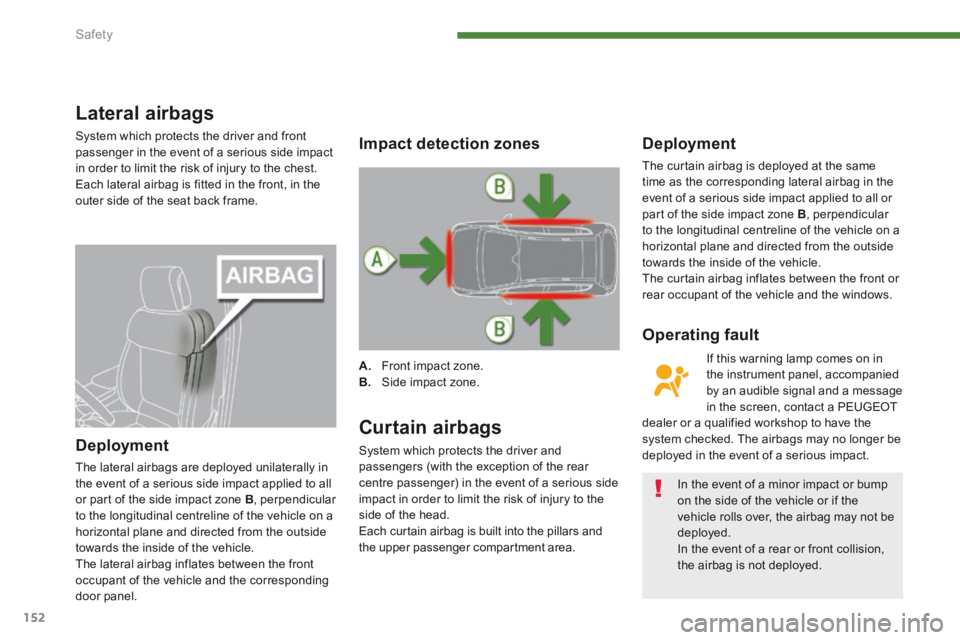
The lateral airbags are deployed unilaterally in the event of a serious side impact applied to all or part of the side impact zone B , perpendicular to the longitudinal centreline of the vehicle on a horizontal plane and directed from the outside towards the inside of the vehicle. The lateral airbag inflates between the front occupant of the vehicle and the corresponding door panel.
Curtain airbags
System which protects the driver and passengers (with the exception of the rear centre passenger) in the event of a serious side impact in order to limit the risk of injury to the side of the head. Each curtain airbag is built into the pillars and the upper passenger compartment area.
Deployment
The curtain airbag is deployed at the same time as the corresponding lateral airbag in the event of a serious side impact applied to all or part of the side impact zone B , perpendicular to the longitudinal centreline of the vehicle on a horizontal plane and directed from the outside towards the inside of the vehicle. The curtain airbag inflates between the front or rear occupant of the vehicle and the windows.
Impact detection zones
A. Front impact zone. B. Side impact zone.
Operating fault
If this warning lamp comes on in the instrument panel, accompanied by an audible signal and a message in the screen, contact a PEUGEOT dealer or a qualified workshop to have the
system checked. The airbags may no longer be deployed in the event of a serious impact.
In the event of a minor impact or bump on the side of the vehicle or if the vehicle rolls over, the airbag may not be deployed. In the event of a rear or front collision, the airbag is not deployed.
Page 156 of 389
154Driving
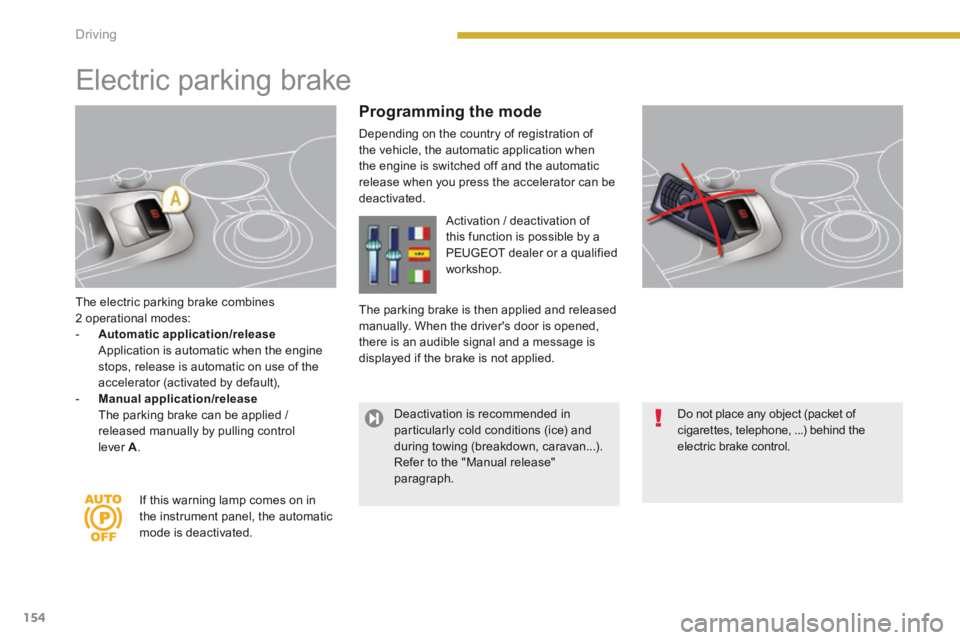
The electric parking brake combines 2 operational modes: - Automatic application/release Application is automatic when the engine stops, release is automatic on use of the accelerator (activated by default), - Manual application/release The parking brake can be applied /
released manually by pulling control lever A .
Electric parking brake
Programming the mode
Depending on the country of registration of the vehicle, the automatic application when the engine is switched off and the automatic release when you press the accelerator can be deactivated.
If this warning lamp comes on in the instrument panel, the automatic mode is deactivated.
Activation / deactivation of this function is possible by a PEUGEOT dealer or a qualified workshop.
The parking brake is then applied and released manually. When the driver's door is opened, there is an audible signal and a message is displayed if the brake is not applied.
Deactivation is recommended in particularly cold conditions (ice) and during towing (breakdown, caravan...). Refer to the "Manual release" paragraph.
Do not place any object (packet of cigarettes, telephone, ...) behind the electric brake control.
Page 157 of 389
9
155
Driving
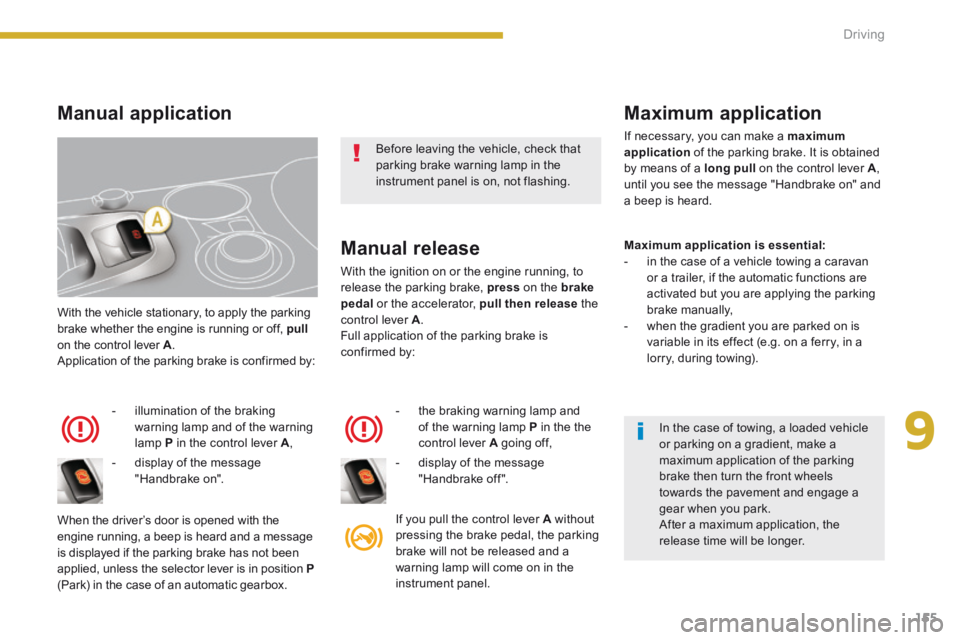
With the vehicle stationary, to apply the parking brake whether the engine is running or off, pull on the control lever A . Application of the parking brake is confirmed by:
- illumination of the braking warning lamp and of the warning lamp P in the control lever A ,
When the driver’s door is opened with the engine running, a beep is heard and a message is displayed if the parking brake has not been applied, unless the selector lever is in position P
(Park) in the case of an automatic gearbox.
Manual release
With the ignition on or the engine running, to release the parking brake, press on the brakepedal or the accelerator, pull then release the control lever A . Full application of the parking brake is confirmed by:
- the braking warning lamp and of the warning lamp P in the the control lever A going off,
If you pull the control lever A without pressing the brake pedal, the parking brake will not be released and a warning lamp will come on in the instrument panel.
Manual application Maximum application
If necessary, you can make a maximum application of the parking brake. It is obtained by means of a long pull on the control lever A , until you see the message "Handbrake on" and a beep is heard.
Maximum application is essential: - in the case of a vehicle towing a caravan or a trailer, if the automatic functions are activated but you are applying the parking brake manually, - when the gradient you are parked on is variable in its effect (e.g. on a ferry, in a lorry, during towing).
- display of the message "Handbrake on". - display of the message "Handbrake off ".
Before leaving the vehicle, check that parking brake warning lamp in the instrument panel is on, not flashing.
In the case of towing, a loaded vehicle or parking on a gradient, make a maximum application of the parking brake then turn the front wheels towards the pavement and engage a gear when you park. After a maximum application, the release time will be longer.
Page 158 of 389
156Driving
Automatic application,
engine off
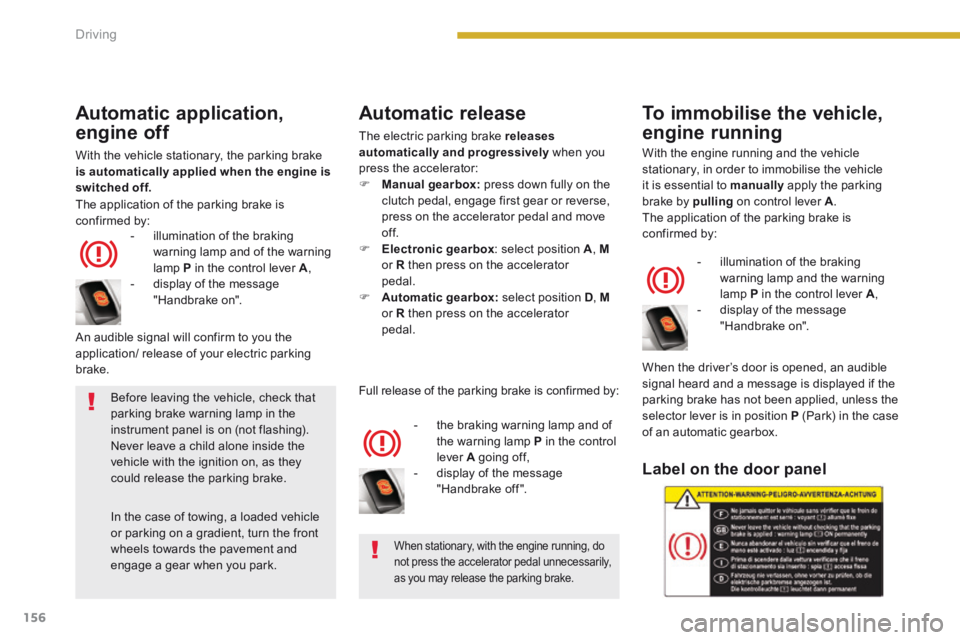
With the vehicle stationary, the parking brake is automatically applied when the engine is switched off.
- illumination of the braking warning lamp and of the warning lamp P in the control lever A ,
Automatic release
The electric parking brake releases automatically and progressively when you press the accelerator: Manual gearbox: press down fully on the clutch pedal, engage first gear or reverse, press on the accelerator pedal and move of f. Electronic gearbox : select position A , Mor R then press on the accelerator pedal. Automatic gearbox: select position D , Mor R then press on the accelerator pedal.
- the braking warning lamp and of the warning lamp P in the control lever A going off,
An audible signal will confirm to you the application/ release of your electric parking brake.
Full release of the parking brake is confirmed by:
To immobilise the vehicle,
engine running
With the engine running and the vehicle stationary, in order to immobilise the vehicle it is essential to manually apply the parking brake by pulling on control lever A . The application of the parking brake is
confirmed by:
- illumination of the braking warning lamp and the warning lamp P in the control lever A ,
When the driver’s door is opened, an audible signal heard and a message is displayed if the parking brake has not been applied, unless the selector lever is in position P (Park) in the case of an automatic gearbox.
The application of the parking brake is confirmed by:
- display of the message "Handbrake on".
- display of the message "Handbrake off ".
- display of the message "Handbrake on".
Label on the door panel
Before leaving the vehicle, check that parking brake warning lamp in the
instrument panel is on (not flashing). Never leave a child alone inside the vehicle with the ignition on, as they could release the parking brake.
In the case of towing, a loaded vehicle or parking on a gradient, turn the front wheels towards the pavement and engage a gear when you park.
When stationary, with the engine running, do not press the accelerator pedal unnecessarily, as you may release the parking brake.
Page 159 of 389
9
157
Driving
Emergency braking
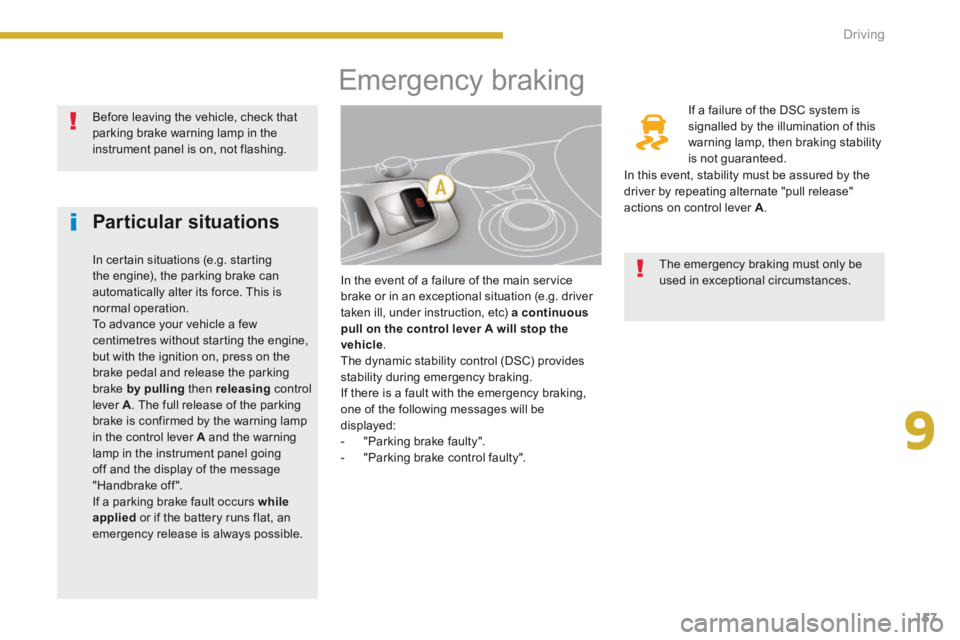
In the event of a failure of the main service brake or in an exceptional situation (e.g. driver taken ill, under instruction, etc) a continuous pull on the control lever on the control lever on the control leverA will stop the vehicle . The dynamic stability control (DSC) provides stability during emergency braking. If there is a fault with the emergency braking, one of the following messages will be displayed: - "Parking brake faulty". - "Parking brake control faulty".
If a failure of the DSC system is signalled by the illumination of this warning lamp, then braking stability is not guaranteed.
The emergency braking must only be used in exceptional circumstances.
Particular situations
In certain situations (e.g. starting the engine), the parking brake can automatically alter its force. This is normal operation. To advance your vehicle a few centimetres without starting the engine, but with the ignition on, press on the brake pedal and release the parking brake by pulling then releasing control lever A . The full release of the parking brake is confirmed by the warning lamp in the control lever A and the warning lamp in the instrument panel going off and the display of the message "Handbrake off ". If a parking brake fault occurs while applied or if the battery runs flat, an emergency release is always possible.
Before leaving the vehicle, check that parking brake warning lamp in the instrument panel is on, not flashing.
In this event, stability must be assured by the driver by repeating alternate "pull release" actions on control lever A .