Page 107 of 389
5
Visibility105
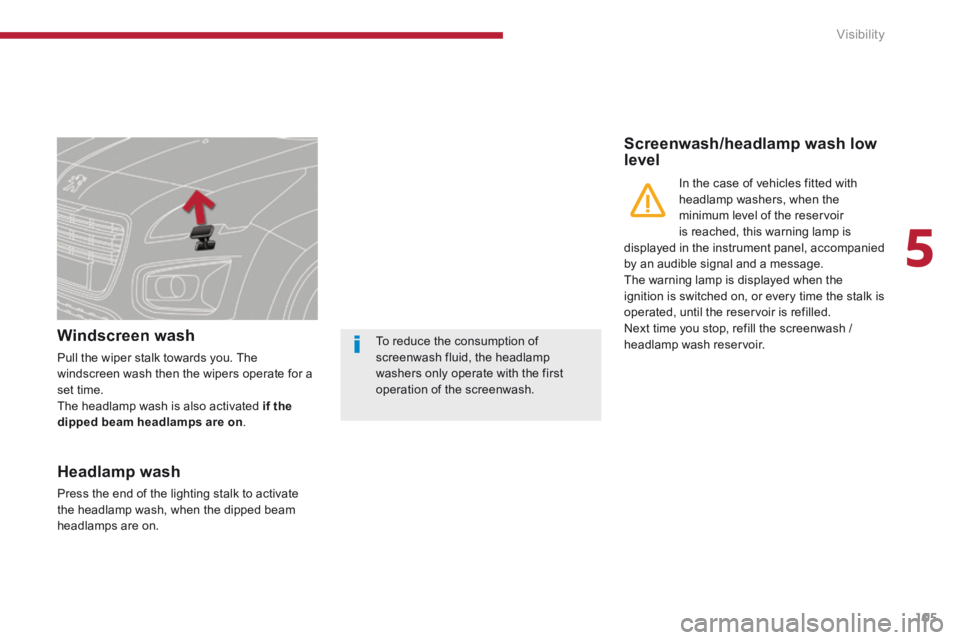
Windscreen wash
Pull the wiper stalk towards you. The windscreen wash then the wipers operate for a set time. The headlamp wash is also activated if the dipped beam headlamps are on .
Screenwash/headlamp wash low level
In the case of vehicles fitted with headlamp washers, when the minimum level of the reservoir is reached, this warning lamp is displayed in the instrument panel, accompanied by an audible signal and a message. The warning lamp is displayed when the ignition is switched on, or every time the stalk is operated, until the reservoir is refilled. Next time you stop, refill the screenwash / headlamp wash reservoir. To reduce the consumption of screenwash fluid, the headlamp washers only operate with the first operation of the screenwash.
Headlamp wash
Press the end of the lighting stalk to activate the headlamp wash, when the dipped beam headlamps are on.
Page 124 of 389
Fittings
122
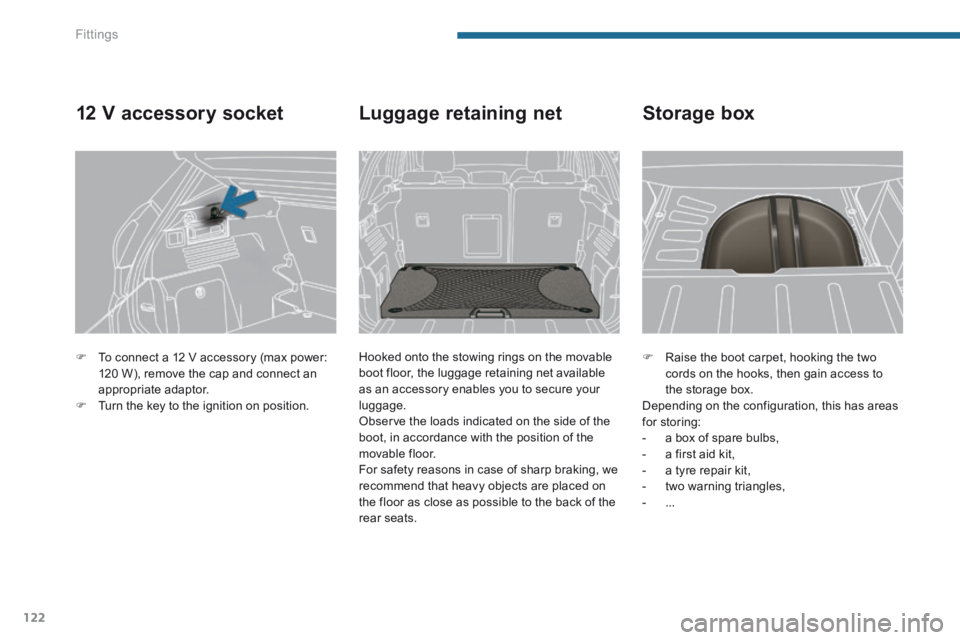
Raise the boot carpet, hooking the two cords on the hooks, then gain access to the storage box. Depending on the configuration, this has areas for storing: - a box of spare bulbs, - a first aid kit, - a tyre repair kit, - two warning triangles, - ...
Storage box
To connect a 12 V accessory (max power: 120 W), remove the cap and connect an appropriate adaptor. Turn the key to the ignition on position.
12 V accessory socket Luggage retaining net
Hooked onto the stowing rings on the movable boot floor, the luggage retaining net available as an accessory enables you to secure your luggage. Observe the loads indicated on the side of the boot, in accordance with the position of the movable floor. For safety reasons in case of sharp braking, we recommend that heavy objects are placed on the floor as close as possible to the back of the rear seats.
Page 129 of 389
7
Child safety127
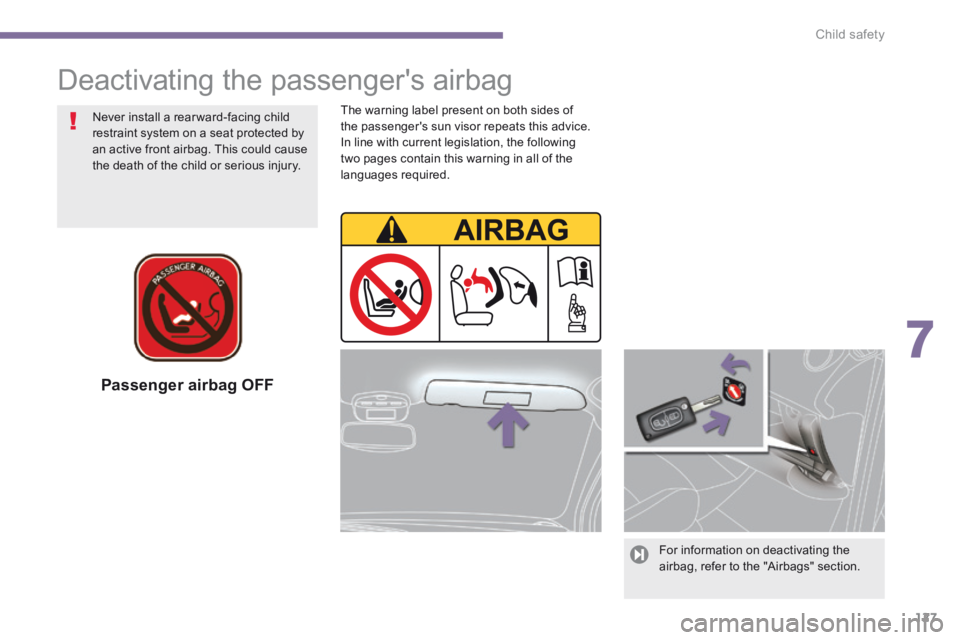
Passenger airbag OFF
For information on deactivating the airbag, refer to the "Airbags" section.
Never install a rear ward-facing child restraint system on a seat protected by an active front airbag. This could cause the death of the child or serious injury.
Deactivating the passenger's airbag
The warning label present on both sides of the passenger's sun visor repeats this advice. In line with current legislation, the following two pages contain this warning in all of the languages required.
Page 141 of 389
8
Safety139
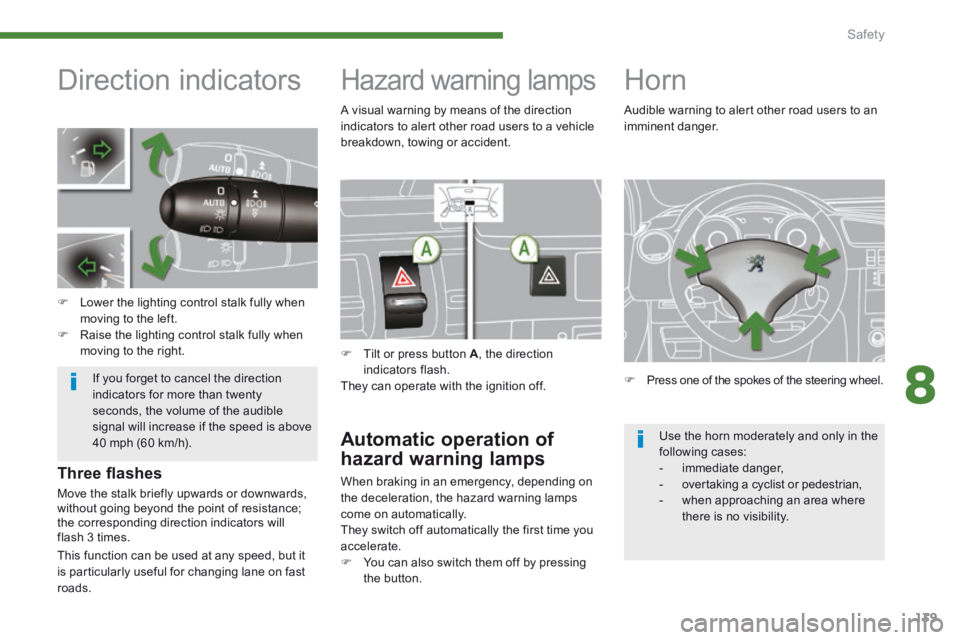
Direction indicators
Lower the lighting control stalk fully when moving to the left. Raise the lighting control stalk fully when moving to the right.
Hazard warning lamps
Tilt or press button A , the direction indicators flash. They can operate with the ignition off.
Automatic operation of
hazard warning lamps
When braking in an emergency, depending on the deceleration, the hazard warning lamps come on automatically. They switch off automatically the first time you
accelerate. You can also switch them off by pressing the button.
Horn
Press one of the spokes of the steering wheel.
Audible warning to alert other road users to an imminent danger.
Three fl ashes
Move the stalk briefly upwards or downwards, without going beyond the point of resistance; the corresponding direction indicators will flash 3 times.
If you forget to cancel the direction indicators for more than twenty seconds, the volume of the audible signal will increase if the speed is above 40 mph (60 km/h).
A visual warning by means of the direction indicators to alert other road users to a vehicle breakdown, towing or accident.
Use the horn moderately and only in the following cases: - immediate danger, - overtaking a cyclist or pedestrian, - when approaching an area where there is no visibility.
This function can be used at any speed, but it is particularly useful for changing lane on fast roads.
Page 143 of 389
8
Safety141
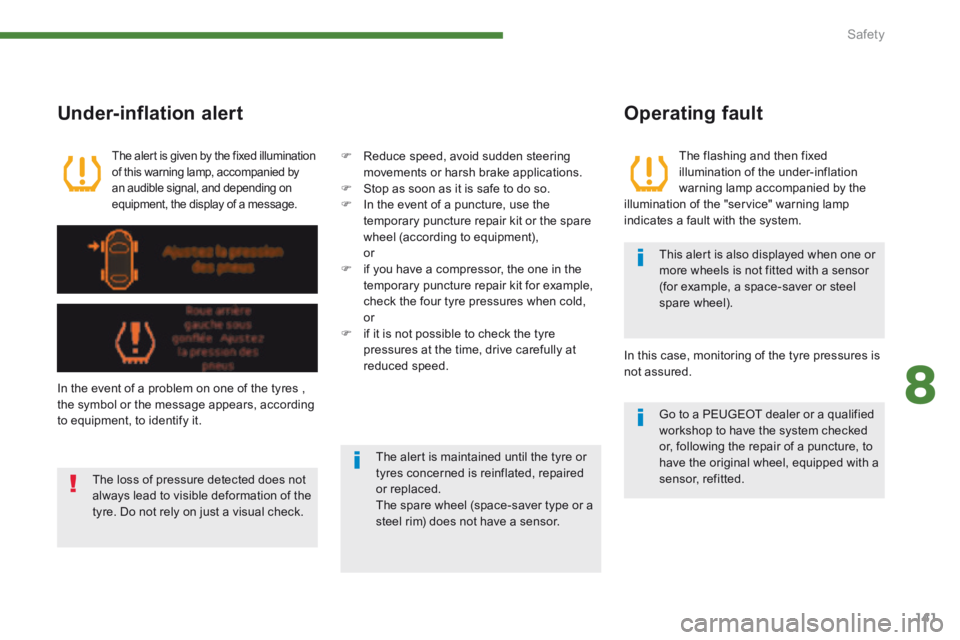
The flashing and then fixed illumination of the under-inflation warning lamp accompanied by the illumination of the "service" warning lamp indicates a fault with the system.
This alert is also displayed when one or more wheels is not fitted with a sensor (for example, a space-saver or steel spare wheel).
Under-inflation alert
The alert is given by the fixed illumination of this warning lamp, accompanied by an audible signal, and depending on equipment, the display of a message.
In the event of a problem on one of the tyres , the symbol or the message appears, according to equipment, to identify it.
Reduce speed, avoid sudden steering movements or harsh brake applications. Stop as soon as it is safe to do so. In the event of a puncture, use the temporary puncture repair kit or the spare
wheel (according to equipment), or if you have a compressor, the one in the temporary puncture repair kit for example, check the four tyre pressures when cold, or if it is not possible to check the tyre pressures at the time, drive carefully at reduced speed.
The loss of pressure detected does not always lead to visible deformation of the tyre. Do not rely on just a visual check.
The alert is maintained until the tyre or tyres concerned is reinflated, repaired or replaced. The spare wheel (space-saver type or a steel rim) does not have a sensor.
Operating fault
Go to a PEUGEOT dealer or a qualified workshop to have the system checked or, following the repair of a puncture, to have the original wheel, equipped with a sensor, refitted.
In this case, monitoring of the tyre pressures is not assured.
Page 145 of 389
8
Safety143
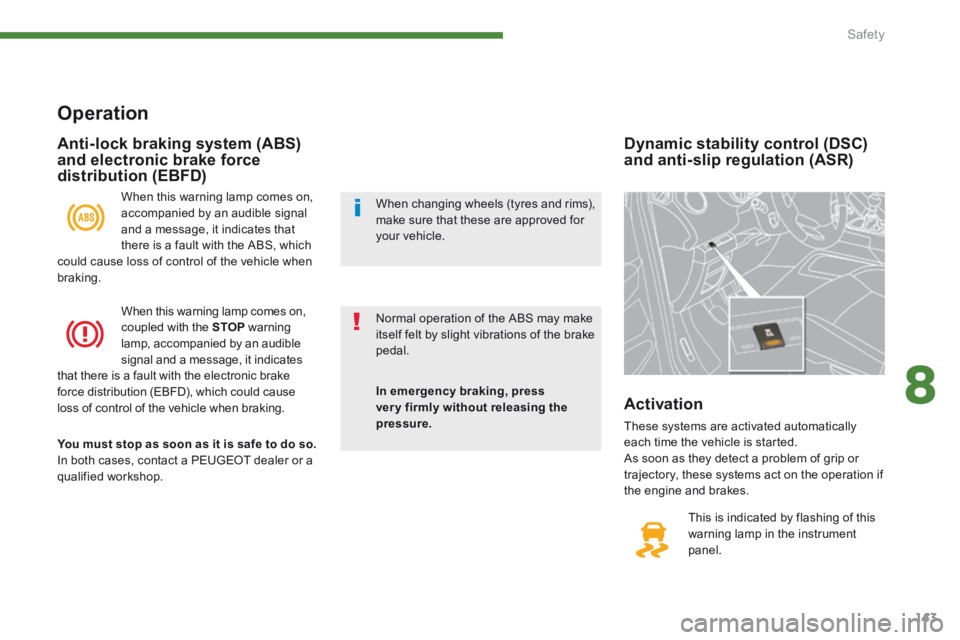
Dynamic stability control (DSC) and anti-slip regulation (ASR)
This is indicated by flashing of this warning lamp in the instrument panel.
Activation
These systems are activated automatically
each time the vehicle is started. As soon as they detect a problem of grip or trajectory, these systems act on the operation if the engine and brakes.
Operation
When this warning lamp comes on, accompanied by an audible signal and a message, it indicates that there is a fault with the ABS, which could cause loss of control of the vehicle when braking.
When this warning lamp comes on, coupled with the STOP warning lamp, accompanied by an audible signal and a message, it indicates that there is a fault with the electronic brake force distribution (EBFD), which could cause loss of control of the vehicle when braking.
You must stop as soon as it is safe to do so. In both cases, contact a PEUGEOT dealer or a qualified workshop.
Anti-lock braking system (ABS) and electronic brake force distribution (EBFD)
In emergency braking, press very firmly without releasing the pressure.
Normal operation of the ABS may make itself felt by slight vibrations of the brake pedal.
When changing wheels (tyres and rims), make sure that these are approved for your vehicle.
Page 146 of 389
Safety
144
Deactivation
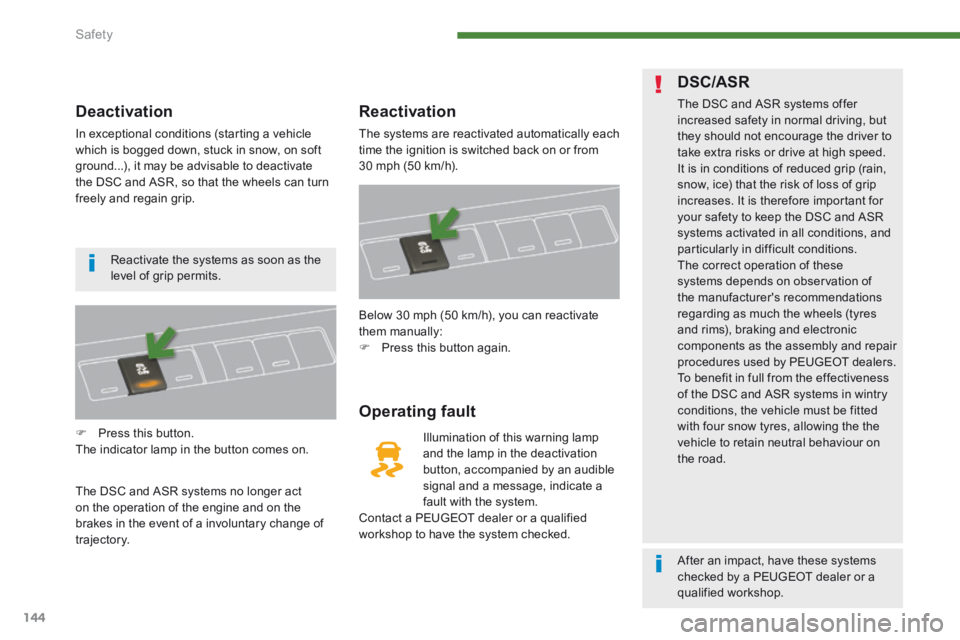
In exceptional conditions (starting a vehicle which is bogged down, stuck in snow, on soft ground...), it may be advisable to deactivate the DSC and ASR, so that the wheels can turn freely and regain grip.
Press this button. The indicator lamp in the button comes on.
The DSC and ASR systems no longer act on the operation of the engine and on the brakes in the event of a involuntary change of trajectory.
Reactivation
The systems are reactivated automatically each time the ignition is switched back on or from 30 mph (50 km/h).
Operating fault
Illumination of this warning lamp and the lamp in the deactivation button, accompanied by an audible signal and a message, indicate a fault with the system. Contact a PEUGEOT dealer or a qualified workshop to have the system checked.
Below 30 mph (50 km/h), you can reactivate them manually: Press this button again.
DSC/ASR
The DSC and ASR systems offer increased safety in normal driving, but they should not encourage the driver to take extra risks or drive at high speed. It is in conditions of reduced grip (rain, snow, ice) that the risk of loss of grip increases. It is therefore important for your safety to keep the DSC and ASR systems activated in all conditions, and particularly in difficult conditions. The correct operation of these systems depends on observation of the manufacturer's recommendations regarding as much the wheels (tyres and rims), braking and electronic components as the assembly and repair procedures used by PEUGEOT dealers. To benefit in full from the effectiveness of the DSC and ASR systems in wintry conditions, the vehicle must be fitted with four snow tyres, allowing the the vehicle to retain neutral behaviour on the road.
Reactivate the systems as soon as the level of grip permits.
After an impact, have these systems checked by a PEUGEOT dealer or a qualified workshop.
Page 149 of 389
8
Safety147
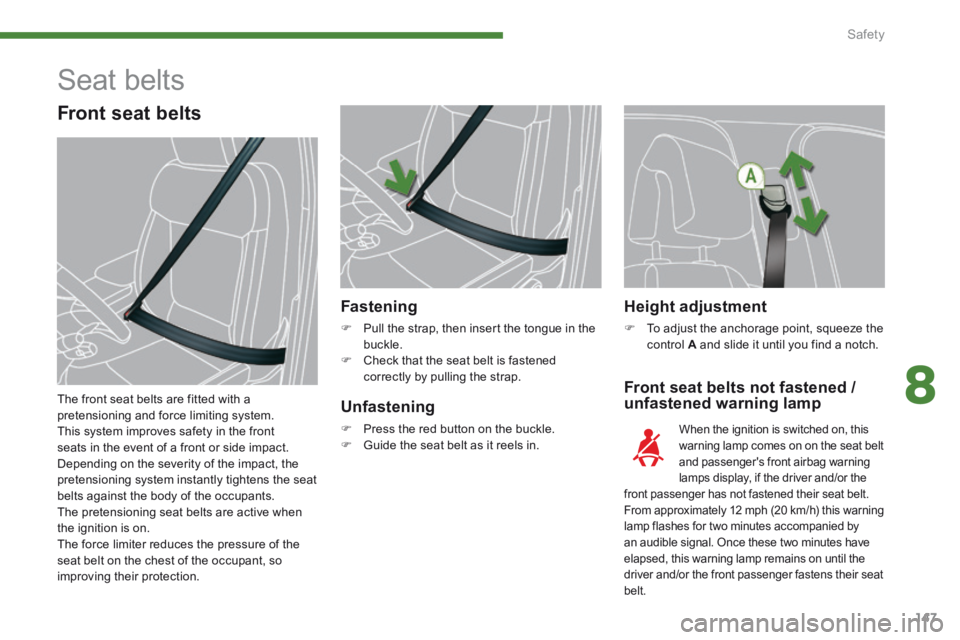
Height adjustment
To adjust the anchorage point, squeeze the control A and slide it until you find a notch.
Front seat belts not fastened / unfastened warning lamp
Fastening
Pull the strap, then insert the tongue in the buckle. Check that the seat belt is fastened correctly by pulling the strap.
When the ignition is switched on, this
warning lamp comes on on the seat belt and passenger's front airbag warning lamps display, if the driver and/or the front passenger has not fastened their seat belt. From approximately 12 mph (20 km/h) this warning lamp flashes for two minutes accompanied by an audible signal. Once these two minutes have elapsed, this warning lamp remains on until the driver and/or the front passenger fastens their seat belt.
Unfastening
Press the red button on the buckle. Guide the seat belt as it reels in.
Seat belts
Front seat belts
The front seat belts are fitted with a pretensioning and force limiting system. This system improves safety in the front seats in the event of a front or side impact. Depending on the severity of the impact, the pretensioning system instantly tightens the seat belts against the body of the occupants. The pretensioning seat belts are active when the ignition is on. The force limiter reduces the pressure of the seat belt on the chest of the occupant, so improving their protection.