Page 4195 of 4801
COMPONENT PARTSSTR-5
< SYSTEM DESCRIPTION >
C
D E
F
G H
I
J
K L
M A
STR
NP
O
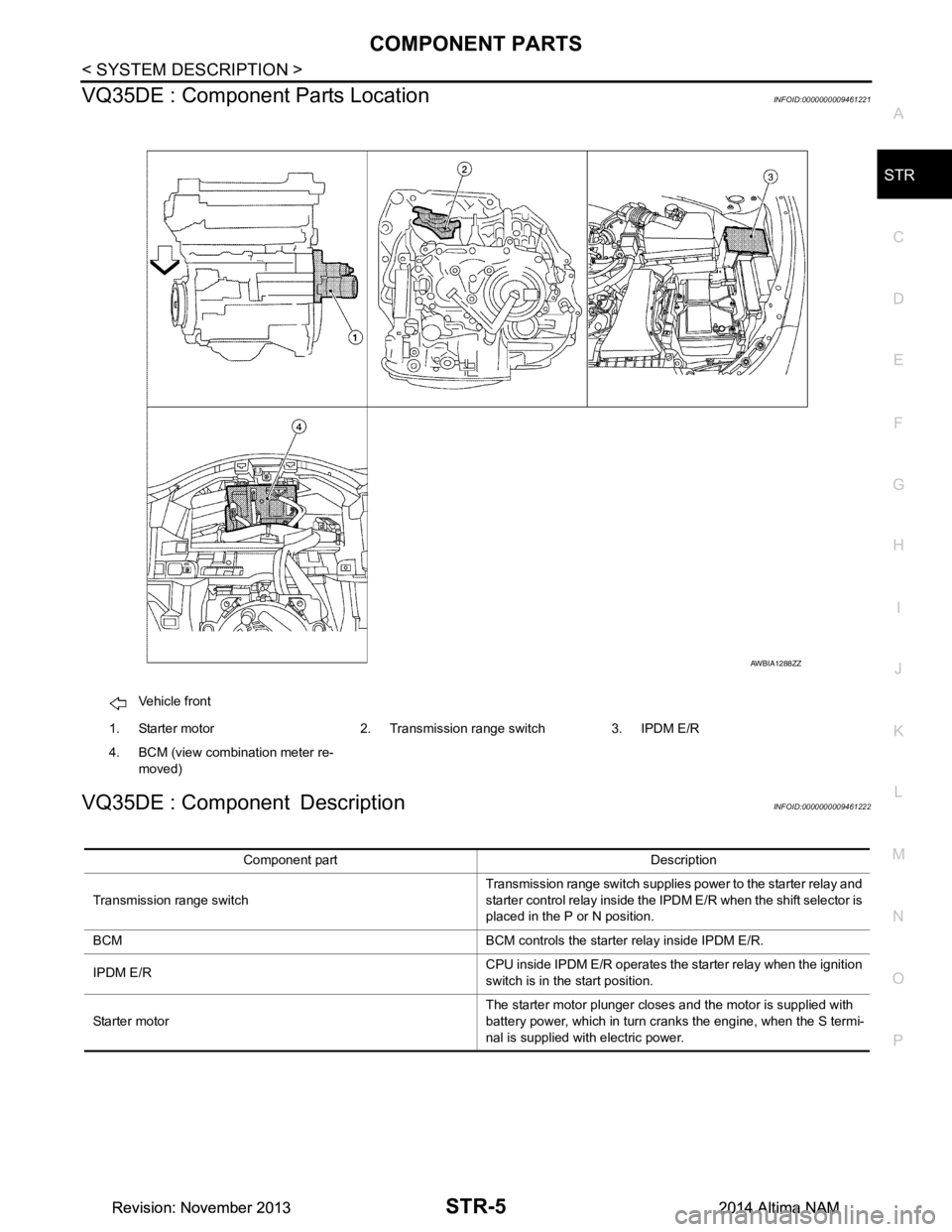
VQ35DE : Component Parts LocationINFOID:0000000009461221
VQ35DE : Component DescriptionINFOID:0000000009461222
Vehicle front
1. Starter motor 2. Transmission range switch 3. IPDM E/R
4. BCM (view combination meter re- moved)
AWBIA1288ZZ
Component part Description
Transmission range switch Transmission range switch supplies power to the starter relay and
starter control relay inside the IPDM E/R when the shift selector is
placed in the P or N position.
BCM BCM controls the starter relay inside IPDM E/R.
IPDM E/R CPU inside IPDM E/R operates the starter relay when the ignition
switch is in the start position.
Starter motor The starter motor plunger closes and the motor is supplied with
battery power, which in turn cranks the engine, when the S termi-
nal is supplied with electric power.
Revision: November 20132014 Altima NAMRevision: November 20132014 Altima NAM
Page 4196 of 4801
STR-6
< SYSTEM DESCRIPTION >
SYSTEM
SYSTEM
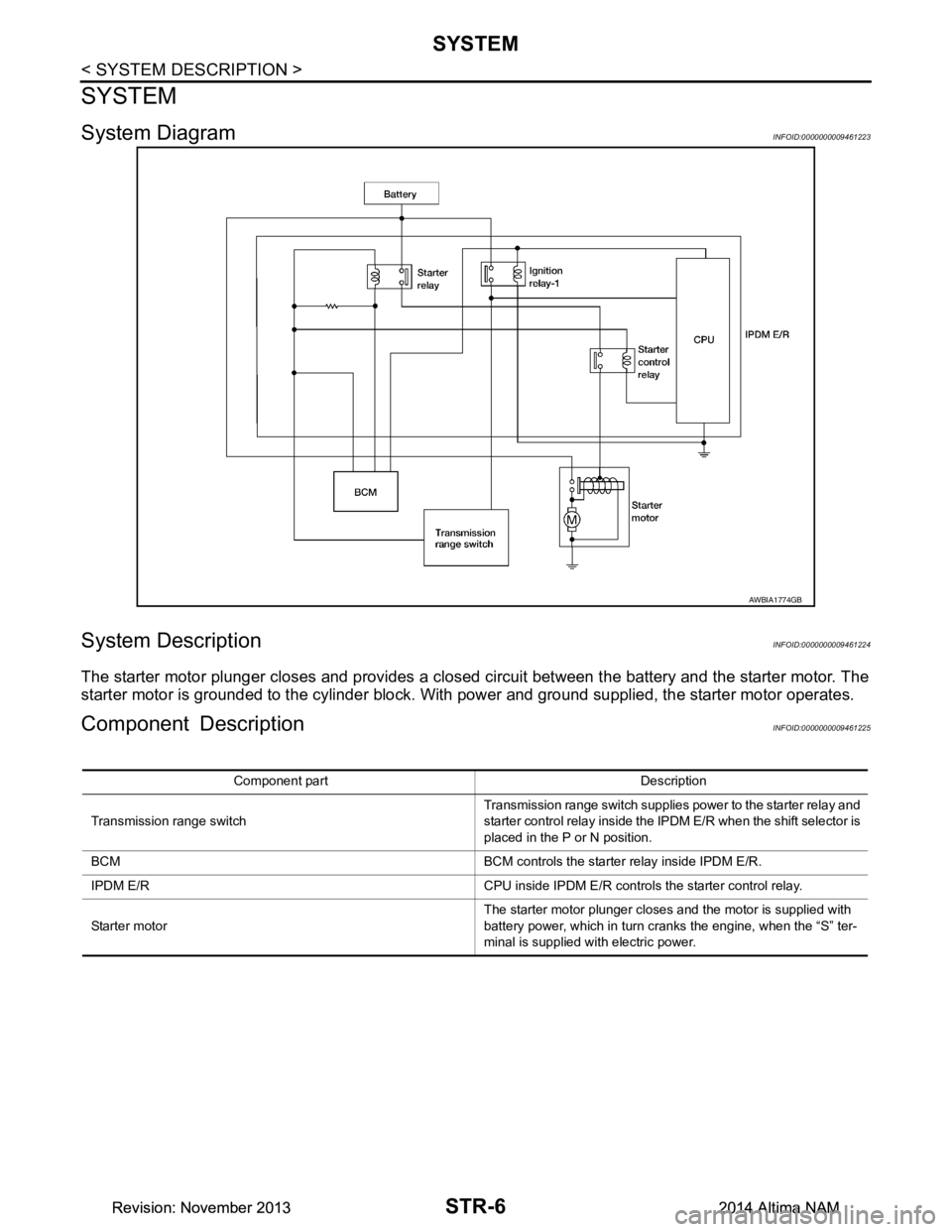
System DiagramINFOID:0000000009461223
System DescriptionINFOID:0000000009461224
The starter motor plunger closes and provides a closed circuit between the battery and the starter motor. The
starter motor is grounded to the cylinder block. With power and ground supplied, the starter motor operates.
Component DescriptionINFOID:0000000009461225
AWBIA1774GB
Component part Description
Transmission range switch Transmission range switch supplies power to the starter relay and
starter control relay inside the IPDM E/R when the shift selector is
placed in the P or N position.
BCM BCM controls the starter relay inside IPDM E/R.
IPDM E/R CPU inside IPDM E/R controls the starter control relay.
Starter motor The starter motor plunger closes and the motor is supplied with
battery power, which in turn cranks the engine, when the “S” ter-
minal is supplied with electric power.
Revision: November 20132014 Altima NAMRevision: November 20132014 Altima NAM
Page 4204 of 4801
STR-14
< BASIC INSPECTION >
DIAGNOSIS AND REPAIR WORKFLOW
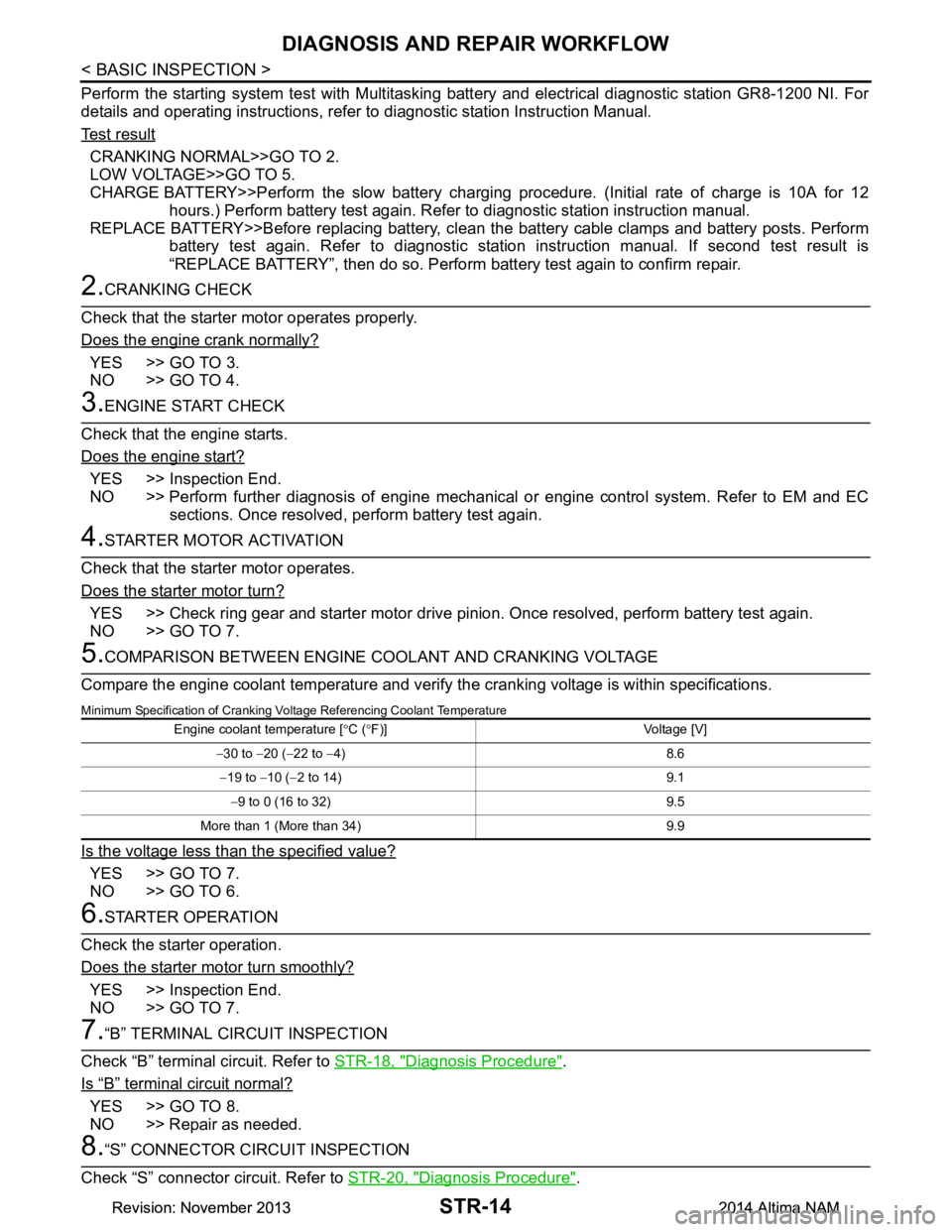
Perform the starting system test with Multitasking battery and electrical diagnostic station GR8-1200 NI. For
details and operating instructions, refer to diagnostic station Instruction Manual.
Te s t r e s u l t
CRANKING NORMAL>>GO TO 2.
LOW VOLTAGE>>GO TO 5.
CHARGE BATTERY>>Perform the slow battery charging procedure. (Initial rate of charge is 10A for 12
hours.) Perform battery test again. Refer to diagnostic station instruction manual.
REPLACE BATTERY>>Before replacing battery, clean t he battery cable clamps and battery posts. Perform
battery test again. Refer to diagnostic station instruction manual. If second test result is
“REPLACE BATTERY”, then do so. Perform battery test again to confirm repair.
2.CRANKING CHECK
Check that the starter motor operates properly.
Does the engine crank normally?
YES >> GO TO 3.
NO >> GO TO 4.
3.ENGINE START CHECK
Check that the engine starts.
Does the engine start?
YES >> Inspection End.
NO >> Perform further diagnosis of engine mechanical or engine control system. Refer to EM and EC sections. Once resolved, perform battery test again.
4.STARTER MOTOR ACTIVATION
Check that the starter motor operates.
Does the starter motor turn?
YES >> Check ring gear and starter motor drive pinion. Once resolved, perform battery test again.
NO >> GO TO 7.
5.COMPARISON BETWEEN ENGINE COOLANT AND CRANKING VOLTAGE
Compare the engine coolant temperature and verify the cranking voltage is within specifications.
Minimum Specification of Cranking Voltage Referencing Coolant Temperature
Is the voltage less than the specified value?
YES >> GO TO 7.
NO >> GO TO 6.
6.STARTER OPERATION
Check the starter operation.
Does the starter motor turn smoothly?
YES >> Inspection End.
NO >> GO TO 7.
7.“B” TERMINAL CIRCUIT INSPECTION
Check “B” terminal circuit. Refer to STR-18, "Diagnosis Procedure"
.
Is
“B” terminal circuit normal?
YES >> GO TO 8.
NO >> Repair as needed.
8.“S” CONNECTOR CIRCUIT INSPECTION
Check “S” connector circuit. Refer to STR-20, "Diagnosis Procedure"
.
Engine coolant temperature [°C ( °F)] Voltage [V]
− 30 to −20 ( −22 to −4) 8.6
− 19 to −10 ( −2 to 14) 9.1
− 9 to 0 (16 to 32) 9.5
More than 1 (More than 34) 9.9
Revision: November 20132014 Altima NAMRevision: November 20132014 Altima NAM
Page 4205 of 4801
DIAGNOSIS AND REPAIR WORKFLOWSTR-15
< BASIC INSPECTION >
C
D E
F
G H
I
J
K L
M A
STR
NP
O
Is “S” connector circuit normal?
YES >> GO TO 9.
NO >> Repair as needed.
9.ENGINE ROTATION STATUS
Check that the engine can be rotated by hand.
Does the engine turn freely by hand?
YES >> Replace starter motor.
NO >> Perform further diagnosis of engine mechanical or powertrain mechanism. Once resolved, per- form battery test again using Multitasking batte ry and electrical diagnostic station GR8-1200 NI.
Refer to the diagnostic station Instruction Manual for proper testing procedures.
Revision: November 20132014 Altima NAMRevision: November 20132014 Altima NAM
Page 4206 of 4801
STR-16
< BASIC INSPECTION >
DIAGNOSIS AND REPAIR WORKFLOW
Work Flow (Without GR8-1200 NI)
INFOID:0000000009461228
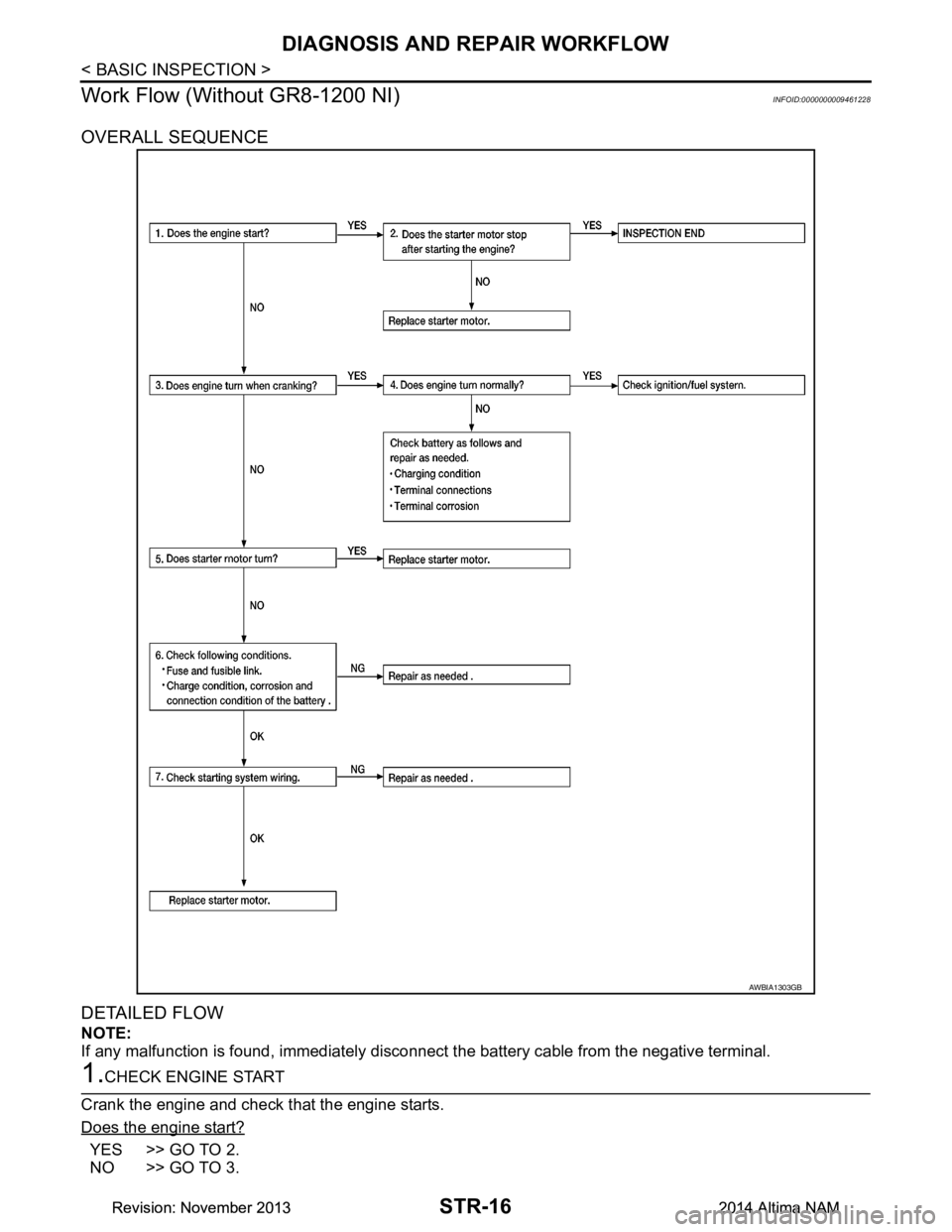
OVERALL SEQUENCE
DETAILED FLOW
NOTE:
If any malfunction is found, immediately disconnec t the battery cable from the negative terminal.
1.CHECK ENGINE START
Crank the engine and check that the engine starts.
Does the engine start?
YES >> GO TO 2.
NO >> GO TO 3.
AWBIA1303GB
Revision: November 20132014 Altima NAMRevision: November 20132014 Altima NAM
Page 4207 of 4801
DIAGNOSIS AND REPAIR WORKFLOWSTR-17
< BASIC INSPECTION >
C
D E
F
G H
I
J
K L
M A
STR
NP
O
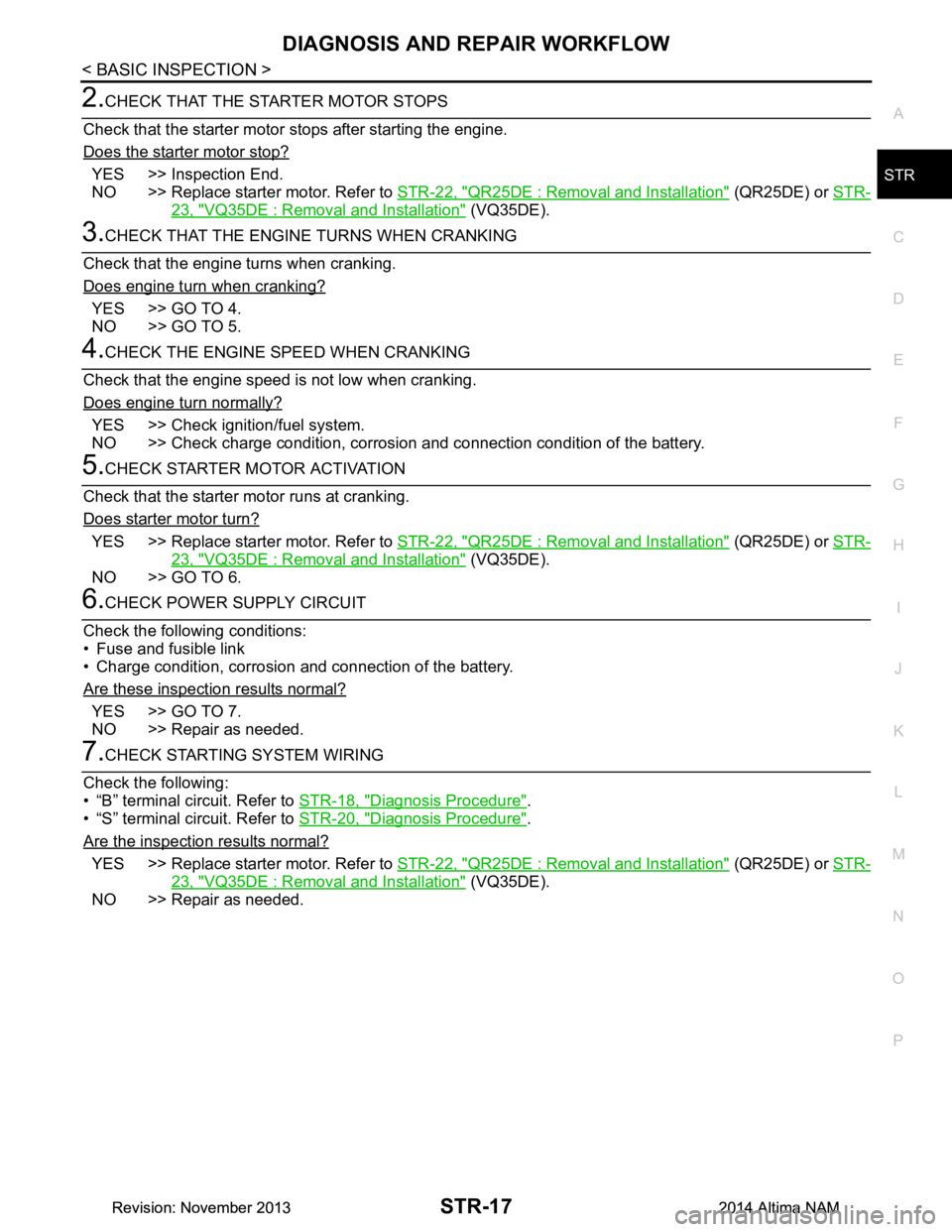
2.CHECK THAT THE STARTER MOTOR STOPS
Check that the starter motor stops after starting the engine.
Does the starter motor stop?
YES >> Inspection End.
NO >> Replace starter motor. Refer to STR-22, "QR25DE : Removal and Installation"
(QR25DE) or STR-
23, "VQ35DE : Removal and Installation" (VQ35DE).
3.CHECK THAT THE ENGINE TURNS WHEN CRANKING
Check that the engine turns when cranking.
Does engine turn when cranking?
YES >> GO TO 4.
NO >> GO TO 5.
4.CHECK THE ENGINE SPEED WHEN CRANKING
Check that the engine speed is not low when cranking.
Does engine turn normally?
YES >> Check igniti on/fuel system.
NO >> Check charge condition, corrosion and connection condition of the battery.
5.CHECK STARTER MOTOR ACTIVATION
Check that the starter motor runs at cranking.
Does starter motor turn?
YES >> Replace starter motor. Refer to STR-22, "QR25DE : Removal and Installation" (QR25DE) or STR-
23, "VQ35DE : Removal and Installation" (VQ35DE).
NO >> GO TO 6.
6.CHECK POWER SUPPLY CIRCUIT
Check the following conditions:
• Fuse and fusible link
• Charge condition, corrosion and connection of the battery.
Are these inspection results normal?
YES >> GO TO 7.
NO >> Repair as needed.
7.CHECK STARTING SYSTEM WIRING
Check the following:
• “B” terminal circuit. Refer to STR-18, "Diagnosis Procedure"
.
• “S” terminal circuit. Refer to STR-20, "Diagnosis Procedure"
.
Are the inspection results normal?
YES >> Replace starter motor. Refer to STR-22, "QR25DE : Removal and Installation" (QR25DE) or STR-
23, "VQ35DE : Removal and Installation" (VQ35DE).
NO >> Repair as needed.
Revision: November 20132014 Altima NAMRevision: November 20132014 Altima NAM
Page 4208 of 4801
STR-18
< DTC/CIRCUIT DIAGNOSIS >
B TERMINAL CIRCUIT
DTC/CIRCUIT DIAGNOSIS
B TERMINAL CIRCUIT
DescriptionINFOID:0000000009461229
Terminal “B” is constantly supplied with battery power.
Diagnosis ProcedureINFOID:0000000009461230
Regarding Wiring Diagram information, refer to STR-7, "Wiring Diagram".
CAUTION:
Perform diagnosis under the condi tion that the engine cannot start by the following procedure.
1. Remove fuel pump fuse.
2. Crank or start the engine (where possi ble) until the fuel pressure is released.
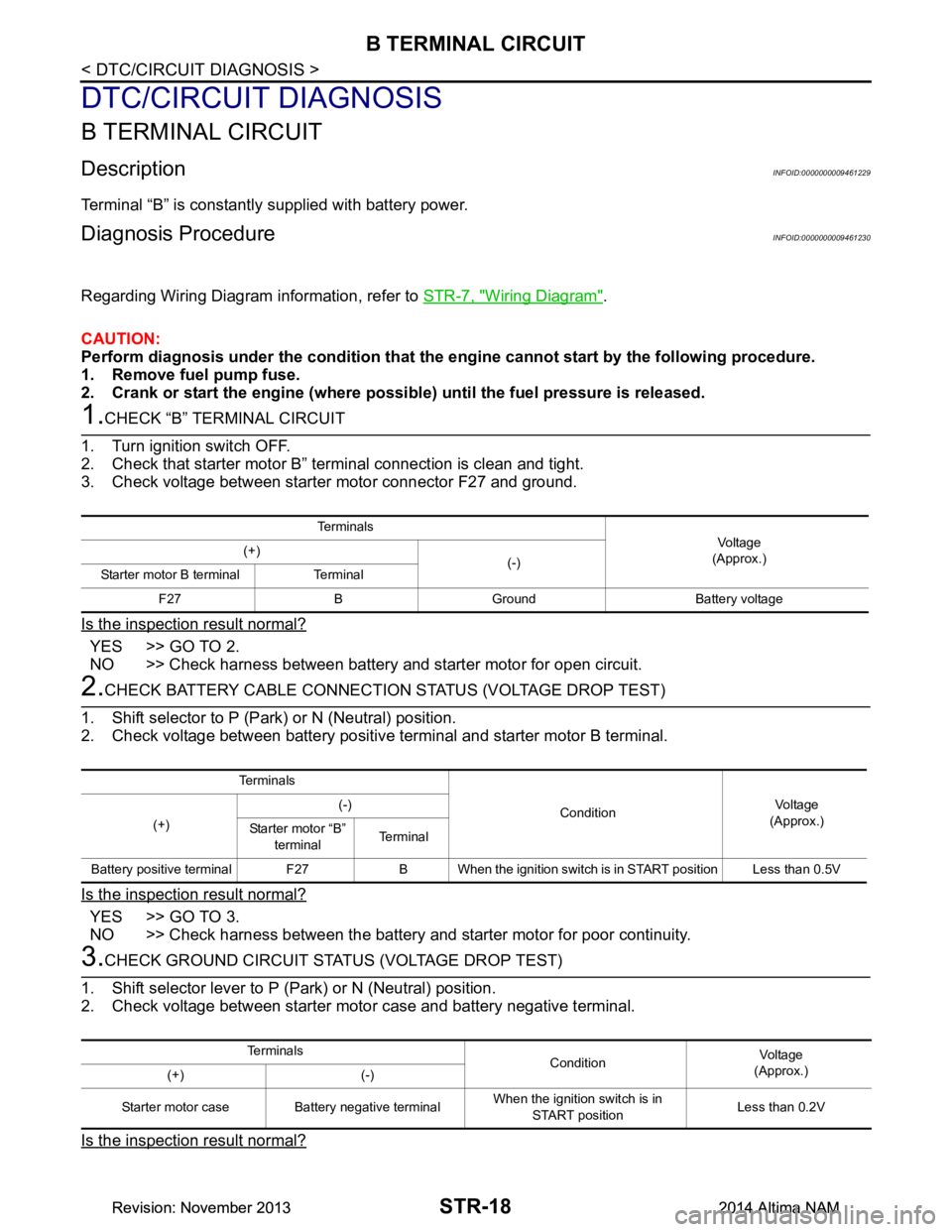
1.CHECK “B” TERMINAL CIRCUIT
1. Turn ignition switch OFF.
2. Check that starter motor B” terminal connection is clean and tight.
3. Check voltage between starter motor connector F27 and ground.
Is the inspection result normal?
YES >> GO TO 2.
NO >> Check harness between battery and starter motor for open circuit.
2.CHECK BATTERY CABLE CONNECTION STATUS (VOLTAGE DROP TEST)
1. Shift selector to P (Park) or N (Neutral) position.
2. Check voltage between battery positive terminal and starter motor B terminal.
Is the inspection result normal?
YES >> GO TO 3.
NO >> Check harness between the battery and starter motor for poor continuity.
3.CHECK GROUND CIRCUIT STATUS (VOLTAGE DROP TEST)
1. Shift selector lever to P (Park) or N (Neutral) position.
2. Check voltage between starter motor case and battery negative terminal.
Is the inspection result normal?
Te r m i n a l s
Voltage
(Approx.)
(+)
(-)
Starter motor B terminal Terminal
F27 B Ground Battery voltage
Te r m i n a l s
ConditionVoltage
(Approx.)
(+) (-)
Starter motor “B” terminal Te r m i n a l
Battery positive terminal F27 B When the ignition switch is in START position Less than 0.5V
Te r m i n a l s ConditionVoltage
(Approx.)
(+) (-)
Starter motor case Battery negative terminal When the ignition switch is in
START position Less than 0.2V
Revision: November 20132014 Altima NAMRevision: November 20132014 Altima NAM
Page 4209 of 4801
B TERMINAL CIRCUITSTR-19
< DTC/CIRCUIT DIAGNOSIS >
C
D E
F
G H
I
J
K L
M A
STR
NP
O
YES >> “B” terminal circuit is OK. Furt
her inspection is necessary. Refer to STR-12, "Work Flow (With
GR8-1200 NI)" or STR-16, "Work Flow (Without GR8-1200 NI)".
NO >> Check the starter motor case to engine mounting for high resistance.
Revision: November 20132014 Altima NAMRevision: November 20132014 Altima NAM