2014 MITSUBISHI OUTLANDER SPORT remove seats
[x] Cancel search: remove seatsPage 88 of 388
Seat belts
Seat and seat belts 5-9
5
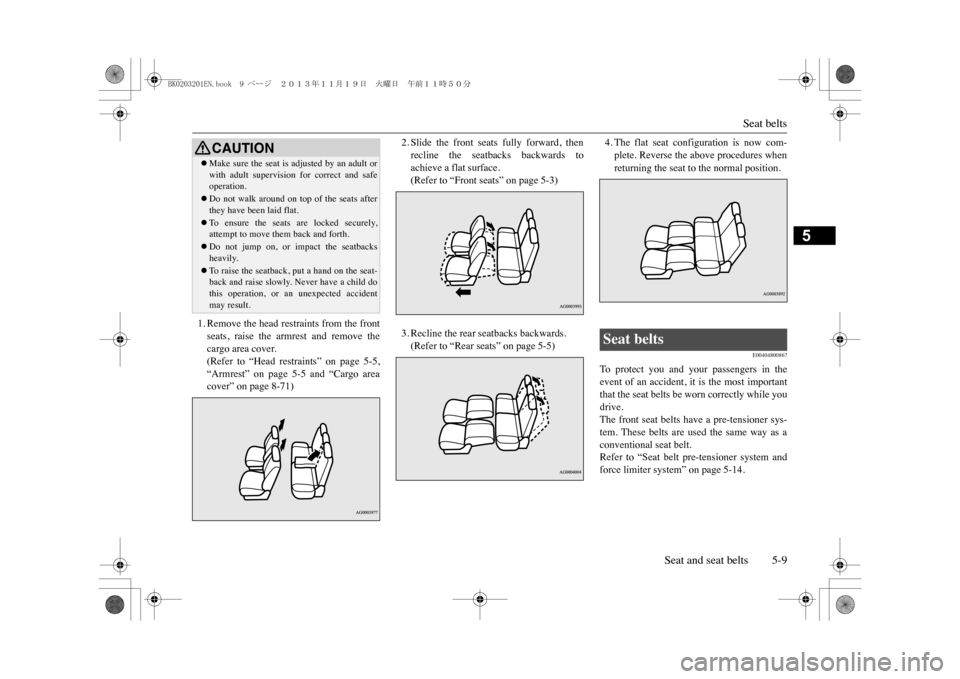
1. Remove the head restraints from the frontseats, raise the armrest and remove thecargo area cover.(Refer to “Head restraints” on page 5-5,“Armrest” on page 5-5 and “Cargo areacover” on page 8-71)
2. Slide the front seats fully forward, thenrecline the seatbacks backwards toachieve a flat surface.(Refer to “Front seats” on page 5-3)3. Recline the rear seatbacks backwards.(Refer to “Rear seats” on page 5-5)
4. The flat seat configuration is now com-plete. Reverse the above procedures whenreturning the seat to the normal position.
E00404800867
To p r o t e c t y o u a n d y o u r p a s s e n g e r s i n t h eevent of an accident, it is the most importantthat the seat belts be worn correctly while youdrive.The front seat belts have a pre-tensioner sys-tem. These belts are used the same way as aconventional seat belt.Refer to “Seat belt pre-tensioner system andforce limiter system” on page 5-14.
zMake sure the seat is adjusted by an adult orwith adult supervisi
on for correct and safe
operation.zDo not walk around on top of the seats afterthey have been laid flat.zTo e n s u r e t h e s e a t s
are locked securely,
attempt to move them back and forth.zDo not jump on, or impact the seatbacksheavily.zTo r a i s e t h e s e a t b a c k ,
put a hand on the seat-
back and raise slowly. Never have a child dothis operation, or an unexpected accidentmay result.CAUTION
Seat belts
BK0203201EN.book 9 ページ 2013年11月19日 火曜日 午前11時50分
Page 95 of 388
Child restraint5-16 Seat and seat belts
5
E00406600465
For infants small enough for infants seats, usea Standards Association of Australiaapproved baby restraint. For small childrenwhose height when seated allows the shoul-der belt to lie in contact with the face or thethroat, a child seat should be used.
E00406700307
Children who have outgrown the childrestraint system should be seated in the rearseat and wear combination lap shoulder belt.The lap portion of the belt should be snug andpositioned low on the abdomen so that it isbelow the top of the hip-bone. Otherwise, thebelt could intrude into the child’s abdomenduring an accident and cause injury.
E00406901931
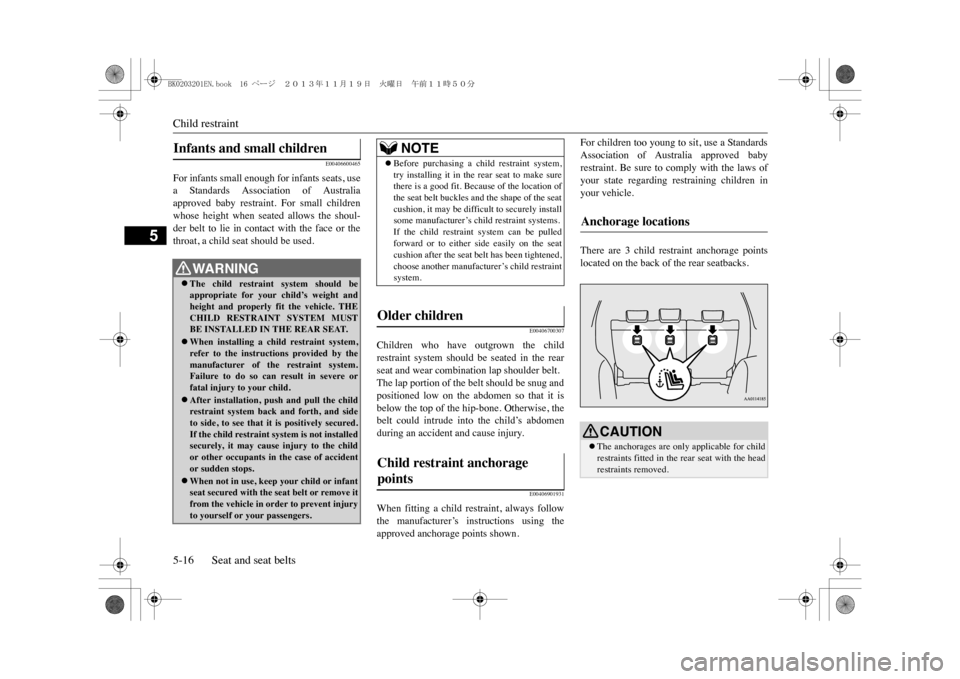
When fitting a child restraint, always followthe manufacturer’s instructions using theapproved anchorage points shown.
For children too young to sit, use a StandardsAssociation of Australia approved babyrestraint. Be sure to comply with the laws ofyour state regarding restraining children inyour vehicle.There are 3 child restraint anchorage pointslocated on the back of the rear seatbacks.
Infants and small children
WA R N I N GzThe child restraint system should beappropriate for your
child’s weight and
height and properly fit the vehicle. THECHILD RESTRAINT SYSTEM MUSTBE INSTALLED IN THE REAR SEAT.zWhen installing a child restraint system,refer to the instructions provided by themanufacturer of the restraint system.Failure to do so can result in severe orfatal injury to your child.zAfter installation, push and pull the childrestraint system back and forth, and sideto side, to see that it is positively secured.If the child restraint system is not installedsecurely, it may cause injury to the childor other occupants in the case of accidentor sudden stops.zWhen not in use, keep your child or infantseat secured with the seat belt or remove itfrom the vehicle in order to prevent injuryto yourself or
your passengers.
NOTE
zBefore purchasing a child restraint system,try installing it in the rear seat to make surethere is a good fit. Because of the location ofthe seat belt buckles and the shape of the seatcushion, it may be difficult to securely installsome manufacturer’s child restraint systems.If the child restraint system can be pulledforward or to either side easily on the seatcushion after the seat belt has been tightened,choose another manufacturer’s child restraintsystem.
Older children Child restraint anchorage points
Anchorage locations
CAUTIONzThe anchorages are only applicable for childrestraints fitted in the rear seat with the headrestraints removed.
BK0203201EN.book 16 ページ 2013年11月19日 火曜日 午前11時50分
Page 96 of 388
Child restraint
Seat and seat belts 5-17
5
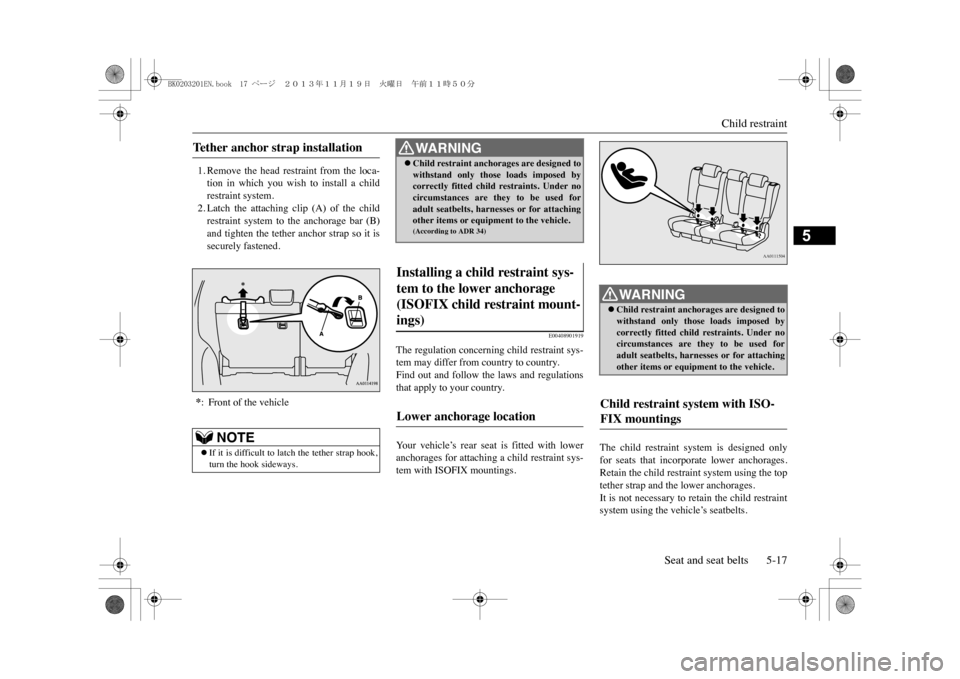
1. Remove the head restraint from the loca-tion in which you wish to install a childrestraint system.2. Latch the attaching clip (A) of the childrestraint system to the anchorage bar (B)and tighten the tether anchor strap so it issecurely fastened.
E00408901919
The regulation concerning child restraint sys-tem may differ from country to country.Find out and follow the laws and regulationsthat apply to your country.Yo u r v e h i c l e ’s r e a r s e a t i s f i t t e d w i t h l o w e ranchorages for attaching a child restraint sys-tem with ISOFIX mountings.
The child restraint system is designed onlyfor seats that incorporate lower anchorages.Retain the child restrain
t system using the top
tether strap and the lower anchorages.It is not necessary to retain the child restraintsystem using the vehicle’s seatbelts.
Te t h e r a n c h o r s t r a p i n s t a l l a t i o n *: Front of the vehicle
NOTE
zIf it is difficult to latch the tether strap hook,turn the hook sideways.
WA R N I N GzChild restraint anchorages are designed towithstand only those loads imposed bycorrectly fitted child restraints. Under nocircumstances are they to be used foradult seatbelts, harnesses or for attachingother items or equipment to the vehicle.(According to ADR 34)
Installing a child restraint sys-tem to the lower anchorage (ISOFIX child restraint mount-ings) Lower anchorage location
WA R N I N GzChild restraint anchorages are designed towithstand only those loads imposed bycorrectly fitted child restraints. Under nocircumstances are they to be used foradult seatbelts, harnesses or for attachingother items or equipment to the vehicle.
Child restraint system with ISO-FIX mountings
AA0111504
BK0203201EN.book 17 ページ 2013年11月19日 火曜日 午前11時50分
Page 328 of 388
![MITSUBISHI OUTLANDER SPORT 2014 3.G Owners Manual How to change a tyre
For emergencies 9-17
9
7. Turn the wheel nuts clockwise by hand toinitially tighten them.[Type 1: On vehicles with steel wheels]Te m p o r a r i l y t i g h t e n t h e w h](/manual-img/19/7545/w960_7545-327.png "MITSUBISHI OUTLANDER SPORT 2014 3.G Owners Manual How to change a tyre
For emergencies 9-17
9
7. Turn the wheel nuts clockwise by hand toinitially tighten them.[Type 1: On vehicles with steel wheels]Te m p o r a r i l y t i g h t e n t h e w h")
How to change a tyre
For emergencies 9-17
9
7. Turn the wheel nuts clockwise by hand toinitially tighten them.[Type 1: On vehicles with steel wheels]Te m p o r a r i l y t i g h t e n t h e w h e e l n u t s b yhand until the tapered parts of the wheelnuts make light contact with the seats ofthe wheel holes and the wheel is notloose.[Type 2: On vehicles with aluminiumwheels]Te m p o r a r i l y t i g h t e n t h e w h e e l n u t s b yhand until the flange parts of the wheelnuts make light contact with the wheeland the wheel is not loose.
8. Lower the vehicle slowly by rotating thewheel nut wrench anticlockwise until thetyre touches the ground.
9. Tighten the nuts in the order shown in theillustration until each nut has been tight-ened to the torque listed here.Tightening torque 88 to 108 N•m
10. On vehicles with wheel covers, install the
covers (refer to “Wheel covers” on page9-18).
11. Lower and remove the jack, then store the
jack, flat tyre, and chocks. Have yourdamaged tyre repaired as soon as possi-ble.
CAUTIONzNever apply oil to either the wheel bolts orthe nuts or they will tighten too much.
Ty p e 1Ty p e 2
NOTE
zOn vehicles with aluminium wheels, if all 4aluminium wheels are changed to steelwheels. e. g. when fitting winter tyres, usetapered nuts.
CAUTIONzNever use your foot or
a pipe extension for
extra force in the wheel nut wrench. If youdo so, you will tighten the nut too much.
BK0203201EN.book 17 ページ 2013年11月19日 火曜日 午前11時50分
Page 338 of 388
Cleaning the exterior of your vehicle
Vehicle care 10-3
10
E00900500207
1. To maintain the value of your new vehi-cle, handle the upholstery carefully andkeep the interior clean.Use a vacuum cleaner and brush to cleanthe seats. If stained, vinyl and syntheticleather should be cleaned with an appro-priate cleaner. Cloth fabrics can becleaned with either upholstery cleaner or amild soap and water solution.2. Clean the carpeting with a vacuumcleaner and remove any stains with carpetcleaner. Oil and grease can be removed bylightly dabbing with a clean colourfastcloth and stain remover.
E00900600950
1. To clean, lightly wipe the leather with asoft cloth soaked in a mild soap and watersolution.2. Dip cloth in fresh water and wring it outwell. Using this cloth, wipe off the deter-gent thoroughly.3. Apply leather protecting agent to the gen-uine leather surface.
E00900700108
If the following is left on your vehicle, it maycause corrosion, discolouration and stains,wash the vehicle as soon as possible.zSeawater, road deicing products.
zSoot and dust, iron powder from factories,chemical substance (acids, alkalis, coal-tar, etc.).zDroppings from birds, carcasses ofinsects, tree sap, etc.
E00900903547
Chemicals contained in the dirt and dustpicked up from the road surface can damagethe paint coat and body of your vehicle if leftin prolonged contact.Frequent washing and waxing is the best wayto protect your vehicle from this damage.This will also be effective in protecting itfrom environmental elements such as rain,snow, salt air, etc.Do not wash the vehicle in direct sunlight.Park the vehicle in the shade and spray it withwater to remove dust. Next, using an ampleamount of clean water and a car washingbrush or sponge, wash the vehicle from top tobottom.Use a mild car washing soap if necessary.Rinse thoroughly and wipe dry with a softcloth. After washing the vehicle, carefullyclean the joints and flanges of the doors, bon-net and other sections where dirt is likely toremain.
Upholstery Genuine leather
*
NOTE
zIf genuine leather is
wet with water or is
washed in water, wipe off water as quickly aspossible with a dry, soft cloth.If left damp, mildew may grow.zOrganic solvents such as benzine, kerosene,alcohol and petrol, acid or alkaline solventsmay discolour the genui
ne leather surface.
Be sure to use neutral detergents.zRemove dirty patche
s or oil substances
quickly as they can stain genuine leather.zThe genuine leather surface may harden andshrink if it is exposed to direct rays of thesun for long hours. When your vehicle isparked, place it in the shade as much as pos-sible.zWhen the temperature of the vehicle interiorrises in summer, vinyl products left on thegenuine leather seat may deteriorate andstick to the seat.
Cleaning the exterior of your vehicle
Was hi n g
BK0203201EN.book 3 ページ 2013年11月19日 火曜日 午前11時50分