2014 MITSUBISHI OUTLANDER SPORT oil
[x] Cancel search: oilPage 192 of 388
Emergency stop signal system*
Starting and driving 7-29
7
E00626001073
This is a device that reduces the possibility ofrear end collisions by the rapid and automaticblinking of the hazard warning lamps to alertvehicles approaching from behind duringsudden braking. When the emergency stopsignal system operates, the hazard warningindicator lamp in the instrument clusterblinks rapidly at the same time.
E00607102489
Environmental conditions can have an effecton braking. During sudden braking whenthere is snow, ice, oil, water etc. on the roadsurface, a skid may occur. In this situation,steering control and braking effectiveness isreduced and the stopping distance isincreased. The vehicle may also go into anuncontrolled spin.The ABS helps prevent the wheels from lock-ing during braking, thus maintaining direc-
tional stability, ensuring controllability andproviding optimum braking force.zAlways maintain the same distance fromthe vehicle in front of you as you wouldfor a vehicle not equipped with ABS.Compared with vehicles not fitted withABS, your vehicle may require a longerstopping distance in the following cases:•Driving on gravel or snow-coveredroads.• Driving with snow traction device (tyrechains) installed.•Driving on roads where the road surfaceis pitted or has other differences in sur-face height.• Driving on bumpy roads or other poordriving surfaces.
zOperation of ABS is not restricted to situ-ations where brakes are applied suddenly.This system may also operate to preventwheel lock when you are driving overmanholes, steel road-work plates, or thevehicle is driven over steps or level differ-ences in the road, road markings, or othersurfaces which are difficult for the wheelsto grip.
Emergency stop signal sys-tem
*CAUTIONzIf the ABS warning or ASC warning is dis-played, the emergency stop signal systemmay not operate. Refer to “ABS warninglamp/display” on page 7-30.Refer to “ASC warn
ing display” on page
7-34.NOTE
z[Activating condition for the emergency stopsignal system]It activates when all
of the following condi-
tions are met.•The vehicle speed is approximately 55km/h or higher.
•The brake pedal has been depressed, andthe system judges that it was sudden brak-ing from the vehicle deceleration and theoperating condition of the anti-lock brakesystem (ABS).[Deactivating condition for the emergencystop signal system]It deactivates when one of the following con-ditions is met.•The brake pedal is released.• The hazard warning flasher switch ispressed.•The system judges that it was not suddenbraking from the vehicle deceleration andthe operating condition of the anti-lockbrake system (ABS).
Anti-lock brake system (ABS)
NOTE
Operating hints
BK0203201EN.book 29 ページ 2013年11月19日 火曜日 午前11時50分
Page 231 of 388
Rear-view camera*7-68 Starting and driving
7
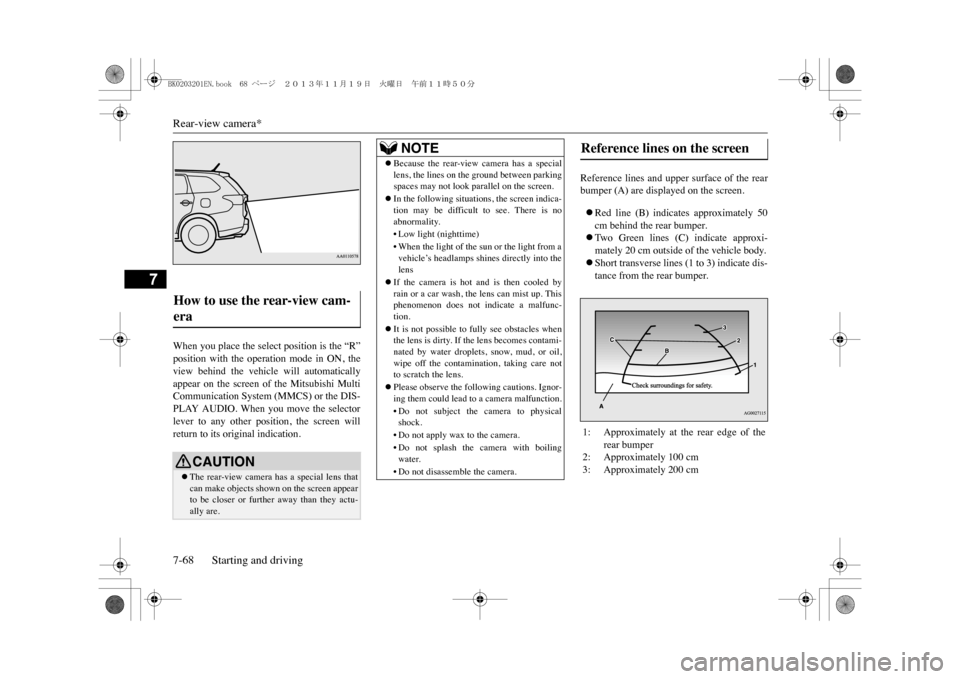
When you place the select position is the “R”position with the operation mode in ON, theview behind the vehicle will automaticallyappear on the screen of the Mitsubishi MultiCommunication System (MMCS) or the DIS-PLAY AUDIO. When you move the selectorlever to any other position, the screen willreturn to its original indication.
Reference lines and upper surface of the rearbumper (A) are displayed on the screen. zRed line (B) indicates approximately 50cm behind the rear bumper.zTw o G r e e n l i n e s ( C ) i n d i c a t e a p p r o x i -mately 20 cm outside of the vehicle body.zShort transverse lines (1 to 3) indicate dis-tance from the rear bumper.
How to use the rear-view cam-era
CAUTIONzThe rear-view camera has a special lens thatcan make objects show
n on the screen appear
to be closer or further away than they actu-ally are.
NOTE
zBecause the rear-view camera has a speciallens, the lines on the
ground between parking
spaces may not look parallel on the screen.zIn the following situations, the screen indica-tion may be difficult to see. There is noabnormality.•Low light (nighttime)•When the light of the sun or the light from avehicle’s headlamps shin
es directly into the
lens
zIf the camera is hot and is then cooled byrain or a car wash, the lens can mist up. Thisphenomenon does not i
ndicate a malfunc-
tion.zIt is not possible to
fully see obstacles when
the lens is dirty. If the lens becomes contami-nated by water droplets, snow, mud, or oil,wipe off the contamination, taking care notto scratch the lens.zPlease observe the following cautions. Ignor-ing them could lead to a camera malfunction.•Do not subject the camera to physicalshock.•Do not apply wax to the camera.•Do not splash the camera with boilingwater.•Do not disassemble the camera.
Reference lines on the screen
1: Approximately at the rear edge of the
rear bumper
2: Approximately 100 cm3: Approximately 200 cm
BK0203201EN.book 68 ページ 2013年11月19日 火曜日 午前11時50分
Page 236 of 388
Towing caravans and trailersStarting and driving 7-73
7
allow air to cool the brakes between applica-tions.Furthermore, it might be able to reduce theload of the brakes by using the regenerativebrake force.Leave plenty of room between the front ofyour vehicle and the preceding vehicle.If the caravan begins to sway or becomes dif-ficult to handle, gently slow down or applythe independent trailer brakes (if fitted) NOTthe vehicle brakes. Stop the vehicle andtrailer in a safe location. Examine the tyres ofthe trailer closely for damage. If you find thedamage of tyre, it is recommended that tyresbe inspected by a MITSUBISHI MOTORSAuthorised Service Point or a tyre retailerbefore proceeding further. Note that treadseparation [separation of the tread band fromthe body of the tyre] of trailer tyres which areaged, and/or loaded near their load limit, canbe difficult to detect, especially on caravanswhere tyres are covered.One cause of swaying is poor trailer balanceand until this has been overcome the swayingwill recur. Relocate the load in your trailer orcaravan and re-assess the problem.If the wheels of your vehicle, the trailer orcaravan leave the road surface and enter the
unsealed edge of the road, resist the urge topull it back quickly. Wait for a section wherethe levels of the road and unsealed edge arecomparable and then ease back onto thesealed section of the road with as little swayas possible.Try to maximise the distance between yourcaravan and passing or overtaking semi-trail-ers or other heavy vehicles. This will reducethe suction forces between the two and mini-mise disturbance of the caravan.Do not apply the brakes severely, be alert andanticipate trouble far enough ahead to enableyou to apply the brakes smoothly and evenly.Do not make any manoeuvres before ensuringthat the road behind and in front of your vehi-cle is clear.This will normally occur as a result of somemechanical failure. If your vehicle shouldoverheat, stop and check for a loose or brokenwater pump drive belt/ oil pump/cooling oil, ablocked radiator air intake or a low coolantlevel. If these items are satisfactory the over-heating could be caused by a number of
mechanical causes that would have to bechecked at a MITSUBISHI MOTORSAuthorised Service Point.If your vehicle is in good mechanical condi-tion and it overheats due to heavy traffic con-ditions or high air temperatures, additionalcooling may be obtained by the followingmethods:zReduce your speed by 15 km/h if towingat high speeds.
Normal cruising
Braking Overheating
CAUTIONzIf the engine overheats,
reference should be
made to “Engine overheating” section of“For emergencies” prior to taking any cor-rective action.
BK0203201EN.book 73 ページ 2013年11月19日 火曜日 午前11時50分
Page 317 of 388
Tools and jack9-6 For emergencies
9
5. Add coolant to the radiator and/or reservetank if necessary. (Refer to the “Mainte-nance” section.)6. Examine the radiator hoses for coolantleakage and the drive belt for looseness ordamage.If there is anything wrong with the cool-ing system or drive belt, we recommendyou to have it checked and repaired.
E00800902507
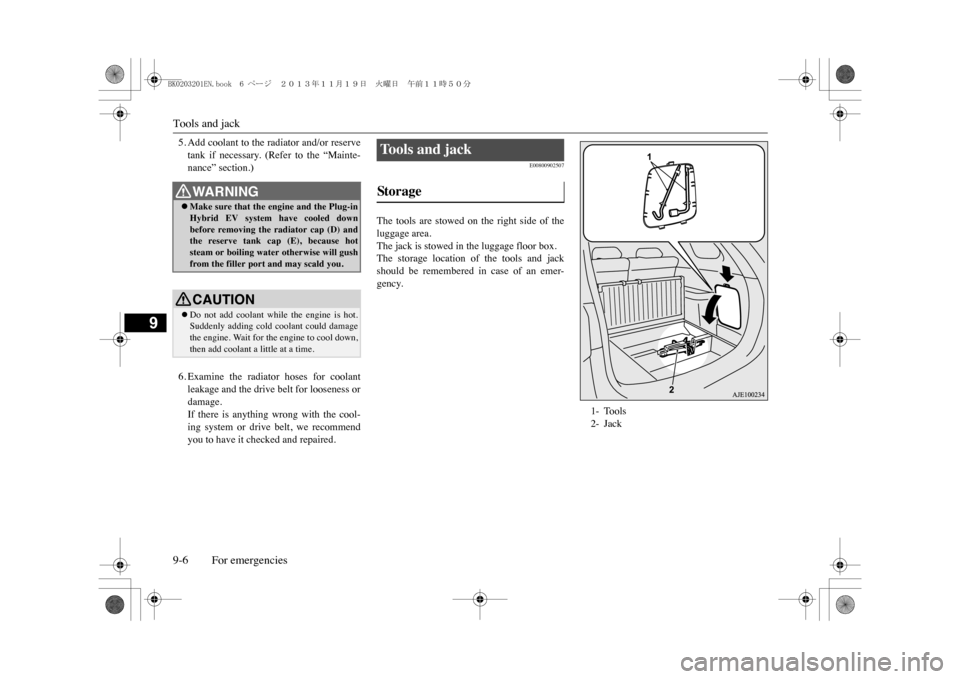
The tools are stowed on the right side of theluggage area.The jack is stowed in the luggage floor box.The storage location of the tools and jackshould be remembered in case of an emer-gency.
WA R N I N GzMake sure that the engine and the Plug-inHybrid EV system
have cooled down
before removing the
radiator cap (D) and
the reserve tank cap (E), because hotsteam or boiling water otherwise will gushfrom the filler port and may scald you.CAUTIONzDo not add coolant while the engine is hot.Suddenly adding cold
coolant could damage
the engine. Wait for the engine to cool down,then add coolant a little at a time.
To o l s a n d j a c k Stor age
1- Tools2- Jack
BK0203201EN.book 6 ページ 2013年11月19日 火曜日 午前11時50分
Page 328 of 388
![MITSUBISHI OUTLANDER SPORT 2014 3.G Owners Manual How to change a tyre
For emergencies 9-17
9
7. Turn the wheel nuts clockwise by hand toinitially tighten them.[Type 1: On vehicles with steel wheels]Te m p o r a r i l y t i g h t e n t h e w h](/manual-img/19/7545/w960_7545-327.png "MITSUBISHI OUTLANDER SPORT 2014 3.G Owners Manual How to change a tyre
For emergencies 9-17
9
7. Turn the wheel nuts clockwise by hand toinitially tighten them.[Type 1: On vehicles with steel wheels]Te m p o r a r i l y t i g h t e n t h e w h")
How to change a tyre
For emergencies 9-17
9
7. Turn the wheel nuts clockwise by hand toinitially tighten them.[Type 1: On vehicles with steel wheels]Te m p o r a r i l y t i g h t e n t h e w h e e l n u t s b yhand until the tapered parts of the wheelnuts make light contact with the seats ofthe wheel holes and the wheel is notloose.[Type 2: On vehicles with aluminiumwheels]Te m p o r a r i l y t i g h t e n t h e w h e e l n u t s b yhand until the flange parts of the wheelnuts make light contact with the wheeland the wheel is not loose.
8. Lower the vehicle slowly by rotating thewheel nut wrench anticlockwise until thetyre touches the ground.
9. Tighten the nuts in the order shown in theillustration until each nut has been tight-ened to the torque listed here.Tightening torque 88 to 108 N•m
10. On vehicles with wheel covers, install the
covers (refer to “Wheel covers” on page9-18).
11. Lower and remove the jack, then store the
jack, flat tyre, and chocks. Have yourdamaged tyre repaired as soon as possi-ble.
CAUTIONzNever apply oil to either the wheel bolts orthe nuts or they will tighten too much.
Ty p e 1Ty p e 2
NOTE
zOn vehicles with aluminium wheels, if all 4aluminium wheels are changed to steelwheels. e. g. when fitting winter tyres, usetapered nuts.
CAUTIONzNever use your foot or
a pipe extension for
extra force in the wheel nut wrench. If youdo so, you will tighten the nut too much.
BK0203201EN.book 17 ページ 2013年11月19日 火曜日 午前11時50分
Page 330 of 388
Towing
For emergencies 9-19
9
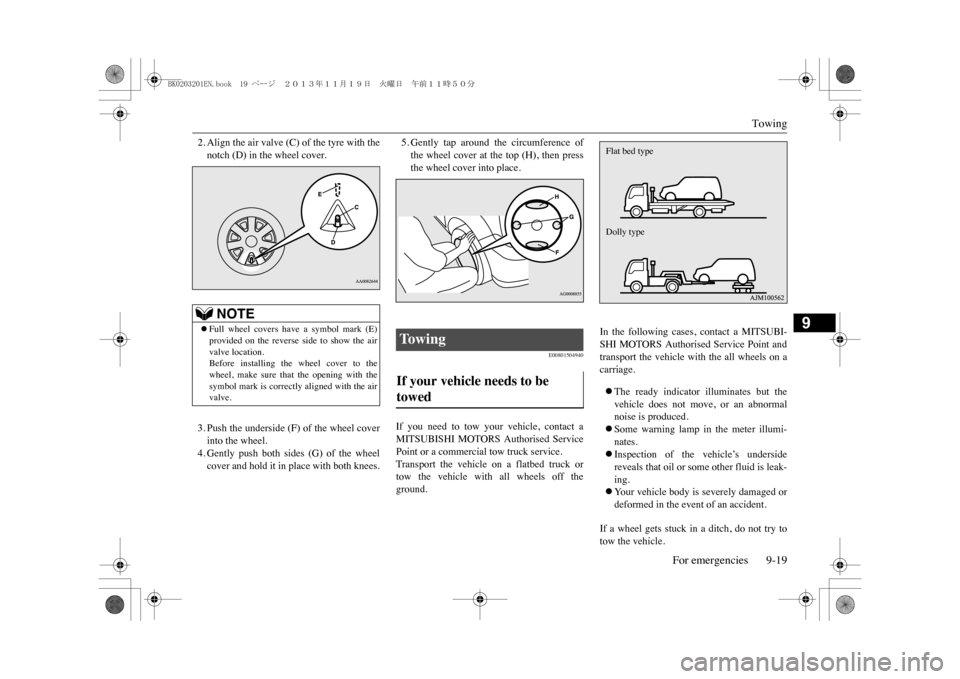
2. Align the air valve (C) of the tyre with thenotch (D) in the wheel cover.3. Push the underside (F) of the wheel coverinto the wheel.4. Gently push both sides (G) of the wheelcover and hold it in place with both knees.
5. Gently tap around the circumference ofthe wheel cover at the top (H), then pressthe wheel cover into place.
E00801504940
If you need to tow your vehicle, contact aMITSUBISHI MOTORS Authorised ServicePoint or a commercial tow truck service.Transport the vehicle on a flatbed truck ortow the vehicle with all wheels off theground.
In the following cases, contact a MITSUBI-SHI MOTORS Authorised Service Point andtransport the vehicle with the all wheels on acarriage.zThe ready indicator illuminates but thevehicle does not move, or an abnormalnoise is produced.zSome warning lamp in the meter illumi-nates.zInspection of the vehicle’s undersidereveals that oil or some other fluid is leak-ing.zYo u r v e h i c l e b o d y i s s e v e r e l y d a m a g e d o rdeformed in the event of an accident.
If a wheel gets stuck in a ditch, do not try totow the vehicle.
NOTE
zFull wheel covers have a symbol mark (E)provided on the reverse side to show the airvalve location.Before installing the wheel cover to thewheel, make sure that the opening with thesymbol mark is correctly aligned with the airvalve.
To w i n g If your vehicle needs to be towed
Flat bed typeDolly type
BK0203201EN.book 19 ページ 2013年11月19日 火曜日 午前11時50分
Page 338 of 388
Cleaning the exterior of your vehicle
Vehicle care 10-3
10
E00900500207
1. To maintain the value of your new vehi-cle, handle the upholstery carefully andkeep the interior clean.Use a vacuum cleaner and brush to cleanthe seats. If stained, vinyl and syntheticleather should be cleaned with an appro-priate cleaner. Cloth fabrics can becleaned with either upholstery cleaner or amild soap and water solution.2. Clean the carpeting with a vacuumcleaner and remove any stains with carpetcleaner. Oil and grease can be removed bylightly dabbing with a clean colourfastcloth and stain remover.
E00900600950
1. To clean, lightly wipe the leather with asoft cloth soaked in a mild soap and watersolution.2. Dip cloth in fresh water and wring it outwell. Using this cloth, wipe off the deter-gent thoroughly.3. Apply leather protecting agent to the gen-uine leather surface.
E00900700108
If the following is left on your vehicle, it maycause corrosion, discolouration and stains,wash the vehicle as soon as possible.zSeawater, road deicing products.
zSoot and dust, iron powder from factories,chemical substance (acids, alkalis, coal-tar, etc.).zDroppings from birds, carcasses ofinsects, tree sap, etc.
E00900903547
Chemicals contained in the dirt and dustpicked up from the road surface can damagethe paint coat and body of your vehicle if leftin prolonged contact.Frequent washing and waxing is the best wayto protect your vehicle from this damage.This will also be effective in protecting itfrom environmental elements such as rain,snow, salt air, etc.Do not wash the vehicle in direct sunlight.Park the vehicle in the shade and spray it withwater to remove dust. Next, using an ampleamount of clean water and a car washingbrush or sponge, wash the vehicle from top tobottom.Use a mild car washing soap if necessary.Rinse thoroughly and wipe dry with a softcloth. After washing the vehicle, carefullyclean the joints and flanges of the doors, bon-net and other sections where dirt is likely toremain.
Upholstery Genuine leather
*
NOTE
zIf genuine leather is
wet with water or is
washed in water, wipe off water as quickly aspossible with a dry, soft cloth.If left damp, mildew may grow.zOrganic solvents such as benzine, kerosene,alcohol and petrol, acid or alkaline solventsmay discolour the genui
ne leather surface.
Be sure to use neutral detergents.zRemove dirty patche
s or oil substances
quickly as they can stain genuine leather.zThe genuine leather surface may harden andshrink if it is exposed to direct rays of thesun for long hours. When your vehicle isparked, place it in the shade as much as pos-sible.zWhen the temperature of the vehicle interiorrises in summer, vinyl products left on thegenuine leather seat may deteriorate andstick to the seat.
Cleaning the exterior of your vehicle
Was hi n g
BK0203201EN.book 3 ページ 2013年11月19日 火曜日 午前11時50分
Page 340 of 388
Cleaning the exterior of your vehicle
Vehicle care 10-5
10
The salt and other chemicals spread on theroads in some areas in winter can have aharmful effect on the vehicle body. Youshould therefore wash the vehicle as often aspossible in accordance with our care-instruc-tions. It is recommended to have a preserva-tive applied and the underfloor protectionchecked before and after the cold weatherseason.After washing your vehicle, wipe off allwaterdrops from the rubber parts around thedoors to prevent the doors from freezing.
E00901000919
Wa x i n g t h e v e h i c l e w i l l h e l p p r e v e n t t h eadherence of dust and road chemicals to thepaintwork. Apply a wax solution after wash-ing the vehicle, or at least once every threemonths to assist di
splacing of water.
Do not wax your vehicle in direct sunlight.Yo u s h o u l d w a x a f t e r t h e s u r f a c e s h a v ecooled.For information on how to use wax refer tothe instruction manual of the wax.
E00901100066
The vehicle should only be polished if thepaintwork has become stained or lost its lus-tre. Do not polish parts with a mat coatingand the plastic bumpers. Doing so couldcause stains or damage the finish.
E00901300808
Use a sponge or chamois leather.If a car wax adheres on a grey or black roughsurface of the bumper, moulding or lamps,the surface becomes white. In such a case,wipe it off using lukewarm water and softcloth or chamois leather.
E00901400098
In order to prevent spots and corrosion ofchrome parts, wash with water, dry thor-oughly, and apply a special protective coat-ing. This should be done more frequently inwinter.
•If your vehicle is equi
pped with a roof rails,
consult a car wash opera
tor before using the
car washer.•If your vehicle has rain
sensor wipers, place
the wiper switch lever in the “OFF” posi-tion to deactivate the rain sensor.
During cold weather
NOTE
zTo p r e v e n t f r e e z i n g o f
the weatherstripping
on the doors, bonnet, etc., they should betreated with silicone spray.CAUTION
Wa x in g
CAUTIONzWa x e s c o n t a i n i n g h i
gh abrasive compounds
should not be used.zOn vehicles with the sunroof, be carefulwhen waxing the area around the sunroofopening, not to put any wax on the weather-strip (black rubber). If stained with wax, theweatherstrip cannot maintain a weatherproofseal with the sunroof.
Polishing
Cleaning plastic parts
CAUTIONzDo not use a scrubbing brush or other hardtools as they may damage the plastic partsurface.zDo not bring the plastic parts into contactwith petrol, light oil,
brake fluids, engine
oils, greases, paint thinners, and sulphuricacid (battery electrolyte) which may crack,stain or discolour
the plastic parts.
If they touch the plastic
parts, wipe them off
with soft cloth, chamois or the like and anaqueous solution of neutral detergent thenimmediately rinse the affected parts withwater.
Chrome parts
BK0203201EN.book 5 ページ 2013年11月19日 火曜日 午前11時50分