Page 146 of 420

WARNING
Remember that in the event of a violent
impact the rear seat passengers not
wearing seat belts are exposed to a very serious
risk and also represent a serious danger for
the front seat occupants.
IMPORTANT When putting the back seats back to
their normal position, make sure the seat belts
are positioned so they are ready to use.
S.B.R. SYSTEM (Seat Belt Reminder)This system consists of a device which, in
conjunction with the
fig. 133 warning light coming
on (initially in fixed mode with continuous acoustic
signal and then in flashing mode with intermittent
acoustic signal), warns the driver and front passenger
that their seat belts have not been fastened.
For long-term deactivation of the SBR system,
contact a Fiat Dealership. The SBR system can be
reactivated at any time through the display Setup
Menu (see “Knowing your car” section).
fig. 133
F0Y0116
142GETTING TO KNOW
YOUR CAR
SAFETY
STARTING AND
DRIVING
WARNING LIGHTS
AND MESSAGES
IN AN EMERGENCY
SERVICING AND
MAINTENANCE
TECHNICAL
SPECIFICATIONS
INDEX
Page 147 of 420

DRIVER
If the driver is the only occupant and the seat belt is
not fastened, when 20 km/h is exceeded or when
travelling at a speed from 10 to 20 km/h for longer
than 5 seconds, an acoustic signal sequence will
be started (front seats) consisting of a tone for 6
seconds followed by a 90 second beep. The
warning light will flash.
The warning light will stay on constantly at the end
of the cycle until the engine is stopped. The acoustic
signal will be interrupted immediately when the
driver's seat belt is fastened and the warning light will
switch off.
The reminder cycle (acoustic and visual) will be
repeated as described above if the seat belt is
unfastened while travelling.
PASSENGER
A similar solution applies for the passenger, but the
indication is interrupted also when the passenger
leaves the car.
If both the front seat belts are unfastened with car in
motion and within a few seconds one from the
other, the acoustic signal and activation of the
warning light will refer to the most recent event.
PRETENSIONERSThe car is equipped with front seat belts
pretensioners, that reduce slack in the belts in the
event of a severe frontal impact. This guarantees the
perfect adherence of the seat belts to the occupants'
bodies before the restraining action begins.
It is evident that the pretensioners have been
activated when the belt withdraws toward the
retractor.
This car is also equipped with a second pretensioner
(in the kick plate area). Its activation is signalled by
the shortening of the metal cable.
A slight discharge of smoke may be produced during
the activation of the pretensioner which is not
harmful and does not involve any fire hazard.
IMPORTANT To obtain the highest degree of
protection from the action of the pretensioner, wear
the seat belt tight to the chest and pelvis.
The pretensioner does not require any maintenance
or lubrication: any changes to its original conditions
will invalidate its efficiency. If, due to unusual natural
events (floods, sea storms, etc.), the device has
been affected by water and mud, it must be replaced.
143GETTING TO KNOW
YOUR CARSAFETYSTARTING AND
DRIVING
WARNING LIGHTS
AND MESSAGES
IN AN EMERGENCY
SERVICING AND
MAINTENANCE
TECHNICAL
SPECIFICATIONS
INDEX
Page 149 of 420

WARNING
For maximum safety, keep the back of
your seat upright , lean back into it
and make sure the seat belt fits closely across
your chest and pelvis. Always fasten the seat
belts on both the front and the rear seats!
Travelling without wearing seat belts will
increase the risk of serious injury and even
death in the event of an accident .
WARNING
Removing or otherwise tampering with
seat belt and pretensioner components
is strictly prohibited. Any operations on these
components must be performed by qualified
and authorised technicians. Always contact
a Fiat Dealership.
The belt must not be twisted. The upper part must
pass over the shoulder and cross the chest diagonally.
The lower part must adhere to the pelvis (as shown
in fig. 135) rather than the abdomen of the occupant.
Never use devices (clips, clamps, etc.) to hold the
seat belt away from your body.Each seat belt must be used by only one person.
Never travel with a child sitting on the passenger's
lap and a single belt to protect them both fig. 136. In
general, do not place any objects between the
person and the belt.
fig. 135
F0Y0015
fig. 136
F0Y0016
145GETTING TO KNOW
YOUR CARSAFETYSTARTING AND
DRIVING
WARNING LIGHTS
AND MESSAGES
IN AN EMERGENCY
SERVICING AND
MAINTENANCE
TECHNICAL
SPECIFICATIONS
INDEX
Page 153 of 420
FITTING "UNIVERSAL" CHILD
RESTRAINT SYSTEM
(with seat belts)GROUP 0 and 0+
WARNING
The figure is indicative and for assembly
purposes only. Fit the child restraint
system according to the instructions, which must
be included with this type of restraint system.
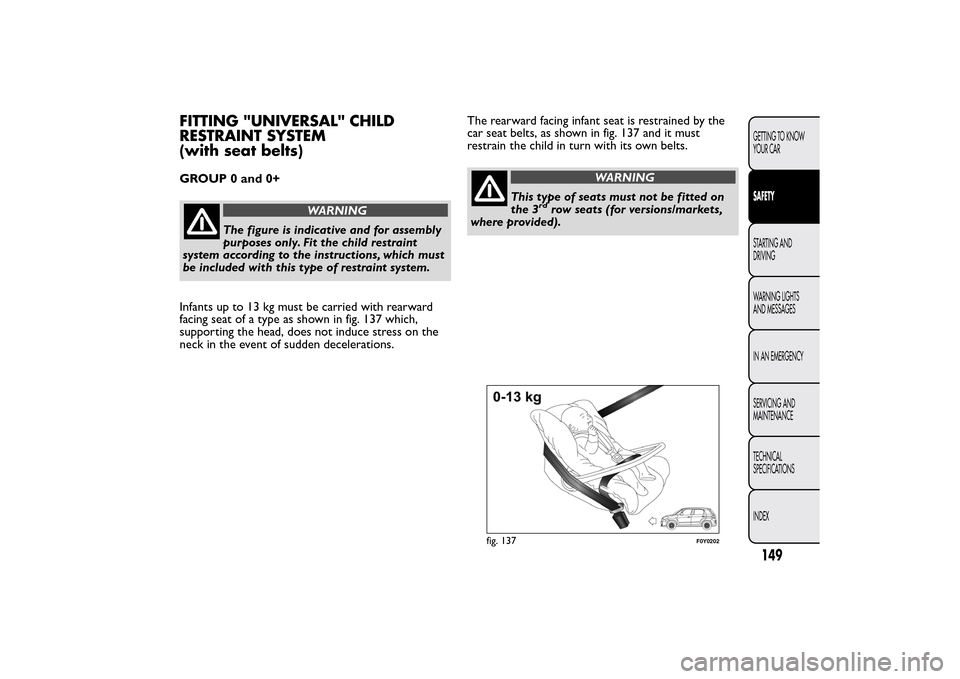
Infants up to 13 kg must be carried with rearward
facing seat of a type as shown in fig. 137 which,
supporting the head, does not induce stress on the
neck in the event of sudden decelerations.The rearward facing infant seat is restrained by the
car seat belts, as shown in fig. 137 and it must
restrain the child in turn with its own belts.
WARNING
This type of seats must not be fitted on
the 3
rd
row seats (for versions/markets,
where provided).
fig. 137
F0Y0202
149GETTING TO KNOW
YOUR CARSAFETYSTARTING AND
DRIVING
WARNING LIGHTS
AND MESSAGES
IN AN EMERGENCY
SERVICING AND
MAINTENANCE
TECHNICAL
SPECIFICATIONS
INDEX
Page 154 of 420
GROUP 1
WARNING
The figure is indicative and for assembly
purposes only. Fit the child restraint
system according to the instructions, which must
be included with this type of restraint system.
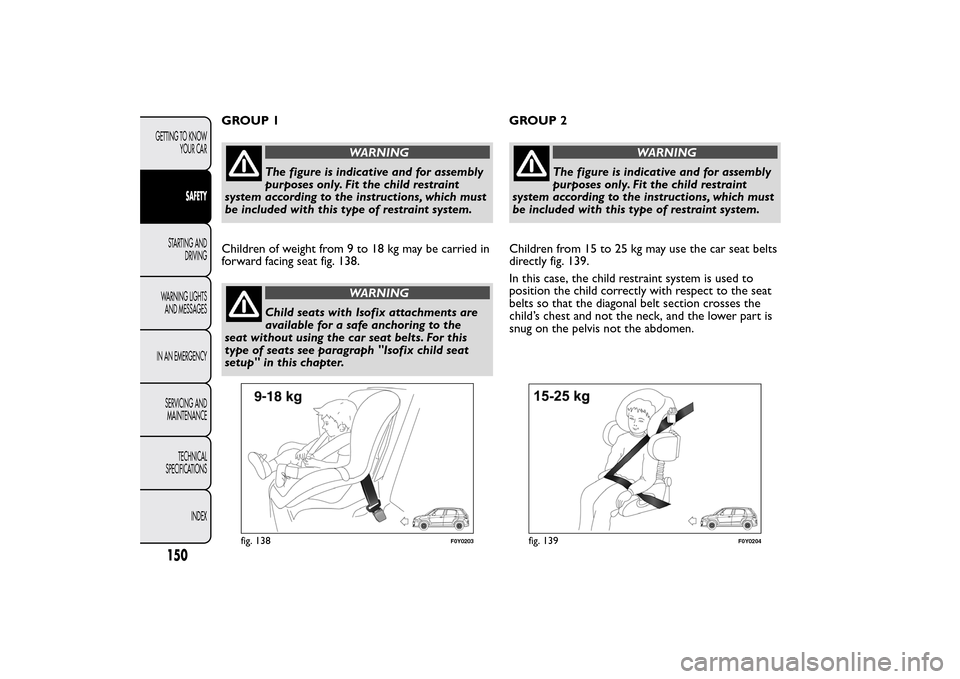
Children of weight from 9 to 18 kg may be carried in
forward facing seat fig. 138.
WARNING
Child seats with Isofix attachments are
available for a safe anchoring to the
seat without using the car seat belts. For this
type of seats see paragraph "Isofix child seat
setup" in this chapter.GROUP 2
WARNING
The figure is indicative and for assembly
purposes only. Fit the child restraint
system according to the instructions, which must
be included with this type of restraint system.
Children from 15 to 25 kg may use the car seat belts
directly fig. 139.
In this case, the child restraint system is used to
position the child correctly with respect to the seat
belts so that the diagonal belt section crosses the
child’s chest and not the neck, and the lower part is
snug on the pelvis not the abdomen.
fig. 138
F0Y0203
fig. 139
F0Y0204
150GETTING TO KNOW
YOUR CAR
SAFETY
STARTING AND
DRIVING
WARNING LIGHTS
AND MESSAGES
IN AN EMERGENCY
SERVICING AND
MAINTENANCE
TECHNICAL
SPECIFICATIONS
INDEX
Page 156 of 420
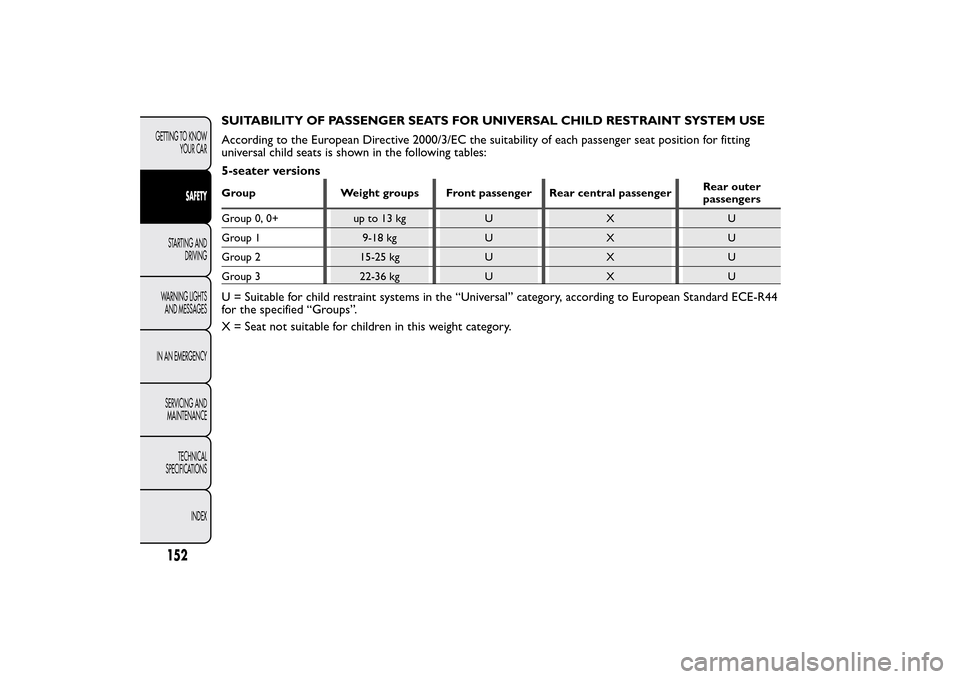
SUITABILITY OF PASSENGER SEATS FOR UNIVERSAL CHILD RESTRAINT SYSTEM USE
According to the European Directive 2000/3/EC the suitability of each passenger seat position for fitting
universal child seats is shown in the following tables:
5-seater versionsGroup Weight groups Front passenger Rear central passengerRear outer
passengers
Group 0, 0+ up to 13 kg U X U
Group 1 9-18 kg U X U
Group 2 15-25 kg U X U
Group 3 22-36 kg U X UU = Suitable for child restraint systems in the “Universal” category, according to European Standard ECE-R44
for the specified “Groups”.
X = Seat not suitable for children in this weight category.
152GETTING TO KNOW
YOUR CAR
SAFETY
STARTING AND
DRIVING
WARNING LIGHTS
AND MESSAGES
IN AN EMERGENCY
SERVICING AND
MAINTENANCE
TECHNICAL
SPECIFICATIONS
INDEX
Page 158 of 420

ISOFIX CHILD RESTRAINT SYSTEMThe car is equipped with ISOFIX anchorages, a new
standard which makes fitting a child restraint system
quick, simple and safe.
Isofix systems can be fitted alongside Universal child
restraint systems to different seats of the same
vehicle.
An example of a Universal Isofix child restraint
system for weight group 1 is shown in fig. 134.
fig. 141
WARNING
The figure is indicative and for assembly
purposes only. Secure the child restraint
system according to the instructions, which must
be included with this type of restraint system.
The other weight groups are covered by specific
Isofix child restraint systems, which can be used only
if specifically approved for this car (see list of cars
provided with the child restraint system).IMPORTANT The central rear seat (for versions/
markets, where provided) is not approved for any
type of Isofix child restraint systems.
fig. 141
F0Y0201
154GETTING TO KNOW
YOUR CAR
SAFETY
STARTING AND
DRIVING
WARNING LIGHTS
AND MESSAGES
IN AN EMERGENCY
SERVICING AND
MAINTENANCE
TECHNICAL
SPECIFICATIONS
INDEX
Page 160 of 420

SUITABILITY OF PASSENGER SEATS FOR ISOFIX CHILD RESTRAINT SYSTEM USE
The table below shows the various installation possibilities for Isofix child restraint systems on seats fitted
with Isofix anchorages in accordance with European standard ECE 16.Weight group Child seat position Isofix size class Rear side passengers
Group0–upto10kg Rearwardfacing E
IL
Group0+–upto13kgRearward facing E
IL
Rearward facing D
IL
Rearward facing C
IL (*)
Group1–from9upto
18 kgRearward facing D
IL
Rearward facing C
IL (*)
Forward facing B
IUF
Forward facing BI
IUF
Forward facing A
IUF
IL : suitable for ISOFIX child restraint systems of the categories for "specific vehicles", "restricted", or "semiuniversal", approved for
this type of vehicle.
(*) : the Isofix child restraint system can be installed by adjusting the front seat.
IUF: suitable for forward facing Isofix child restraint systems in the Universal category and type-approved for the use in the weight
group.
156GETTING TO KNOW
YOUR CAR
SAFETY
STARTING AND
DRIVING
WARNING LIGHTS
AND MESSAGES
IN AN EMERGENCY
SERVICING AND
MAINTENANCE
TECHNICAL
SPECIFICATIONS
INDEX