2014 AUDI RS7 SPORTBACK abs
[x] Cancel search: absPage 192 of 292
190 Intelligent technology
differential lock (EDL), dynamic steering* and
selective whee l torque control. ESC is switch
ed on all the t ime. In certa in situations when
you need less traction, you can switch off ASR
by pressing the button
[ill c> page 191,
fig. 180. Be sure to switch ASR on again when
you no longe r need less traction .
Anti-loc k br ak ing system (ABS)
ABS prevents the wheels from locking up
when braking. The vehicle can still be steered
even during hard brak ing. Apply steady pres
sure to the brake pedal. Do not pump the ped
al. A puls ing in the brake pedal ind icates that
the system is he lp ing you to b rake the vehicle.
B rake as sist sys tem
The brake assist system can decrease braking
d istance. It increases braking power when the
driver presses the brake pedal quick ly in emer
gency situations. You must p ress and hold the
b rake pedal until the situation is over. I n
vehicles w ith adaptive cru ise cont rol*, the
b rake assist system is more sens it ive if the
d istance detected to the vehicle ahead is too
smal l.
Anti-slip regulation (ASR)
ASR reduces engi ne power when the d rive
wheels begin to spin and ad apts the fo rce to
the road condit ions. This makes i t easier to
start, accelerate and drive up hills .
Electronic differential lock (EDL)
The EDL brakes wheels that are spinning and
transfers the d rive powe r to the other d rive
wheel o r whee ls if the vehi cle is equipped wi th
a ll-w hee l drive* . This function is available up
to about 75 mph (120 km/h).
I n extreme cases, ED L automat ica lly swit ches
off to help keep the brake o n the braked whee l
from overheating . EDL wi ll switch on again au
tomatically when conditions have returned to
norma l.
Dynamic steering*
On vehi cles w ith dy namic stee ring*, ESC helps
stabilize the steering i n critical s ituations.
Selective wheel torque control
T he sele ctive whee l torq ue con trol ope rates
when driving through c urves . The front whee l
on the inside of th e curve o r both wheels on
the inside of the curve are braked selectively
as needed. This minimizes sliding in the front
whee ls and allows for more precise driving
t hr ough curves. The appl icable system may
not act ivate when dr iv ing in wet or snowy con
ditions .
,&. WARNING
-ESC, ABS, ASR, EDL, dy namic steeri ng*
and the select ive wheel torq ue con trol
c a nnot ove rcome the laws of physics.
T his is especially important on slippery
or wet roads.
If the systems begin acting
to stabilize your veh icle, yo u should im
mediately change your speed to match
the road and traffic conditions. Do not
let the increased safety provided by
these systems tempt you to take r isks.
Doing so will increase the risk of a loss of
veh icle cont ro l, collision and ser ious per
sonal injur ies.
- Always adapt your speed to road, traffic
and wea ther conditions. The risk of los
ing con trol of t he vehicle increases when
d riving too fast, espec ially through
curves and on slippery or wet roads, and
when dr iving too close to vehicles up
ahead. ESC, ABS, the brake assist sys
tem, ASR, EDL, dynam ic steering* and
the selective wheel torque contro l can
not prevent collisions .
- Always accelerate with special care on
even, smooth su rfaces such as those that
are wet or covered with ice and snow .
The drive wheels can spin eve n w ith
these assistan ce systems that cannot al
ways he lp to re duce the risk of loss of ve
h icle control.
(D Tips
- ABS and ASR o nly wo rk correctly when
all four wheels are equipped with identi
cal tires. D iffe ren t tire si zes can lead to a
reduction in engine power.
-
...
Page 208 of 292
206 Vehicl e c are and cle aning
Component Situation Solution
Tex tile s,
Stains adhering to Vacuum cleaner
Vin yl, the surface
A lcan ta ra Water -based stains Absorbent cloth and mild soap solutiona>
such as coffee, tea,
blood, etc.
O il-based stains Apply a mild soap solutiona >, blot away the d issolved oil
such as oil, make- or dye, treat afterward w ith water, if necessary
up, etc.
Special stains such Special stain remover, blot with absorbent material,
as ballpoint pen, treat afterward with mild soap solutiona >, if necessary
na il polish, latex
pa int, shoe polish,
etc.
N atu ral l eathe r Fresh stains Cotton cloth with a mild soap solution a>
Water-based stains Fresh stains: absorbent cloth
such as coffee, tea, Dr ied stains: sta in remover suitable for leather
blood, etc.
Oil-based stains Fresh stains: absorbent cloth and stain remover suitable
such as oil, make- for leather
up, etc. dried stains: Oil cleaning spray
Special stains such Stain remover suitable for leather
as ballpo int pen,
na il polish, latex
paint, shoe polish,
etc.
Care Regular
ly apply conditioning cream that protects from
light a nd penetrates into the material. Use specially-col-
ored conditioning cream, if necessary.
Carbon part s Dirty Clean tlhe same way as plastic parts
a) Mil d soap so lution : m ax im um two ta b les poons neu tral soa p in a lite r of wate r
& WARNING
The windshie ld may not be treated with
water-repe lling windshield coating agents.
Unfavorab le conditions such as wetness,
darkness, or low sun can result in in
creased glare. W iper blade chatter is also
possible .
(V Note
-Headlights /tail li ghts
- Never clean headlights or tail lights
w ith a dry cloth or sponge. - Do not use any cleaning product that
contains alcohol, because they could
cause cracks to form.
-W hee ls
- Never use any paint polish or other
abrasive mater ials.
- Damage to the protective layer on the
rims such as stone chips or scratches
must be repa ired immediately.
- Sen sor s/c ame ra len ses
-Never use warm or hot water to re-
move snow or ice from the camera
le ns. This could cause the lens to crack . ""
Page 225 of 292
Before you check anything in the engine com
partment,
always r ead and heed all W ARN
ING S ~ A in Working in the engine compart
ment on page 213.
.. Read the brake fluid level from the brake
fluid reservoir ¢
fig. 192, ~ page 215,
fig . 188.
The brake fluid level must be be
tween the "MIN" and "MAX" markings.
The location of the brake fl uid reservoir can be
seen in the engine compartment illustration
¢page 215.
The fluid level may drop slightly after some
time due to the automatic adjustment of the brake pads . This is not cause for alarm .
If the brake fluid level falls considerably be
l ow the "MIN" mark, the brake wa rning/indi
cator light
1111 (U .S . models)/ . (Canadian
models) will come on
~ page 14. Do not con
tinue to operate the vehicle. The comp lete
brake system shou ld be thoroughly checked
by an authorized Audi dealer or other quali
f ied fac ility and the cause corrected . If the
b rake fluid level is too low, the brake warn ing/
i ndicator light w ill illuminate . Contact an au
thor ized Audi dealer
imm ediately .
Changing brake fluid
Have the brake fluid changed by an experi
enced technician .
Brake fluid absorbs moisture from the a ir . If
the water content in the brake fluid is too
hi gh, cor rosion in the brake system may result
after a per iod of t ime . The bo iling po int of the
b rake fluid w ill also decrease considerab ly and
decrease braking performance.
Therefore, the brake flu id must be changed
ev ery two ye ars. A lways use new b rake fluid
which confo rms to Federal Motor Vehicle
Standard "FMVSS
116 DO T 4".
The brake flu id rese rvoi r ca n be difficult to
r each, therefo re , we recommend that yo u
h ave the brake fl uid changed by you r autho r
i zed
Audi de aler . Your dea le r has the correct
Checkin g and fillin g 223
tools, the right brake fl uid and the know -how
to do this for you .
A WARNING
-Brake flu id is poisonous. It must be stor
ed only in the closed or iginal container
out of the reach of children!
- Brake failure can resu lt from o ld or inap
propriate brake f lu id. Observe these pre
cautions:
- Use only b rake fluid tha t meets SA E
spe cificat ion
J 17 03 and conforms to
Federa l Moto r Ve hicl e Standard
116.
Always check with your authorized Audi
dealer to make sure yo u are using the
correct brake fluid. The correct type of
brake f luid is also ind icated on the
brake f luid reservoir .
- The brake fluid must be new. Heavy use
of the brakes ca n cause a vapor lock if
the brake fluid is left i n the system too
long. This can se riously affect the effi
c iency of the b rakes as well as your
safety , T his could result in an accident.
(!) Note
Brake fluid will damage the paint of your
vehicle.
@) For the sake of the environment
Because of the prob lem of proper disposal
of brake fluid as well as the spec ial too ls
r equired and the necessary expertise, we
r ecommend that you have th e brake flu id
changed by you r autho rized Aud i dea le r.
Battery
General information
Under normal operating cond itions, the bat
tery in your Audi does not need any ma inte
nance . With
high outside temperatu res or
lo ng da ily drives we recommend that you have
the e lectrolyte leve l che cked by a se rv ice fa
c il ity. The ele ctroly te leve l should also be
chec ked each t ime the battery is cha rged
~ page 226 . Iii>
•
•
Page 226 of 292
224 Check ing and filling
Have the battery checked when you take your
vehicle in for service. You are well advised to replace a battery that is older than 5 years .
W ith certa in types o f airbag deployment, the
battery is disconnected from the vehicle elec
trica l system for safety reasons¢
& in Re
pair, core and disposal of the airbags on
page 158.
Disconn ecting the battery terminal s
Some vehicle functions (power w indow regu
l ators, for example) are lost if the battery ter
minals are disconnected . These functions have
to be re learned after the battery terminals are
connected again. To prevent this, the battery
should only be disconnected from the vehicle
e lectrical system when absolutely necessary
for repairs .
Vehicles not driven for l ong period s
If you do not drive your vehicle over a period
of several days or weeks, electrical compo
nents are gradually cut back or switched off.
This reduces energy consumption and main
tains starting capab il ity over a longer period
¢
page 195. Some of the convenience func
tions may not operate, s uch as the inte rior
lights or power seat adjus tment. The conven
ience f unctions will be available again when
you switch on the ignition and start the en gine.
Winter operation
D uring the winter months, ba tte ry capaci ty
tends to decrease as tempe rat ures d rop . This
is because more powe r is also consumed while
starting , and the headlights, rear window de
fogger, etc., are used more often.
Avoid unnecessary power consumption, par
ticular ly in c ity traffic or when t raveling on ly
short distances. Let you r authorized Audi
dea ler check the capacity of the vehicle bat
tery before winter sets in
¢ page 226. A we ll
charged battery w ill not only prevent starting
prob lems when the weather is cold , but w ill
also last longer .
(D Tips
If your vehicle is left standing for seve ral
weeks at extremely low temperatures, the
vehicle battery sho uld be removed and
stored where it w ill not freeze . This will
prevent it from be ing damaged and having
to be replaced .
Working on the battery
Be especially careful when working on or near
the battery.
The battery is located in the luggage compart
ment under the floor. Before you check any
t hi ng in the luggage compartment,
read and
heed all WARNINGS
¢ ,& .
Always heed the safety warnings , when work
ing on the vehicle battery or the vehicle e lec
trical system to prevent inju ry.
The following WARNINGS are very
important when working on the battery :
Al ways heed the follo wing WARNING SYM -
BOLS and safety precautions when working
on the battery .
®
Always wear eye prote cti on.
&
Battery acid contains sulfuric acid.
Always wear glove s and eye protec-
tion.
@
No
- spa rks
- flames
- smoking.
£
When a battery i s charged, it produ-
ce s hydrogen gas which is e xplosi ve
and could cau se personal injury.
@
Alwa ys k eep the battery well out of
rea ch of children .
_&. WARNING ~
Whenever working on t he battery o r on
the electrical system, there is the risk of
i njury, accident and even fire . Read and
heed the following WARNINGS:
-
Page 289 of 292
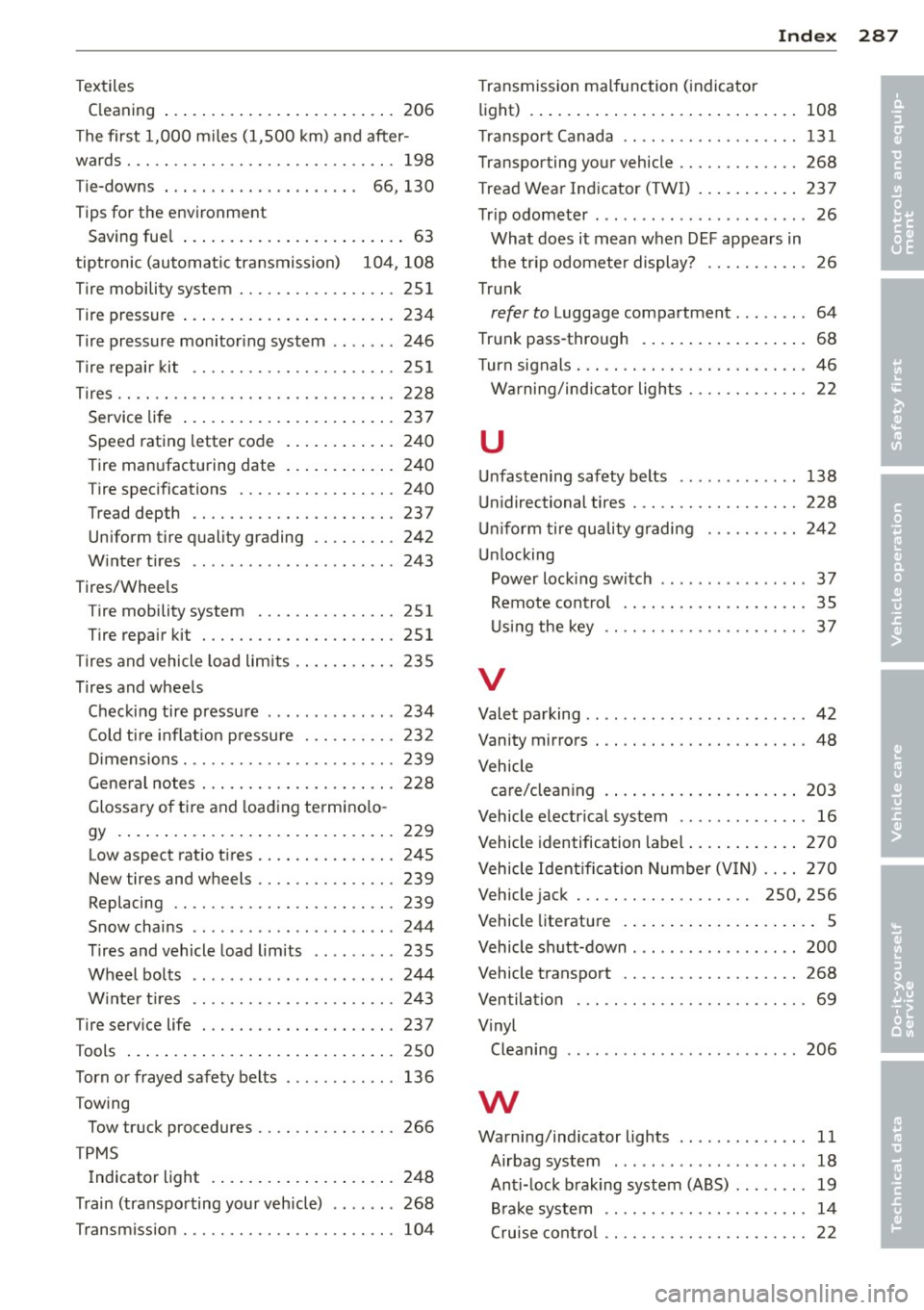
Textiles Cleaning ... ..... ..... ... .. .. .. ... 206
The first 1,000 miles (1 ,500 km) and after-
wards . .. .. .. .... ........... .. .. ... 198
T ie-downs . . . . . . . . . . . . . . . . . . . . . 66, 130
Tips for the env ironment
Saving fue l . . . . . . . . . . . . . . . . . . . . . . . . 63
tiptronic (au tomatic tra ns m ission) 10 4, 108
Tire mobility system ........ .. .. .. .. . 251
Tire pressure ..... .. .... ... .. .. .. ... 234
T ire pressure monitor ing system .. . ... . 246
T ire repair kit ............. .... .. ... 251
T ires .. .. .. .. .... ............. .. .. . 228
Service life ... .... .... ... .. .. .. ... 23 7
Speed rating letter code ... .. .. .. .. . 240
Tire manufacturing date ... .. .. .. .. . 240
T ire specifications ........ .. .. .. .. . 240
Tread depth .. ........... .. .. .. ... 237
Uniform t ire quality grading .. .. .. .. . 242
W inter t ires ................ ... ... 243
Tires/Whee ls
T ire mobility system
251
Tire repair kit ............ .... .. ... 251
Tires and vehicle load limits . ... .. .. .. . 235
Tires and whee ls
Checking tire p ressure ........ .. .... 234
Cold ti re inflat io n pressu re . .. .. .. .. . 23 2
Di mensions . .. ........... .. .. .. ... 239
General notes ............ .... .. ... 228
Glossary of t ire and load ing termino lo-
gy . ..... .. ... .. .. ..... ... .. .. ... 229
Low aspect ratio t ires ...... .. .. .. .. . 245
New tires and wheels ...... .. .. .. .. . 239
Replacing .. .. ........... .. .. .. ... 239
Snow chains .............. ... ... .. 244
T ires and vehicle load limits .. .. ... .. 235
Wheel bo lts . . . . . . . . . . . . . . . . . . . . . . 244
W inte r tir es ............. .... .. .. . 243
Tire serv ice life ............ .... .. .. . 237
Tools ..... .. .. .... .. .... ... .. .. ... 250
Torn or frayed safety belts ... .. .. .. .. . 136
T owing
Tow truck procedures ...... .. .. .. .. . 266
TPMS Indicator light . ....... ... .. .. .. ... 248
Train (transpo rting your veh icle) .. ... .. 268
Transm ission . ............. .... .. ... 104
Inde x 287
Transmission mal function (indicator
light) . ... .. .. .. .... . ... ...... ... .. 108
T ra nspo rt Canada .. ................. 131
Transporting your vehicle ......... .... 268
T read Wea r Ind icator ( TW I) .... ... .. .. 237
Tr ip odometer . .. .. .. ... ....... ...... 26
What does it m ean when DEF appears in
t h e tr ip odomete r display? ...... .. .. . 26
Trunk
refer to Luggage compartment ........ 64
T runk pass-through . .. .. ..... ... .. .. . 68
T urn signals . .. .. .. .... ........... .. . 46
Warning/ind icat or lights ........ .... . 22
u
Un fastening safety belts ............. 138
U nidirectional tires . .... ............. 228
Unif orm tire quality g radi ng
U nlocking 2
42
Power locki ng switc h ... .. .. ... ... .. . 37
Remote cont ro l .... ... .. ..... ..... . 35
U si ng the key .. .. .. . .............. . 37
V
Valet pa rking .. .. .. .. . .. .... .... .. .. . 42
Vanity mirrors . .. .. .. ............... . 48
Vehicle care/clean ing . ... .. .. ... ..... ... .. 20 3
Vehicle electr ical system ............ .. 16
Vehicle identification label ..... ... .. .. 270
Vehicle Ident ifi cat ion Numbe r (V IN) .. .. 270
Vehicle jack . . . . . . . . . . . . . . . . . . . 250, 256
Vehicle literature .... . .. .. ..... ... .. .. 5
Vehicle shutt-down ........ ......... . 200
Vehicle transport .. ................. 268
Ven tila tion . . . . . . . . . . . . . . . . . . . . . . . . . 69
V inyl
Cleaning .. .. .. .. .. . .. .... .... .. .. 206
w
Warning/ind icator lights . . . . . . . . . . . . . . 11
Airbag system . ......... ........... 18
Ant i- lock b raking system (ABS) .. ... .. . 19
B ra ke system . . . . . . . . . . . . . . . . . . . . . . 14
Cruise cont ro l . . . . . . . . . . . . . . . . . . . . . . 22
•
•