2014 AUDI R8 SPYDER ignition
[x] Cancel search: ignitionPage 175 of 244

WARNINGS. The engine compartment of any
vehicle is a hazardous area!
c::> &.
A WARNING
To help avoid injury, before you check any
thing under the engine compartment lid:
- Switch off the engine.
- Remove the ignition key.
- Apply the parking brake.
- Move selector lever of S tronic to "N"
(Neutral); put manual transmission in
Neutral.
- Always let the engine cool down. Hot
components will burn skin on contact.
- To reduce the risk of being burned, never
open the engine compartment lid if you
see or hear steam or coolant escaping
from the engine compartment. Wait un
til no steam or coolant can be seen or heard before carefully opening the en
gine compartment lid .
- Keep children away from the engine com
partment .
-Never spill fluids on hot engine compo
nents. They can cause a fire.
- Never open the coolant reservoir cap when the engine is still warm. The coolant system is pressurized and hot cool
ant could spray out.
- Protect your face, hands and arm from
steam or hot engine coolant by placing a
thick rag over the cap when you open the
coolant reservoir .
- Do not remove the engine cover under
any circumstances. This increases the
risk of burns.
- If work on the fuel system or the electri
cal system is necessary:
- Always disconnect the battery.
- Never smoke or work near heaters or
open flames. Fluids in the engine com
partment could start a fire.
- Keep an approved fire extinguisher im
mediately available.
- To avoid electrical shock and personal in
jury while the engine is running or being
started, never touch:
Checking and filling 173
- Ignition cables
- Other components of the high voltage electronic ignition system.
- If you must perform a check or repair
with the engine running:
- First, fully apply the parking brake,
move selector lever of S tronic to "N"
(Neutral); put manual transmission in
Neutral.
- Always use extreme caution to prevent
clothing, jewelry, or long hair from get
ting caught in the radiator fan, V-belts
or other moving parts, or from contact ing hot parts. Tie back hair before
starting, and wear no clothing that will hang or droop into the engine.
- Minimize exposure to emission and chemical hazards
c::> .&. .
A WARNING
California Proposition 65 Warning:
- Engine exhaust, some of its constituents,
and certain vehicle components contain
or emit chemicals known to the State of
California to cause cancer and birth de
fects and reproductive harm. In addition, certain fluids contained in vehicles and
certain products of component wear con
tain or emit chemicals known to the
State of California to cause cancer and birth defects or other reproductive harm.
- Battery posts, terminals and related ac
cessories contain lead and lead com
pounds, chemicals known to the State of
California to cause cancer and reproduc
tive harms. Wash hands after handling.
@ Note
When adding fluids, always make sure that
they are poured into the proper container
or filler opening, otherwise serious dam
age to vehicle systems will occur.
@ For the sake of the environment
To detect leaks in time, inspect the vehicle
floor pan from underneath regularly. If
you see spots from oil or other vehicle
IJI>
•
•
Page 184 of 244

182 Checking and filling
Checking the engine coolant level
Proceed carefully when checking the coolant.
Fig. 144 Convertible top: se rvice position
Fig. 145 Convert ible top sto rage bay: coo lant expan
sion tank
Before you check anything in the engine com
partment,
always read and heed all WARN
INGS c:::> &_ in Working in the engine compart
ment on page 173
and park your vehicle on a
level surface.
The coolant expansion tank is located in the
right side of the convertible top storage bay
under the round metal cover
c:::> fig. 145. The
convertible top must be in the service position
to check the coolant leve l
c:::> fig. 144.
Bringing the closed convertible top into
the service position
.. Switch the ignition on .
.. Pull and hold the convertible top switch .
.. Press and hold the rear window switch too
until the convertib le top moves into the
service position
c:::> fig. 144.
Bringing the open convertible to into the
service position
.. Switch the ignition on.
.. Press and hold the convertible top switch. ..
Press and hold the rear window switch too
until the convertible top moves into the
service position
c:::> fig. 144.
Opening the coolant expansion tank cover
.. Stop the engine and allow it to cool.
.. Switch the ignition off .
.. Care fully remove the bolts in the cover@
using a screwdriver and remove the cover.
The coolant reservoir is located below
¢fig. 145.
Checking the engine coolant level
.. Place a rag or cloth on the cap of the coolant
expansion tank and turn the cap
carefully to
the left (counter-clockwise)
c:::> .&, .
.. Read the coolant leve l inside the coolant ex
pansion tank¢
fig. 145. With a cold engine,
it must be above the "min" mark. With a hot
eng ine, it can be a little above the indicated
range.
To obtain an accurate reading, the engine must be switched off.
The expansion tank in your vehicle is equipped
with an electric coo lant level sensor
c:::> page 15. We still recommend you check the
coolant level from time to time .
Coolant loss
Coolant loss may indicate a leak in the cooling
system. In the event of coolant loss, the cool
ing system should be inspected immediately
by your authorized Audi dealer. It is not
enough merely to add coolant.
In a
sealed system, losses can occur on ly if
the boiling point of the coo lant is exceeded as
a result of overheating .
A WARNING
-- The cooling system is under pressure. Do
notopenthecapofthecoolantexpan
sion tank when the engine is hot. You
ris k be ing sca lded.
- The coolant additive, and therefore the
coo lant itself, is haza rdous to hea lth .
Keep the coolant additive in the original
Page 189 of 244

(D Note
-Do not disconnect the vehicle battery
when the ignition is switched on or when
the engine is running, otherwise, you will
damage electronic components in the
electrical system .
- If your vehicle is going to stand for a
long period of time without being driven,
protect the battery from "freezing", oth
erwise it will be damaged and will then have to be replaced.
Charging the battery
Connections for charging the battery are lo
cated in the Luggage compartment.
Fig. 146 Luggage com pa rtm ent: batt ery cov er
Fig. 147 Luggag e com partm ent: connec tor s for a
c harge r and jump start cables
Do not connect the negative cable direc tly to
the negative terminal on the battery . Connect
it to a
jump start pin instead c::.> fig . 147 .
.. Always read and heed all WARNINGS c::.> .&.
in Working on the ba ttery on page 186 and
Q ,&. .
.. Switch off the ignition and all electrical con
sumers .
.. Open the luggage compartment lid
c::.> page 3 3.
Checking and filling 187
.. Remove the battery cover c::.> fig. 146.
.. Connect the terminal clamps from the
charger to the battery terminal (red = "posi
tive") and the jump start pin
c::.> fig. 147
(black or brown= "negative") as specified.
.. Only now plug the mains lead for the charg
ing equipment into the wall outlet and turn
it on .
.. When the battery is fully charged: Turn the
charging equipment off and
remove the
mains lead from the wall outlet .
.. Now
remove the clamps for the charging
equipment .
.. Install the battery
cover.
.. Close the luggage compartment lid
c::.> page 3 3.
When charging at low voltages (e.g. with a
trickle charger), the battery cables do not
have to be disconnected first. Before charging
at
high voltages, i.e . "fast charging", you
must disconnect both cables. In either case,
follow the instructions from the manufacturer
of the charger.
Fastcharging a battery is
dangerous c::.> .&. in
Working on the battery on page 186 .
It re
quires special charging equipment and the
knowledge to go with it. We recommend hav
ing your battery fast charged only by a quali
fied workshop .
A discharged battery can
freeze at tempera
tures of only 32 °F (0 °C). Allow a frozen bat
tery to thaw completely before attempting to
charge it
c::.> & . However, we recommend not
using a thawed battery again because the bat
tery casing can be cracked due to ice forma
tion and can leak battery acid .
Do not open the battery caps when charging
the battery.
WARNING
Charging a battery can be dangerous.
- Never charge a frozen battery. It may ex
plode because of gas trapped in the ice .
Allow a frozen battery to thaw out first.
- Do not reuse batteries which were fro-
zen. The battery housing may have
Page 215 of 244

Inflating tire
"' Move the switch @¢ fig. 157 on the elec
tric air pump
ll to posit ion I. After 5 mi
nutes, tire pressure must have reached at
l east 1.8 bar .
"' Switch the electric a ir pump off - switch in
position
0 . If the required tire pressure of at
least 1.8 bar has not been reached, follow
the instructions in the section
Re -inflating
tire .
Re-infl ating tire
"' Remove the hose from the valve and pu ll the
plug out of the socket.
"' Drive the vehicle slowly 10 meters backward
or forward. This helps to distribute the seal
ant better.
"' Remove the empty inflat ion bottle and
sc rew the hose ®¢
fig. 156 from the elec
tric pump directly onto the va lve.
"' Insert the plug @ into the socket for the
cigarette lighter .
"' Switch on the ignition.
"' Move the switch @¢
fig. 157 on the elec
tric a ir pump
l) to posit ion I. After 5 mi
nutes, t ire pressure must have reached at
least 1.8 bar.
"' Switch the electric a ir pump off - switch in
pos ition
0 . If the requ ired t ire pressu re of at
l east 1.8 ba r has not been reached, it is not
possible to make a repair with the tire seal
ant . Seek professional assistance .
Disassembling Tire Mobility System
"'Remove the hose from the valve and pu ll the
plug out of the soc ket.
"' Screw the dust c ap onto the va lve.
"' Place the empty sealant bottle back in the
o riginal packaging and clip it in p lace under
the floor so that no tire sealant can run out into the vehicle.
"' Start driving right away so that the sealant
is d istributed in the tire.
l ) The e lectr ic a ir pu mp sho uld never r un for lo nge r th an
6 m in utes .
What do I do now? 213
A WARNING
-Follow the manufacturer's safety instruc
tions on the decal for the air pump and
the sealant bottle.
- If a tire pressure of 1.8 bar cannot be
achieved after pumping for 5 minutes,
the t ire is too severe ly damaged . Do not
continue to dr ive.
- Seek professional ass istance if it is not
possible to repa ir the tire w ith the t ire
sealant.
(D Tips
- Do not operate the electric air pump for
more than 6 minu tes witho ut stopping,
otherwise it can overheat . When the a ir
pump has coo led down, you can continue
to use it.
- I f sea lant has escaped, allow it to dry,
t hen yo u can peel it off.
Final check
App lies to vehicl es: wi th Tire Mobility Sy stem
Aft er driv ing for a short distance, tire
pre ssure must be chec ked
"' After driving for about 10 min utes, stop and
check the tire pressure.
"' If tire pressure is st ill at least 1.3 bar, in
flate the tire to specified pressure (see dr iv
er's side B-pillar), drive to the next repa ir
shop and have the tire and the sealant bot
tle replaced .
"'I f ti re pressu re is less than 1.3 ba r, the t ire
is too severely damaged. Do not con tinue to
drive . See k professiona l assist ance.
A WARNING
=
If t ire press ure is less than 1.3 bar after
driving for 10 minutes, the tire is too se
verely damaged. Do not cont in ue to drive.
Seek professional ass istance.
-
•
•
Page 223 of 244

Fuses and bulbs
Electrical fuses
Replacing fuses
Fuses that have blown will have metal strips
that have burned through.
Fig. 166 Passenger 's s ide wheel well: Foot rest w ith
fuse arrangement
The fuses are located in the footwell area on
the passenger's side behind a cover.
• Turnoff the ignition and the affected electri
cal consumers .
• Check the following table to see which fuse
belongs to the consumer.
• Remove the floor mat .
• Fold the foot rest back
c::> fig. 166 .
• Remove the clamp from the holder in the
fuse box.
• Remove the fuse using the clamp and re
place the blown fuse w ith an identical new
one.
• Fold the foot rest down again .
A WARNING
Do not repair fuses and never replace a
blown fuse w ith one that has a higher amp
rating. This can cause damage to the e lec
trical system and a fire.
(D Note
If a new fuse burns o ut aga in after shortly
have you have installed it, have the electri
cal system checked by your author ized
Aud i dealer.
Fu se s and bulb s 221
@ Tips
-The following tab le does not list fuse lo
cat ions that a re not used.
- Some of the equipment items listed are
optional or only ava ilable on certain
mode l con figurations.
Fuse assignment
Fi g. 167 Passe nge r foo twell: Fuse panel
Fuse panel @
Consumer
1 VOA interface
2
3
4
s
H ea ted windshield washer
nozz le
Parking system
E ngine compartment lid re
lease
Diagnostic inte rface, light
switch, indicator light
Pa s
senger Air Bag OFF ,
selector
lever
6 Networking gateway
Amps
5
5
5
10
10
5
Page 225 of 244
General information Explanation of
technical data
Som e of t he technical data listed in this man
ual require further explanation.
The technical data for your vehicle are listed in
the charts starting on
Q page 225. This chap
t e r p rovides general informa tion, notes and
r estr ictions wh ich app ly to these data .
Vehicle identification
The key data are given on the vehicle identifi
cat io n number
(V IN) pla te and the vehicle da
ta sticker.
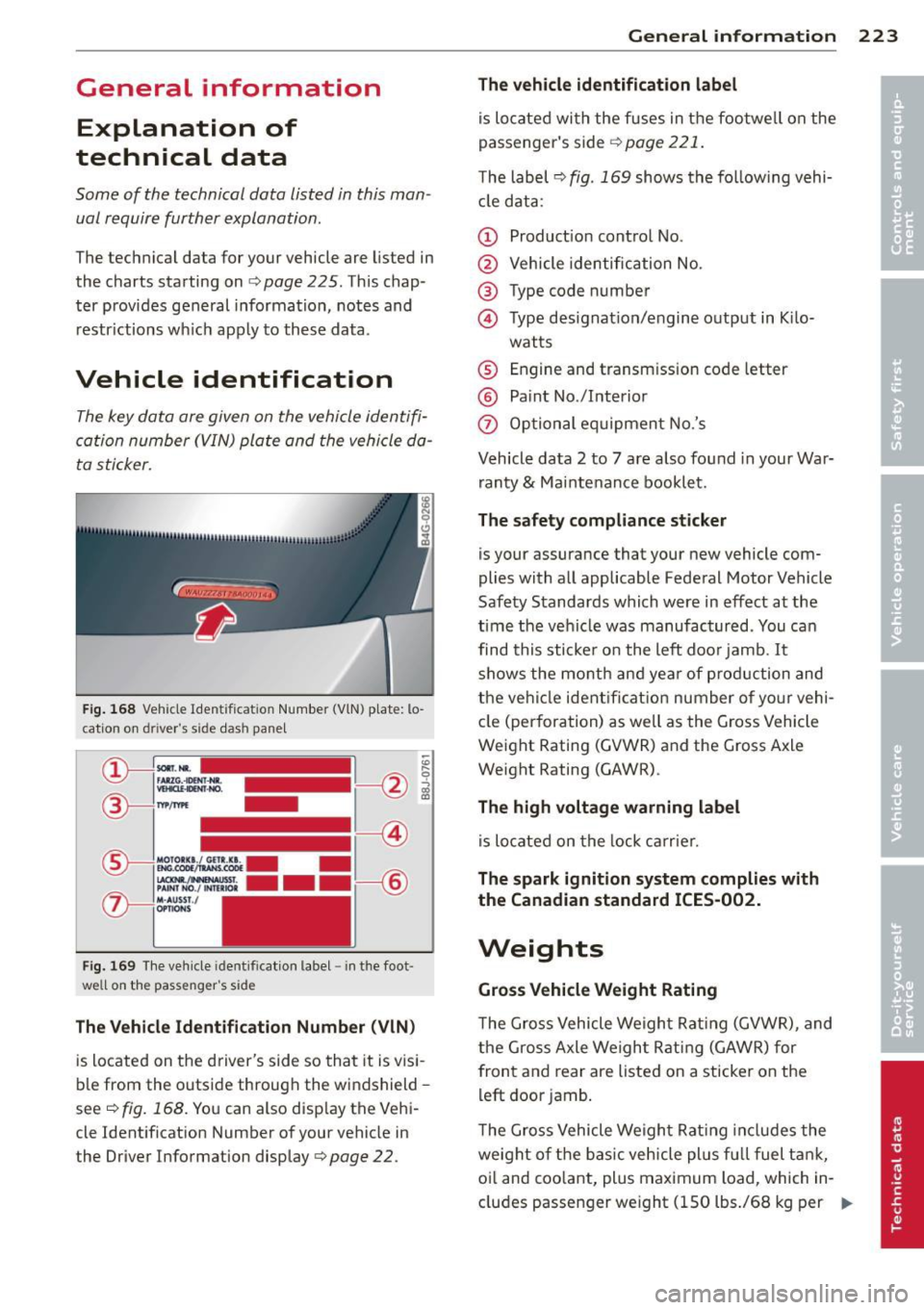
Fig. 1 68 Vehicle I dent ificat ion Num ber {VlN) p la te: lo
cation o n driver's side dash pa nel
Fi g. 1 69 The ve hicle identificat ion label -in the foot
well on the passenger's side
The Vehicle Identification Number (VlN)
is located on the d river's side so tha t it is v is i
b le from the outsi de throug h the windshield -
see
c!) fig. 168. You can also disp lay the Vehi
cle Ident ificat ion Number of your vehicle in
the Driver Information display
Q page 22.
General inform ation 223
The vehicle identification label
is lo cated wi th the fuses in t he footwe ll on the
passenger 's side
Q page 221 .
The label c!) fig. 169 shows th e fo llow ing vehi
cl e data :
(D Product ion cont ro l No .
@ Vehicle identific ation No.
@ Type code number
© Type designat ion/engine o utput in K ilo-
wat ts
® Engine and transm ission code letter
® Pa int No./lnterior
0 Option al eq uipment No.'s
Vehicle data 2 to 7 are a lso fo und in your War
ranty
& Mai nte nance bookle t.
The safety compliance sticker is your assurance that your new vehicle com
plies with a ll applicable Federal Motor Vehicle
Safety Standa rds which were in effect at the
time the ve hicle was manufactur ed . You can
find this sticke r o n the left doo r jamb.
It
sh ows the month an d ye ar of pro duction and
t he ve hicl e ident ifi cat io n number of yo ur vehi
cle (perfora tion) as well as the G ross Vehicle
Weight Rating (GVW R) and the Gross Axle
Weight Rating (GAWR) .
The high voltage warning label i s lo cated on the lock ca rrie r.
The spark ignition system complies with
the Canadian standard ICES-002.
Weights
Gross Vehicle Weight Rating
T he Gro ss Vehicle Weigh t Rat ing (GVWR), and
the Gross Axle We igh t Rati ng (GAWR) for
fron t and rear are lis ted on a sticker on the
l eft door jamb .
T he Gro ss Vehicle Weigh t Rat ing incl udes the
weight o f the bas ic ve hicle plus f ull fuel t ank,
oi l and coo lant, plus maximum load, which in
cludes passenger we ight (150 lbs./68 kg per ..,.
Page 230 of 244

228 Con sum er Inf ormation
steadi ly reduced the scope of maintenance
and repairs which can be carried out by vehicle
owners.
Als o, sa fe ty a nd en vir onm ent al con
cerns place very strict limits on the nature of
repairs and adjustments to engine and trans
miss ion parts which an owner can perform .
Maintenance, adjustments and repa irs usua lly
require special tools, testing devices and oth
er equipment available to specially trained
workshop personnel in order to assure proper pe rformance, reliab ility and safety of the vehi
cle and its many systems.
Improper maintenance, adjustments and re
pa irs can impair the operation and reliab ility
of your vehicle and even void your vehicle war
ranty. Therefore, proof of servic ing in accord
ance w ith the ma intenance schedule may be a
condition for upholding a poss ible warranty
claim made within the warranty period.
Above all, operational safety can be adversely
affected, c reating unnecessary risks for you
and your passengers.
If in doubt about any se rv icing, have it done
by your author ized Audi dealer or any other
p roperly equipped and qualified workshop.
We strong ly urge you to give yo ur autho rized
Audi dealer the opportunity to perfo rm all
schedu led maintenance and necessary repairs.
Your dea ler has the facilities, original parts
and trained specialists to keep your vehicle
running properly.
Performing limit ed m aint enance yours elf
The following pages describe a limited num
ber of proced ures which can be performed on
your vehicle with ordinary too ls, shou ld the
need arise and trained personnel be unavaila
ble. Before performing any of these proce
dures, always thoroughly read all of the app li
cable text and carefully follow the instruc
tions given . Always rigorously observe the
WARNINGS p rovided.
Before you ch eck anything in th e eng ine
co mpartm ent , alway s re ad and h eed all
WA RNINGS
c::> .&. and c::> ..&. in Working in the
engine compartment on page 173.
A WARNING
- Serious personal injury may occur as a re
sult of improperly performed mainte
nance, adjustments or repa irs.
- Always be extremely careful when work
ing on the vehicle. Always follow com
monly accepted safety pract ices and gen
eral common sense. Never r is k personal
injury.
- Do not attempt any of the maintenance,
checks or repairs descr ibed on the fol
lowing pages if you are not fu lly fam iliar
with these or other procedures with re
spect to the vehicle, or are uncertain how
to proceed .
- Do not do any work without the proper
too ls and equipment. Have the necessa ry
work done by your authorized A udi deal
er or another proper ly equipped and
qualified workshop.
- Always remove the ignition key before
anyone gets under the vehicle.
- Always support your veh icle with safety
stands if it is necessary to work under
neath the vehicle. The jack* is not ade
quate for this purpose and cou ld collapse
causing ser ious personal inju ry.
- If you must work underneath the vehicle
with the wheels on the ground, a lways
make sure the vehicle is on level ground,
that the wheels a re a lways secure ly
b locked and that t he engine cannot be
started.
- Always make sure the transmission se
lec to r l ever is in
"N" (Neut ral) (R t ron ic)
or Neutral (manual transmission) and
the hand bra ke is f irmly app lied.
@ For the sake of the environment
- Changing the engine sett ings will ad
verse ly affect emission leve ls. Th is is det
r imental to the environment and increas
es fuel consumpt ion .
- Always observe environmenta l regu la
tions when disposing of old eng ine oil,
used brake flu id, dirty engine coo lant,
spent batteries or worn out tires.
Page 237 of 244

Fuel supply too low . . . . . . . . . . . . . . . . . 18
Gasoline ... .................. .... 167
Gasoline additives ................. 168
Octane rating ............ .... .. ... 167
Recommendation ......... .. .. .. .. . 167
Refueling .. ................ ... ... 169
Reserve . ... ... .. .. ...... .. .. .. .. .. 10
Tank capacity ............... .... .. 225
Unlocking the fuel filler flap by hand . . 170
Fuel gauge .. ............. .... .. .... 10
F uses
Assignment ................ .... .. 221
Replacing . ................. ... ... 221
G
Garage door opener (Homelink®) ... .. .. 90
Gearshift lever . . . . . . . . . . . . . . . . . . . . . . 77
Gearshift lever (S tronic) Positions . . . . . . . . . . . . . . . . . . . . . . . . . . 78
Generator Warning/indicator lights ............. 14
Glossary of tire and loading terminology 190
Glove compartment ........ .. .. .. .. .. 61
Gross Vehicle Weight Rating (GVWR) .. . 223
H
Headlight
Defective
Headlights .
. .... ......... .... .. .. .. 18
46
Head restraints . . . . . . . . . . . . . . . . . . 59, 96
Adjusting .. .. .............. ... .... 96
H eated
Exterior mirrors .......... .. .. .. .. .. 50
Rear window defogger . . . . . . . . . . . . . . . 67
Seats . ..... .. .............. ... .... 67
Heated washer jets
Wiper and washer system .. .. .. .. .. .. 51
Heating .... . .... ......... .... .. .. .. 63
High beam . . . . . . . . . . . . . . . . . . . . . . 46, 47
High voltage warn ing label .. .. .. .. .. . 223
Hill hold assist Starting on hills .......... .. .. .. .. .. 71
H omelink ® universal remote control . ... 90
Horn ..... ... ...... ............. ... . 6
How many airbags does my vehicle have? 117
Index 235
How often should I check my tire pres-
sures? ....... .. .... ............... 196
•
How safety belt pretens ioners work .. .. 109 •
Hydroplaning . .. .. ................. 199
I
Ignition ..... ..... .. ................ 68
Immobilizer .. .. .. .. .. ........... .. . 10
Important things to do before driving .. . 93
Improperly worn safety belts ......... . 108
Indicator light Airbag system . . . . . . . . . . . . . . . 121,122
Audi magnetic ride .... ........... .. . 19
Convertible top .. .. ................ 15
PASSENGER AIR BAG OFF .......... . 122
Ind icator lights .. ... ................. 11
Red symbols in the center display . .. .. . 11
Yellow symbols in the center display .. . 12
also refer to Warning/indicator lights . . 11
Infant seats ....... ...... .......... 137
Installing child safety seats Safety belts . . . . . . . . . . . . . . . . . . . . . . 140
Instrument cluster and controls ... .. .. .. 8
Instrument panel illumination ......... 49
Instruments and controls General illustration . . . . . . . . . . . . . . . . . . 6
Interior lights ... .. .. ............... . 49
Luggage compartment . . . . . . . . . . . . . . 50
J
Jump-starting . .. .. .... ........... .. 217
K
Key ........... ... .. ..... ........... 28
Battery replacement . . . . . . . . . . . . . . . . 29
Emergency key ... .... ........... .. . 28
Key replacement . . . . . . . . . . . . . . . . . . . 28
Master key . ..... .. ................ 28
Valet key . . . . . . . . . . . . . . . . . . . . . . . . . . 28
Kick-down . . . . . . . . . . . . . . . . . . . . . . . . . . 80
Knee airbags .. .. .. ................. 126
Description .. .. .. ................. 126
How they work ..... .. .. ...... ..... 127
Important safety instructions ........ 128