2014.5 Citroen C4 DAG fuel
[x] Cancel search: fuelPage 173 of 340
1010
171
C4-2_en_Chap10_verification_ed01-2014
FUEL TANK
Capacity of the tank: approximately
60 litres.
When the low fuel level in the
tank
is
reached,
this
warning
lamp
comes
on
in
the
instru
-
ment
panel,
accompanied
by
an
audible
warning
and
the
dis
-
play
of
an
alert
message.
When
it
first
comes
on,
around
6 li-
tres
of fuel remain in the tank.
Until
sufficient
fuel
has
been
added,
ev
-
ery
time
the
ignition
is
switched
on,
this
warning
lamp
appears,
accompanied
by
an
audible
signal
and
an
alert
mes
-
sage.
When
driving,
this
audible
signal
and
the
display
of
this
alert
message
are
repeated
with
increasing
frequency
,
as
the level drops towards 0.
You
must
refuel
as
soon
as
possible
to
avoid
running out.
If you run out of fuel (
d iesel), refer also
to
"Checks".
Low fuel level Refuelling
Additions of
fuel must be of at least
5 litres to be registered by the fuel
gauge.
Opening
the
filler
cap
may
result
in
an
inrush
of
air
.
This
vacuum
is
entirely
normal
and
results
from
the
sealing
of
the
fuel system.
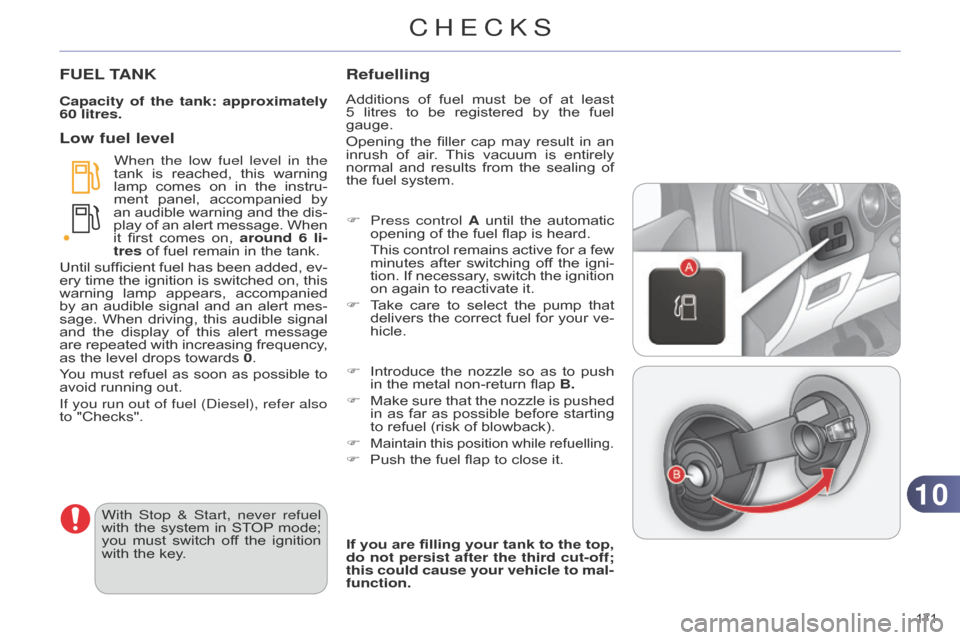
F
Press control
A
until
the
automatic
opening
of the fuel flap is heard.
This
control
remains
active
for
a
few
minutes
after
switching
of
f
the
igni
-
tion.
If
necessary
,
switch
the
ignition
on
again to reactivate it.
F
T
ake
care
to
select
the
pump
that
delivers
the
correct
fuel
for
your
ve
-
hicle.
If you are filling your tank to the top,
do not persist after the third cut-off;
this could cause your vehicle to mal-
function.
With Stop & Start, never refuel
with
the
system
in
ST
OP
mode;
you
must
switch
of
f
the
ignition
with
the
key. F
Introduce
the
nozzle
so
as
to
push
in
the metal non-return flap B.
F
Make
sure
that
the
nozzle
is
pushed
in
as
far
as
possible
before
starting
to
refuel (risk of blowback).
F
Maintain this position while refuelling.
F Push the fuel flap to close it.
CHECKS
Page 174 of 340

1010
172
C4-2_en_Chap10_verification_ed01-2014
Fuel used for petrol engines
The petrol engines are compatible with E10
bio-petrol (containing 10 % etha -
nol),
conforming
to
European
standards
EN
228 and EN 15376.
E85
type
fuels
(containing
up
to
85
%
ethanol)
are
reserved
exclusively
for
vehicles
marketed
for
the
use
of
this
type
of
fuel
(BioFlex
vehicles).
The
quality
of
the
ethanol
must
comply
with
European
standard EN 15293.
Fuel used for Diesel engines
The Diesel engines are compatible with biofuels
which conform to current and
future
European
standards
(Diesel
fuel
which
complies
with
standard
EN
590
mixed
with
a
biofuel
which
complies
with
standard
EN
14214)
available
at
the
pumps
(containing
up
to
7
%
Fatty
Acid
Methyl Ester).
The
B30
biofuel
can
be
used
in
cer
-
tain
Diesel
engines.
However
,
this
use,
even
occasional,
requires
strict
applica
-
tion
of
the
special
servicing
conditions.
Contact
a
CITROËN
dealer
or
a
quali
-
fied
workshop.
The use of any other type of (bio)fuel
(vegetable
or
animal
oils,
pure
or
dilu
t-
ed,
domestic
fuel...)
is
strictly
prohibited
(risk
of
damage
to
the
engine
and
fuel
system).
The
petrol
or
Diesel
engine
of
your
ve
-
hicle
is
fitted
with
a
catalytic
converter
,
a
device
which
helps
to
reduce
the
lev
-
el
of
harmful
emissions
in
the
exhaust
gases.
For petrol engines, the use of un
-
leaded fuel is compulsory.
The
filler
neck
is
narrower
,
admitting
unleaded
petrol
nozzles
only.
Fuel supply cut-off
Your vehicle is equipped with a safety device
which cuts of f the fuel supply in
the
event of a collision.
If you have put in the wrong
fuel for your vehicle, you must
have the tank drained and re-
filled with the correct fuel be-
fore you start the engine.
CHECKS
Page 175 of 340

1010
173
C4-2_en_Chap10_verification_ed01-2014
MISFUEL PREVENTION
(D IESEL )*
Mechanical device which prevents fill -
ing the tank of a Diesel vehicle with
petrol.
It
avoids
the
risk
of
engine
dam
-
age
that
can
result
from
fillin
g
with
the
wrong
fuel.
Located
in
the
filler
neck,
the
misfuel
prevention
device
appears
when
the
filler
cap is removed.
Operation
When a petrol filler nozzle is introduced into
the fuel filler neck of your Diesel
vehicle,
it
comes
into
contact
with
the
flap.
The
system
remains
closed
and
prevents
filling.
Do not persist but introduce a Diesel
type filler nozzle.
It
remains
possible
to
use
a
fuel
can
to fill the tank.
In
order
to
ensure
a
good
flow
of
fuel,
do
not
place
the
nozzle
of
the
fuel
can
in
direct
contact
with
the
flap
of
the
misfuel
prevention
device
and pour slowly.*
According
to country of sale.
Travelling abroad
As
Diesel
fuel
pump
nozzles
may
be
dif
ferent
in
other
coun
-
tries,
the
presence
of
the
misfuel
prevention
device
may
make
re
-
fuelling impossible.
Before
travelling
abroad,
we
recommend
that
you
check
with
the
CITROËN
dealer
network,
whether your vehicle is suitable
for
the
fuel
pumps
in
the
country
in
which you want to travel.
CHECKS
Page 176 of 340

1010
174
C4-2_en_Chap10_verification_ed01-2014
RUNNING OUT OF FUEL
(D IESEL )
1.6 HDi engine
F Fill the fuel tank with at least five li -
tres of diesel.
F
Open
the bonnet.
F
If
necessary
,
unclip
the
styling
cover
for
access to the priming pump.
F
Squeeze
and
release
the
priming
pump
repeatedly
until
resistance
is
felt
(there
may
be
resistance
at
the
first
press).
F
Operate
the
starter
until
the
engine
starts
(if
the
engine
does
not
start
at
the
first
attempt,
wait
around
15 seconds
before trying again).
F
If
the
engine
does
not
start
after
a
few
attempts,
operate
the
priming
pump
again then start the engine.
F
Refit
the
styling
cover
and
clip
it
in
place.
F
Close
the bonnet.
2.0 HDi engine
F Fill the fuel tank with at least five li -
tres of Diesel.
F
Open
the bonnet.
F
If necessary
, unclip the style cover
for
access to the priming pump.
F
Slacken
the bleed screw.
F
Squeeze
and
release
the
priming
pump
repeatedly
until
fuel
appears
in
the transparent pipe.
F
T
ighten the bleed screw.
F
Operate
the
starter
until
the
engine
starts
(if
the
engine
fails
to
start
at
the
first
attempt,
wait
around
15 seconds
before trying again).
F
If
the
engine
fails
to
start
after
a
few
attempts,
operate
the
priming
pump
again,
then the starter.
F
Put
the
style
cover
back
in
position
and
clip
it
in
place,
ensuring
that
it
has
clipped correctly.
F
Close
the bonnet.
If
the
engine
does
not
start
first
time,
don't
keep
trying
but
start
the
procedure
again
from
the
be
-
ginning.
On
vehicles
fitted
with
HDi
engines,
the
fuel
system
must
be
primed
if
you
run
out
of
fuel;
refer
to
the
corresponding
engine
compartment
view.
If
the
tank
on
your
vehicle
is
fitted
with
a
misfuel
prevention
device,
refer
to
the
"Misfuel
prevention
(Diesel)"
section.
1.6 BlueHDi engine
F Fill the fuel tank with at least five li -
tres of Diesel.
F
Switch
on
the
ignition
(without
start
-
ing
the engine).
F
W
ait
around
6
seconds
and
switch
of
f the ignition.
F
Repeat
the operation 10 times.
F
o perate the starter to run the en-
gine.
CHECKS
Page 179 of 340

1010
177
C4-2_en_Chap10_verification_ed01-2014
* According to engine.
DIESEL ENGINES
The various caps and covers allow access for checking the levels of the various fluids, for replacing certain components and for
priming the fuel system.
1.
Power
steering reservoir.
2.
Screenwash
and
headlamp
wash
reservoir
.
3.
Coolant
reservoir. 4.
Brake
fluid reservoir.
5.
Battery/Fuses.
6.
Fusebox.
7.
Air
filter.8.
Engine
oil dipstick.
9.
Engine
oil filler cap.
10.
Priming
pump*.
11 .
Bleed
screw*.
CHECKS
Page 185 of 340

1010
183
C4-2_en_Chap10_verification_ed01-2014
ADBLUE® ADDITIVE AND SCR SYSTEM
FOR
B
LUE HD I D IESEL
ENGINES
To assure respect for the environment and
conformity with the new Euro 6
emissions
standard,
without
adversely
af
fecting
the
performance
or
fuel
con
-
sumption
of
Diesel
engines,
CITROËN
has
taken
the
decision
to
equip
its
ve
-
hicles
with
an
ef
fective
system
that
associates SCR (Selective Catalytic
Reduction)
with
a
particle
filter
(F
AP)
for
the treatment of exhaust gases.
Presentation of the SCR system
Using an additive called AdBlue® con-
taining
urea,
a
catalytic
converter
turns
up
to
85%
of
nitrous
oxides
(NOx)
into
nitrogen
and
water
,
which
are
harmless
to
health
and
the
environment. The
AdBlue® additive
is held in a spe -
cial
tank
located under the boot at the
rear
of
the
vehicle.
It
has
a
capacity
of
17
litres:
this
provides
a
driving
range
of
about
12
500
miles
(20
000
km),
after
which
an
alert
is
triggered
warning
you
when
the
reserve
remaining
is
enough
for
just
1
500 miles (2 400 km).
During
each
scheduled
service
of
your
vehicle
by
a
CITROËN
dealer
or
a
qual
-
ified
workshop,
the
AdBlue® additive tank
is
refilled
in
order
to
allow normal
operation
of
the
SCR
system.
If
the
estimated
mileage
between
two
services
is
greater
than
12
500
miles
(20
000
km),
we
recommend
that
you
go
to
a
CITROËN
dealer
or
a
qualified
workshop
to
have
the
necessary
top-up
carried
out. Once
the
AdBlue® tank is
empty , a
system
required
by regulations
prevents
starting
of the engine.
If the SCR
is faulty, the level of
emissions
from
your
vehicle
will
no
longer
meet
the
Euro
6
stan
-
dard:
you
vehicle
becomes
pol
-
luting.
In
the
event
of
a
confirmed
fault
with
the
SCR
system,
you
must
go
to
a
CITROËN
dealer
or
a
qualified
workshop
as
soon
as
possible:
after
a
running
dis
-
tance
of
650
miles
(1
100
km),
a
system
will
be
triggered
au
-
tomatically
to
prevent
engine
starting.
CHECKS
Page 189 of 340

1010
187
C4-2_en_Chap10_verification_ed01-2014
Topping-up the AdBlue®
additive
Filling the AdBlue® tank is an operation included
in
every
routine service on
your
vehicle
by
a
CITROËN
dealer
or
a
qualified
workshop.
Nevertheless,
given
the
capacity
of
the
tank,
it
may
be
necessary
to
top-up
the
additive
between
services,
more
partic
-
ularly
if
an
alert
(warning
lamps
and
a
message)
signals
the requirement.
You
can
got
to
a
CITROËN
dealer
or
a
qualified
workshop.
If
you
envisage
topping-up
yourself,
please
read
the
following
warnings
carefully
. Precautions in use
The
AdBlue® additive is an urea-based solution.
This liquid is non-flammable,
colourless
and
odourless
(kept
in
a
cool
area).
In
the
event
of
contact
with
the
skin,
wash
the
af
fected
area
with
soap
and
water
.
In
the
event
of
contact
with
the
eyes,
wash
(irrigate)
the
eyes
with
large
amounts
of
water
or
with
an
eye
wash
solution
for
at
least
15
minutes.
If
a
burning
sensation
or
irritation
persists,
get
medical
attention.
If
swallowed,
immediately
wash
out
the
mouth
with
clean
water
and
then
drink
plenty
of
water.
In
certain
conditions
(high
ambient
tem
-
perature,
for
example),
the
risk
of
re
-
lease
of
ammonia
cannot
be
excluded:
do
not
inhale
the
product.
Ammonia
vapour
has
en
irritant
ef
fect
on
mucous
membranes
(eyes, nose and throat).
Keep
AdBlue® out of the reach
of
children,
in
its original bottle.
Never
transfer
AdBlue® to an-
other
container:
it
would loose
its
purity. Use
only
AdBlue® additive
that meets the
ISO
22241
standard.
Never
dilute
the
additive
with
water
.
Never
pour
the
additive
into
the
Diesel
fuel
tank.
The supply in a non-drip bottle simplifies toping-up.
Y ou can obtain 1.89 litre (half a
US
gallon)
bottles
from
a
CITROËN
deal-
er
or a qualified workshop.
Never top-up from an AdBlue®
dispenser
reserved
for
heavy
goods
vehicles.
CHECKS
Page 225 of 340

223
C4-2_en_Chap12_caracteristique_ed01-2014
* The maximum power corresponds to the value type-approved on a test bed, under conditions defined in European legisla -
tion (Directive 1999/99/EC).
PETROL ENGINES AND GEARBOXES
.../1: model fitted with low rolling resistance tyres.
.../2: model fitted with very low rolling resistance tyres.
Petrol engine
VTi 95THP 110 VTi 120
Gearbox Manual
(5-speed) Manual
(5-speed) Manual
(5-speed) Automatic
(4-speed)
Model code:
NC... 8FR0HNZ6
HNZ6/1
HNZ6/2 5FS0
5FS9
5FS9/D
Cubic capacity (cc) 1 397
1 199
1 598
Bore x stroke (mm)
77 x 72.5 75 x 90.5
77 x 85.8
Max power*: EU standard (kW)
7081 88
Max power engine speed (rpm)
6 000
5 500
6 000
Max torque: EU standard (Nm)
135205 160
Max torque engine speed (rpm)
4 000
1 500
4 250
Fuel Unleaded Unleaded Unleaded
Catalytic converter Ye sYe s Ye s
Engine oil capacity (in litres) 4.25- 4.25
12
TECHNICAL DATA