2013 VOLVO V60 warning
[x] Cancel search: warningPage 156 of 422

04 Driver support
Adaptive cruise control*
04
154* Option/accessory, for more information, see Introduction.
General information on ACC
The adaptive cruise control (ACC – Adaptive
Cruise Control) helps the driver maintain a safe
distance from the vehicle ahead. An adaptive
cruise control provides a more relaxing driving
experience on long journeys on motorways
and long straight main roads in smooth traffic
flows.
The driver sets the desired speed and time
interval to the car in front. When the radar
detector detects a slower vehicle in front of the
car, the speed is automatically adapted to that.
When the road is clear again the car returns to
the selected speed.
If the adaptive cruise control is switched off or
set to the standby mode and the car comes too
close to a vehicle in front, then the driver is
warned by Distance Warning (see page 165)
about the short distance.WARNING
The driver must always be observant with
regard to the traffic conditions and intervene
when the adaptive cruise control is not
maintaining a suitable speed or suitable dis-
tance.
The adaptive cruise control cannot handle
all traffic, weather and road conditions.
Read the whole of this section for informa-
tion on the limitations of the adaptive cruise
control. The driver must be familiar with this
information before using the adaptive cruise
control.
The driver always bears responsibility for
maintaining the correct distance and speed,
even when the adaptive cruise control is
being used.
IMPORTANT
Maintenance of adaptive cruise control
components must only be performed at a
workshop - an authorised Volvo workshop
is recommended.
Automatic gearboxCars with automatic gearbox have enhanced
functionality with the adaptive cruise control's
Queue Assistant, see page 159.
Function
Function overview1.
Warning lamp - braking by driver required
Steering wheel keypad
Radar sensor
Adaptive cruise control consists of a cruise
control system and a coordinated spacing sys-
tem.
1NOTE: The illustration is schematic - details may differ depending on car model.
ProCarManuals.com
Page 157 of 422

04 Driver support
Adaptive cruise control*
04
* Option/accessory, for more information, see Introduction.155
WARNING
Adaptive cruise control is not a collision
avoidance system. The driver must inter-
vene if the system does not detect a vehicle
in front.
The adaptive cruise control does not brake
for humans or animals, and not for small
vehicles such as bicycles and motorcycles.
Nor for oncoming, slow or stationary vehi-
cles and objects.
Do not use the adaptive cruise control, for
example, in city traffic, in dense traffic, at
junctions, on slippery surfaces, with a lot of
water or slush on the road, in heavy rain/
snow, in poor visibility, on winding roads or
on slip roads.
The distance to the vehicle ahead is mainly
measured by a radar sensor. Cruise control
regulates the speed with acceleration and
braking. It is normal for the brakes to emit a low
sound when they are being used by the Adap-
tive cruise control.
WARNING
The brake pedal moves when the cruise
control brakes. Do not rest your foot under
the brake pedal as it could become trapped.
The adaptive cruise control aims to follow the
vehicle ahead in the same lane at a time interval
set by the driver. If the radar sensor cannot see
any vehicle in front then the car will instead
maintain the cruise control's set speed. This
also happens if the speed of the vehicle in front
exceeds the cruise control's set speed.
The adaptive cruise control aims to control the
speed in a smooth way. In situations that
demand sudden braking the driver must brake
himself/herself. This applies with large differ-
ences in speed, or if the vehicle in front brakes
heavily. Due to limitations in the radar sensor,
braking may come unexpectedly or not at all,
see page 160.
The adaptive cruise control can be activated to
follow another vehicle at speeds from
30 km/h
2 up to 200 km/h. If the speed falls
below 30 km/h or if the engine speed becomes
too low, the cruise control is set in standby
mode at which automatic braking ceases - the
driver must then take over himself/herself to
maintain a safe distance to the vehicle ahead.
Warning lamp - braking by driver
required
Adaptive cruise control has a braking capacity
that is equivalent to more than 40% of the car's
braking capacity.If the car needs to be braked more heavily than
cruise control capacity and the driver does not
brake, then the cruise control uses the collision
warning system's warning lamp and warning
sound (see page 173) to alert the driver that
immediate intervention is required.
NOTE
The warning lamp may be difficult to notice
in strong sunlight or when sunglasses are
being worn.
WARNING
Cruise control only warns of vehicles
detected by the radar sensor. Consequently
there may be no warning or it may be sub-
ject to a delay. Do not wait for a warning but
brake when it is necessary.
Steep roads and/or heavy loadBear in mind that the adaptive cruise control is
primarily intended for use when driving on level
road surfaces. It may have difficultly in keeping
the correct distance from the vehicle ahead
when driving on steep roads, with a heavy load
or with a trailer - in which case, be extra atten-
tive and ready to slow down.
2Queue Assistant (in cars with automatic gearbox) can operate in the range of 0-200 km/h, see page 159.
ProCarManuals.com
Page 159 of 422
04 Driver support
Adaptive cruise control*
04
* Option/accessory, for more information, see Introduction.157
Changing the speedTo change the stored speed:
•Adjust with short presses on or -
every press gives +/- 5 km/h. The last
presses made are stored in the memory.
If speed is increased using the accelerator
pedal prior to pressing the
/ button,
then it is the car's current speed when the
button is pressed that is stored in the
cruise control.
•In active mode the button has the same
function as
but results in a lower
increase in speed: + 1 km/h.
NOTE
If any of the Cruise Control buttons are held
down for more than approx. 1 minute, it is
blocked and disabled. To be able to reacti-
vate Cruise Control, the car must be stop-
ped and the engine restarted.
In certain situations, cruise control cannot
be activated. Then the display shows
Cruise control Unavailable, see
page 162.
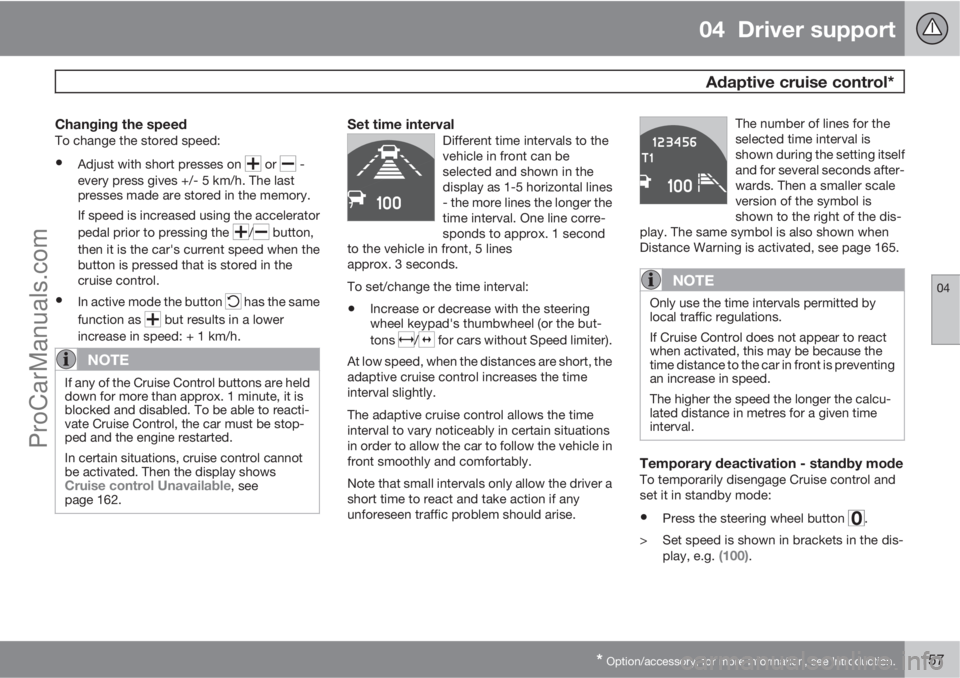
Set time intervalDifferent time intervals to the
vehicle in front can be
selected and shown in the
display as 1-5 horizontal lines
- the more lines the longer the
time interval. One line corre-
sponds to approx. 1 second
to the vehicle in front, 5 lines
approx. 3 seconds.
To set/change the time interval:
•Increase or decrease with the steering
wheel keypad's thumbwheel (or the but-
tons
/ for cars without Speed limiter).
At low speed, when the distances are short, the
adaptive cruise control increases the time
interval slightly.
The adaptive cruise control allows the time
interval to vary noticeably in certain situations
in order to allow the car to follow the vehicle in
front smoothly and comfortably.
Note that small intervals only allow the driver a
short time to react and take action if any
unforeseen traffic problem should arise.The number of lines for the
selected time interval is
shown during the setting itself
and for several seconds after-
wards. Then a smaller scale
version of the symbol is
shown to the right of the dis-
play. The same symbol is also shown when
Distance Warning is activated, see page 165.
NOTE
Only use the time intervals permitted by
local traffic regulations.
If Cruise Control does not appear to react
when activated, this may be because the
time distance to the car in front is preventing
an increase in speed.
The higher the speed the longer the calcu-
lated distance in metres for a given time
interval.
Temporary deactivation - standby modeTo temporarily disengage Cruise control and
set it in standby mode:
•Press the steering wheel button .
> Set speed is shown in brackets in the dis-
play, e.g.
(100).
ProCarManuals.com
Page 160 of 422

04 Driver support
Adaptive cruise control*
04
158* Option/accessory, for more information, see Introduction.
Keypad without Speed limiter*To temporarily disengage Cruise control and
set it in standby mode:
•Press the steering wheel button .
Standby mode due to driver interventionCruise control is temporarily disengaged and
set in standby mode if:
•the foot brake is used
•the clutch pedal is depressed for longer
than 1 minute6
•the gear selector is moved to N position
(automatic gearbox)
•the driver maintains a speed higher than
the set speed for longer than 1 minute.
The driver must then regulate the speed.
A temporary increase in speed with the accel-
erator pedal, e.g. during overtaking, does not
affect the cruise control setting - the car returns
to the last stored speed when the accelerator
pedal is released.
Automatic standby modeThe Adaptive cruise control is dependent on
other systems, e.g.. DSTC (see page 146). Ifany of these systems stop working then cruise
control is automatically deactivated.
In the event of automatic deactivation a signal
will sound and the message
Cruise control
Cancelled is shown in the display. The driver
must then intervene and adapt the speed and
distance to the vehicle ahead.
An automatic deactivation can be due to:
•engine speed is too low/high
•speed falls below 30 km/h7
•wheels lose traction
•brake temperature is high
•the radar sensor is covered e.g. by wet
snow or heavy rain (radar waves blocked).
Resume set speedCruise control in standby mode is re-activated
with one press on the steering wheel button
- the speed is then set to the last stored
speed.
NOTE
A significant increase in speed may arise
after the speed has been resumed with .
Overtaking another vehicleWhen the car is following another vehicle and
the driver indicates an imminent overtake with
the direction indicator
8, the Cruise control
helps to briefly accelerate the car towards the
vehicle in front.
The function is active at speeds
above 70 km/h.
WARNING
Be aware that this function can be activated
in more situations other than during over-
taking, e.g. when a direction indicator is
used to indicate a change of lane or exit to
another road - the car will then accelerate
briefly.
Deactivate
Keypad with Speed limiter
Adaptive cruise control is deactivated with the
steering wheel button
. The set speed is
cleared and cannot be resumed with the
button.
Keypad without Speed limiterWith a short press on the steering wheel button
the cruise control is set in standby mode.
6Disengaging and selecting a higher or lower gear does not involve standby mode.7Does not apply to a car with Queue Assistant - it manages right down to stationary.8On left flash only in left-hand drive car, or right flash in right-hand drive car.
ProCarManuals.com
Page 162 of 422

04 Driver support
Adaptive cruise control*
04
160* Option/accessory, for more information, see Introduction.
WARNING
When the cruise control is following another
vehicle at speeds in excess of 30 km/h and
the target is changed from a moving vehicle
to a stationary vehicle, the cruise control will
ignore the stationary vehicle and instead
select the stored speed.
•The driver must intervene him/herself
and brake.
Automatic standby mode with change of
target
Cruise control is disengaged and set in
standby mode:
•when the speed is below 5 km/h and cruise
control is not sure whether the target
object is a stationary vehicle or some other
object, e.g. a speed bump.
•when the speed is below 5 km/h and the
vehicle in front turns off so the cruise con-
trol no longer has a vehicle to follow.
Termination of automatic braking at a
standstill
In certain situations Queue Assist automati-
cally interrupts braking when stationary. This
means that the brakes are released and the car
may start to roll - the driver must therefore
intervene and brake the car himself/herself in
order to maintain its position.Queue Assist releases the foot brake and sets
cruise control in standby mode in the following
situations:
•the driver puts his/her foot on the brake
pedal
•the parking brake is applied
•the gear selector is moved to P, N or R
position
•the driver sets the cruise control in standby
mode.
Automatic activation parking brakeIn some situations Queue Assist applies the
parking brake in order to keep the car station-
ary.
This takes place if:
•the driver opens the door or takes off his/
her seatbelt
•DSTC is changed from Normal to Sport
mode
•Queue Assist has held the car stationary
for more than 4 minutes
•the engine is switched off
•the brakes have overheated.
The radar sensor and its limitations
The radar sensor is used - apart from by Adap-
tive cruise control - by the following functions
as well:
•Collision Warning with Auto Brake, see
page 173
•Distance Warning, see page 165.
The function of the radar sensor is to detect
cars or larger vehicles in the same direction, in
the same lane.
Modification of the radar sensor could result in
it being illegal to use.
ProCarManuals.com
Page 163 of 422

04 Driver support
Adaptive cruise control*
04
* Option/accessory, for more information, see Introduction.161
WARNING
The driver must always be observant with
regard to the traffic conditions and intervene
when the adaptive cruise control is not
maintaining a suitable speed or suitable dis-
tance.
The adaptive cruise control cannot handle
all traffic, weather and road conditions.
Read the whole of this section for informa-
tion on the limitations of the adaptive cruise
control. The driver must be familiar with this
information before using the adaptive cruise
control.
The driver always bears responsibility for
maintaining the correct distance and speed,
even when the adaptive cruise control is
being used.
WARNING
Accessories or other objects such as auxil-
iary lamps must not be installed in front of
the grille.
WARNING
Adaptive cruise control is not a collision
avoidance system. The driver must inter-
vene if the system does not detect a vehicle
in front.
The adaptive cruise control does not brake
for humans or animals, and not for small
vehicles such as bicycles and motorcycles.
Nor for oncoming, slow or stationary vehi-
cles and objects.
Do not use the adaptive cruise control, for
example, in city traffic, in dense traffic, at
junctions, on slippery surfaces, with a lot of
water or slush on the road, in heavy rain/
snow, in poor visibility, on winding roads or
on slip roads.
The capacity of the radar sensor to detect vehi-
cles in front is reduced significantly:
•if the radar sensor becomes blocked and
cannot detect other vehicles e.g. in heavy
rain or slush, or if other objects have col-
lected in front of the radar sensor.
NOTE
Keep the area in front of the radar sensor
clean - see "Maintenance" on page 176.
•if the speed of vehicles in front is signifi-
cantly different from your own speed.
Examples where the cruise control does
not work optimally
The radar sensor has a limited field of vision. In
some situations another vehicle is not
detected, or the detection is made later than
expected.
ACC field of vision.
ProCarManuals.com
Page 164 of 422

04 Driver support
Adaptive cruise control*
04
162* Option/accessory, for more information, see Introduction.
Sometimes the radar sensor is late at
detecting vehicles at close distances, e.g.
a vehicle that drives in between the car and
vehicles in front.
Small vehicles, such as motorcycles, or
vehicles not driving in the centre of the lane
can remain undetected.
In bends the radar sensor may detect the
wrong vehicle or lose a detected vehicle
from view.
Fault tracing and action
If the display shows the message Radar
blocked See manual this means that the
radar signals from the radar sensor are blocked
and that vehicles in front of the car could not
be detected.
This means that in addition to the Adaptive
Cruise Control, Distance Warning and CollisionWarning with Auto Brake functions are not
operating either.
The following table presents possible causes
for a message being shown along with the
appropriate action.
CauseAction
The radar surface in the grille is dirty or covered with ice or snow.Clean the radar surface in the grille from dirt, ice and snow.
Heavy rain or snow blocking the radar signals.No action. Sometimes the radar does not work during heavy rain or
snowfall.
Water or snow from the road surface swirls up and blocks the radar sig-
nals.No action. Sometimes the radar does not work on a very wet or snowy
road surface.
The radar surface has been cleaned but the message remains.Wait. It could take several minutes for the radar to sense that it is no
longer blocked.
Symbols and messages in the display
SymbolMessageSpecification
Standby mode or active mode without detected vehicle.
Active mode with detected vehicle to which cruise control adapts the speed.
ProCarManuals.com
Page 167 of 422
04 Driver support
Distance Warning*
04
* Option/accessory, for more information, see Introduction.165 General
Distance Warning (Distance Alert) is a function
that informs the driver about the time interval
to vehicles in front.
Distance Warning is active at speeds above
30 km/h and only reacts to vehicles driving in
front of the car, in the same direction. No dis-
tance information is provided for oncoming,
slow or stationary vehicles.
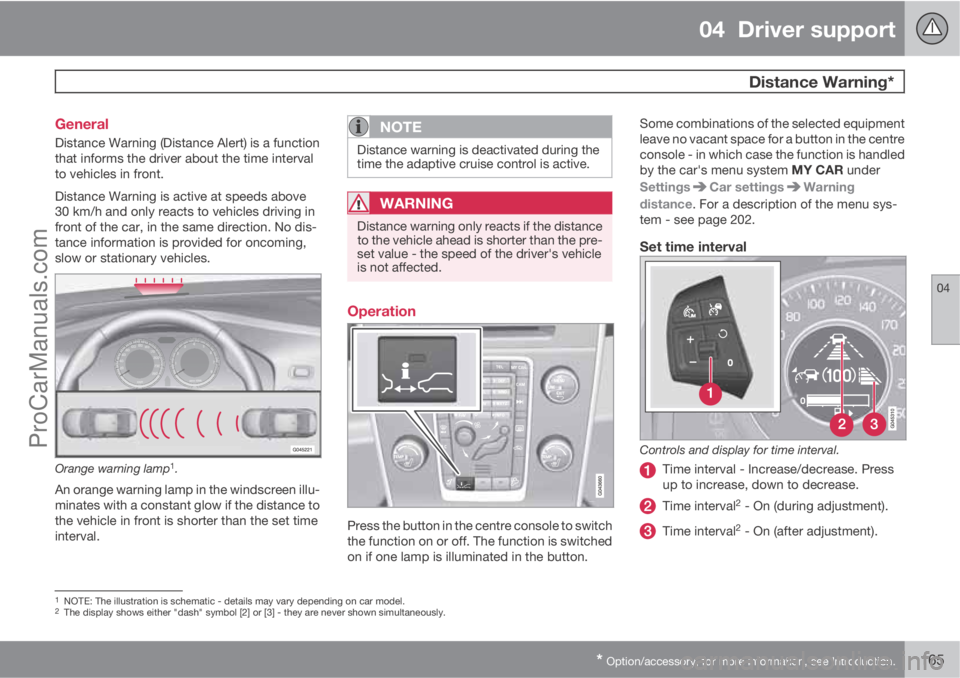
Orange warning lamp1.
An orange warning lamp in the windscreen illu-
minates with a constant glow if the distance to
the vehicle in front is shorter than the set time
interval.
NOTE
Distance warning is deactivated during the
time the adaptive cruise control is active.
WARNING
Distance warning only reacts if the distance
to the vehicle ahead is shorter than the pre-
set value - the speed of the driver's vehicle
is not affected.
Operation
Press the button in the centre console to switch
the function on or off. The function is switched
on if one lamp is illuminated in the button.Some combinations of the selected equipment
leave no vacant space for a button in the centre
console - in which case the function is handled
by the car's menu system MY CAR under
Settings
Car settingsWarning
distance. For a description of the menu sys-
tem - see page 202.
Set time interval
Controls and display for time interval.
Time interval - Increase/decrease. Press
up to increase, down to decrease.
Time interval2 - On (during adjustment).
Time interval2 - On (after adjustment).
1NOTE: The illustration is schematic - details may vary depending on car model.2The display shows either "dash" symbol [2] or [3] - they are never shown simultaneously.
ProCarManuals.com