Page 44 of 476

44 1-2. Opening, closing and locking the doors
iQ_WE_74014E
Note for electronic key operation
Do not get the electronic key too close to the vehicle when operating the
system from the outside of the vehicle. Depending on the position and
holding conditions of the electronic key, the key may not be detected cor-
rectly and the system may not operate properly. (The alarm may go off
accidentally, or the door lock prevention may not function.)
Even when the electronic key is within the effective range (detection
areas), the system may not operate properly in the following cases.
• When locking or unlocking the doors, the electronic key is too close to
a door window or door handle, near the ground, or in a high place.
• The electronic key is on the instrument panel, interior floor, or in a door
pocket.
Do not leave the electronic key on top of the instrument panel or near the
door pockets when exiting the vehicle. Depending on the radio wave
reception conditions, it may be detected by the antenna outside the cabin
and the door will become lockable from the outside, possibly trapping the
electronic key inside the vehicle.
Special note for smart entry & start system
When the electronic key is in the operating range, anyone can lock and
unlock the doors even without having the electronic key. However, the
unlocking operation will not be active at a door that has not detected the
electronic key.
When the electronic key is in the operating range and the door handles
get soaked with water due to car washing or heavy rain, the doors may
be locked or unlocked. If the doors are unlocked, the doors will automati-
cally be locked again when no door operations occur in approximately 30
seconds.
If the electronic key is inside or near the vehicle and if the doors are
locked using the wireless remote control, the doors may not be unlocked
with the smart entry & start system. In this case, unlock the doors using
the wireless remote control.
Page 131 of 476

131 1-7. Safety information
1
Before driving
iQ_WE_74014E
Vehicles with rear window curtain shield
airbag: The rear of the vehicle is dam-
aged or deformed, or the vehicle was
involved in an accident that was not
severe enough to cause the SRS rear
window curtain shield airbag to inflate.
The pad section of the steering wheel
or dashboard near the front passenger
airbag cover or lower portion of the
instrument panel is scratched, cracked,
or otherwise damaged.
Front passenger seat: The seat cushion
surface is scratched, cracked, or other-
wise damaged.
The surface of the seats with the side
airbag is scratched, cracked or other-
wise damaged.
Vehicles with curtain shield airbags:
The portion of the front pillars, rear pil-
lars or roof side rail garnishes (padding)
containing the curtain shield airbags is
scratched, cracked or otherwise dam-
aged.
Vehicles with rear window curtain shield
airbag: The portion of the rear roof
headlining or rear pillars containing the
rear window curtain shield airbag is
scratched, cracked or otherwise dam-
aged.
Page 132 of 476
132 1-7. Safety information
iQ_WE_74014E
CAUTION
SRS airbag precautions
Observe the following precautions regarding the airbags.
Failure to do so may cause death or serious injury.
The driver and all passengers in the vehicle must wear their seat belts
properly.
The SRS airbags are supplemental devices to be used with the seat belts.
The SRS driver airbag deploys with considerable force, and can cause
death or serious injury especially if the driver is very close to the airbag.
Since the risk zone for the driver’s airbag is the first 50 - 75 mm (2 - 3 in.) of
inflation, placing yourself 250 mm (10 in.) from your driver airbag provides
you with a clear margin of safety. This distance is measured from the center
of the steering wheel to your breastbone. If you sit less than 250 mm (10 in.)
away now, you can change your driving position in several ways:
• Move your seat to the rear as far as you can while still reaching the
pedals comfortably.
• Slightly recline the back of the seat.
Although vehicle designs vary, many drivers can achieve the 250 mm
(10 in.) distance, even with the driver seat all the way forward, simply
by reclining the back of the seat somewhat. If reclining the back of your
seat makes it hard to see the road, raise yourself by using a firm, non-
slippery cushion, or raise the seat if your vehicle has that feature.
• If your steering wheel is adjustable, tilt it downward. This points the air-
bag toward your chest instead of your head and neck.
The seat should be adjusted as recommended above, while still maintaining
control of the foot pedals, steering wheel, and your view of the instrument
panel controls.
The SRS front passenger airbag also deploys with considerable force, and
can cause death or serious injury especially if the front passenger is very
close to the airbag. The front passenger seat should be as far from the air-
bag as possible with the seatback adjusted, so the front passenger sits
upright.
Page 134 of 476
134 1-7. Safety information
iQ_WE_74014E
CAUTION
SRS airbag precautions
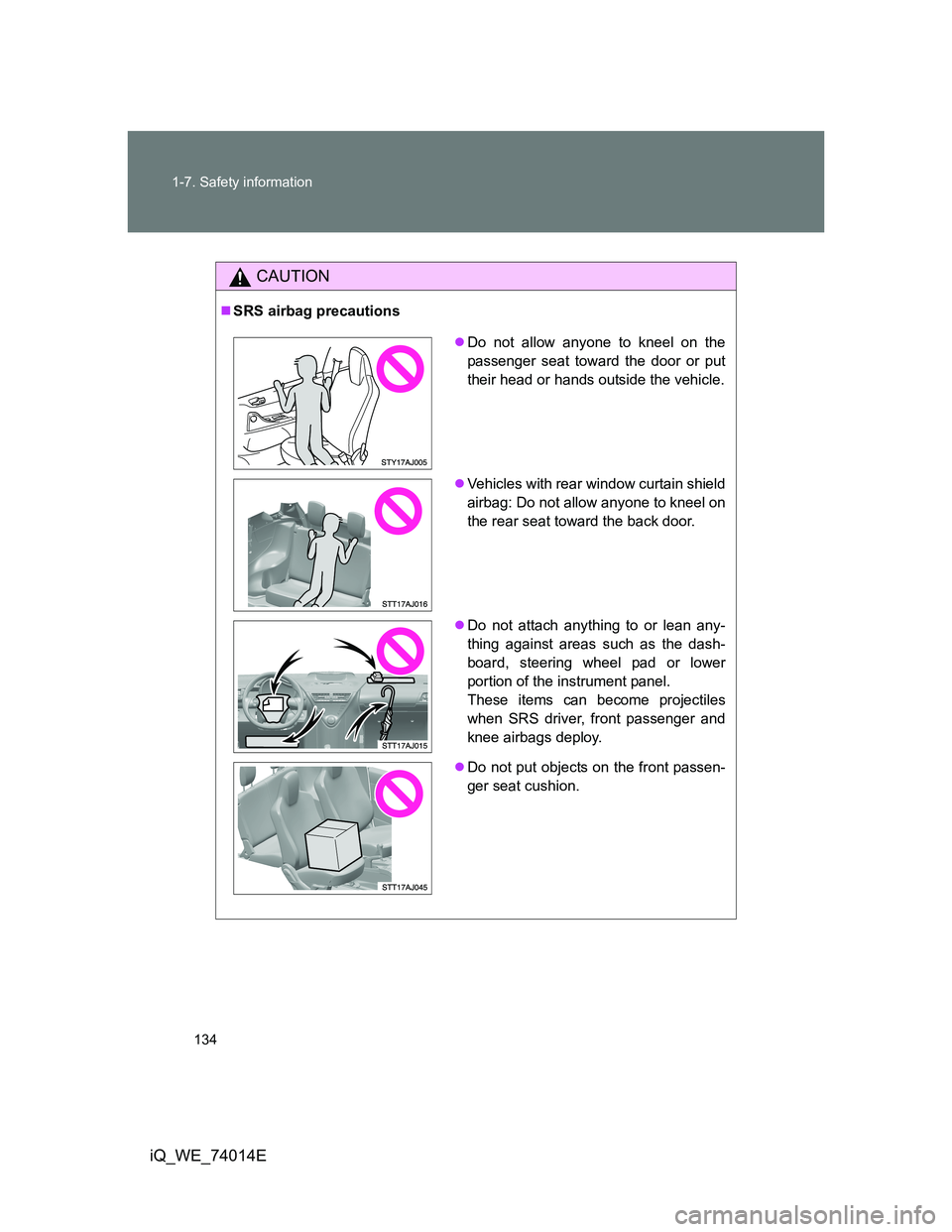
Do not allow anyone to kneel on the
passenger seat toward the door or put
their head or hands outside the vehicle.
Vehicles with rear window curtain shield
airbag: Do not allow anyone to kneel on
the rear seat toward the back door.
Do not attach anything to or lean any-
thing against areas such as the dash-
board, steering wheel pad or lower
portion of the instrument panel.
These items can become projectiles
when SRS driver, front passenger and
knee airbags deploy.
Do not put objects on the front passen-
ger seat cushion.
Page 136 of 476

136 1-7. Safety information
iQ_WE_74014E
CAUTION
SRS airbag precautions
Vehicles without curtain shield airbags: If the areas where the SRS airbags
are stored, such as the steering wheel pad are damaged or cracked, have
them replaced by any authorized Toyota dealer or repairer, or another duly
qualified and equipped professional.
Vehicles with curtain shield airbags: If the areas where the SRS airbags
are stored, such as the steering wheel pad and front and rear pillar
garnishes, are damaged or cracked, have them replaced by any
authorized Toyota dealer or repairer, or another duly qualified and
equipped professional.
Modification and disposal of SRS airbag system components
Do not dispose of your vehicle or perform any of the following modifications
without consulting any authorized Toyota dealer or repairer, or another duly
qualified and equipped professional.
The SRS airbags may malfunction or deploy (inflate) accidentally, causing
death or serious injury.
Installation, removal, disassembly and repair of the SRS airbags.
Repairs, modifications, removal or replacement of the steering wheel,
instrument panel, dashboard, seats or seat upholstery, roof headlining,
front, side and rear pillars, or roof side rail.
Vehicles without curtain shield airbags: Repairs or modifications of the
front fender, front bumper, or side of the occupant compartment.
Vehicles with curtain shield airbags: Repairs or modifications of the front
fender, front and rear bumper, or side and rear of the occupant compart-
ment.
Installation of snow plows, winches, etc. to the front grille (bull bars, kan-
garoo bar etc.).
Vehicles with curtain shield airbags: Installation of racks etc. to the back
door (strap racks, bicycle rack etc.).
Modifications to the vehicle’s suspension system.
Installation of electronic devices such as an RF-transmitter or CD players.
Page 157 of 476
157 1-7. Safety information
1
Before driving
iQ_WE_74014E
CAUTION
When installing a child restraint system
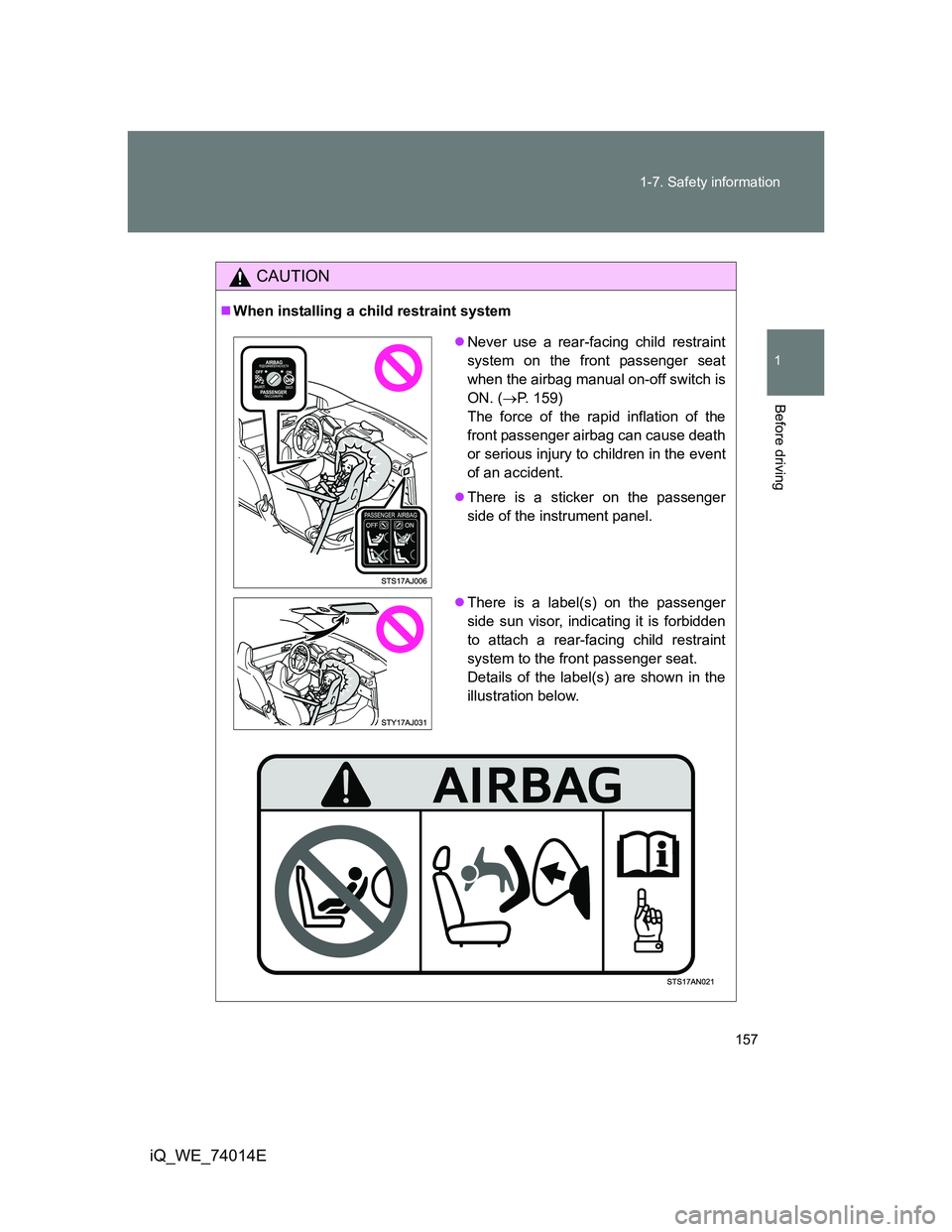
Never use a rear-facing child restraint
system on the front passenger seat
when the airbag manual on-off switch is
ON. (P. 159)
The force of the rapid inflation of the
front passenger airbag can cause death
or serious injury to children in the event
of an accident.
There is a sticker on the passenger
side of the instrument panel.
There is a label(s) on the passenger
side sun visor, indicating it is forbidden
to attach a rear-facing child restraint
system to the front passenger seat.
Details of the label(s) are shown in the
illustration below.
Page 199 of 476
199
2-2. Instrument cluster
2
When driving
iQ_WE_74014E
Indicators and warning lights
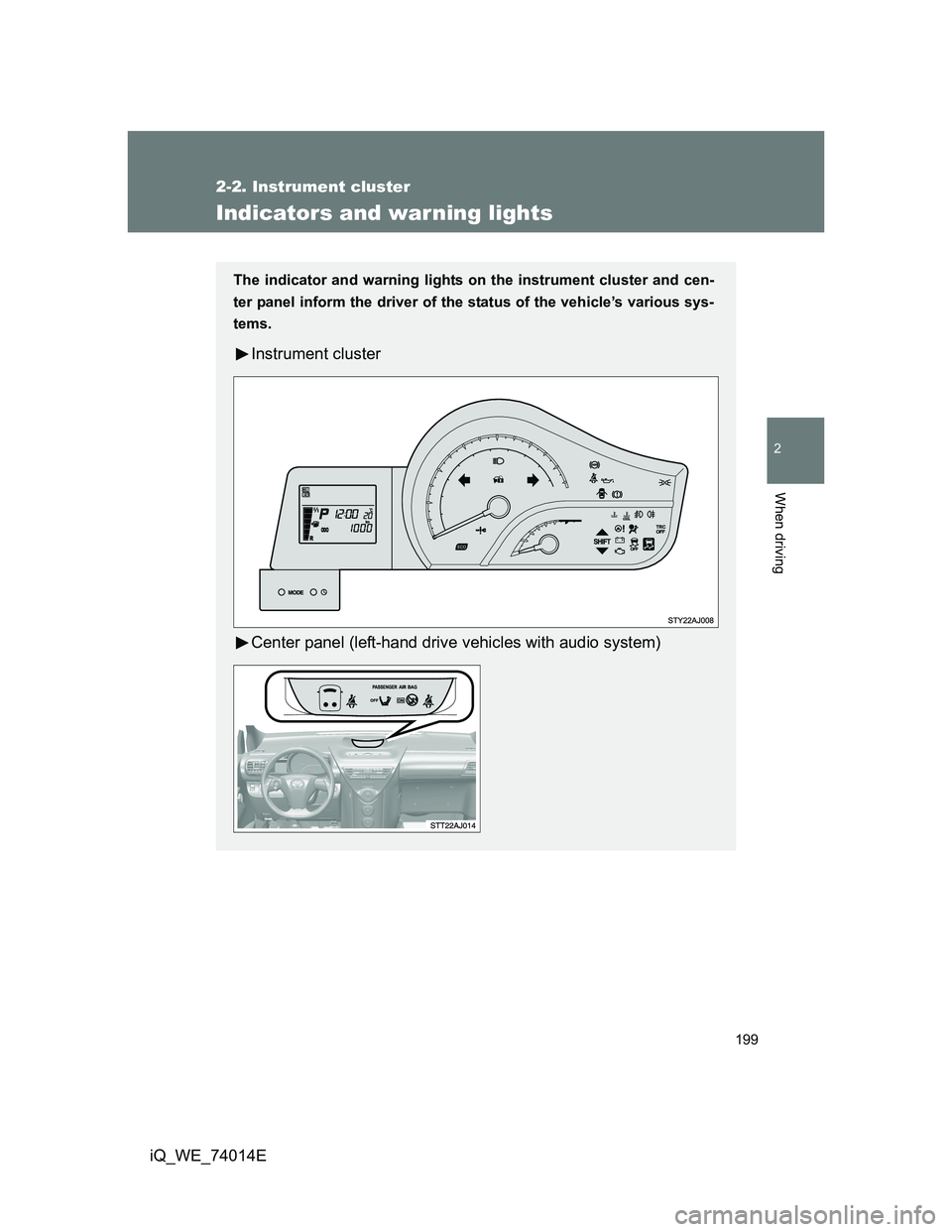
The indicator and warning lights on the instrument cluster and cen-
ter panel inform the driver of the status of the vehicle’s various sys-
tems.
Instrument cluster
Center panel (left-hand drive vehicles with audio system)
Page 200 of 476
200 2-2. Instrument cluster
iQ_WE_74014E
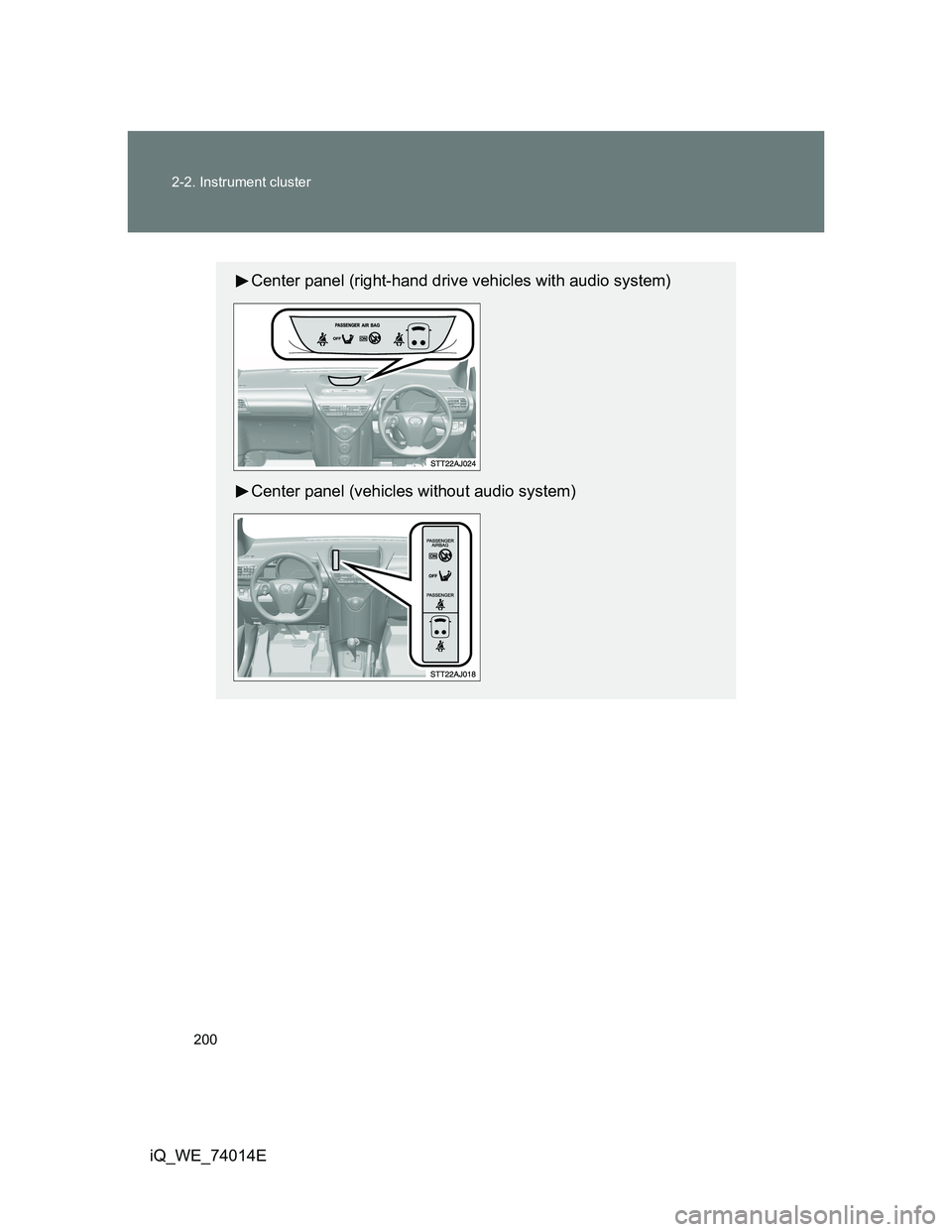
Center panel (right-hand drive vehicles with audio system)
Center panel (vehicles without audio system)