Page 373 of 429
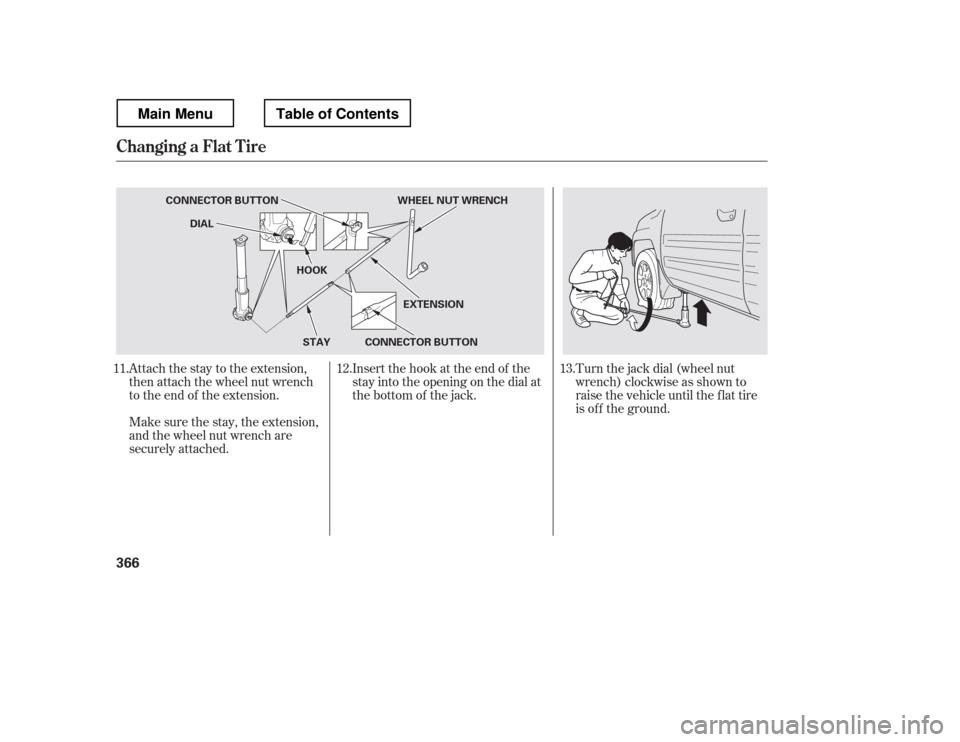
Attach the stay to the extension,
then attach the wheel nut wrench
to the end of the extension.Turn the jack dial (wheel nut
wrench) clockwise as shown to
raise the vehicle until the f lat tire
is of f the ground.
Make sure the stay, the extension,
and the wheel nut wrench are
securely attached. Insert the hook at the end of the
stay into the opening on the dial at
the bottom of the jack.
11. 12. 13.
Changing a Flat T ire
366
EXTENSION
DIAL
CONNECTOR BUTTON
HOOK
STAY WHEEL NUT WRENCH
CONNECTOR BUTTON
Main MenuTable of Contents
Page 374 of 429
CONT INUED
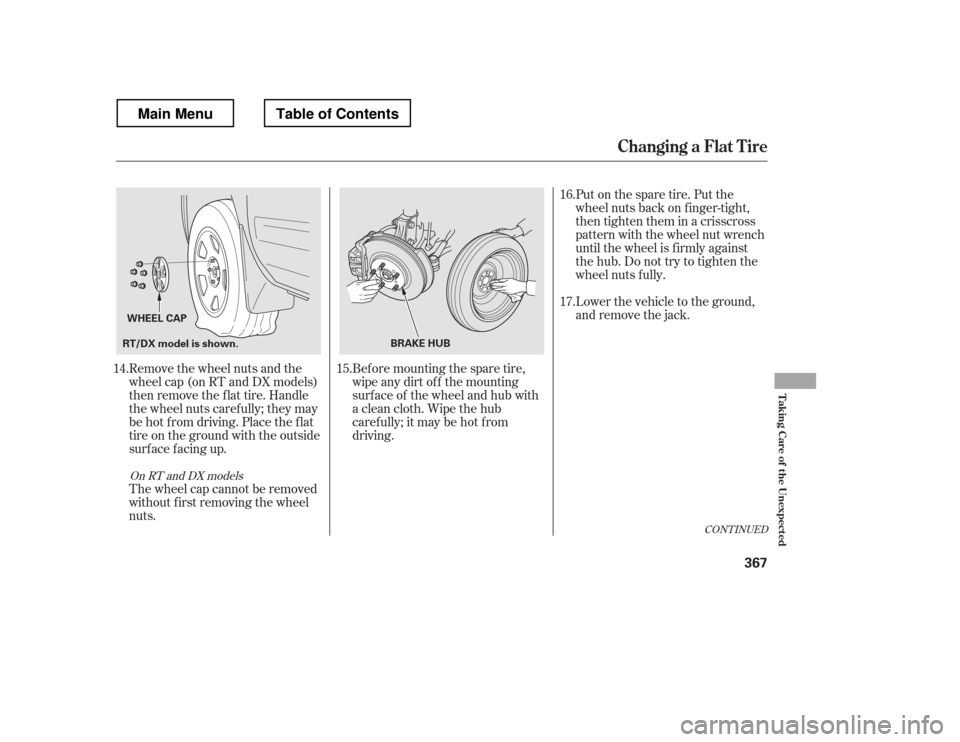
Put on the spare tire. Put the
wheel nuts back on f inger-tight,
then tighten them in a crisscross
pattern with the wheel nut wrench
until the wheel is f irmly against
the hub. Do not try to tighten the
wheel nuts f ully.
Lower the vehicle to the ground,
and remove the jack.
Bef ore mounting the spare tire,
wipeanydirtoff themounting
surface of the wheel and hub with
a clean cloth. Wipe the hub
carefully;itmaybehotfrom
driving.
The wheel cap cannot be removed
without first removing the wheel
nuts.
Remove the wheel nuts and the
wheel cap (on RT and DX models)
then remove the f lat tire. Handle
the wheel nuts caref ully; they may
be hot from driving. Place the flat
tire on the ground with the outside
surface facing up.
14. 15. 16. 17.
On RT and DX models
Changing a Flat T ire
T aking Care of the Unexpected
367
BRAKE HUB
WHEEL CAP
RT/DX model is shown.
Main MenuTable of Contents
Page 375 of 429
Tighten the wheel nuts securely in
the same crisscross pattern. Have
the wheel nut torque checked at
the nearest automotive service
f acility.
Tighten the wheel nuts to:Place the flat tire face up on the
tire tray.
Remove the spacer cone f rom the
wing bolt, turn it over, and put it
back on the bolt.
Securetheflattirebyscrewing
the wing bolt back into its hole.Release the tire tray and slide it
back in place.
Tighten the tire tray holding bolts
securely.
Remove the center cap from the
flat tire.
18. 19.
20. 21. 22. 23. 24.
On all models except RT and DX
Changing a Flat T ire
368
WING BOLT
SPACER CONE For normal tireFor sparetire
94 lbf·ft (127 N·m , 13 kgf·m)
Main MenuTable of Contents
Page 376 of 429
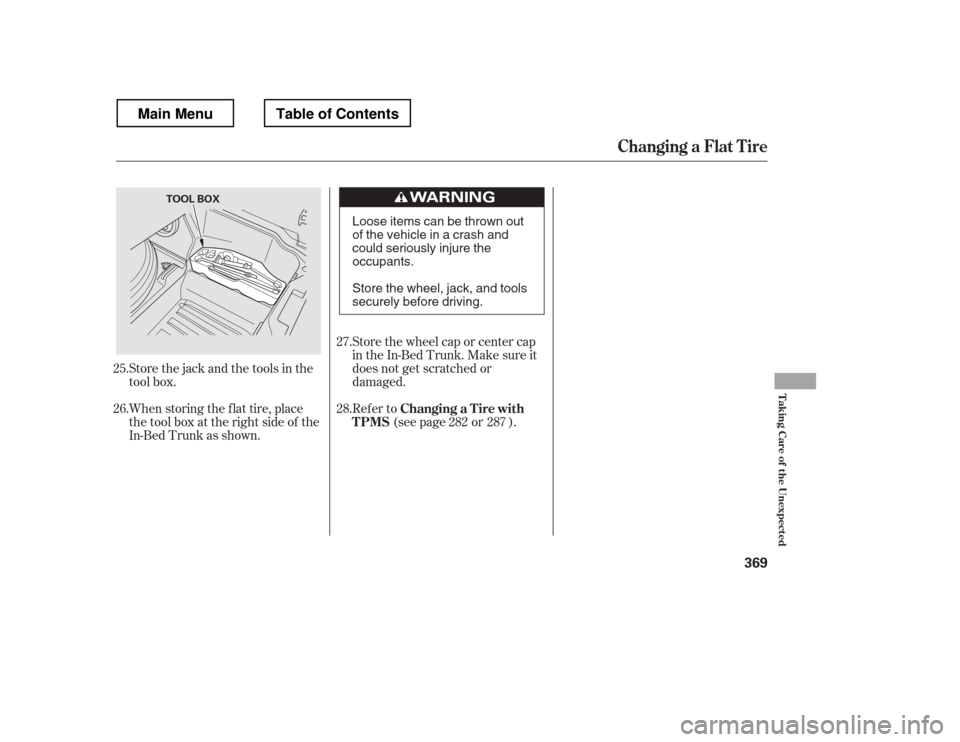
Store the wheel cap or center cap
in the In-Bed Trunk. Make sure it
does not get scratched or
damaged.
When storing the f lat tire, place
the tool box at the right side of the
In-Bed Trunk as shown.
Store the jack and the tools in the
tool box.
Refer to(see page or ).
25. 26. 27. 28.
282 287
Changing a Flat T ire
Changing a T ire with
TPMS
T aking Care of the Unexpected
369
TOOL BOX
Loose items can be thrown out
of the vehicle in a crash and
could seriously injure theoccupants.
Store the wheel, jack, and tools
securely before driving.
Main MenuTable of Contents
Page 377 of 429
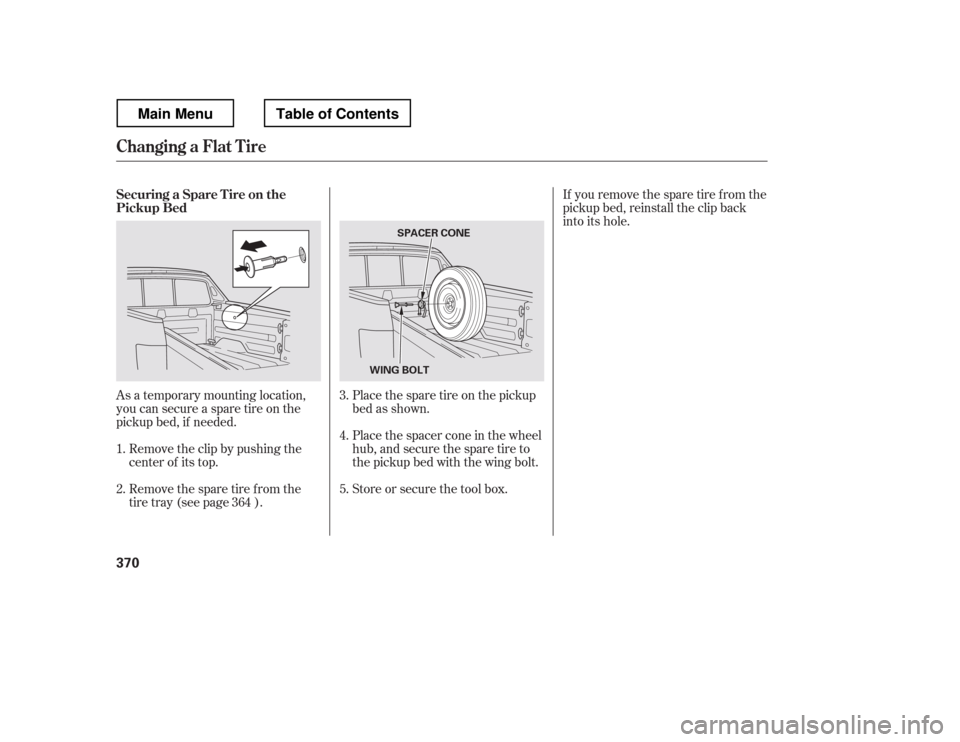
As a temporary mounting location,
you can secure a spare tire on the
pickup bed, if needed.Placethesparetireonthepickup
bed as shown.
Place the spacer cone in the wheel
hub,andsecurethesparetireto
the pickup bed with the wing bolt.If youremovethesparetirefromthe
pickup bed, reinstall the clip back
into its hole.
Remove the clip by pushing the
center of its top.
Remove the spare tire from the
tire tray (see page ). Store or secure the tool box.
1. 2. 3. 4. 5.
364
Changing a Flat T ire
Securing a Spare Tire on the
Pickup Bed
370
SPACER CONE
WING BOLT
Main MenuTable of Contents
Page 392 of 429
CONT INUED
If your vehicle needs to be towed,
call a prof essional towing service or
organization. Never tow your vehicle
with just a rope or chain. It is very
dangerous.The operator will load
your vehicle on the back of a truck.
Any other method of towing will
damage the drive system. When you
contact the towing agency, inf orm
them a f lat-bed is required. If your vehicle gets stuck in sand,
mud, or snow, call a towing service
to pull it out (see the previous
column).
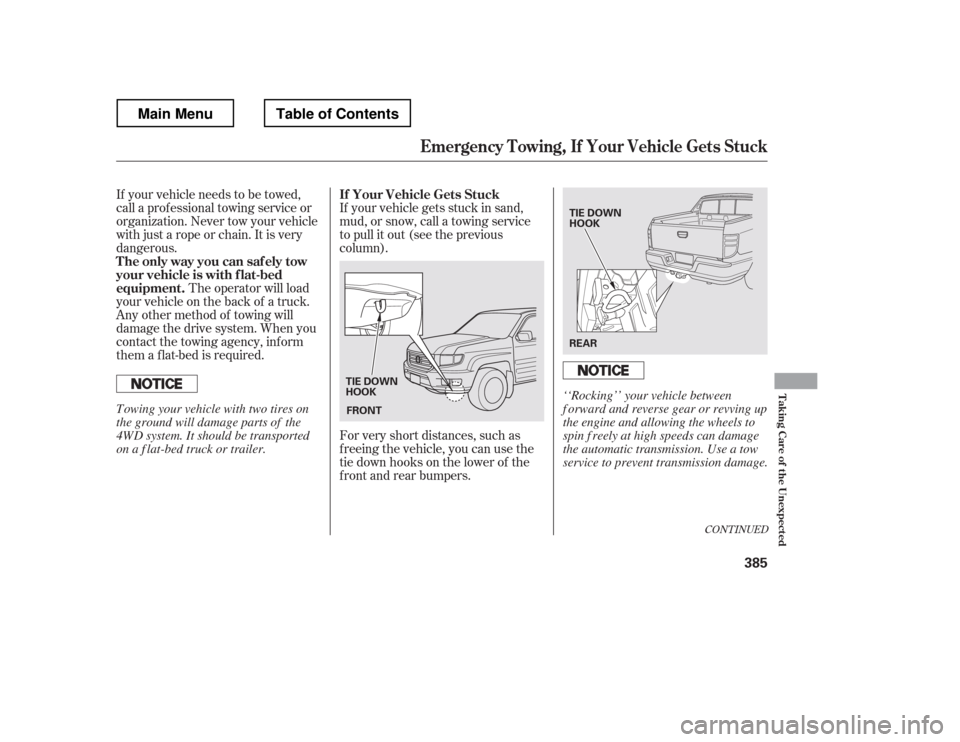
For very short distances, such as
f reeing the vehicle, you can use the
tie down hooks on the lower of the
f ront and rear bumpers.
Emergency Towing, If Your Vehicle Gets Stuck
The only way you can saf ely tow
your vehicle is with f lat-bed
equipment.
If Your Vehicle Gets Stuck
T aking Care of the Unexpected
385
FRONT
REAR
TIE DOWN
HOOK TIE DOWN
HOOK
‘‘Rocking’’ your vehicle between
f orward and reverse gear or revving up
the engine and allowing the wheels to
spin f reely at high speeds can damage
the automatic transmission. Use a tow
service to prevent transmission damage.
Towing your vehicle with two tires on
the ground will damage parts of the
4WD system. It should be transported
on a f lat-bed truck or trailer.
Main MenuTable of Contents
Page 397 of 429
�µ�µ
�Î �Î
�Î �Î �Î
�Î
�Î
�Î �Î �Î�Î �Î
�Î
�Î
Specif ications
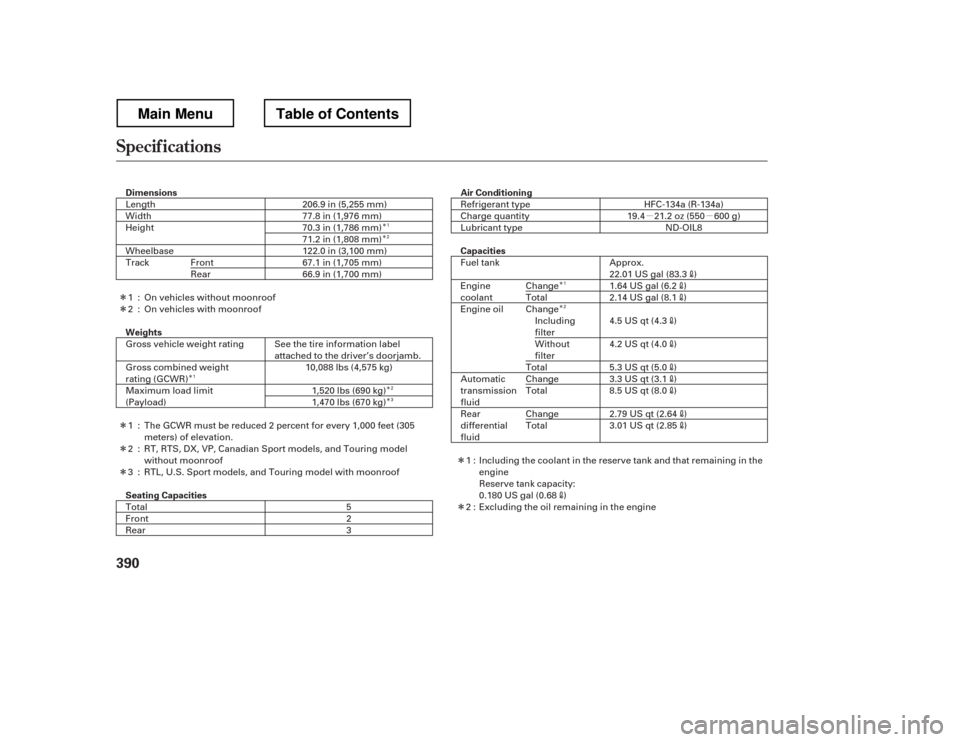
390 Air Conditioning
Dimensions
Capacities
Weights
Seating Capacities 206.9 in (5,255 mm)
77.8 in (1,976 mm)
70.3 in (1,786 mm)
Refrigerant type
Charge quantity
Lubricant type HFC-134a (R-134a)
19.4 21.2 oz (550 600 g) ND-OIL8
1,470 lbs (670 kg)
1,520 lbs (690 kg)
10,088 lbs (4,575 kg)
Length
Width
Height
Wheelbase
Track
66.9 in (1,700 mm)
67.1 in (1,705 mm)
122.0 in (3,100 mm)
The GCWR must be reduced 2 percent for every 1,000 feet (305
meters) of elevation. Fuel tank
Engine
coolant
Engine oil Automatic
transmission
fluidRear
differential
fluid
22.01 US gal (83.3
)
1.64 US gal (6.2)
2.14 US gal (8.1)
4.2 US qt (4.0
)
4.5 US qt (4.3
)
5.3 US qt (5.0
)
3.3 US qt (3.1)
8.5 US qt (8.0)
2.79 US qt (2.64
)
3.01 US qt (2.85)
Including the coolant in the reserve tank and that remaining in the
engine
Reserve tank capacity:
0.180 US gal (0.68
)
Excluding the oil remaining in the engine
71.2 in (1,808 mm)
Gross vehicle weight rating
Gross combined weight
rating (GCWR)
Maximum load limit
(Payload) See the tire information label
attached to the driver’s doorjamb.
3
2
5
Total
FrontRear Approx.
FrontRear
1: 2:
1: 2: 3:
Change Total
Change
Including
filter
Without
filter
Total
ChangeTotal
Change Total
1:
2:
On vehicles without moonroof
On vehicles with moonroof
RT, RTS, DX, VP, Canadian Sport models, and Touring model
without moonroof
RTL, U.S. Sport models, and Touring model with moonroof 1
231 2
1
2
Main MenuTable of Contents
Page 404 of 429
�µ
Always check the TPMS malf unction
telltale af ter replacing one or more
tires or wheels on your vehicle to
ensure that the replacement or
alternate tires and wheels allow the
TPMS to continue to f unction
properly.
TPMS malf unctions may occur f or a
variety of reasons, including the
installation of replacement or
alternate tires or wheels on the
vehicle that prevent the TPMS f rom
f unctioning properly.
When the malf unction indicator is
illuminated,
the system may not be able to detect
or signal low tire pressure as
intended.
Your vehicle has also been equipped
with a TPMS malf unction indicator
to indicate when the system is not
operating properly. The TPMS
malf unction indicator is provided by
a separate telltale, which displays the
symbol ‘‘TPMS