2012 FORD FOCUS ELECTRIC boost
[x] Cancel search: boostPage 188 of 380
When to use the automatic locking mode
This mode should be usedany timea child safety seat, except a
booster, is installed in passenger front or rear seating positions. Children
12 years old and under should be properly restrained in a rear seating
position whenever possible. Refer to Safety restraints for childrenor
Safety seats for children later in this chapter.
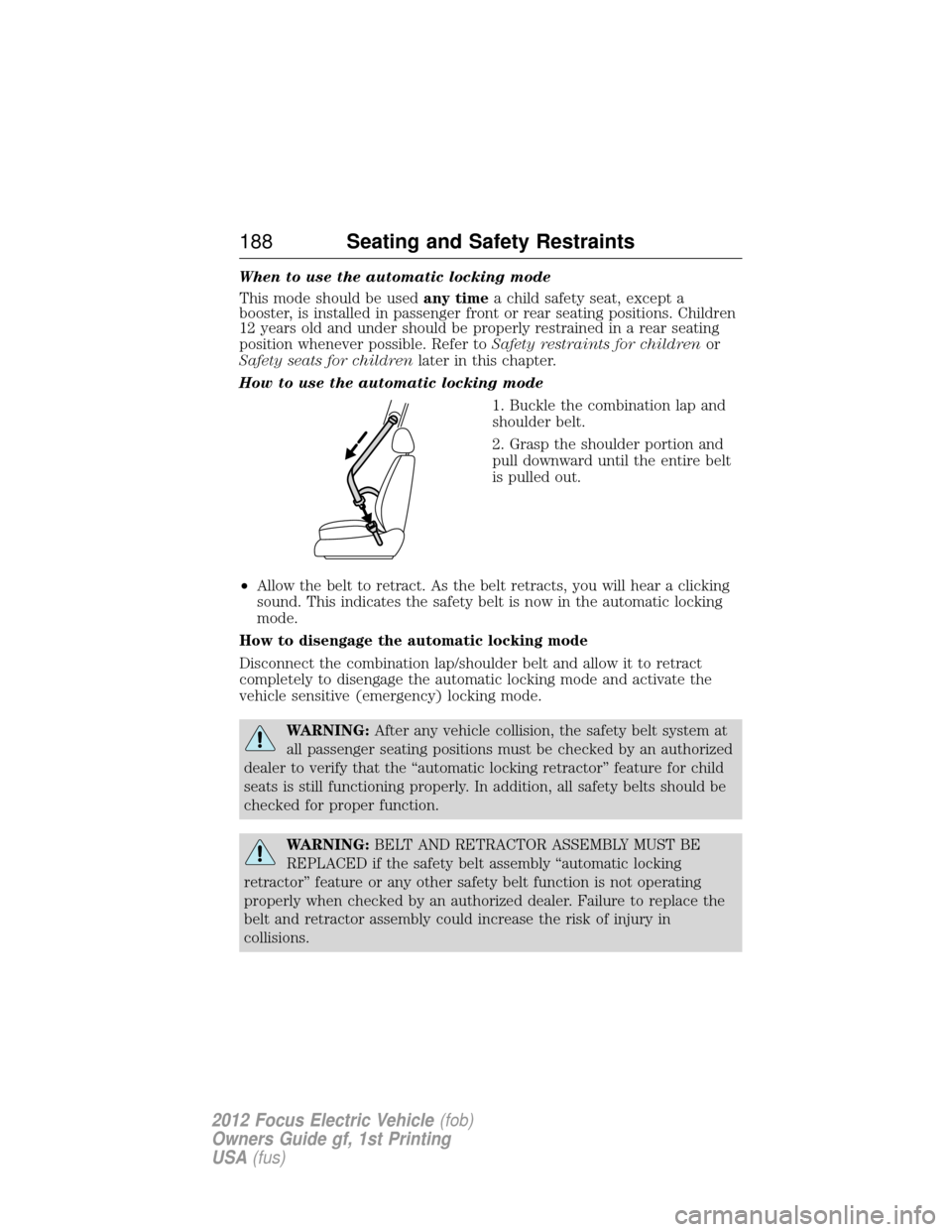
How to use the automatic locking mode 1. Buckle the combination lap and
shoulder belt.
2. Grasp the shoulder portion and
pull downward until the entire belt
is pulled out.
• Allow the belt to retract. As the belt retracts, you will hear a clicking
sound. This indicates the safety belt is now in the automatic locking
mode.
How to disengage the automatic locking mode
Disconnect the combination lap/shoulder belt and allow it to retract
completely to disengage the automatic locking mode and activate the
vehicle sensitive (emergency) locking mode.
WARNING: After any vehicle collision, the safety belt system at
all passenger seating positions must be checked by an authorized
dealer to verify that the “automatic locking retractor” feature for child
seats is still functioning properly. In addition, all safety belts should be
checked for proper function.
WARNING: BELT AND RETRACTOR ASSEMBLY MUST BE
REPLACED if the safety belt assembly “automatic locking
retractor” feature or any other safety belt function is not operating
properly when checked by an authorized dealer. Failure to replace the
belt and retractor assembly could increase the risk of injury in
collisions.
188 Seating and Safety Restraints
2012 Focus Electric Vehicle (fob)
Owners Guide gf, 1st Printing
USA (fus)
Page 199 of 380
This system works with sensors that are part of the front passenger’s
seat and safety belt to detect the presence of a properly seated occupant
and determine if the front passenger’s frontal airbag should be enabled
(may inflate) or not.The front passenger sensing system
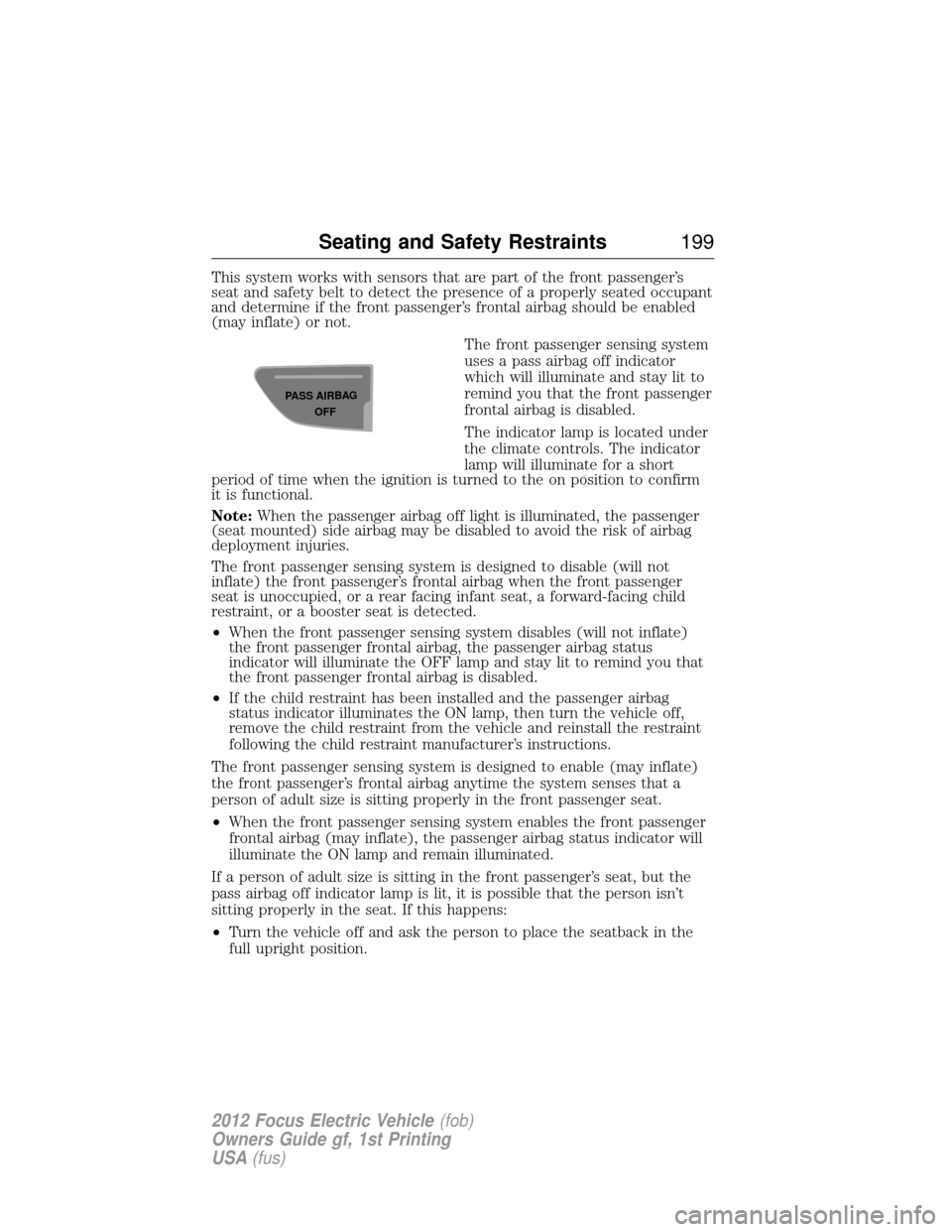
uses a pass airbag off indicator
which will illuminate and stay lit to
remind you that the front passenger
frontal airbag is disabled.
The indicator lamp is located under
the climate controls. The indicator
lamp will illuminate for a short
period of time when the ignition is turned to the on position to confirm
it is functional.
Note: When the passenger airbag off light is illuminated, the passenger
(seat mounted) side airbag may be disabled to avoid the risk of airbag
deployment injuries.
The front passenger sensing system is designed to disable (will not
inflate) the front passenger’s frontal airbag when the front passenger
seat is unoccupied, or a rear facing infant seat, a forward-facing child
restraint, or a booster seat is detected.
• When the front passenger sensing system disables (will not inflate)
the front passenger frontal airbag, the passenger airbag status
indicator will illuminate the OFF lamp and stay lit to remind you that
the front passenger frontal airbag is disabled.
• If the child restraint has been installed and the passenger airbag
status indicator illuminates the ON lamp, then turn the vehicle off,
remove the child restraint from the vehicle and reinstall the restraint
following the child restraint manufacturer’s instructions.
The front passenger sensing system is designed to enable (may inflate)
the front passenger’s frontal airbag anytime the system senses that a
person of adult size is sitting properly in the front passenger seat.
• When the front passenger sensing system enables the front passenger
frontal airbag (may inflate), the passenger airbag status indicator will
illuminate the ON lamp and remain illuminated.
If a person of adult size is sitting in the front passenger’s seat, but the
pass airbag off indicator lamp is lit, it is possible that the person isn’t
sitting properly in the seat. If this happens:
• Turn the vehicle off and ask the person to place the seatback in the
full upright position.
PASS AIRBAG
OFF
Seating and Safety Restraints 199
2012 Focus Electric Vehicle(fob)
Owners Guide gf, 1st Printing
USA (fus)
Page 206 of 380
Children 12 years old and under should always be properly restrained in
the rear seats. The side air curtain will not interfere with children
restrained using a properly installed child or booster seat because it is
designed to inflate downward from the headliner above the doors along
the side window openings.
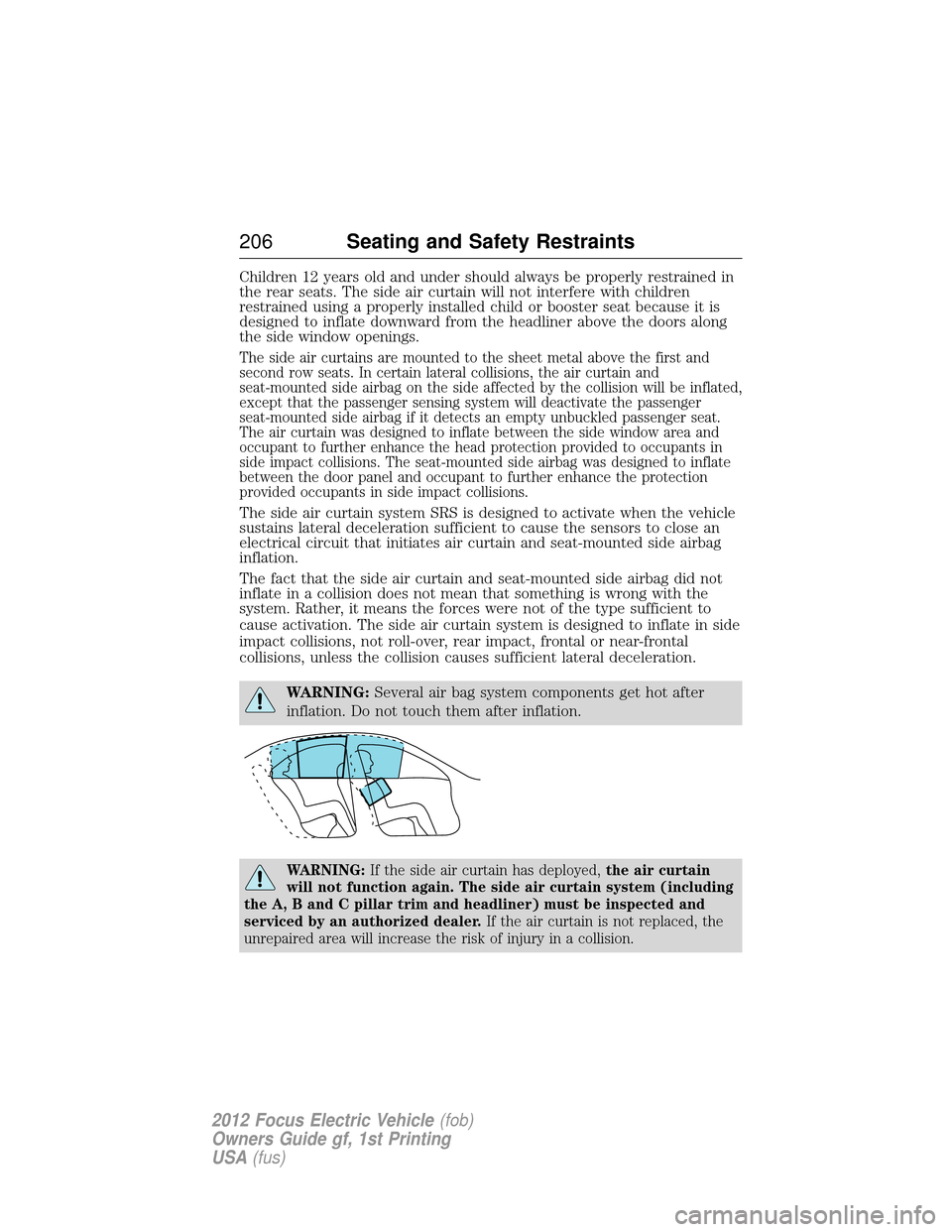
The side air curtains are mounted to the sheet metal above the first and
second row seats. In certain lateral collisions, the air curtain and
seat-mounted side airbag on the side affected by the collision will be inflated,
except that the passenger sensing system will deactivate the passenger
seat-mounted side airbag if it detects an empty unbuckled passenger seat.
The air curtain was designed to inflate between the side window area and
occupant to further enhance the head protection provided to occupants in
side impact collisions. The seat-mounted side airbag was designed to inflate
between the door panel and occupant to further enhance the protection
provided occupants in side impact collisions.
The side air curtain system SRS is designed to activate when the vehicle
sustains lateral deceleration sufficient to cause the sensors to close an
electrical circuit that initiates air curtain and seat-mounted side airbag
inflation.
The fact that the side air curtain and seat-mounted side airbag did not
inflate in a collision does not mean that something is wrong with the
system. Rather, it means the forces were not of the type sufficient to
cause activation. The side air curtain system is designed to inflate in side
impact collisions, not roll-over, rear impact, frontal or near-frontal
collisions, unless the collision causes sufficient lateral deceleration.
WARNING:Several air bag system components get hot after
inflation. Do not touch them after inflation.
WARNING: If the side air curtain has deployed, the air curtain
will not function again. The side air curtain system (including
the A, B and C pillar trim and headliner) must be inspected and
serviced by an authorized dealer. If the air curtain is not replaced, the
unrepaired area will increase the risk of injury in a collision.
206 Seating and Safety Restraints
2012 Focus Electric Vehicle (fob)
Owners Guide gf, 1st Printing
USA (fus)
Page 209 of 380
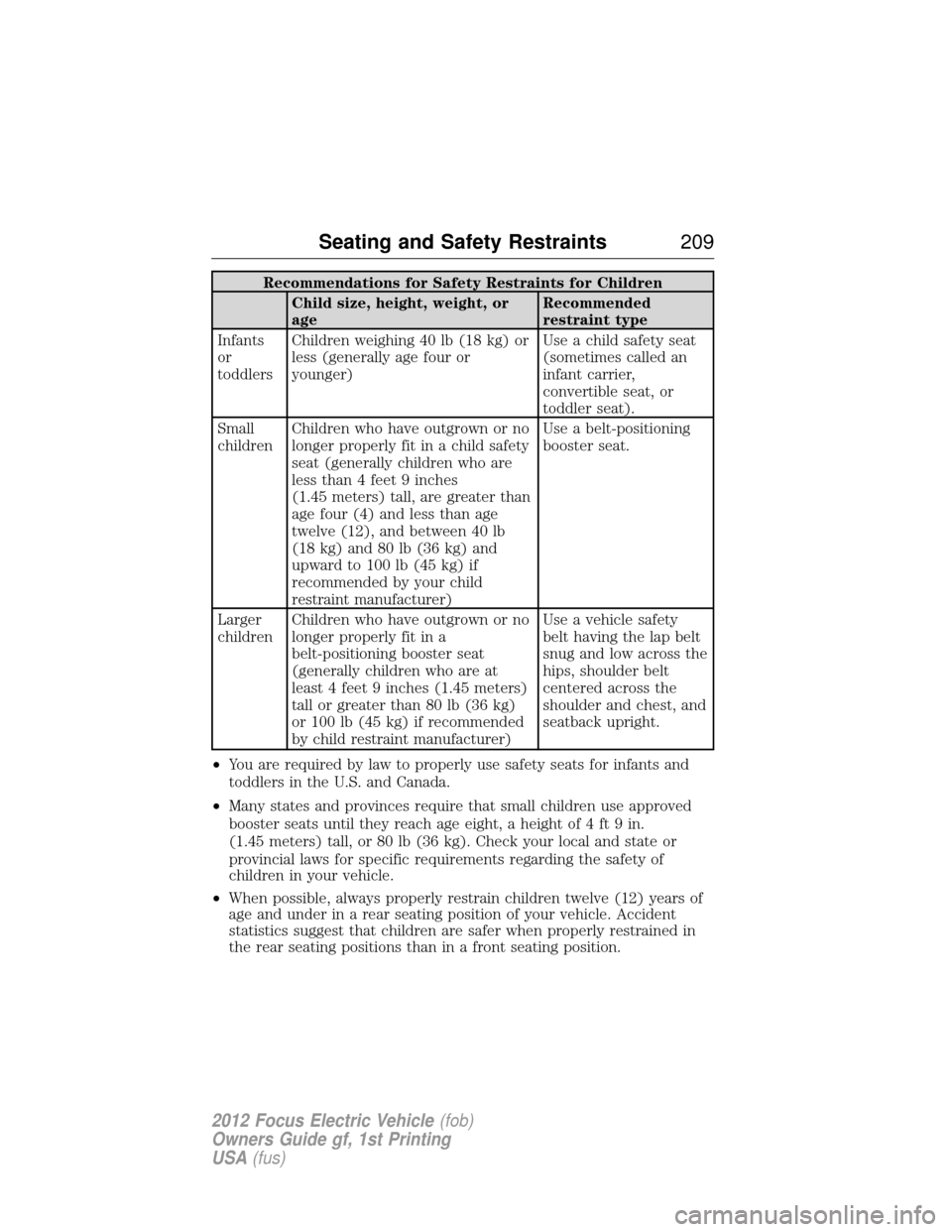
Recommendations for Safety Restraints for ChildrenChild size, height, weight, or
age Recommended
restraint type
Infants
or
toddlers Children weighing 40 lb (18 kg) or
less (generally age four or
younger) Use a child safety seat
(sometimes called an
infant carrier,
convertible seat, or
toddler seat).
Small
children Children who have outgrown or no
longer properly fit in a child safety
seat (generally children who are
less than 4 feet 9 inches
(1.45 meters) tall, are greater than
age four (4) and less than age
twelve (12), and between 40 lb
(18 kg) and 80 lb (36 kg) and
upward to 100 lb (45 kg) if
recommended by your child
restraint manufacturer) Use a belt-positioning
booster seat.
Larger
children Children who have outgrown or no
longer properly fit in a
belt-positioning booster seat
(generally children who are at
least 4 feet 9 inches (1.45 meters)
tall or greater than 80 lb (36 kg)
or 100 lb (45 kg) if recommended
by child restraint manufacturer) Use a vehicle safety
belt having the lap belt
snug and low across the
hips, shoulder belt
centered across the
shoulder and chest, and
seatback upright.
• You are required by law to properly use safety seats for infants and
toddlers in the U.S. and Canada.
• Many states and provinces require that small children use approved
booster seats until they reach age eight, a height of 4 ft 9 in.
(1.45 meters) tall, or 80 lb (36 kg). Check your local and state or
provincial laws for specific requirements regarding the safety of
children in your vehicle.
• When possible, always properly restrain children twelve (12) years of
age and under in a rear seating position of your vehicle. Accident
statistics suggest that children are safer when properly restrained in
the rear seating positions than in a front seating position.
Seating and Safety Restraints 209
2012 Focus Electric Vehicle(fob)
Owners Guide gf, 1st Printing
USA (fus)
Page 211 of 380
WARNING:Never let a passenger hold a child on his or her lap
while the vehicle is moving. The passenger cannot protect the child
from injury in a collision, which may result in serious injury or death.
WARNING: Never use pillows, books, or towels to boost a child.
They can slide around and increase the likelihood of injury or
death in a collision.
WARNING: Always restrain an unoccupied child seat or booster
seat. These objects may become projectiles in a collision or
sudden stop, which may increase the risk of serious injury.
WARNING: Never place, or allow a child to place, the shoulder
belt under a child’s arm or behind the back because it reduces
the protection for the upper part of the body and may increase the risk
of injury or death in a collision.
WARNING: Do not leave children, unreliable adults, or pets
unattended in your vehicle.
Transporting children
Always make sure your child is secured properly in a device that is
appropriate for their age, height and weight. All children are shaped
differently. The child height, age and weight thresholds provided are
recommendations or the minimum requirements of law. The National
Highway Traffic Safety Administration (NHTSA) provides education and
training to ensure that all children ages 0 to 16 are properly restrained in
the correct restraint system. Ford recommends checking with a NHTSA
Certified Child Passenger Safety Technician (CPST) and your
pediatrician to make sure your seat is appropriate for your child and
properly installed in the vehicle. To locate a child seat fitting station and
CPST contact the NHTSA toll free at 1-888-327-4236or on the internet
at http://www.nhtsa.dot.gov. In Canada, check with your local St. John
Ambulance office for referral to a CPST or for further information,
contact your provincial ministry of transportation, your local St. John
Ambulance office at http://www.sfa.ca, or Transport Canada at
1–800–333–0371 (http://www.tc.gc.ca).
Follow all the safety restraint and airbag precautions that apply to adult
passengers in your vehicle.
Seating and Safety Restraints 211
2012 Focus Electric Vehicle(fob)
Owners Guide gf, 1st Printing
USA (fus)
Page 212 of 380
If the child is the proper height, age, and weight (as specified by your
child safety seat or booster manufacturer), fits the restraint and can be
restrained properly, then restrain the child in the child safety seat or
with the belt-positioning booster. Remember that child seats and
belt-positioning boosters vary and may be designed to fit children of
different heights, ages and weights. Children who are too large for child
safety seats or belt-positioning boosters (as specified by your child safety
seat manufacturer) should always properly wear safety belts.
SAFETY SEATS FOR CHILDREN
Infant and/or toddler seats
Use a safety seat that is recommended for the size and weight of the
child.
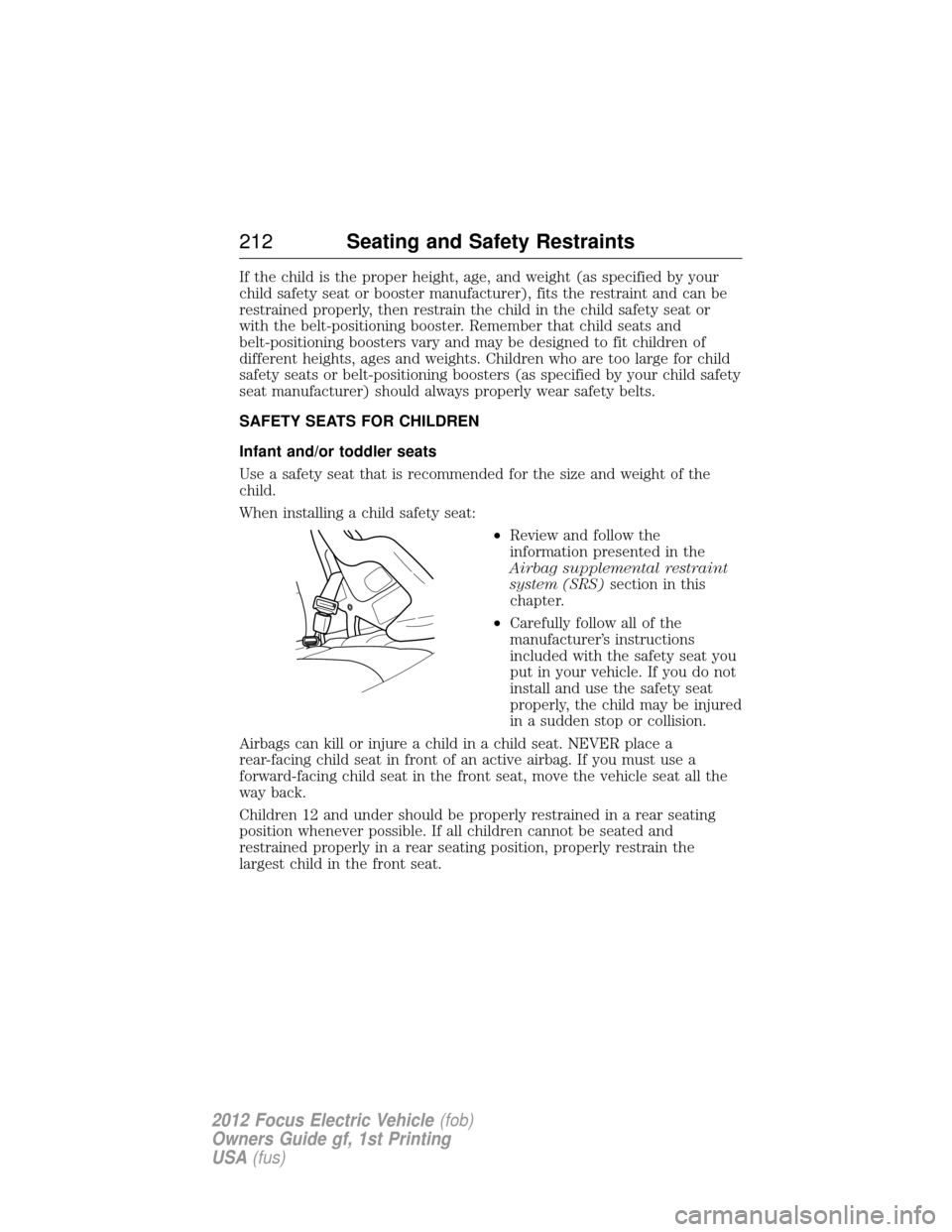
When installing a child safety seat:•Review and follow the
information presented in the
Airbag supplemental restraint
system (SRS) section in this
chapter.
• Carefully follow all of the
manufacturer’s instructions
included with the safety seat you
put in your vehicle. If you do not
install and use the safety seat
properly, the child may be injured
in a sudden stop or collision.
Airbags can kill or injure a child in a child seat. NEVER place a
rear-facing child seat in front of an active airbag. If you must use a
forward-facing child seat in the front seat, move the vehicle seat all the
way back.
Children 12 and under should be properly restrained in a rear seating
position whenever possible. If all children cannot be seated and
restrained properly in a rear seating position, properly restrain the
largest child in the front seat.
212 Seating and Safety Restraints
2012 Focus Electric Vehicle (fob)
Owners Guide gf, 1st Printing
USA (fus)
Page 220 of 380
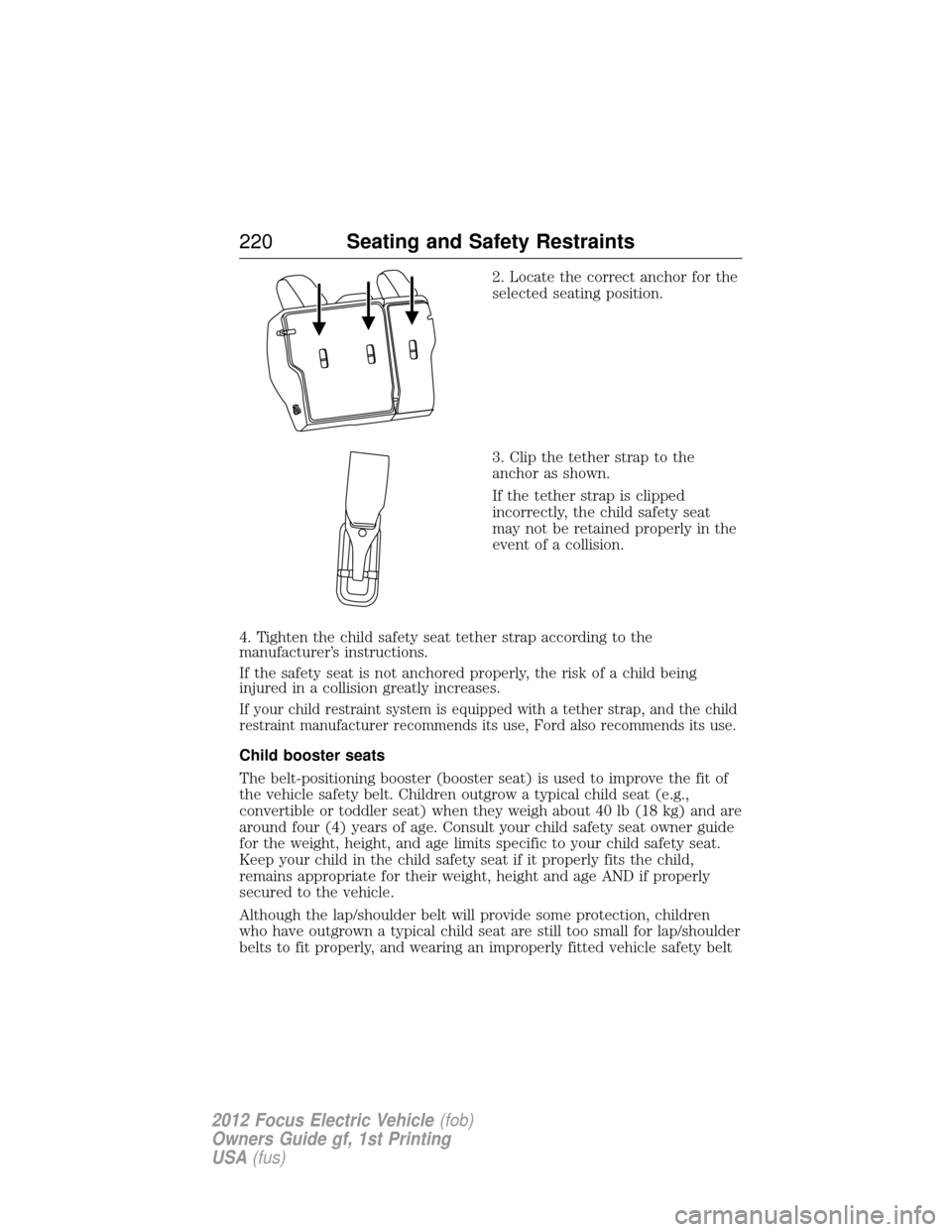
2. Locate the correct anchor for the
selected seating position.
3. Clip the tether strap to the
anchor as shown.
If the tether strap is clipped
incorrectly, the child safety seat
may not be retained properly in the
event of a collision.
4. Tighten the child safety seat tether strap according to the
manufacturer’s instructions.
If the safety seat is not anchored properly, the risk of a child being
injured in a collision greatly increases.
If your child restraint system is equipped with a tether strap, and the child
restraint manufacturer recommends its use, Ford also recommends its use.
Child booster seats
The belt-positioning booster (booster seat) is used to improve the fit of
the vehicle safety belt. Children outgrow a typical child seat (e.g.,
convertible or toddler seat) when they weigh about 40 lb (18 kg) and are
around four (4) years of age. Consult your child safety seat owner guide
for the weight, height, and age limits specific to your child safety seat.
Keep your child in the child safety seat if it properly fits the child,
remains appropriate for their weight, height and age AND if properly
secured to the vehicle.
Although the lap/shoulder belt will provide some protection, children
who have outgrown a typical child seat are still too small for lap/shoulder
belts to fit properly, and wearing an improperly fitted vehicle safety belt
220 Seating and Safety Restraints
2012 Focus Electric Vehicle (fob)
Owners Guide gf, 1st Printing
USA (fus)
Page 221 of 380
could increase the risk of serious injury in a crash. To improve the fit of
both the lap and shoulder belt on children who have outgrown child
safety seats, Ford Motor Company recommends use of a belt-positioning
booster.
Booster seats position a child so that vehicle lap/shoulder safety belts fit
better. They lift the child up so that the lap belt rests low across the hips
and the knees bend comfortably at the edge of the cushion, while
minimizing slouching. Booster seats may also make the shoulder belt fit
better and more comfortably. Try to keep the belt near the middle of the
shoulder and across the center of the chest. Moving the child closer (a
few centimeters or inches) to the center of the vehicle, but remaining in
the same seating position, may help provide a good shoulder belt fit.
When children should use booster seats
Children need to use booster seats from the time they outgrow the
toddler seat until they are big enough for the vehicle seat and
lap/shoulder belt to fit properly. Generally this is when they reach a
height of at least 4 feet 9 inches (1.45 meters) tall (around age eight to
age twelve and between 40 lb (18 kg) and 80 lb (36 kg) or upward to
100 lb (45 kg) if recommended by your child restraint manufacturer).
Many state and provincial laws require that children use approved
booster seats until they reach age eight, a height of 4 feet 9 inches
(1.45 meters) tall, or 80 lb (36 kg).
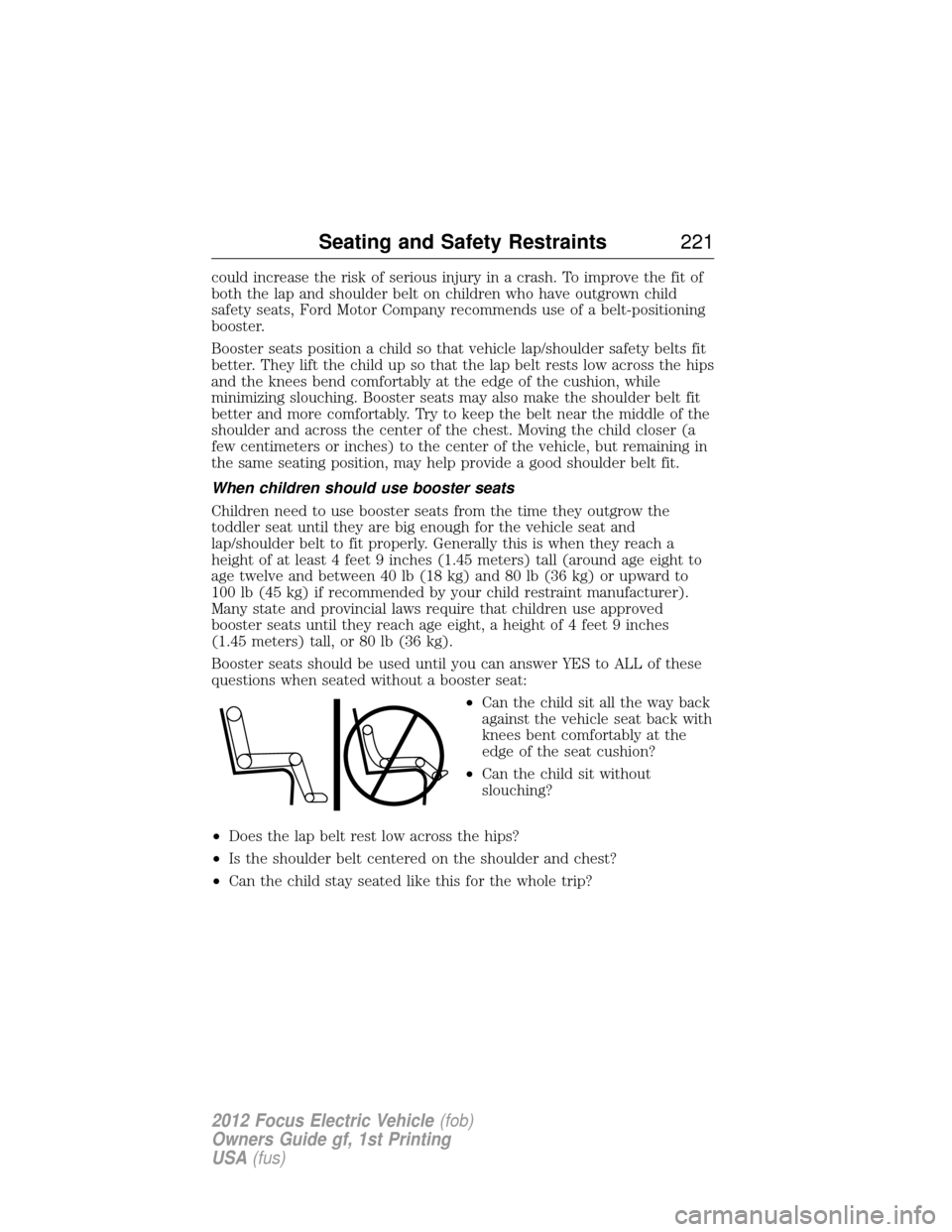
Booster seats should be used until you can answer YES to ALL of these
questions when seated without a booster seat:•Can the child sit all the way back
against the vehicle seat back with
knees bent comfortably at the
edge of the seat cushion?
• Can the child sit without
slouching?
• Does the lap belt rest low across the hips?
• Is the shoulder belt centered on the shoulder and chest?
• Can the child stay seated like this for the whole trip?
Seating and Safety Restraints 221
2012 Focus Electric Vehicle(fob)
Owners Guide gf, 1st Printing
USA (fus)