Page 251 of 380
RECREATIONAL TOWING
Follow these guidelines if you have a need for recreational (RV) towing.
An example of recreational towing would be towing your vehicle behind
a motor home.
In case of a roadside emergency with a disabled vehicle, please refer to
Wrecker towingin theRoadside Emergencies chapter.
These guidelines are designed to prevent damage to your vehicle.
Do not tow your vehicle with any wheels on the ground, as vehicle or
transmission damage may occur. It is recommended to tow your vehicle
with all four (4) wheels off the ground such as when using a car-hauling
trailer. Otherwise, no recreational towing is permitted.
Tires, Wheels and Loading 251
2012 Focus Electric Vehicle(fob)
Owners Guide gf, 1st Printing
USA (fus)
Page 264 of 380
SINGLE SPEED AUTOMATIC TRANSMISSION
WARNING:Always set the parking brake fully and make sure
the gearshift lever is latched in P (Park).
The single-speed transmission is built specifically to handle the high RPM
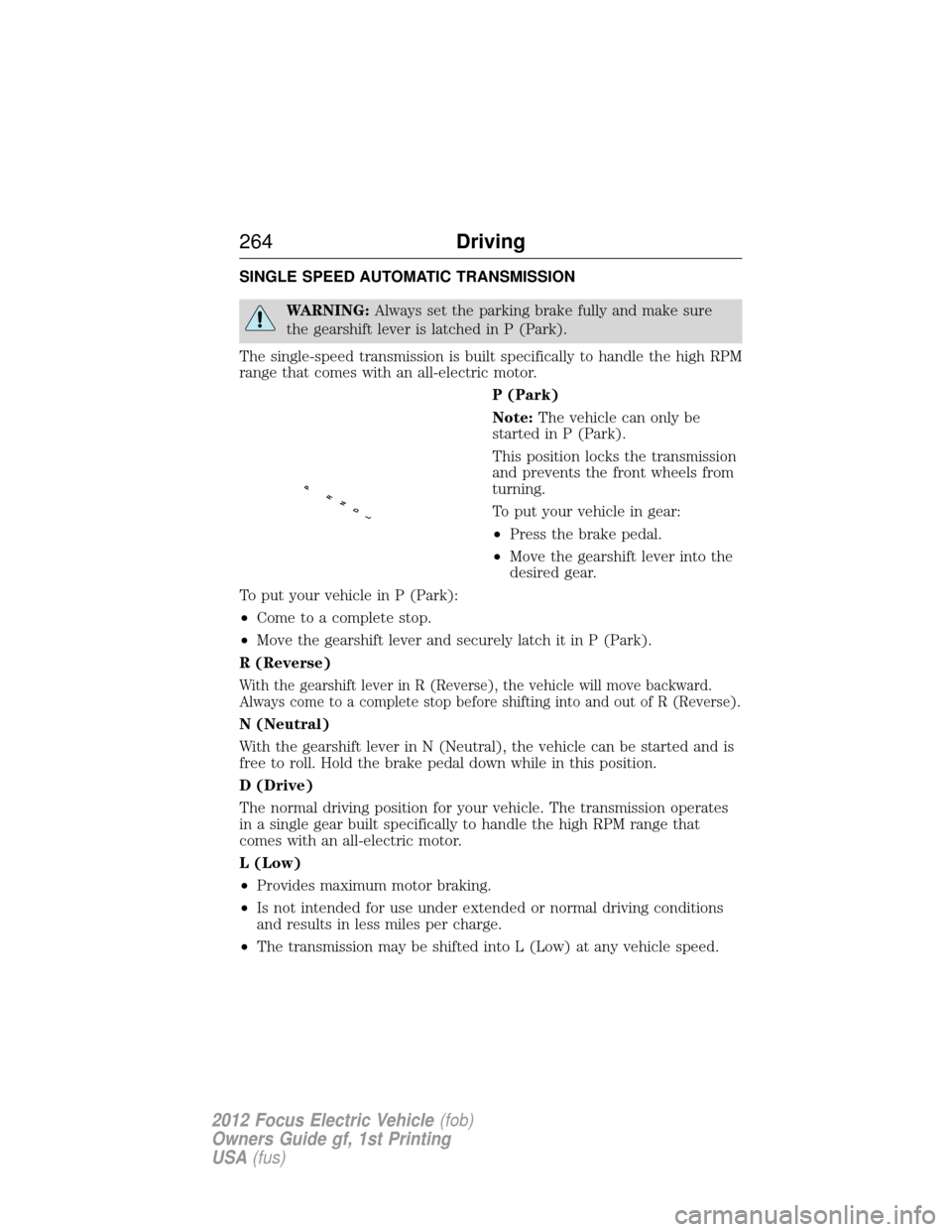
range that comes with an all-electric motor. P (Park)
Note:The vehicle can only be
started in P (Park).
This position locks the transmission
and prevents the front wheels from
turning.
To put your vehicle in gear:
• Press the brake pedal.
• Move the gearshift lever into the
desired gear.
To put your vehicle in P (Park):
• Come to a complete stop.
• Move the gearshift lever and securely latch it in P (Park).
R (Reverse)
With the gearshift lever in R (Reverse), the vehicle will move backward.
Always come to a complete stop before shifting into and out of R (Reverse).
N (Neutral)
With the gearshift lever in N (Neutral), the vehicle can be started and is
free to roll. Hold the brake pedal down while in this position.
D (Drive)
The normal driving position for your vehicle. The transmission operates
in a single gear built specifically to handle the high RPM range that
comes with an all-electric motor.
L (Low)
• Provides maximum motor braking.
• Is not intended for use under extended or normal driving conditions
and results in less miles per charge.
• The transmission may be shifted into L (Low) at any vehicle speed.
PRNDL
264 Driving
2012 Focus Electric Vehicle (fob)
Owners Guide gf, 1st Printing
USA (fus)
Page 265 of 380
HILL START ASSIST
WARNING:The hill start assist feature does not replace the
parking brake. When you leave the vehicle, always apply the
parking brake and shift the transmission into P (Park).
WARNING: You must remain in the vehicle once you have
activated the hill start assist feature.
WARNING: During all times, you are responsible for controlling
the vehicle, supervising the hill start assist system and
intervening, if required.
WARNING: If the motor is revved excessively, or if a malfunction
is detected when the hill start assist feature is active, the hill
start assist feature will be deactivated.
The hill start assist feature makes it easier to pull away when the vehicle is
on a slope without the need to use the parking brake. When the hill start
assist feature is active, the vehicle will remain stationary on the slope for
up to two seconds after you release the brake pedal. During this time, you
have time to move your foot from the brake to the accelerator pedal and
pull away. The brakes are released automatically once the motor has
developed sufficient drive to prevent the vehicle from rolling down the
slope. This is an advantage when pulling away on a slope; for example from
a car park ramp, traffic lights or when reversing uphill into a parking space.
The hill start assist feature is activated automatically when the vehicle is
stopped on a slope greater than five degrees. The hill start assist feature
operates with the vehicle facing downhill if reverse gear is selected. The
hill start assist feature will not operate if the parking brake is activated.
To activate hill start assist, do the following:
1. Press the brake pedal to bring the vehicle to a complete standstill.
Keep the brake pedal pressed.
2. If the sensors detect that the vehicle is on a slope, the hill start assist
feature will be activated automatically.
3. When you remove your foot from the brake pedal, the vehicle will
remain on the slope without rolling away for approximately up to two
seconds. This hold time will automatically be extended if you are in the
process of driving off.
4. Drive off in the normal manner. The brakes will be released automatically.
Driving 265
2012 Focus Electric Vehicle (fob)
Owners Guide gf, 1st Printing
USA (fus)
Page 266 of 380
If Your Vehicle Gets Stuck in Mud or Snow
Note:Do not rock the vehicle if the motor is not at normal operating
temperature or damage to the transmission may occur.
Note: Excessive rocking of the vehicle may eventually cause a loss of
power as the powertrain protects against overheating or damage.
If your vehicle gets stuck in mud or snow, it may be rocked out by
shifting between forward and reverse gears, stopping between shifts in a
steady pattern. Press lightly on the accelerator in each gear.
REVERSE SENSING SYSTEM (IF EQUIPPED)
The Reverse Sensing System (RSS) sounds a tone to warn the driver of
obstacles near the rear bumper when R (Reverse) is selected and the
vehicle is moving at speeds less than 3 mph (5 km/h). The system is not
effective at speeds above 3 mph (5 km/h) and may not detect certain
angular or moving objects.
WARNING: To help avoid personal injury, please read and
understand the limitations of the reverse sensing system as
contained in this section. Sensing is only an aid for some (generally
large and fixed) objects when moving in reverse on a flat surface at
parking speeds. Traffic control systems, inclement weather, air brakes,
and external motors and fans may also affect the function of the
sensing system; this may include reduced performance or a false
activation.
WARNING: To help avoid personal injury, always use caution
when in R (Reverse) and when using the sensing system.
WARNING: This system is not designed to prevent contact with
small or moving objects. The system is designed to provide a
warning to assist the driver in detecting large stationary objects to
avoid damaging the vehicle. The system may not detect smaller objects,
particularly those close to the ground.
266 Driving
2012 Focus Electric Vehicle (fob)
Owners Guide gf, 1st Printing
USA (fus)
Page 268 of 380
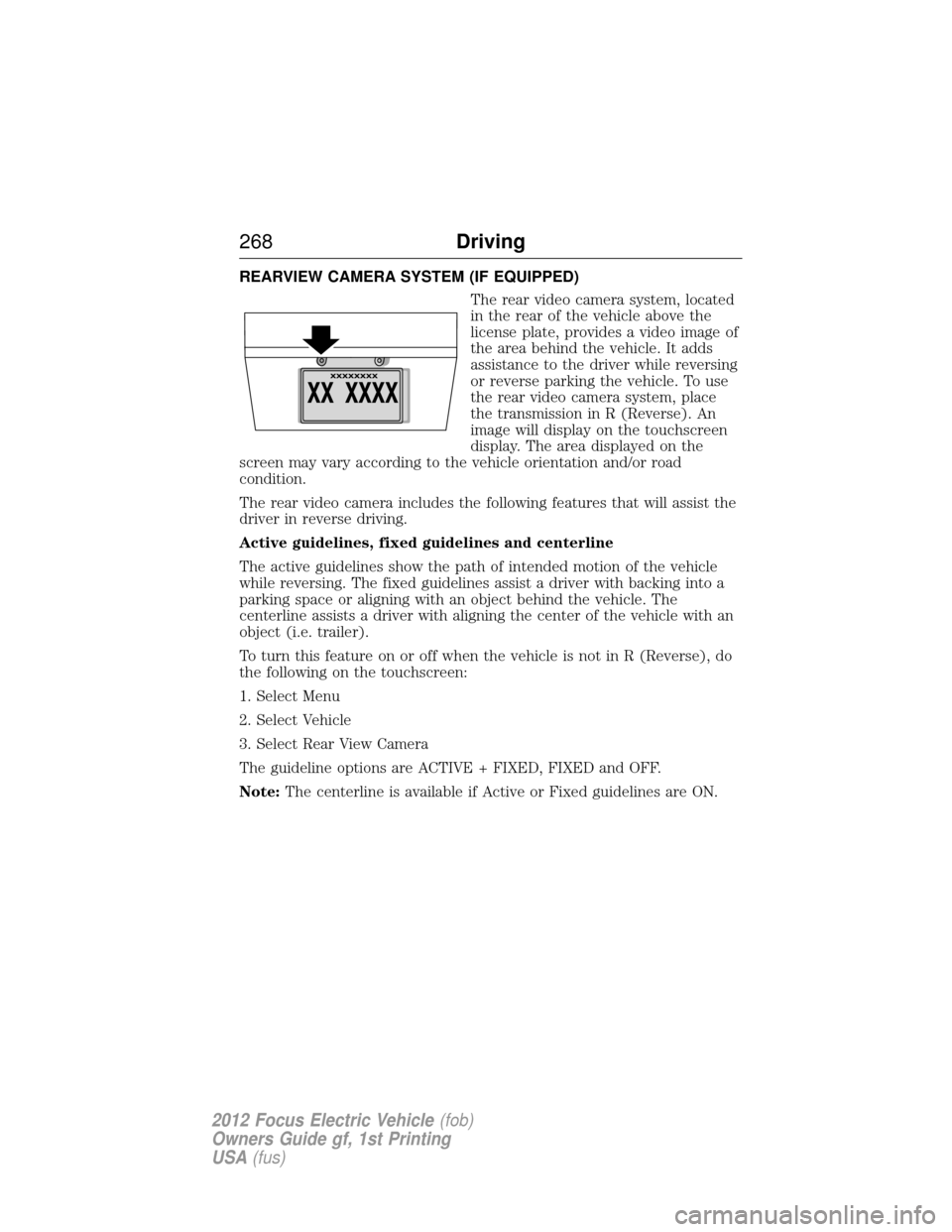
REARVIEW CAMERA SYSTEM (IF EQUIPPED)The rear video camera system, located
in the rear of the vehicle above the
license plate, provides a video image of
the area behind the vehicle. It adds
assistance to the driver while reversing
or reverse parking the vehicle. To use
the rear video camera system, place
the transmission in R (Reverse). An
image will display on the touchscreen
display. The area displayed on the
screen may vary according to the vehicle orientation and/or road
condition.
The rear video camera includes the following features that will assist the
driver in reverse driving.
Active guidelines, fixed guidelines and centerline
The active guidelines show the path of intended motion of the vehicle
while reversing. The fixed guidelines assist a driver with backing into a
parking space or aligning with an object behind the vehicle. The
centerline assists a driver with aligning the center of the vehicle with an
object (i.e. trailer).
To turn this feature on or off when the vehicle is not in R (Reverse), do
the following on the touchscreen:
1. Select Menu
2. Select Vehicle
3. Select Rear View Camera
The guideline options are ACTIVE + FIXED, FIXED and OFF.
Note: The centerline is available if Active or Fixed guidelines are ON.
268 Driving
2012 Focus Electric Vehicle (fob)
Owners Guide gf, 1st Printing
USA (fus)
Page 274 of 380
DRIVING THROUGH WATER
Note:Driving through deep water may allow water into the transmission
and motor causing internal damage. Have the fluid checked and, if water
is found, replace the fluid.
Do not drive quickly through standing water, especially if the depth is
unknown. Traction or brake capability may be limited and if enough
water is present, the vehicle may stall.
If driving through deep or standing
water is unavoidable , proceed very
slowly. Never drive through water
that is higher than the bottom of
the wheel rims.
Once through the water, always try the brakes. Wet brakes do not stop
the vehicle as effectively as dry brakes. Drying can be improved by
moving your vehicle slowly while applying light pressure on the brake
pedal.
274 Driving
2012 Focus Electric Vehicle (fob)
Owners Guide gf, 1st Printing
USA (fus)
Page 285 of 380
Fuse/RelayLocation Fuse Amp
Rating Protected Circuits
F13 40A** On-board charger
F14 40A** Heater element 1
F15 — Not used
F16 40A** Heater element 2
F17 — Not used
F18 20A** Front wiper motor
F19 5A* Anti-lock brake control module
F20 15A* Horn
F21 5A* Stop light switch
F22 15A* Battery monitoring sensor
F23 5A* Relay coils
F24 5A* Light switch module
F25 — Not used
F26 10A* Powertrain Control Module (PCM)
F27 15A* Charger port light ring
F28 5A* Vacuum pump monitor
F29 — Not used
F30 5A* Transmission control module
F31 10A* Smart datalink connector;
Diagnostic connector
F32 10A* Compressor bypass valves,
Coolant valves, Electronic fan
control module relay
F33 10A* PCM (PSR feedback), A/C
compressor solenoid
F34 15A* PCM (contactor sense), Battery
electronics control module (PSR)
F35 — Not used
F36 20A* Coolant water pumps
F37 5A* Vehicle audible speaker for
pedestrians
Roadside Emergencies 285
2012 Focus Electric Vehicle(fob)
Owners Guide gf, 1st Printing
USA (fus)
Page 299 of 380
JUMP STARTING THE VEHICLE (12 VOLT BATTERY ONLY)
WARNING:Batteries contain sulfuric acid which can burn skin,
eyes and clothing, if contacted.
Note: This procedure is only for the low voltage, 12 volt underhood
battery only. Do not attempt to jump start your high-voltage battery.
Do not attempt to push-start your automatic transmission vehicle.
Automatic transmissions do not have push-start capability. Attempting to
push-start a vehicle with an automatic transmission may cause
transmission damage.
Preparing Your Vehicle
Note: Your vehicle has a 12 volt battery that is easily accessible under
the hood. The 12 volt battery controls the switches and contacts that
engage the high voltage battery. The high-voltage battery cannot be
jumped with a standard 12 volt battery. If your high voltage battery
does not accept a regular charge, your vehicle must be towed to your
authorized dealership.
1. Use only a 12 volt supply to start your vehicle.
2. Do not disconnect the battery of the disabled vehicle as this could
damage the vehicle’s electrical system.
3. Park the booster vehicle close to the hood of the disabled vehicle
making sure the two vehicles do nottouch. Set the parking brake on
both vehicles. Stay clear of the motor cooling fan and other moving parts
on both vehicles.
4. Check all battery terminals and remove any excessive corrosion before
you attach the battery cables. Ensure that vent caps are tight and level.
5. Turn the heater fan on in both vehicles to protect from any electrical
surges. Turn all other accessories off.
Roadside Emergencies 299
2012 Focus Electric Vehicle(fob)
Owners Guide gf, 1st Printing
USA (fus)