Page 457 of 664

457
6
6-1. Using the air conditioning system and defogger
Interior features
Therefore, the fan may stop for a while
until warm or cool air is ready to flow immediately after the “AUTO” switch is pressed.
■Windshield fog detection function
When automatic mode is set, the humid- ity sensor detects fog on the windshield and controls the air conditioning system
to prevent fog.
This feature is used to prevent ice
from building up on the windshield
and wiper blades.
Press the switch to turn the system
on/off.
The indicator comes on when the sys-
tem is on.
Vehicles with windshield wiper de-icer:
The windshield wiper de-icer will auto-
matically turn off after a period of time.
Vehicles with Heated Windshield
Defroster:
The Heated Windshield
Defroster will automatically turn
off in 4 minutes.
The Heated Windshield
Defroster will not operate if the
outside temperature is 5°C
(41°F) or higher.
Windshield wiper de-icer switch
Heated Windshield Defroster
switch
This function automatically controls
the air conditioning airflow so that
priority is given to the front seats.
When the front passenger seat is
not occupied, airflow may switch to
only the driver’s seat. Unnecessary
air conditioning is suppressed, con-
Windshield wiper de-icer (if
equipped)/Heated Wind-
shield Defroster (if
equipped)
WARNING
■To prevent burns
●Vehicles with windshield wiper
deicer: Do not touch the glass at lower part of the windshield or to the side of the front pillars when the
windshield wiper de-icer is on.
●Vehicles with Heated Windshield
Defroster: Do not touch the wind- shield (especially the lower part) as the surfaces can become very hot
when the Heated Windshield Defroster is on.
Front seat concentrated air-
flow mode (S-FLOW)
A
B
Page 459 of 664
459
6
6-1. Using the air conditioning system and defogger
Interior features
■Adjusting the air flow direction
and opening/closing the air
outlets
Front
1 Direct air flow to the left or right,
up or down
2 Open the vent
3 Close the vent
Rear
1 Direct air flow to the left or right,
up or down
2 Open the vent
3 Close the vent
WARNING
■To not interrupt the windshield defogger from operating
Do not place anything on the instru- ment panel which may cover the air outlets. Otherwise, air flow may be
obstructed, preventing the windshield defoggers from defogging.
NOTICE
■Humidity sensor
In order to detect fog on the wind- shield, a sensor which monitors the
temperature of the windshield, the surround humidity, etc. is installed.
Follow these points to avoid damag-
ing the sensor:
●Do not disassemble the sensor
●Do not spray the glass cleaner on the sensor or subject it to strong
impacts
●Do not stick anything on the sensor
Page 461 of 664
461
6
6-1. Using the air conditioning system and defogger
Interior features
●The outside temperature is extremely
low
●When the hybrid system is cool (for
example, after being left for a long time in low temperatures)
■Windshield defogger
When defogging the windshield using
the Remote Air Conditioning System, defogging may be insufficient due to the power being restricted more than during
normal air conditioning operation. Also, the outside of the windshield may fog up due to the outside temperature, humidity
or air conditioning set temperature.
■Using the heater via the Remote Air Conditioning System
●When the outside temperature is low, heating may feel insufficient due to restricted operation of the air condi-
tioning.
●When the outside heat exchanger
becomes frosted over, heating perfor- mance may decline due to automati-cally switching to the frost removal
operation. ( P.452)
■Security feature
Any unlocked doors will be automatically locked when the system is operating.
The emergency flashers flash to indicate that the doors have been locked or the system has been turned off.
■Conditions affecting operation
P.225
■While the Remote Air Conditioning System is operating
●Depending on the operating condition of the Remote Air Conditioning Sys-tem, the air conditioning compressor
or cooling fan may spin and an operat- ing noise may be heard.However, this does not indicate a mal-
function.
●The air conditioning operation
switches, etc. will not operate while the Remote Air Conditioning System is operating.
■Electronic key battery depletion
P.202
■When the electronic key battery is fully depleted
P.543
■Customization
Setting (e.g. Operation using “A/C” on the wireless remote control) can be changed. (Customizable features:
P.629)
WARNING
■Precautions for the Remote Air Conditioning System
●Do not use the system if people are in the vehicle. Even when the system is in use, the
internal temperature may still reach a high or low level due to features such as the automatic shut-off.
Children and pets left inside the vehicle may suffer heatstroke dehy-dration or hypothermia, or could
result in death or serious injury.
●Depending on the surrounding envi-
ronment, signals from the wireless switch may transmit further than expected. Pay appropriate attention
to the vehicle’s surroundings and use the switch only when neces-sary.
●Do not operate “A/C” on the wire-less remote control if the hood is
open. The air conditioning may operate unintentionally and objects may be drawn into the electrical
cooling fan.
NOTICE
■To prevent the hybrid battery (traction battery) from being dis-charged
Use “A/C” on the wireless remote control only when necessary.
Page 462 of 664
4626-1. Using the air conditioning system and defogger
*: If equipped
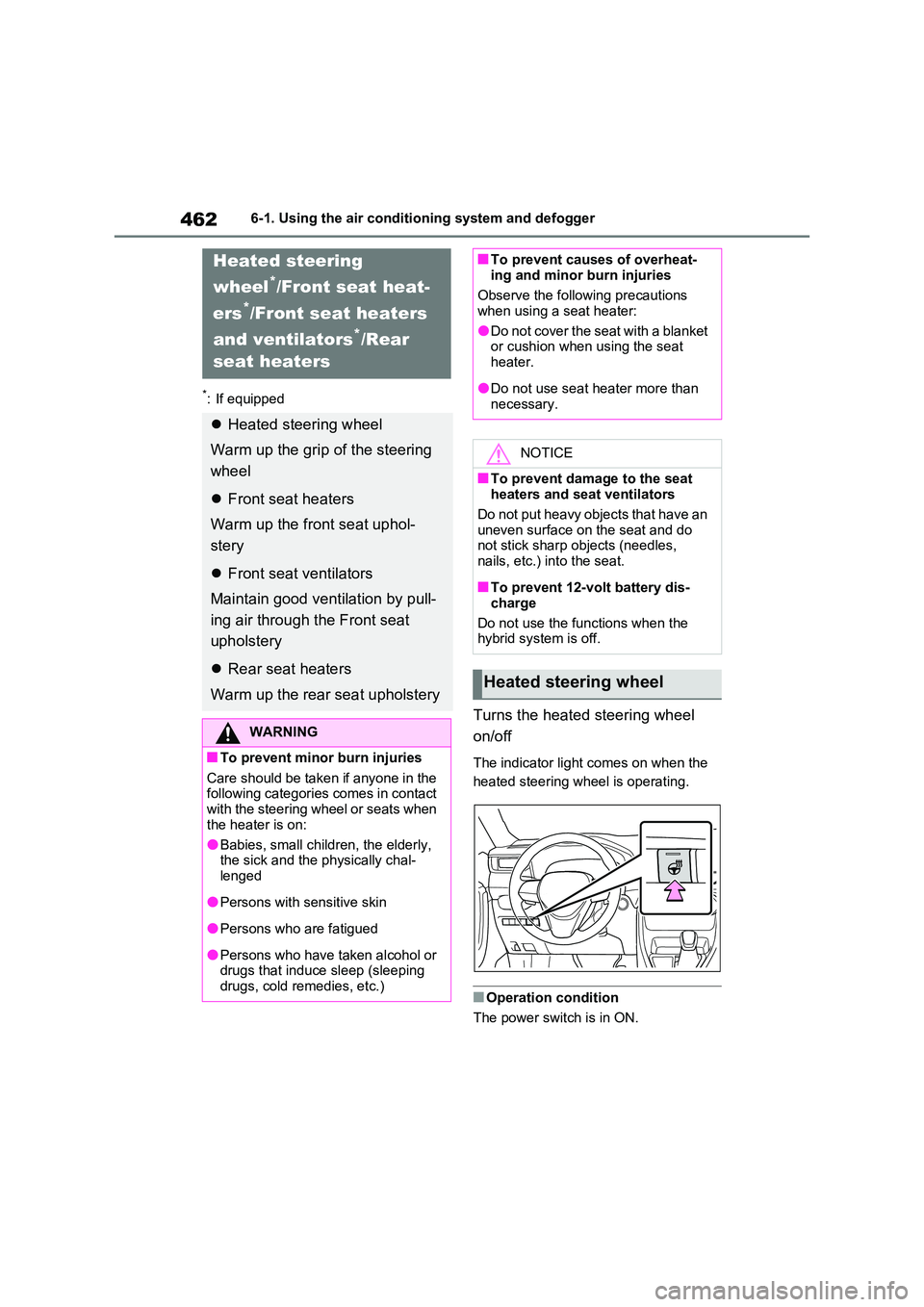
Turns the heated steering wheel
on/off
The indicator light comes on when the
heated steering wheel is operating.
■Operation condition
The power switch is in ON.
Heated steering
wheel*/Front seat heat-
ers*/Front seat heaters
and ventilators*/Rear
seat heaters
Heated steering wheel
Warm up the grip of the steering
wheel
Front seat heaters
Warm up the front seat uphol-
stery
Front seat ventilators
Maintain good ventilation by pull-
ing air through the Front seat
upholstery
Rear seat heaters
Warm up the rear seat upholstery
WARNING
■To prevent minor burn injuries
Care should be taken if anyone in the following categories comes in contact with the steering wheel or seats when
the heater is on:
●Babies, small children, the elderly, the sick and the physically chal-
lenged
●Persons with sensitive skin
●Persons who are fatigued
●Persons who have taken alcohol or drugs that induce sleep (sleeping drugs, cold remedies, etc.)
■To prevent causes of overheat-ing and minor burn injuries
Observe the following precautions
when using a seat heater:
●Do not cover the seat with a blanket or cushion when using the seat
heater.
●Do not use seat heater more than
necessary.
NOTICE
■To prevent damage to the seat heaters and seat ventilators
Do not put heavy objects that have an uneven surface on the seat and do not stick sharp objects (needles,
nails, etc.) into the seat.
■To prevent 12-volt battery dis-
charge
Do not use the functions when the hybrid system is off.
Heated steering wheel
Page 469 of 664
469
6
6-3. Using the storage features
Interior features
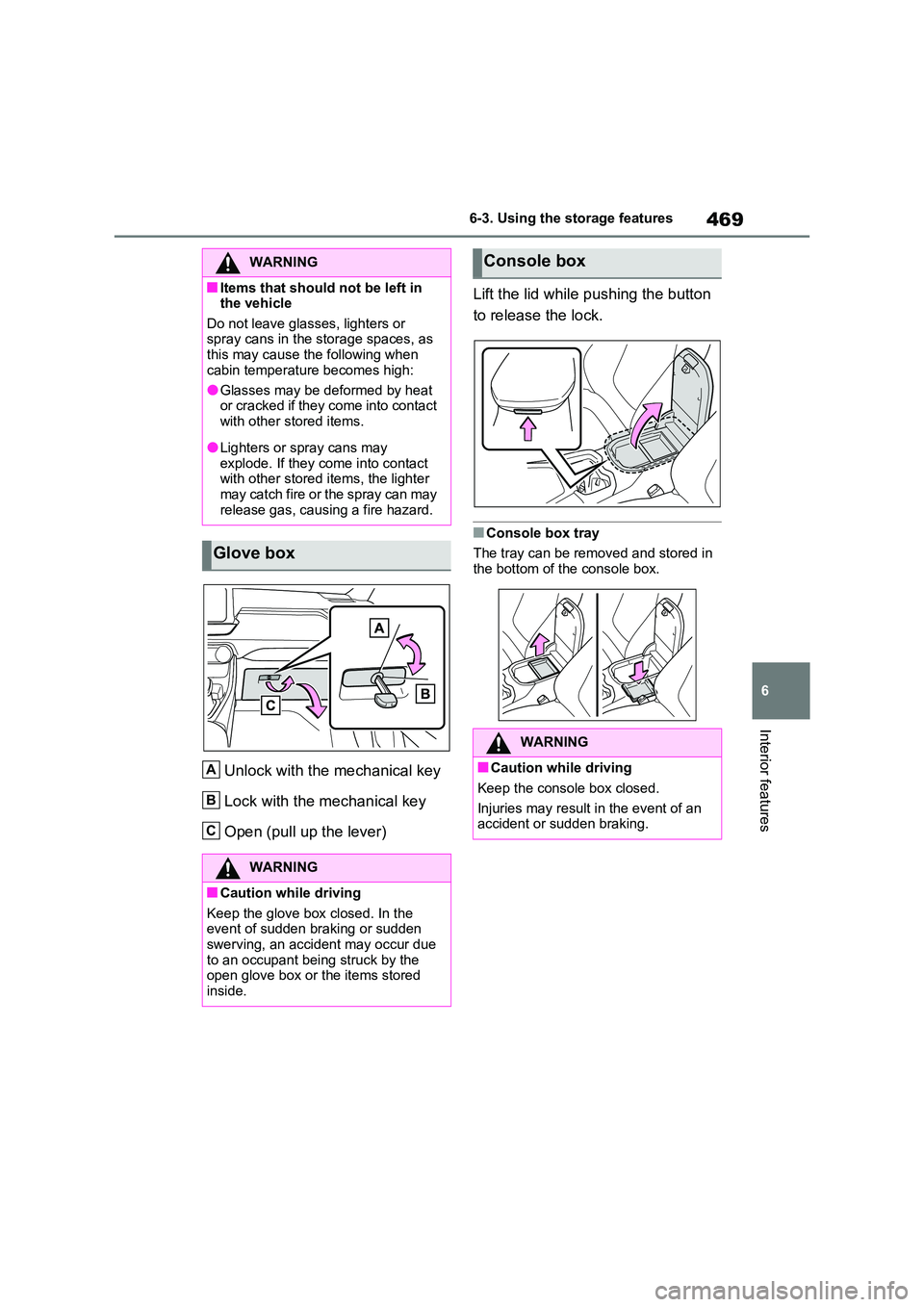
Unlock with the mechanical key
Lock with the mechanical key
Open (pull up the lever)
Lift the lid while pushing the button
to release the lock.
■Console box tray
The tray can be removed and stored in
the bottom of the console box.
WARNING
■Items that should not be left in the vehicle
Do not leave glasses, lighters or spray cans in the storage spaces, as this may cause the following when
cabin temperature becomes high:
●Glasses may be deformed by heat or cracked if they come into contact
with other stored items.
●Lighters or spray cans may
explode. If they come into contact with other stored items, the lighter may catch fire or the spray can may
release gas, causing a fire hazard.
Glove box
WARNING
■Caution while driving
Keep the glove box closed. In the event of sudden braking or sudden swerving, an accident may occur due
to an occupant being struck by the open glove box or the items stored inside.
A
B
C
Console box
WARNING
■Caution while driving
Keep the console box closed.
Injuries may result in the event of an accident or sudden braking.
Page 470 of 664
4706-3. Using the storage features
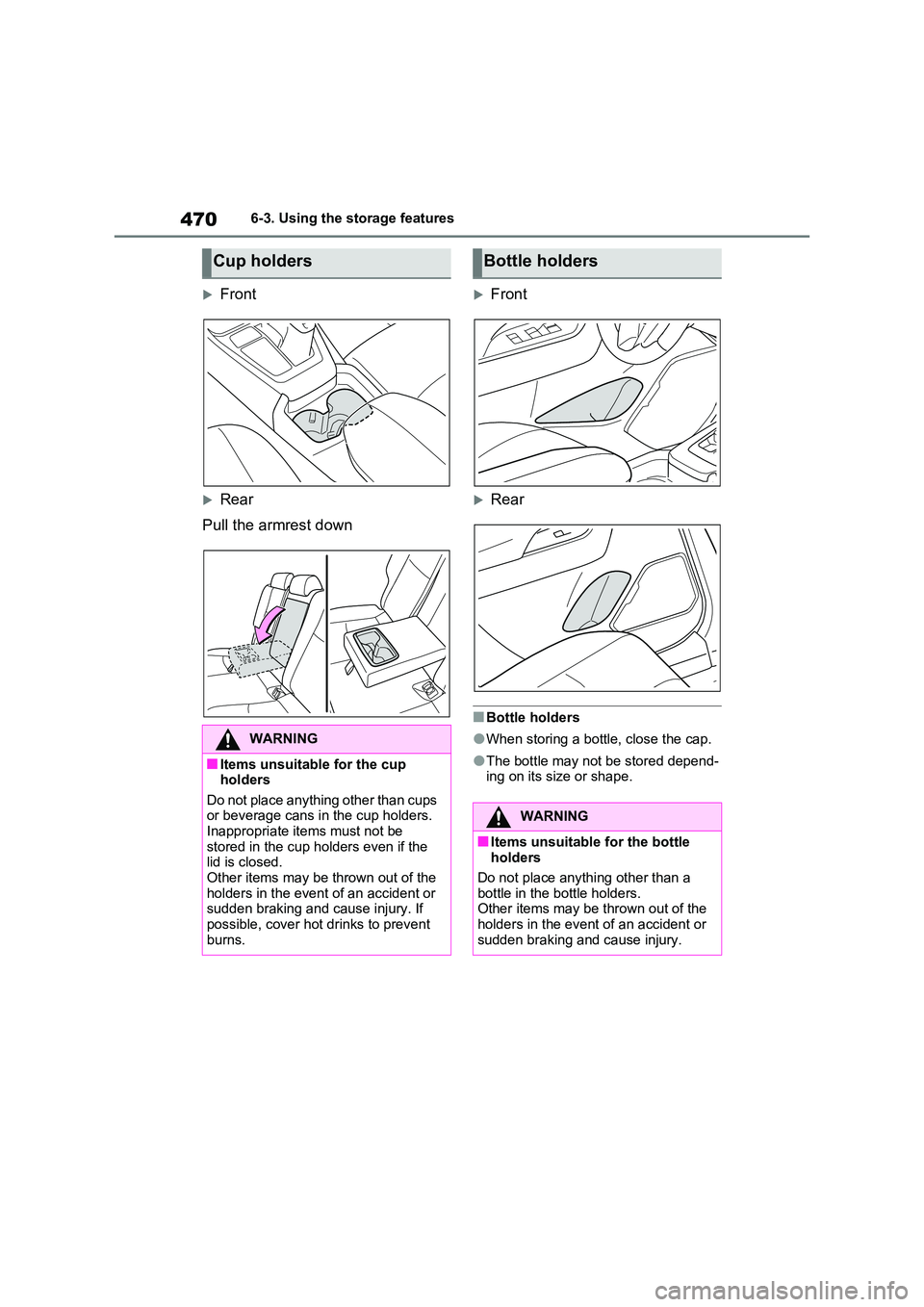
Front
Rear
Pull the armrest down
Front
Rear
■Bottle holders
●When storing a bottle, close the cap.
●The bottle may not be stored depend- ing on its size or shape.
Cup holders
WARNING
■Items unsuitable for the cup holders
Do not place anything other than cups or beverage cans in the cup holders. Inappropriate items must not be
stored in the cup holders even if the lid is closed. Other items may be thrown out of the
holders in the event of an accident or sudden braking and cause injury. If possible, cover hot drinks to prevent
burns.
Bottle holders
WARNING
■Items unsuitable for the bottle holders
Do not place anything other than a
bottle in the bottle holders. Other items may be thrown out of the holders in the event of an accident or
sudden braking and cause injury.
Page 471 of 664
471
6
6-3. Using the storage features
Interior features
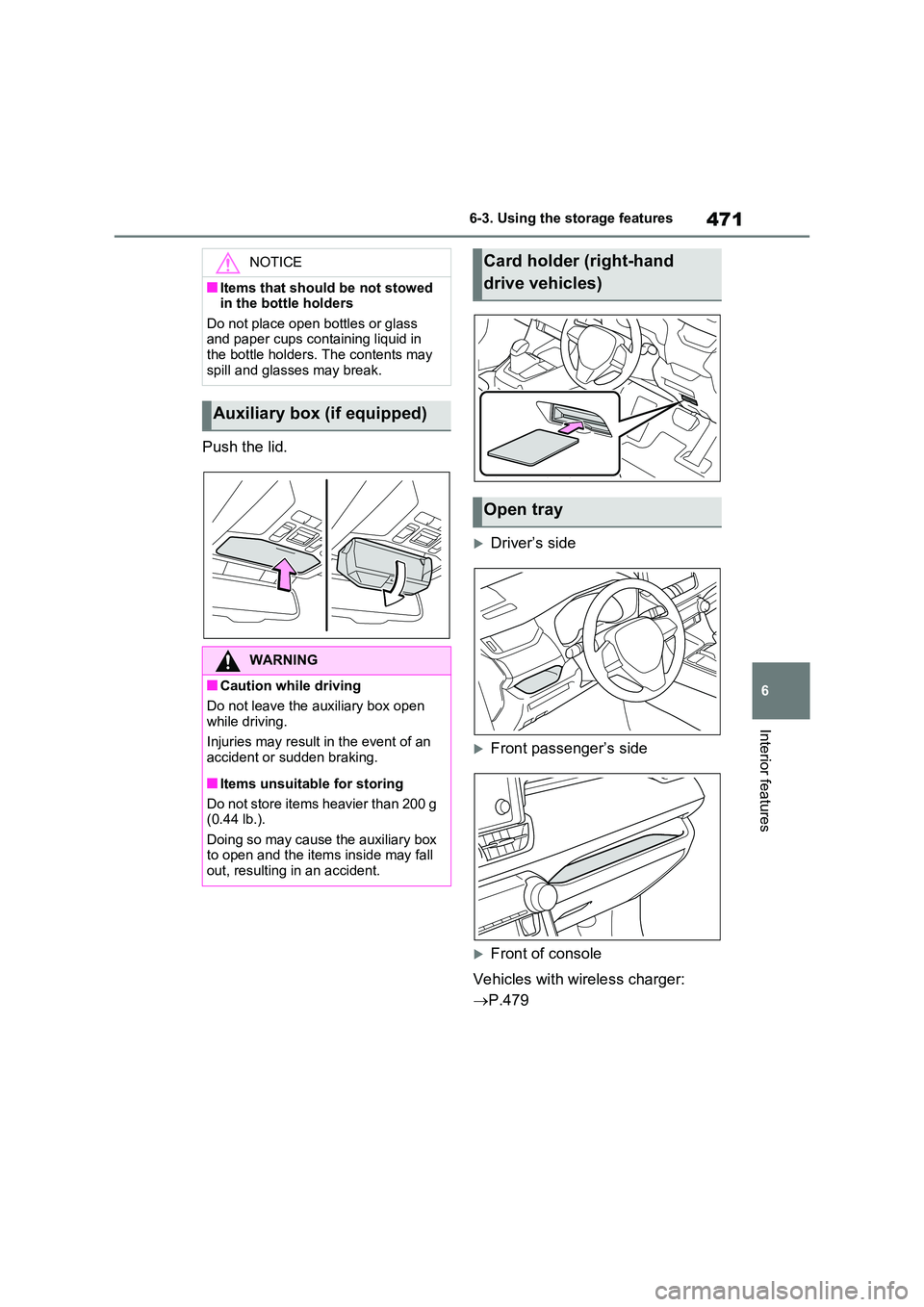
Push the lid.
Driver’s side
Front passenger’s side
Front of console
Vehicles with wireless charger:
P.479
NOTICE
■Items that should be not stowed in the bottle holders
Do not place open bottles or glass and paper cups containing liquid in the bottle holders. The contents may
spill and glasses may break.
Auxiliary box (if equipped)
WARNING
■Caution while driving
Do not leave the auxiliary box open while driving.
Injuries may result in the event of an accident or sudden braking.
■Items unsuitable for storing
Do not store items heavier than 200 g (0.44 lb.).
Doing so may cause the auxiliary box to open and the items inside may fall out, resulting in an accident.
Card holder (right-hand
drive vehicles)
Open tray
Page 472 of 664
4726-3. Using the storage features
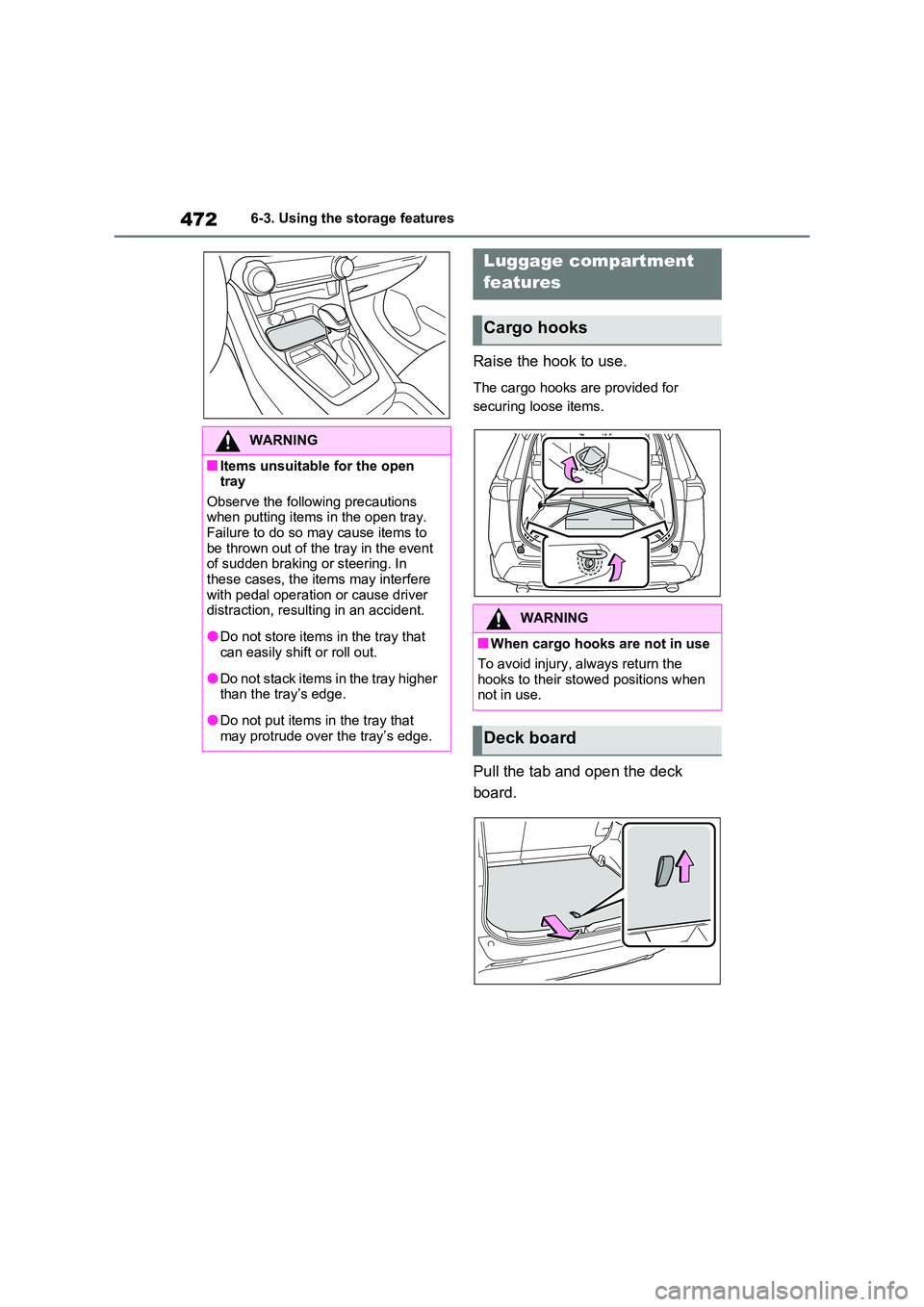
Raise the hook to use.
The cargo hooks are provided for
securing loose items.
Pull the tab and open the deck
board.
WARNING
■Items unsuitable for the open tray
Observe the following precautions when putting items in the open tray. Failure to do so may cause items to
be thrown out of the tray in the event of sudden braking or steering. In these cases, the items may interfere
with pedal operation or cause driver distraction, resulting in an accident.
●Do not store items in the tray that can easily shift or roll out.
●Do not stack items in the tray higher than the tray’s edge.
●Do not put items in the tray that may protrude over the tray’s edge.
Luggage compartment
features
Cargo hooks
WARNING
■When cargo hooks are not in use
To avoid injury, always return the hooks to their stowed positions when not in use.
Deck board