2011 SKODA OCTAVIA TOUR engine
[x] Cancel search: enginePage 154 of 183
Breakdown assistance153
Using the system
Safety
Driving Tips
General Maintenance
Breakdown assistance
Technical Data
Note
The set of safety wheel bolts can be obta ined from an authorised Škoda Service
Partner.Jump-startingInitial stepsYou can use the battery of another vehicl e for jump-starting yours if the engine
does not start because the battery on your ve hicle is flat. You will require jump-start
cables for this purpose.
Both batteries must have a rated voltage of 12 V. The capacity (Ah) of the battery
supplying the power must not be signific antly less than the capacity of the
discharged battery in your vehicle.
Jump-start cables
Only use jump-start cables which have an adequately large cross-section and insu-
lated terminal clamps. Please pay attent ion to the manufacturer's instructions.
Positive cable - colour coding in the majority of cases red.
Negative cable - colour coding in the majority of cases black.
WARNING
•
A discharged battery may already freeze at temperatures just below 0 °C. In
case of frozen battery carry out no jump-starting - risk of explosion!
•
Please pay attention to the warning instructions relating to working in the
engine compartment page 131, “Working in the engine compartment”.Note
•
There must not be any contact between the two vehicles otherwise current may
flow as soon as the negati ve terminals are connected.
•
The discharged battery must be properly connected to the system of the
vehicle.
•
Switch off any mobile phone, pay attention to the instructions for use of the
mobile phone in such a situation.
•
We recommend you buy jump-start cables from a car battery specialist.
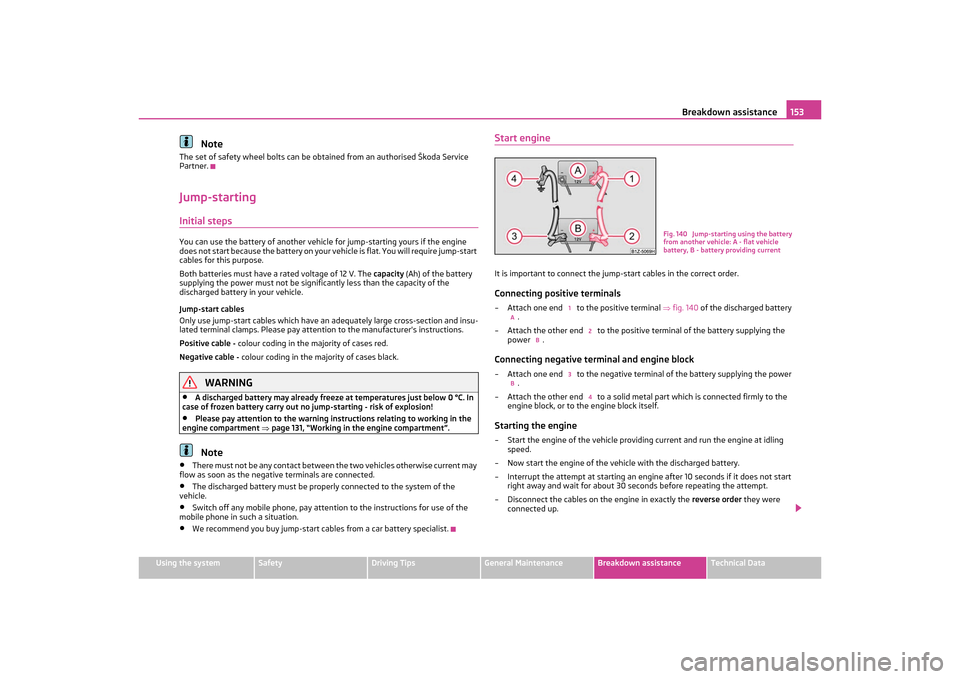
Start engineIt is important to connect the jump -start cables in the correct order.Connecting positive terminals– Attach one end to the positive terminal fig. 140 of the discharged battery
.
– Attach the other end to the positive terminal of the battery supplying the
power .Connecting negative terminal and engine block– Attach one end to the negative termin al of the battery supplying the power
.
– Attach the other end to a solid metal part which is connected firmly to the engine block, or to the engine block itself.Starting the engine– Start the engine of the vehicle providing current and run the engine at idling
speed.
– Now start the engine of the vehicle with the discharged battery.
– Interrupt the attempt at starting an engine after 10 seconds if it does not start right away and wait for about 30 seconds before repeating the attempt.
– Disconnect the cables on the engine in exactly the reverse order they were
connected up.
Fig. 140 Jump-starting using the battery
from another vehicle: A - flat vehicle
battery, B - battery providing current
1
A
2
B
3
B
4
s2lk.2.book Page 153 Monday, April 18, 2011 7:41 AM
Page 155 of 183
Breakdown assistance
154WARNING
•
The non-insulated parts of the termi nal clamps must never make contact
with each other. Furthermore, the cable connected to the positive terminal of
the battery must not come into contact with electrically conducting parts of the
vehicle - risk of a short circuit!
•
Do not affix the jump starting cables to the negative terminal of the
discharged battery. There is the risk of detonating gas seeping out the battery
being ignited by the strong spark which results from the engine being started.
•
Run the jump-start cables so that they cannot be caught by any rotating
parts in the engine compartment.
•
Do not bend over the batteries - risk of caustic burns!
•
The vent screws of the battery cells must be tightened firmly.
•
Keep any sources of ignition (naked fl ame, smouldering cigarettes etc.) away
from the battery - risk of an explosion!
•
Never jump-start the batteries which have a too low electrolyte level - risk
of explosion and caustic burns!
Tow-starting and towing vehicleGeneralPlease pay attention to the following instru ctions if you are going to use a tow rope:Driver of the towing vehicle– Do not drive off until the tow rope is taught.
– Release the clutch particularly gently when starting off.Driver of the towed vehicle– Switch the ignition on so that the steering wheel is not blocked and you can also
operate the turn signal lights, the headli ght flasher, the windscreen wipers and
windscreen washer system.
–Move the gearshift lever into Neutral.
– Note that the brake servo unit and power steering only operate if the engine is running. You will require significantly greater physical force to depress the brake
pedal and to steer the vehicle if the engine is not running.
– Ensure that the tow rope is always kept taught. Tow rope or tow bar
A tow
bar is safest way of towing a vehicle and also minimizes any shocks. You can
use a tow rope only if a suitable tow bar is not available.
The tow rope must be elastic to protect the vehicle. Thus one should only use
plastic fibre rope or a rope made out of a similarly elastic material.
Only attach the tow rope to the towing eyes provided for this purpose page 155
and page 155.
Driving style
Towing another vehicle requires a certain amount of practice. Both drivers should
be familiar with the particular points about towing a vehicle. Unskilled drivers
should not attempt to tow in another vehicle or to be towed in.
One should be constantly vigilant not to allow impermissibly high towing forces or
jerky loadings. There is always a risk of excessive stresses and damage resulting at
the points to which you attach the tow rope or tow bar when you attempt to tow a
vehicle which is not standing on a paved road.
Caution
If the gearbox of your vehicle no longer contains any oil because of a defect, your
vehicle must only be towed in with the driven wheels raised clear of the ground, or
on a special vehicle tr ansporter or trailer.
Note
•
Please comply with any national legal provisions particularly regarding the
switched on signal systems, when towing in or tow-starting another vehicle.
•
The tow rope must not be twisted as it ma y in certain circumstances result in the
front towing eye being unsc rewed out of your vehicle.
s2lk.2.book Page 154 Monday, April 18, 2011 7:41 AM
Page 157 of 183

Fuses and light bulbs
156
Fuses and light bulbsElectric fusesReplacing fuses
Defect fuses must be replaced.Individual electrical circuits are protected by fuses. The fuses are located on the left
side of the dash panel behind the safety cover and under the cover in the engine
compartment on the left.
– Switch the ignition off and also the electrical component affected.
– Use a screwdriver to take off the fuse cover on the side of the dash panel
fig. 143 or the fuse cover in the engine compartment page 157.
– Find out which fuse belongs to the relevant component page 158, “Fuse
assignment in the dash panel” or page 157, “Fuse assignment in engine
compartment”.
– Take the plastic clip out of its fixture in the fuse cover, insert it onto the respec- tive fuse and pull out this fuse.
– Defect fuses can be detected by their melted metal strips. Replace the defect fuse by a new fuse of the same ampere number.
– Fit on the fuse cover again.
We recommend that you always have the small box of replacement fuses in your
vehicle. You can obtain replacement fuses from Škoda original accessories or from
a specialist garage
8). Colour coding of fuses
Caution
•
Never attempt to “repair” fuses and also
do not replace them with a fuse of a
higher amperage - risk of fire! This may also cause damage at another part of the
electrical system.
•
Have the electrical system checked as quickly as possible by a specialist garage
if a newly inserted fuse bl ows again after a short time.
Fig. 143 Fuse cover: left side of the dash
panel
8)The small box with replacement fuses is part of the basic equipping of the vehicle in some
countries.
Colour
Maximum amperage
light brown
5
brown
7.5
red
10
blue
15
yellow
20
white
25
green
30
orange
40
red
50
s2lk.2.book Page 156 Monday, April 18, 2011 7:41 AM
Page 158 of 183

Fuses and light bulbs157
Using the system
Safety
Driving Tips
General Maintenance
Breakdown assistance
Technical Data
Fuse cover in engine compartmentOn some vehicles, the battery cover must be removed before removing the fuse
cover page 136.Removing fuse cover–Move the circlips fig. 144 as far as the stop, the symbol
appears behind
the circlip and remove the cover.
Installing fuse cover– Position the fuse cover on the fuse box and push the circlips as far as the stop - the symbol
is visible behind the circlip.
Caution
•
When unlocking and locking the fuse cover, it must be pressed on the sides to
the box, otherwise damage can occur to the locking mechanism.
•
Carefully position the fuse cover in the engine compartment. If the cover was
not correctly positioned, water can get into the fuses and this results in a damage
to the vehicle!
Fuse assignment in engine compartmentCertain electrical components are only st andard on certain vehicle model versions
or only suppliable as optional equipment for certain models.
Fig. 144 Fuse cover in engine compart-
ment
A
A
No.
Power consumer
Amperes
F1
Not assigned
F2
Control unit for automatic gearbox DQ 200
30
F3
Measuring circuit
5
F4
Valves for ABS
30/20
F5
Control unit for automatic gearbox
15
F6
Instrument cluster, windshield wiper lever and turn sig-
nal light lever
5
F7
Power supply for terminal 15 (ignition on), starter
40
F8
Radio
15
F9
Phone
5
F10
Engine control unit, Main relay
5/10
F11
Control unit for auxiliary heating
20
F12
Control unit for CAN databus
5
F13
Engine control unit
15/30
F14
Ignition
20
Fig. 145 Schematic representation of
fuse carrier in engine compartment
s2lk.2.book Page 157 Monday, April 18, 2011 7:41 AM
Page 159 of 183

Fuses and light bulbs
158
Fuse assignment in the dash panelCertain electrical components are only st andard on certain vehicle model versions
or only suppliable as optional equipment for certain models.
F15
Lambda probe
glow plug system relay
10
5
F16
Central control unit, right main headlight, right rear light
unit
30
F17
Horn
15
F18
Amplifier for digital sound processor
30
F19
Front window wiper
30
F20
Water pump
valve for fuel dosing
High-pressure pump
10
20
15
F21
Lambda probe
Vacuum pump
10/15 20
F22
Clutch pedal switch, brake pedal switch
5
F23
Secondary air pump
Air mass meter
Fuel high pressure pump
5
10
15
F24
Activated charcoal filter, exha ust gas recirculation valve,
radiator fan
10
F25
Pump for ABS
30/40
F26
Central control unit, left main headlight, left rear light
unit
30
F27
Secondary air pump
Glow plug system
40 50
F28
Not assigned
F29
Power supply terminal 30 (continuous current supply
from the battery)
50
F30
Terminal X
a)
50
a)In order not to drain the battery unnecessarily when starting the engine, the electrical com-
ponents of this terminal are automatically switched off.No.
Power consumer
Amperes
No.
Power consumer
Amperes
1
Diagnostic socket, Engine control unit, Electrical fuel
pump
10
2
Control unit for ABS, ESP
5
3
Airbag
5
4
Heating, air conditioning, reversing lights, interior rear
view mirror dimming, telephone preinstallation
5
5
Control unit for headlamp beam adjustment
5
6
Instrument cluster, Control unit for automatic gearbox,
Control unit for electromechanical power steering, Park-
ing aid; Haldex clutch
5
7
Not assigned
8
Not assigned
9
Not assigned
10
Not assigned
11
Not assigned
12
Central locking control unit
10
13
Diagnostic socket, light switch, rain sensor
10
Fig. 146 Schematic representation of the
fuse carrier in the dash panel
s2lk.2.book Page 158 Monday, April 18, 2011 7:41 AM
Page 160 of 183

Fuses and light bulbs159
Using the system
Safety
Driving Tips
General Maintenance
Breakdown assistance
Technical Data
BulbsChanging bulbsThe relevant lamp must always be switched off before a light bulb is replaced.
Defect light bulbs should only be replaced with light bulbs of the same type. The
designation is located on the light socket or the glass bulb.
Changing certain bulbs is not something which you can do yourself, but requires to
be done by a specialist. Other parts of the vehicle must be removed in order to
change the light bulbs. This applies, in particular, to bulbs which can only be reached
from the engine compartment.
We therefore recommend that you have an y bulbs changed by an authorised Škoda
Service Partner or, in exceptional cases, by calling on other professional assistance.
Please note that the engine compartment is a hazardous area page 131, “Working
in the engine compartment”.
We recommend that you always have a sm all box of replacement bulbs in your
vehicle. You can obtain replacement bulbs from Škoda original accessories or from
a specialist garage
9).
14
Control unit for automatic gearbox, Selector lever lock
5
15
Central control unit - interior lights
5
16
Heating, air conditioning, Climatronic
10
17
Park Assist
5
18
Not assigned
19
Control unit for trailer detection
5
20
Not assigned
21
Cornering lights for the left and right side
10
22
Air blower for Climatronic
40
23
Front power window
30
24
Cigarette lighter
25
25
Rear window heater
Rear window heater, Auxiliary heating (auxiliary heating
and ventilation)
25
30
26
Power socket in the luggage compartment
20
27
Fuel pump relay, Injection valves (diesel engine)
15
28
Not assigned
29
Engine control unit, Crankcase ventilation heater
10
30
Control unit for automatic gearbox
20
31
Vacuum pump
20
32
Rear power window
30
33
Electric sliding/tilting roof
25
34
Control unit for convenience functions
20
35
Anti-theft alarm system
5
36
Headlight cleaning system
20
37
Front seat heating
30
38
Heated rear seats
30
No.
Power consumer
Amperes
39
Not assigned
40
Air blower for heating and air conditioning
40
41
Rear window wiper
15
42
Not assigned
43
Towing device
15
44
Towing device
20
45
Towing device
15
46
Controlling the seat heating, heated windscreen washer
nozzles
5
47
Relay for auxiliary heating
5
48
Not assigned
49
Light switch
5
No.
Power consumer
Amperes
s2lk.2.book Page 159 Monday, April 18, 2011 7:41 AM
Page 166 of 183

Technical Data165
Using the system
Safety
Driving Tips
General Maintenance
Breakdown assistance
Technical Data
Technical DataTechnical DataGeneral informationThe details given in the official vehicle registration documents always take prece-
dence over the details in the Owner's Manual. Please refer to the official vehicle
registration documents or consult an auth orised Škoda Service Partner concerning
the engine with which your vehicle is equipped.Used abbreviationsPerformancesThe listed performance values were determined without performance-reducing
equipment, e.g. air conditioning system.WeightThe loading capacity is reduced in line with the range of the special equipment. The
unloaden weight contains a fu el tank topped up to 90 %. A driver with a weight of
75 kg is also included in the value.
Identification detailsVehicle data sticker
The vehicle data sticker fig. 154 is located on the floor of the luggage compart-
ment and is also stated in the Service schedule.
The vehicle data sticker contains the following data: Vehicle identification number (VIN)
Vehicle type
Gearbox code, paint number, interior equipment number, engine output,
engine code
Partial description of the vehicle
Vehicle identification number (VIN)
The vehicle identification number - VIN (cha ssis number) is stamped into the engine
compartment on the right hand shock absorber dome. This number is also located
on a sign on the lower left hand edge below the windscreen.
Engine number
The engine number is stamped into the engine block.
Type plate (production plate)
The type plate is located in the lower area of the left centre column.
Abbreviation
Importance
kW
Kilowatt, measuring unit for the engine output
rpm
Engine revolutions per minute
Nm
Newton meter, measuring unit for the engine torque
g/km
discharged quantity of carbon dioxide in grams per driven
kilometre
TDI CR
Diesel engine with turbocharger and injection system
Common Rail
Fig. 154 Vehicle data sticker
1234
s2lk.2.book Page 165 Monday, April 18, 2011 7:41 AM
Page 167 of 183

Technical Data
166
Sticker on inside of fuel filler flap
The stickers are affixed to the inside of the fuel filler flap and contain the following
information:•
The prescribed types of fuel,
•
Tyre size,
•
Tyre pressure.
Fuel consumption based on ECE regulations and EC guidelinesDepending on the range of the special equipment, style of driving, traffic situation,
weather influences and vehicle condition, the consumption values which in practice
result when using the vehicle can deviate from the indicated values.
Urban traffic
The consumption measurement in urban traffic begins with starting of the cold
engine. Afterwards the normal urban traffic is simulated.
Non-urban traffic
For the consumption measurement in non-ur ban traffic the vehicle, as in daily
motoring, is accelerated and braked several times in all gears. The vehicle speed
changes within the range from 0 to 120 km/h.
Combined traffic
The consumption value in the combined traffic consists of 37 % from the value for
the urban traffic and of 63 % from the value for the non-urban traffic.DimensionsDimensions (mm)
Engine oil specificationsThe grade of engine oil should be selected in accordance with
precise specifications.The engine of your vehicle has been factory-filled with a high-grade oil which you
can use throughout the year - except in extreme climatic regions.
You can mix various oils together with each other when refilling with oil. This does
not, however, apply for models with flexible service intervals (QG1).
Engine oils are, of course , undergoing continuous further development. Thus the
information stated in this Owner's Manual is only correct at the time of publication.
Authorised Škoda Service Partners are informed by Škoda Auto about current
changes. This why you should always have engine oil changed by an authorised
Škoda Service Partner.
The specifications (VW standards) stated in the following must be indicated sepa-
rately or together with other specifications on the bottle.
Engine oil specifications for models with flexible service intervals (QG1)
OCTAVIA
COMBI
Length
4572
4572
Width
1769
1769
Width including exterior mirror
2018
2018
Height
1462
1485
a)
1468
1490
a)
Clearance
140
164a)
140
164a)
Wheel base
2578
2578
Track gauge front/rear
1541/1514
1541/1514
a)The value corresponds to the status with rough road package.Petrol engines
Specification
Filling level
a)
a)Oil capacity with oil filter change. Inspect oil le vel when filling; do not fill up too much. The oil
level must be between the markings page 132.1.4 ltr./59 kW - EU5
VW 503 00, VW 504 00
3,2
1.6 ltr./75 kW - EU4, EU2
VW 503 00, VW 504 00
4,5
Diesel engine
Specification
Filling level
a)
2.0 l/81 kW TDI CR EU4
VW 507 00
4,3
OCTAVIA
COMBI
s2lk.2.book Page 166 Monday, April 18, 2011 7:41 AM