2011 SKODA OCTAVIA TOUR engine
[x] Cancel search: enginePage 134 of 183

Inspecting and replenishing133
Using the system
Safety
Driving Tips
General Maintenance
Breakdown assistance
Technical Data
– Pour in a suitable grade of oil in portions of 0.5 litres
page 166, “Engine oil
specifications”.
– Inspect the oil level page 132.
– Carefully screw on the cap of the filler opening and push the dipstick in fully.
WARNING
•
Avoid dripping oil onto hot parts of the engine when topping up will oil - a
risk of fire!
•
Read and observe the warning notes page 131, “Working in the engine
compartment” before working in the engine compartment.For the sake of the environment
The oil level must on no account extend beyond the range page 132. Oil will
otherwise be drawn in through the crankc ase ventilation and may pass through the
exhaust system to atmosphere. The oil ma y combust in the catalytic converter and
damage it.Changing engine oilThe engine oil must be changed at the intervals stated in the Service schedule or
according to the service interval indicator page 17, “Service Interval Display”.
WARNING
•
Only carry out the engine oil change, if you have the required professional
knowledge!
•
Read and observe the warning notes page 131, “Working in the engine
compartment” before working in the engine compartment.
•
First of all, let the engine cool down, wear an eye protection and gloves - risk
of caustic burns due to hot oil.Caution
You must not pour any additives into the engine oil - risk of engine damage!
Damage, which results from such produc t, are excluded from the warranty.
For the sake of the environment
•
You must on no account pour oil into the ground or into the sewage system.
•
In view of the problems involved in properly disposing of old oil, the necessary
special tools and the knowledge required for such work, we recommend that you
have the oil and oil filter change carried out by an authorised Škoda Service Partner.Note
After your skin has come in contact with the oil, you must thoroughly wash your
skin.Cooling systemCoolant
The job of the coolant is to cool the engine.The cooling system does not require any maintenance under normal operating
conditions. The coolant consists of water with a concentration of coolant additive
of 40 %. This mixture not only provides antifreeze prot ection down to -25 °C but
also protects the cooling and heating system from corrosion. It also prevents the
formation of scale and significantly increases the boiling point of the coolant.
You must therefore not reduce the concentration of antifreeze agent in the coolant
by adding water, also not during the summer months or in countries with a warm
climate. The concentration of coolant additive in the coolant must be at least 40
%.
You can increase the amount of antifreeze in the coolant if a higher concentration
of antifreeze is necessary for climatic reasons but only up to 60 % (antifreeze
protection down to approx. -40 °C). The antifreeze protection tails off above that
concentration.
Vehicles exported to countries with a co ld climate (e.g. Sweden, Norway, Finland)
are already factory-filled with a coolant wh ich offers antifreeze protection down to
about -35 °C. In these countries the concentr ation of coolant additive should be at
least 50 %.
Coolant
The cooling system is factory-filled with coolant (purple in colour), which complies
with the specification TL-VW 774 G.
We recommend that you use the same cool ant additive - G12 PLUS-PLUS (purple in
colour) for topping up the system.
Please contact an authorised Škoda Serv ice Partner if you have any questions
regarding the coolant or if you wish to fill up with a different coolant.
AA
s2lk.2.book Page 133 Monday, April 18, 2011 7:41 AM
Page 135 of 183

Inspecting and replenishing
134
An authorised Škoda Service Partner can also supply you with the correct coolant
additives.
Coolant quantity
Caution
•
Other coolant additives may cause operational problems which, in particular,
involves significantly reduci ng the anticorrosion effect.
•
Any faults or problems resulting from corrosion may cause a loss of coolant
and, as a consequence of this, re sult in major engine damage.
Inspecting the coolant levelThe coolant expansion bottle is located in the engine compartment on the right.
– Switch the engine off.
–Open the bonnet page 130. – Check the level of coolant in the coolant expansion bottle
fig. 124. The
coolant level when the engine is cold must lie between the (MIN) and
(MAX) markings. The level may also rise slightly above the (MAX) marking
when the engine is warm.
If the coolant level in the reservoir is too low, this is indicated by the warning light
in the instrument cluster page 25, “Coolant temperature/coolant level ”. We
nevertheless recommend inspecting the coolant level directly at the reservoir from
time to time.
Loss of coolant
A loss of coolant is first and foremost an indication of a leak in the system. You
should not merely top up the coolant in the re servoir. It is also important to have the
cooling system inspected without delay by a specialist garage.
Losses can only occur through the pressure relief in the cap of the coolant expan-
sion bottle which is completely free of leaks if the coolant boils as a result of over-
heating and is forced out of the cooling system.
WARNING
Read and observe the warning notes page 131, “Working in the engine
compartment” before working in the engine compartment.
Caution
One should contact a specialist garage as soon as possible if the source of over-
heating itself cannot be determined and removed, since there may be grave
damage to the engine.Replenishing the coolant– Switch the engine off.
– Allow the engine to cool down.
– Place a cloth over the cap of the coolant expansion reservoir fig. 124 and
unscrew the cap carefully by turning it to the left .
– Top up the coolant.
– Screw the cap tight until it is heard to lock.
The coolant which you use for replenishing the system, must comply with one
specific specification page 133. Do not use an altern ative additive if the coolant
additive G13 is not available in an emergency. Just top up the system with water and
Petrol engines
Content
1.4 ltr./59 kW - EU4
7.1
1.6 ltr./75 kW - EU4, EU2
7.4
Diesel engine
Content
2.0 ltr./81 kW TDI CR - EU4
8.4
Fig. 124 Engine compartment: Coolant
expansion bottle
Ab
Aa
Aa
s2lk.2.book Page 134 Monday, April 18, 2011 7:41 AM
Page 136 of 183

Inspecting and replenishing135
Using the system
Safety
Driving Tips
General Maintenance
Breakdown assistance
Technical Data
as soon as possible arrange adjustment
to correct the mixing ratio of water and
coolant additive again by a specialist garage.
Only use fresh coolant for topping up the system.
Do not fill up over the “MAX” marking! Exce ss coolant which is heated up is forced
out of the cooling system through the pressu re relief valve in the cap of the coolant
compensation bottle.
Wait until the engine has cooled down for a system which has suffered a major loss
of coolant before pouring in coolant. This is necessary to avoid engine damage.
WARNING
•
The cooling system is pressurized! Do not open the cap of the coolant expan-
sion bottle if the engine is still hot - risk of scalding!
•
The coolant additive and thus all of the coolant is harmful to your health.
Avoid contact with the coolant. Coolant vapours are also harmful to the health.
It is important, therefore, to always safely store any coolant additive in its orig-
inal container out of the reach of children - risk of poisoning!
•
If any splashes of coolant get into your eyes, rinse out your eyes immediately
with clear water and contact a doctor as soon as possible.
•
You should also consult a doctor wi thout delay if you have inadvertently
swallowed coolant.Caution
Do not continue your journey if for some reason it is not possible under the condi-
tions prevailing to top up with coolant. Switch the engine off and obtain profes-
sional assistance from a specialist garage, otherwise it could lead to severe engine
damage.
For the sake of the environment
Do not re-use coolant if it is necessary to drain the coolant in the system. It should
be collected and disposed of in comp liance with environmental protection
regulations.Radiator fan
The radiator fan may switch on suddenly.The radiator fan is driven by an electric motor and controlled according to the
coolant temperature. The radiator fan may continue running for up to 10 minutes after the engine has
been switched off - even if the ignition is also off. It may also switch on suddenly
after a certain time, if
•
the coolant temperature has risen beca
use of an accumulation of heat or
•
the warm engine compartment is heated up additionally by strong sunlight.
WARNING
You must therefore be aware when workin g in the engine compartment that the
fan may switch on suddenly - risk of injury!Brake fluidInspecting the brake fluid levelThe brake fluid reservoir is located on the left of the engine compartment. The
brake fluid reservoir on right-hand steering models is positioned on the other side
of the engine compartment.
– Switch the engine off.
– Open the bonnet page 130.
– Inspect the brake fluid level in the reservoir fig. 125 . The level must be
between the “MIN” and “MAX” markings.
A slight drop in the fluid level results when driving due to normal wear-and-tear and
automatic adjustment of the brak e pads, and is perfectly normal.
There may be an indication of a leak in the brake system, however, if the fluid level
drops significantly within a sh ort time or if it drops below the “MIN” marking. If the
Fig. 125 Engine compartment: Brake
fluid reservoir
s2lk.2.book Page 135 Monday, April 18, 2011 7:41 AM
Page 137 of 183
Inspecting and replenishing
136
brake fluid level is too low, this is indicated by the warning light page 27, “Brake
system ” lighting up in the instrument cluster. In this case stop immediately and
do not drive any further! Ob tain professional assistance.
WARNING
•
Read and observe the warning notes page 131, “Working in the engine
compartment” before working in the engine compartment.
•
If the fluid level has dropped below the MIN marking, do not drive any further
- risk of accident! Obtain professional assistance.
Replacing brake fluidBrake fluid absorbs moisture. This causes the fluid to absorb moisture from the
surrounding air over a period of time. Excessive water in the brake fluid may be the
cause of corrosion in the brake system. The water content also lowers the boiling
point of the brake fluid.
One may only use new genuine brake fluid from Škoda Auto. The brake fluid must
comply with one of the followin g standards or specifications:•
VW 50114
•
FMVSS 116 DOT4
•
DIN ISO 4925 CLASS 4
We recommend that you have the brake fluid replaced by an authorised Škoda
Service Partner as part of an Inspection Service.
WARNING
Using old brake fluid can result in severe stress on the brakes because of the
formation of vapour bubbles in the br ake system. This greatly impairs the
braking efficiency and thus also the safety of your vehicle.
Caution
Brake fluid damages the paintwork of the vehicle.
For the sake of the environment
In view of the problems involved with proper disposal of brake fluid, the special
tools and the professional knowledge requ ired, you should have the brake fluid
replaced by a Škoda Service Partner.
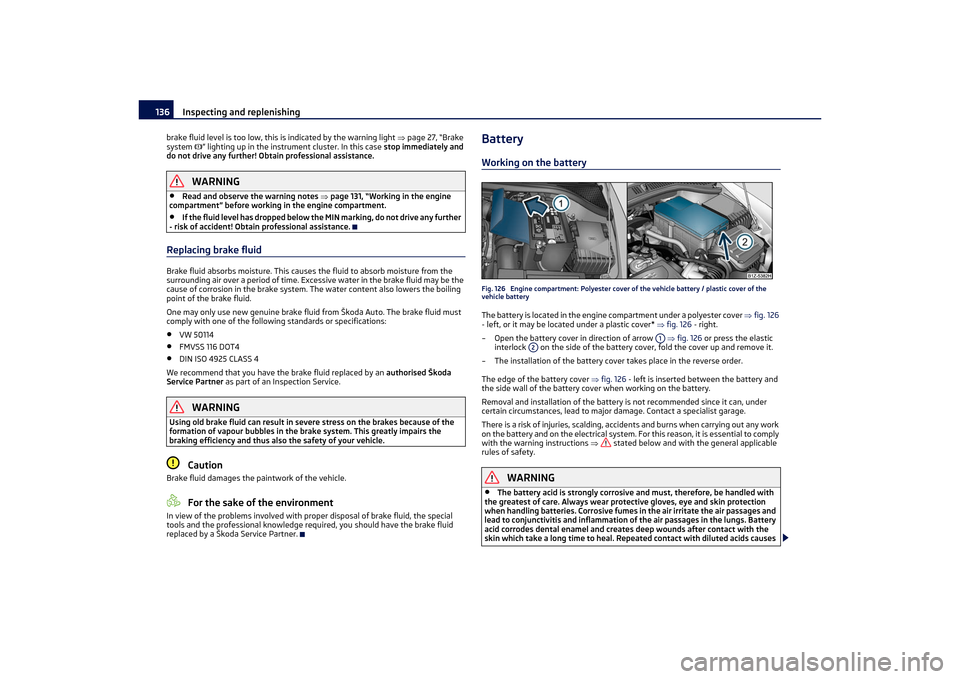
BatteryWorking on the batteryFig. 126 Engine compartment: Polyester cover of the vehicle battery / plastic cover of the
vehicle batteryThe battery is located in the engine compartment under a polyester cover fig. 126
- left, or it may be located under a plastic cover* fig. 126 - right.
– Open the battery cover in direction of arrow fig. 126 or press the elastic
interlock on the side of the battery co ver, fold the cover up and remove it.
– The installation of the battery co ver takes place in the reverse order.
The edge of the battery cover fig. 126 - left is inserted between the battery and
the side wall of the battery cover when working on the battery.
Removal and installation of the battery is not recommended since it can, under
certain circumstances, lead to major damage. Contact a specialist garage.
There is a risk of injuries, scalding, accidents and burns when carrying out any work
on the battery and on the electrical system. For this reason, it is essential to comply
with the warning instructions stated below and with the general applicable
rules of safety.
WARNING
•
The battery acid is strongly corrosiv e and must, therefore, be handled with
the greatest of care. Always wear protective gloves, eye and skin protection
when handling batteries. Corrosive fumes in the air irritate the air passages and
lead to conjunctivitis and inflammation of the air passages in the lungs. Battery
acid corrodes dental enamel and create s deep wounds after contact with the
skin which take a long time to heal. Re peated contact with diluted acids causes
A1
A2
s2lk.2.book Page 136 Monday, April 18, 2011 7:41 AM
Page 138 of 183

Inspecting and replenishing137
Using the system
Safety
Driving Tips
General Maintenance
Breakdown assistance
Technical Data
skin diseases (inflammations, ulcers, sk
in cracks). Acids coming into contact
with water are diluted accompanied by significant development of heat.
•
Do not tilt the battery otherwise batt ery electrolyte may flow out of the
battery vent openings. Protect the eyes wi th safety glasses or a shield! There is
the danger of suffering blindness! If any battery electrolyte gets into your eye,
rinse out your eye immediately with clear water for several minutes. Contact a
doctor without delay.
•
Splashes of acid on your skin or clot hes should be neutralised as soon as
possible using soap suds and then rinsed with plenty of water. Contact a doctor
immediately if you swal low battery electrolyte.
•
Keep batteries out of the reach of children.
•
Hydrogen is released when you charge a battery and a highly explosive gas
mixture is produced. An explosion can be caused through sparkling over during
unclamping or loosening of the cable plug while the ignition is on.
•
Bridging of the poles will create a short circuit (e.g. through metal objects,
cables). Possible consequences of a short circuit: Melting of lead struts, explo-
sion and burning of the battery, jets of acid spurting out.
•
It is prohibited to work with a naked fl ame and light, to smoke or to carry out
any activities which produce sparks. Avoid creating sparks when working with
cables and electrical devices. Strong spar k build-up represents a risk of injury.
•
Before carrying out any work on the electrical system, switch off the engine,
the ignition as well as all electrical components and disconnect the negative
cable (-) on the battery. If you wish to repl ace a bulb it is sufficient to switch off
the appropriate light.
•
Never charge a frozen or thawed batt ery - risk of explosion and caustic
burns! Replace a frozen battery.
•
Never jump-start the batteries which have a too low electrolyte level - risk
of explosion and caustic burns!
•
Never use a battery which is damaged - risk of explosion! Immediately
replace a damaged battery.Caution
•
You must only disconnect the battery if the ignition is switched off, otherwise
the electrical system (electronic componen ts) of the vehicle may be damaged. When
disconnecting the battery from the electrical system of the vehicle, first disconnect
the negative terminal (-) of the battery. Then disconnect the positive terminal (+).
•
When reconnecting the battery, first connect the positive terminal (+) and only
then the negative terminal (-) of the batt ery. You must on no account connect the
cables wrongly - risk of a cable fire.
•
Ensure that battery acid does not come into contact with the vehicle body
otherwise damage could occur to the paintwork.
•
Do not place the battery in direct daylight in order to protect the battery housing
from the effects of ultra-violet light.For the sake of the environment
A removed battery is a special type of wa ste which is harmful to the environment -
contact your specialist garage regarding disposing of the battery.
Note
Please also refer to the guidelines page 139, also after connecting the battery.Battery with a two-tone indicatorAn indicator for the electrolyte level, the so-called magic eye fig. 127, is located
on the top of the battery. The indicator changes its colour in line with the electrolyte
level in the battery.
Air bubbles can influence the colour of the indicator. For this reason carefully knock
on the indicator before carrying out the check.•
Black colour - electrolyte level is correct.
•
Colourless or light yellow colour - electrolyte level too low, the battery must be
replaced.
Batteries, which are more than 5 years ol d, must be replaced. We recommend you
have the battery checked or replaced by a specialist garage.
WARNING (continued)
Fig. 127 The battery: Show
s2lk.2.book Page 137 Monday, April 18, 2011 7:41 AM
Page 139 of 183

Inspecting and replenishing
138Caution
If the vehicle has not been driven for more than 3 to 4 weeks, the battery will
discharge because certain electrical components consume electricity (e.g. control
units) also in idle state. You can prevent the discharging of the battery by discon-
necting the negative terminal or charging the battery constantly with a very low
charging current. Please also refer to the notes when working on the battery
in “Working on the battery” on page 136.
Note
•
Batteries with two-tone indicator, which are mounted as of factory, are marked
with a code which always begins with 5K0. The actual marking can be e.g.
5K0 915 105 D.
•
Replacement batteries with two-tone indicator, which were obtained from
Škoda original accessories, are marked with the code 000 915 105 Dx, whereby
“x” stands for a variable. The actual marking can be e.g. 000 915 105 DB.
Battery with a three-tone indicatorAn indicator for the electrolyte level and the charge state, the so-called magic eye
page 137, fig. 127 , is located on the top of the battery. The indicator changes its
colour in line with the charge state of and the electrolyte level in the battery.
Air bubbles can influence the colour of the indicator. For this reason carefully knock
on the indicator before carrying out the check.•
Green colour - the battery is adequately charged.
•
Dark colour - the battery has to be charged
•
Colourless or yellow colour - electrolyte level too low, the battery must be
replaced.
Batteries, which are more than 5 years old, must be replaced. We recommend you
have the battery checked or replaced by a specialist garage.Caution
If the vehicle has not been driven for more than 3 to 4 weeks, the battery will
discharge because certain electrical components consume electricity (e.g. control
units) also in idle state. You can prevent the discharging of the battery by discon-
necting the negative terminal or charging the battery constantly with a very low
charging current. Please also refer to the notes when working on the battery
in “Working on the battery” on page 136.
Note
•
Batteries with three-tone indicator, which are mounted as of factory, are
marked with a code which always begins with 1J0, 7N0 or 3B0 . The actual marking
can be e.g. 1J0 915 105 AC .
•
Replacement batteries with three-tone indicator, which were obtained from
Škoda original accessories, are marked with the code 000 915 105 Ax, whereby
“x” stands for a variable. The actual marking can be e.g. 000 915 105 AB.
Inspecting the electrolyte levelThe battery is practically maintenance-free under normal operating conditions. We
do, however, recommend that you have the electrolyte level inspected from time to
time by a Škoda Service Partner when outside temperatures are high or when
driving on long trips. You should also have the electrolyte level page 138 checked
each time the battery is charged.
The electrolyte level of the battery will also be checked as part of the Inspection
Service.Operation in winterThe battery has to provide gr eater amounts of electricity during the winter. It also
has only part of the initial power output at low temperatures that it has at normal
temperatures.
A discharged battery may already freeze at temperatures just below 0 °C.
We therefore recommend that you have the battery checked by a Škoda Service
Partner before the start of the winter and recharged if necessary.
WARNING
Never charge a frozen or thawed battery - risk of explosion and caustic burns.
Replace a frozen battery.Charging the battery
A properly charged battery is essential for reliably starting the
engine.– Read the warning notes in “Working on the battery” on page 136 and
.
s2lk.2.book Page 138 Monday, April 18, 2011 7:41 AM
Page 141 of 183

Inspecting and replenishing
140
Windshield washer systemThe windshield washer reservoir contains the cleaning fluid for the windscreen or
rear window and for the headlamp cleaning system*. The reservoir is located at the
front right of the engine compartment fig. 128 .
The filling level of the container is 3 litres, 5.5 litres on vehicles which also have a
headlight washing system.
Clear water is not sufficient to intensively clean the windscreen and headlights. We
therefore recommend using clean washing water together with the screen cleaner
from Škoda genuine accessories (in winter additionally with antifreeze) which is
capable of removing stubborn dirt. Follow the instructions for use on the packaging
when using screen cleaning products.
You should always add antifreeze to the cleaning water in winter even if your
vehicle is fitted with heated windscreen washer nozzles*.
It is also possible in exceptional cases to use methylated spirits when no screen
cleaner with antifreeze is available. The concentration of methylated spirits must
not be more than 15 %. Please note, howeve r, that the antifreeze protection at this
concentration is only ad equate down to -5 °C.
WARNING
Read and observe the warning notes page 131, “Working in the engine
compartment” before working in the engine compartment.
Caution
•
On no account should you add radiator an tifreeze or other additives to the wind-
screen washer fluid.
•
If the vehicle is fitted with headlight cleaning system, you should only add
cleaning products which do not attack the polycarbonate coating of the headlights
to the windscreen washer fluid. Please contact your Škoda Service Partner, who will
tell you which cleaning agent you can use.
Fig. 128 Engine compartment: Wind-
shield washer fluid reservoir
s2lk.2.book Page 140 Monday, April 18, 2011 7:41 AM
Page 150 of 183

Breakdown assistance149
Using the system
Safety
Driving Tips
General Maintenance
Breakdown assistance
Technical Data
Components of the tyre repair kitFig. 134 Components of the tyre repair kitThe tyre repair kit is made up of the following parts:
Screwdriver for removal and re-installation of valve core
Sticker with speed designation “max. 80 km/h”/“max. 50 mph”
Inflation hose with plug
Compressor
Air hose for the compressor
Tyre pressure checker
Air release valve
Stop button
Plug for 12V cigarette lighter socket
Bottle with sealant
Replacement valve corePreparing to use the tyre repair kitBefore using the tyre repa ir kit, carry out the following preparatory work:
– If it is necessary to change a wheel, park the vehicle as far away as possible from
the traffic flow. The plac e you choose should be level .
–Have all the occupants get out. While changing a wheel, the occupants of the
vehicle should not stand on the ro ad (e.g. behind a crash barrier).
– Apply the handbrake firmly. – Shift up into the
1st gear.
– If a trailer is coup led, uncouple it.
– Remove the tyre repair kit from the luggage compartment.
WARNING
If you find yourself in flowing traffic sw itch on the hazard warning lights system
and place the warning triangle on the side of the road at the prescribed distance
from your vehicle while observing all nat ional legal provisions. In this way you
are protecting not only yourself but also other road users.Changing a wheelPreliminary workThe following steps should be carried ou t before actually changing the wheel.
– If it is necessary to change a wheel, park the vehicle as far away as possible from
the traffic flow. The place you choose should be level.
–Have all the occupants get out. While changing a wheel, the occupants of the
vehicle should not stand on the road (e.g. behind a crash barrier).
–Apply the handbrake firmly.
– Shift up into the 1st gear.
– If a trailer is coup led, uncouple it.
–Take the vehicle tool kit page 147 and the spare wheel* page 148 out of
the luggage compartment.
WARNING
•
If you find yourself in flowing traffi c switch on the hazard warning lights
system and place the warning triangle on the side of the road at the prescribed
distance from your vehicle while observin g all national legal provisions. In this
way you are protecting not only yourself but also other road users.
•
Never start the engine with the vehicle sitting on the raised jack - danger of
suffering injury.
A1A2A3A4A5A6A7A8A9A10A11
s2lk.2.book Page 149 Monday, April 18, 2011 7:41 AM