2011 SKODA OCTAVIA TOUR lights
[x] Cancel search: lightsPage 108 of 183

Intelligent Technology107
Using the system
Safety
Driving Tips
General Maintenance
Breakdown assistance
Technical Data
Switching off
You can switch the TCS off and on again as you wish by pressing the button
page 106, fig. 112 . The TCS warning light lights up in the instrument cluster when
the TCS is switched off
page 25.
The TCS should normally always be switched on. It may be good practice in certain
exceptional cases, such as when you wish to have wheel slip, to switch off the
system.
Examples:
•
when driving with snow chains
•
when driving in deep snow or on a loose surface
•
when it is necessary to rock a vehicle when it has become stuck.
then you should switch on the TCS again.
WARNING
You should always adjust your style of driving to the conditions of the road
surface and the traffic situation. The in creased safety offered must not tempt
you to take greater risks than ot herwise - risk of an accident!
Note
•
All four wheels must be fitted with the same tyres in order to achieve problem-
free operation of the TCS. Differing rolling circumferences of the tyres can lead to
an undesirable reduction in the engine output.
•
Changes to vehicle (e.g. on engine, on the brakes, on chassis or another combi-
nation of tyres and wheels) can influence the function of the TCS page 146,
“Accessories, changing and replacing parts”.
Active driver-steerin g recommendation (DSR)*Vehicles with ESP are equipped with active driver-steering recommendation (DSR).
This function indicates to the driver in critical situations a steering recommendation
in order to stabilise the vehicle. The active driver-steering recommendation is acti-
vated, for example, on the right and left vehicle side when braking sharply on
different road surfaces.
WARNING
Even with this function the vehicle cannot steer itself! The driver is furthermore
responsible for the steering of the vehicle!BrakesWhat has a negative effect on braking efficiency?Wear-and-tear
Wear-and-tear to the brake pads is greatly dependent on the operating conditions
of the vehicle and your style of driving. Particularly if you drive a great deal in towns
and over short distances or if you adopt a sp orty style of driving, it may be necessary
to have the thickness of the brake pads inspected at a specialist garage between
the service inspections.
Wet roads or road salt
There may be a certain delay before the brakes take full effect under certain condi-
tions such as when driving through water, during heavy rain showers or after the
vehicle has been washed in an automatic vehicle wash, since the brake discs and
brake pads may be moist or even have a coating of ice on them in winter. You should
dry the brakes as soon as possible by applying and releasing the brakes several
times.
There also may be a certain delay before the full braking efficiency is available when
driving on roads which have been treated wi th road salt if you have not used the
brakes for some considerable time beforehand. The layer of salt on the brake discs
and brake pads must first be rubbed off when you apply the brakes.
Corrosion
Corrosion on the brake discs and dirt on the bake pads occur if the vehicle has been
parked for a long period and if you do not make much use of the braking system.
We recommend cleaning the brake discs by firmly applying the brakes at a fairly high
speed if you do not make much use of the braking system or if surface corrosion is
present .
Faults in the brake surface
If you notice that the braking distance has suddenly become longer and that the
brake pedal can be depressed further, it is possible that a brake circuit of the dual-
circuit brake system has failed. Drive, in such cases, to the nearest specialist garage
without delay in order to have the problem rectified. Drive at a reduced speed while
on your way to the dealer and adapt your style of driving to the higher brake pedal
pressure required.
s2lk.2.book Page 107 Monday, April 18, 2011 7:41 AM
Page 110 of 183

Intelligent Technology109
Using the system
Safety
Driving Tips
General Maintenance
Breakdown assistance
Technical Data
take account of the ABS fault in the meantime since you will not know the
extent of the fault and in how far
the braking efficiency is affected.
Note
•
A warning light comes on if a fault occurs in the ABS system
page 26.
•
Changes to vehicle (e.g. on engine, on the brakes, on chassis or another combi-
nation of tyres and wheels) can influence the function of the ABS page 146,
“Accessories, changing and replacing parts”.
Brake Assist*During a severe brake application (e.g. if a hazard exists), the Brake Assist increases
the braking force and thus makes it possible to rapidly produce the pressure
required in the brake system.
The majority of drivers do apply the brakes in good time in dangerous situations, but
do not depress the brake pedal with sufficient pressure. Consequently, it is not
possible for the vehicle to achieve its maximum deceleration and the vehicle covers
a greater distance than necessary.
The Brake Assist is activated by the very quick operation of the brake pedal. In such
cases, a much greater braking pressure exists than during a normal brake applica-
tion. This makes it possible, even with a relatively low resistance of the brake pedal,
to produce an adequate pressure in the brake system in the shortest possible time,
which is required for maximum deceleration of the car. You must apply the brake
pedal firmly and hold it in this position in order to achieve the shortest possible
braking distance.
The Brake Assist is able to help you achi eve a shorter braking distance in emergency
situations by rapidly producing the pressure required in the brake system. It fully
exploits the attributes of the ABS. After you release the brake pedal, the function
of the Brake Assist is automatically swit ched off and the brakes operate in the
normal way.
The Brake Assist is part of the ESP system. If a fault occurs in the ESP, the Brake
Assist function is also not availa ble. Further information on the ESP page 105.
WARNING
•
The Brake Assist is also not able to overcome the physical limits of your
vehicle in terms of the braking distance required.
•
Adapt your speed to the conditions of th e road surface and to the traffic situ-
ation.
•
The increased safety offered by the Brake Assist must not tempt you to take
a greater safety risk than otherwise.
Electromechanical power steeringThe power steering enables you to steer the vehicle with less physical force.
With the electromechanical power steering, the steering assist is automatically
adapted to the speed and to the steering angle.
It is still possible to fully steer the vehicle if the power steering fails or if the engine
is not running (vehicle being towed in). The only difference is that greater physical
effort is required.
If there is a fault in the power steering, the warning light
or lights up in the
instrument cluster page 24.
WARNING
Contact your specialist garage if the power steering is defective.Tyre inflation pressure-control system*The tyre inflation pressure-control system compares with the aid of the ABS
sensors the speed and also the rolling circumference of the individual wheels. If the
rolling circumference of a wheel is changed, the warning light
lights up in the
WARNING (continued)
WARNING (continued)
Fig. 113 Button for setting the tyre infla-
tion pressure control value
s2lk.2.book Page 109 Monday, April 18, 2011 7:41 AM
Page 111 of 183

Intelligent Technology
110
instrument cluster page 26 and an audibl e signal sounds. The rolling circumfer-
ence of the tyre can change if:•
the tyre inflation pressure is too low,
•
the structure of the tyre is damaged,
•
the vehicle is loaded on one side,
•
the wheels of an axle are loaded heavil y (e.g. when towing a trailer or when
driving uphill or downhill),
•
snow chains are mounted,
•
the temporary spare wheel is mounted,
•
one wheel per axle was changed.
Basic setting of tyre inflation pressure-control system
After changing the tyre inflation pressures, after changing one or several wheels,
the position of a wheel on the vehicle (e.g. exchanging the wheels between the
axles) or when the warning light lights up while driving, a basic setting of the
system must be carried out as follows.
•
Inflate all tyres to the specified inflation pressure page 141.
•
Switch on the ignition.
•
Press button page 109, fig. 113 for more than 2 seconds. While pressing
the button, the warning light
lights up. At the same time the memory of the
system is erased and the new calibration is started, which is confirmed with an
audible signal and then the warning light
goes out.
•
If the warning light
does not go out after the basic setting, there is a fault in
the system. Have the vehicle inspected by your nearest specialist garage.
Warning light
lights up
If the tyre inflation pressure of at least one wheel is insufficiently inflated in
comparison to the stored basic value, the warning light
lights up.
Warning light
flashes
If the warning light flashes, there is a system fault. Have the vehicle inspected by
your nearest specialist garage.
WARNING
•
When the warning light
lights up, immediately reduce the speed and
avoid sudden steering and brake manoeu vres. Please stop the vehicle without
delay at the nearest possible stop and inspect the tyres and their inflation pres-
sures.
•
The driver is responsible for the correct tyre inflation pressure. For this
reason, the tyre inflation pressu res must be checked regularly.
•
Under certain circumstances (e.g. sporty style of driving, wintry or unpaved
roads) the warning light
can be delayed or does not light up at all.
•
The tyre inflation pressure-control syst em does not take away the responsa-
bility from the driver for the correct tyre inflation pressure.Note
The tyre inflation pres sure-control system:•
does not replace the regular tyre inflatio n pressure control, because the system
cannot detect an even pressure loss,
•
cannot warn in case of very rapid tyre inflation pressure loss, e.g. in case of
sudden tyre damage. In this case carefull y bring the vehicle to a standstill without
sudden steering movements and without sharp braking.
•
In order to ensure a proper functioning of the tyre inflation pressure-control
system, it is necessary to carry out the basic setting again every 10 000 km or 1x a
year.
WARNING (continued)
s2lk.2.book Page 110 Monday, April 18, 2011 7:41 AM
Page 113 of 183

Driving and the Environment
112
– Do not tow-start the vehicle over a distance of more than 50 metres
page 154, “Tow-starting and towing vehicle”.
If you drive your vehicle in a country in wh ich unleaded petrol is not available, you
must have the catalytic converter replaced later when driving the vehicle into a
country in which use of a cata lytic converter is mandatory.
WARNING
•
In view of the high temperatures which may be produced in the catalytic
converter, one should always park a vehicle in such a way that the catalytic
converter cannot come into contact with easily flammable materials below the
vehicle - a risk of fire!
•
Never use additional underbody protection or corrosion-protection agents
for the exhaust pipes, catalytic converters or heat shields. Such substances
might ignite when driving - risk of fire!Caution
•
Vehicles fitted with cataly tic converter should never be allowed to let the fuel
tank to run completely empty. An irregular fuel supply can result in poor ignition or
misfiring. Unburnt fuel may get into the exhaust system and damage the catalytic
converter.
•
Filling the tank even only once with leaded petrol will result in the catalytic
converter being destroyed.
•
If you detect misfiring, a drop in performance or irregular engine running when
driving, reduce your speed immediately and have the vehicle inspected by the
nearest specialist garage. The symptoms described may be caused by a fault in the
ignition system. Unburnt fuel may get into the exhaust system and damage the
catalytic converter.For the sake of the environment
Even if the exhaust system is operating properly, a sulphur-like exhaust odour may
be produced under certain operating conditions of the engine. This depends on the
sulphur content of the fuel. It is often su fficient to refuel with unleaded premium-
grade petrol of a different brand or at a different filling station.
Driving in an economical and environmentally
conscious mannerGeneral
Your personal style of driving is a major factor.Your fuel consumption, any pollution of the environmental and the wear-and-tear
to the engine, brakes and tyres, depend essentially on three factors:•
your personal style of driving,
•
the conditions under which your vehicle is operated,
•
technical aspects.
You can easily improve your fuel economy by 10 - 15 percent by driving in an econom-
i c a l w a y w i t h f o r e s i g h t . T h i s s e c t i o n i s i n t e n d e d t o p r o v i d e y o u w i t h a n u m b e r o f t i p s
on how to protect the environment and at the same time save money.
The fuel consumption can naturally also be influenced by factors which are beyond
the driver's control. It is, for example, normal for the fuel consumption to increase
in winter and under worsened conditions such as poor road conditions, towing a
trailer, etc.
The technical requirements for low fuel usage and economic efficiency of the
vehicle have already been built into the vehicle at the works. Special attention has
been given to minimising negative effects on the environment. It is necessary to
take note of the guidelines given in this chapter in order to make best use of these
characteristics and to main tain their effectiveness.
The optimal engine speed should be obtain ed when accelerating, in order to avoid
a high fuel consumption and resonance of the vehicle.
Looking ahead when driving
A vehicle's highest fuel consumption occurs it accelerates.Avoid accelerating and braking unnecessarily. If you drive with forsight you will not
need to brake so often and wi ll also then not have to accelerate so much. Let your
vehicle coast to a stop, for example, if this is possible, when you see that the next
set of traffic lights is at red.
s2lk.2.book Page 112 Monday, April 18, 2011 7:41 AM
Page 114 of 183

Driving and the Environment113
Using the system
Safety
Driving Tips
General Maintenance
Breakdown assistance
Technical Data
Shifting gears and saving energy
Shifting up early saves on fuel.– Drive no more than about one leng th of your vehicle in first gear.
– Always shift up into the next higher gear at approx. 2 000 to 2 500 revs.
An effective way of achieving good fuel economy is to shift up early. You will
consume more fuel if you drive at unnecessarily high revolutions in any given gear.
The fig. 114 shows the ratio of fuel consumption to the speed of your vehicle in
the relevant gears. Fuel consumption in 1st gear is the highest, while that in 5th or
the 6th gear is the lowest.
Note
Also use the information supplied by the multi-functional indicator* page 18.
Avoiding full throttle
Driving more slowly means saving fuel.Sensitive use of the accelerator will not only significantly reduce fuel consumption
but also positively influence environmental pollution and wear of your vehicle.
You should avoid exploiting the top speed of your vehicle wherever possible. Fuel
consumption, pollutant emissions and vehicl e noises increase disproportionally at
high speeds.
The fig. 115 shows the ratio of fuel consumption to the speed of your vehicle. You
will cut your fuel consumption by half if you only make use three-quarters of the
possible top speed of your vehicle.Reducing idling
Idling also costs fuel.It is worthwhile switching off the engine in a traffic jam or when waiting at a level
crossing or at traffic lights with a lengthy red phase. Even after just 30 - 40 seconds
you will have saved more fuel than that is needed when you start the engine up
again.
If an engine is only idling it takes much longer for it to reach its normal operating
temperature. Wear-and-tear and pollutant em issions, though, are particularly high
in the warming-up phase. This is why you should drive off right after starting the
engine. Do avoid high engine revolutions at this time, however.
Fig. 114 Fuel consumption in litres/100
km. and speed in km/h.
Fig. 115 Fuel consumption in litres/100
km. and speed in km/h.
s2lk.2.book Page 113 Monday, April 18, 2011 7:41 AM
Page 117 of 183
Driving and the Environment
116Note
Detailed information about the trade-in and recycling of old cars is available from a
Škoda Service Partner.Motoring abroadGeneral
Other circumstances may exist abroad.It is possible, in certain countries, that the Škoda Service Partner network is limited
or has not been established yet. This is the reason why obtaining certain spare parts
may be somewhat complicated and specialist garage personnel may only be able to
make limited repairs. Škoda Auto in the Czech Republic and relevant importers are
happy to provide information about technical aspects of the vehicle, required main-
tenance work and possibilities for getting repairs done.Unleaded petrolA vehicle fitted with a petrol engine must always be refuelled with unleaded petrol
page 111. The automobile associations can provide you with information
regarding the locations of filling stations which offer unleaded petrol.HeadlightThe low beam of your headlights is set asy mmetrically. It illuminates the side of the
road on which you are driving to a greater extent. If you drive abroad on the other
side of the road, you will dazzle oncoming traffic.
In order to prevent the dazzling of oncoming traffic, it is necessary that an adjust-
ment of the headlights is carried out by your authorised Škoda Service Partner.Avoiding damage to your vehicleWhen driving on poor roads and lanes or when driving over kerbstones, steep ramps
etc., you must pay particular attention to ensuring that any low-slung parts of the
vehicle, such as spoiler and exhaust, do not touch the ground and get damaged.
This particularly applies to models with a lowered suspension (sport suspension)
and also when your vehicle is fully laden.
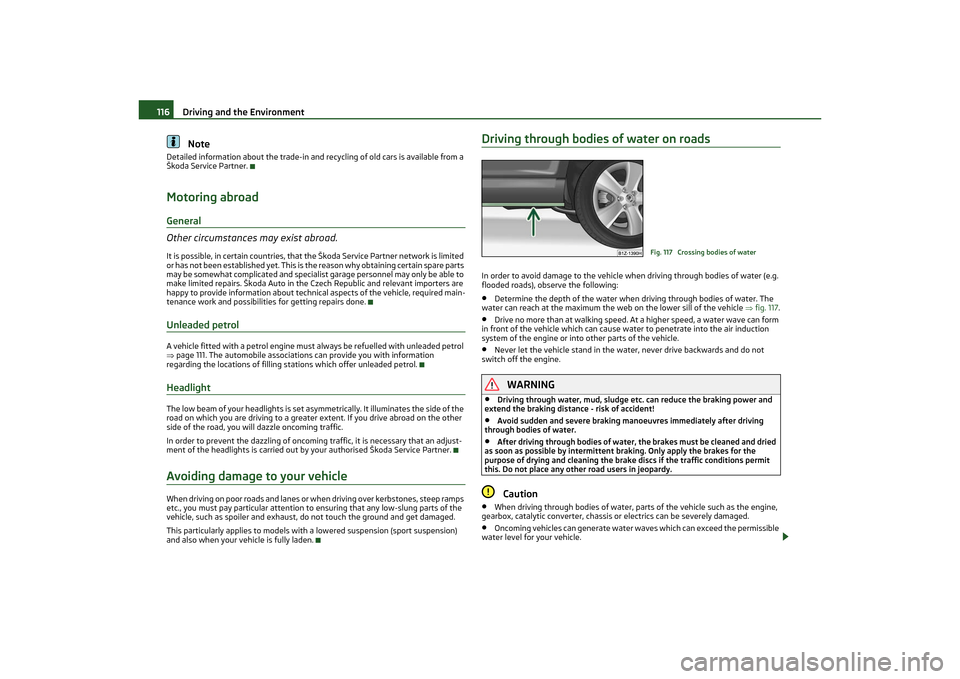
Driving through bodies of water on roadsIn order to avoid damage to the vehicle when driving through bodies of water (e.g.
flooded roads), observe the following:•
Determine the depth of the water when driving through bodies of water. The
water can reach at the maximum the web on the lower sill of the vehicle fig. 117 .
•
Drive no more than at walking speed. At a higher speed, a water wave can form
in front of the vehicle which can cause water to penetrate into the air induction
system of the engine or into other parts of the vehicle.
•
Never let the vehicle stand in the water, never drive backwards and do not
switch off the engine.
WARNING
•
Driving through water, mud, sludge etc. can reduce the braking power and
extend the braking distance - risk of accident!
•
Avoid sudden and severe braking m anoeuvres immediately after driving
through bodies of water.
•
After driving through bodies of water, the brakes must be cleaned and dried
as soon as possible by intermittent braking. Only apply the brakes for the
purpose of drying and cleaning the brake discs if the traffic conditions permit
this. Do not place any other road users in jeopardy.Caution
•
When driving through bodies of water, parts of the vehicle such as the engine,
gearbox, catalytic converter, chassis or electrics can be severely damaged.
•
Oncoming vehicles can generate water waves which can exceed the permissible
water level for your vehicle.
Fig. 117 Crossing bodies of water
s2lk.2.book Page 116 Monday, April 18, 2011 7:41 AM
Page 119 of 183

Towing a trailer
118
Towing a trailerTowing a trailerTechnical requirementsYour vehicle is designed primarily for tr ansporting persons and luggage. It can,
however, also be used for towing a trailer - provided certain technical equipment is
fitted.
If your vehicle has already been supplied with a factory-fitted towing device then
everything that is necessary for towing a tr ailer in technical terms, and in terms of
the law, has already been taken into account.
Your vehicle is fitted with a 13-pin power socket for the electrical connection
between the vehicle and trailer. If th e trailer which you wish to tow has a 7-pin
connector , you can use a suitable adapter
6) from Škoda original accessories.
This work must be carried out in accordance with the manufacturer's specifications
if a towing device is retrofitted.
Authorised Škoda Service Partners can pr ovide information about retrofitting a
towing device and for any necessary modifications to the cooling system.
WARNING
We recommend that you have the towing de vice from Škoda original accessories
installed by an authorised Škoda Service Partner. He is familiar with all the rele-
vant details relating to retrofitting such equipment. There is a risk of an accident
if the towing device is not properly fitted!General MaintenanceTrailer load
The permissible trailer load must on no account be exceeded.
You can negotiate appropriately steeper inclines and descents if you do not make
full use of the permissible trailer load.
The trailer loads specified only apply for altitudes up to 1 000 metres above mean
sea level. The fact that the engine power output drops with increasing height due
to a lowering of air pressure and thus th e ability to climb, means that the towed w e i g h t m u s t b e r e d u c e d b y 1 0 % f o r e v e r y f u r t h e r i n c r e a s e o f 1 0 0 0 m e t r e s i n h e i g h t
above sea level. The towed weight is the weight of the (laden) vehicle and the
(laden) trailer together. One should take
this into account before driving up to
higher altitudes.
The trailer and drawbar load information on the type plate of the towing device
are merely test data for the towing device The data relating to your vehicle, which
is often less than this test data, can be found in your vehicle registration docu-
ments.
Distribution of the load
Distribute the load in the trailer in such a way that any heavy items are located as
close as possible to the axle. Secure the items to prevent them slipping.
Tyre inflation pressure
Select the tyre inflation pressure on your vehicle for that of “fully laden”,
page 141. The inflation pressure of the tyre s fitted to the trailer adjust in accord-
ance with the manufacturer's recommendation.
Exterior mirrors
You have to have additional exterior mirr ors fitted if you are not able to see the
traffic behind the trailer with the standard rear-view mirrors. Both exterior mirrors
should be attached to folding arms. Adjust the mirrors so that they provide you with
an adequate field of view to the rear.
Headlights
Before starting off with a hitched trailer, also check the setting of the headlights.
Alter the setting as necessary with th e aid of the headlight beam adjuster
page 41.
Detachable ball head
The ball rod is detachable on vehicles wh ich feature a factory-fitted towing device.
Further information on the towing device page 119.
Note
•
We recommend that you also have your vehicle inspected between service
intervals if you tow a trailer frequently.
•
The handbrake on the towing vehicle must be put on when coupling and decou-
pling the trailer.
6)In some countries the adapter is supplied with the towing device.s2lk.2.book Page 118 Monday, April 18, 2011 7:41 AM
Page 124 of 183

Taking care of your vehicle and cleaning the vehicle123
Using the system
Safety
Driving Tips
General Maintenance
Breakdown assistance
Technical Data
PolishingPolishing is only necessary if the paintwork of your vehicle has become unattractive
and if it is no longer possible to achieve a gloss with wax preservers.
You must treat the paintwork with a wax preserver if the polish you use does not
contain any preserving elements page 122.
We recommend using a preservative from Škoda genuine accessories offered by
your Škoda dealer.
Caution
•
You must not treat mat painted parts or plastic with polishing products or hard
wax.
•
Do not polish the paintwork of the vehicle in a dusty environment, otherwise the
paintwork can be scratched.
Chrome partsFirst clean the chrome parts with a damp cloth and then polish them with a soft, dry
cloth. If it does not prove to be adequate, use a chrome care product from Škoda
original accessories.
Caution
Do not polish the chrome parts in a du sty environment, otherwise they can be
scratched.Paint damageS li g ht da m a g e t o p a in tw o rk s uc h a s s c ra tc h e s, sc uf f s o r tra c e s o f c hi p da m a ge m ust
be touched up immediately with paint (Škoda painting pen) before any corrosion
can result. You can of course have this work carried out by authorised Škoda Service
Partners.
The authorised Škoda Service Partners have a range of matching touch-up pens or
spray cans available in the colour of your vehicle.
The paint number of the original paintwork of your vehicle is indicated on the
vehicle data sticker page 165.
Any corrosion which has already have formed must be removed thoroughly. Apply a
corrosion protection primer and then the paint to the affected point. You can of
course have this work carried out by authorised Škoda Service Partners.
Plastic partsExternal plastic parts are cleaned by norm al washing. Plastic parts and synthetic
leather can also be treated with special solvent-free plastic cleaning agents if a
damp cloth is not sufficient. Paint care products are not suitable for plastic parts.
Caution
Solvent-free cleaners attack the material and can damage it.WindowsOnly use a plastic ice scraper for removi ng snow and ice from the windows and
mirrors. You should not move the ice scraper forward and backward but in one direc-
tion on the window which yo u are cleaning in order to avoid any damage to the
surface of the glass.
You can best remove residues of rubber, oil, grease, wax or silicone by using a
special window cleaner or a special silicone remover.
You should also clean the windows regularly from the inside.
Do not use window leathers which you have used to polish the vehicle body to dry
off the windows. Residues of preservatives in the window leather can dirty the
window and reduce visibility.
Do not affix any stickers over the inside of the rear window to avoid damage to the
heating elements of the rear window heater.
We recommend using a preservative from Škoda genuine accessories offered by
your Škoda dealer.
Caution
Never remove snow or ice from the glass parts with warm or hot water - risk of
formation of cracks in the glass!The headlight lensesPlease do not use any aggressive cleaning or chemical solvent products for cleaning
the front headlights - risk of damage to the plastic lenses. Please use soap and
clean warm water.
s2lk.2.book Page 123 Monday, April 18, 2011 7:41 AM