2011 SKODA OCTAVIA TOUR engine
[x] Cancel search: enginePage 26 of 183

Instruments and Indicator/Warning Lights25
Using the system
Safety
Driving Tips
General Maintenance
Breakdown assistance
Technical Data
The glow plug indicator light will come on
for about 1 second if the engine is at a
normal operating temperature or if the outside temperature is above +5 °C. This
means that you can start the engine right away .
There is a fault in the glow plug system if the warning light
does not come on
at all or lights up continuously . Contact a specialist garage as soon as possible to
obtain assistance.
If the warning light
begins to flash while driving, a fault exists in the engine
control. The engine management system selects an emergency programme which
enables you to drive to the nearest specialist garage by adopting a gentle style of
driving.
Coolant temperature/coolant level
The warning light
comes on for a few seconds when the ignition is switched on.
The coolant temperature is too high or the coolant level too low if the warning light
does not go out or flashes while driving.
3 peeps sound as an additional warning signal.
In this case stop and switch the engine off and check the coolant level; top up the
coolant as necessary.
Do not continue your journey if for some reason it is not possible under the condi-
tions prevailing to top up with coolant. Keep the engine switched off and obtain
professional assistance from a specialist garage, otherwise it could lead to severe
engine damage.
If the coolant is within the specified range, the increased temperature may be
caused by an operating problem at the coolant fan. Check the fuse for the coolant
fan, replace it if necessary page 157, “Fuse assignment in engine compartment”.
Do not continue driving if the warning light does not go off although the fluid is at
the correct level and also the fuse of the fan is in proper order. Contact a specialist
garage to obtain assistance.
Please also refer to the additional instructions page 133, “Cooling system”.
WARNING
•
If you must stop for technical reason s, then park the vehicle at a safe
distance from the traffic and switch o ff the engine and switch on the hazard
warning light system page 42.
•
Take care when opening the coolant exp ansion bottle. If the engine is hot,
the cooling system is pressuri zed - risk of scalding! It is best to allow the engine
to cool down before removing the cap.
•
Do not touch the coolant fan The coolant fan may switch on automatically
even if the ignition is off.
Traction control system (TCS)
The warning light
comes on for a few seconds when the ignition is switched on.
The warning light flashes when a control cycle is activated while driving.
The warning light lights up permanently if there is a fault in the system.
The fact that the TCS system operates to gether with the ABS means that the TCS
warning light will also come on if the ABS system is not operating properly.
If the warning light comes on immediately after starting the engine, the TCS
system can be switched off for technical reasons. In this case, the TCS system can
be switched on again by switching the igniti on on and off. If the warning light goes
out, the TCS system is fully functional again.
Further information about the TCS page 106, “Traction control system (TCS)”.
Note
If the battery has been disconnected and reconnected, the warning light
comes
on after switching on the ignition. The warning light must go out after driving a
short distance.
Switch off the Traction control system (TCS)
The TCS system is switched off by pressing the button page 106, fig. 112 and the
warning light lights up
.
Electronic stability programme (ESP)*
The warning light
comes on for a few seconds when the ignition is switched on.
When the ESP system is actively helping to stabilise the vehicle, the warning light
in the instrument cluster
flashes quickly.
The warning light lights up permanently if there is a fault in the ESP system.
The fact that the ESP system operates to gether with the ABS means that the ESP
warning light will also come on if the ABS system is not operating properly.
WARNING (continued)
s2lk.2.book Page 25 Monday, April 18, 2011 7:41 AM
Page 27 of 183
Instruments and Indicator/Warning Lights
26
If the warning light
comes on immediately after starting the engine, the ESP
system can be switched off for technical reasons. In this case, the ESP system can
be switched on again by switching the ignition on and off. If the warning light goes
out, the ESP system is fully functional again.
Further information on the ESP page 105, “Electronic stability programme
(ESP)*”.
Electronic Differential Lock (EDL)*
The EDL is a part of the ESP. A fault in the EDL is indicated by the ESP warning light
in the instrument cluster. Have the vehi cle inspected without delay by an author-
ised Škoda Service Partner. Further information on the EDL page 106, “Electronic
Differential Lock (EDL)*”.
Note
If the battery has been disconnected and reconnected, the warning light
comes
on after switching on the ignition. The wa rning light must go out after driving a
short distance.
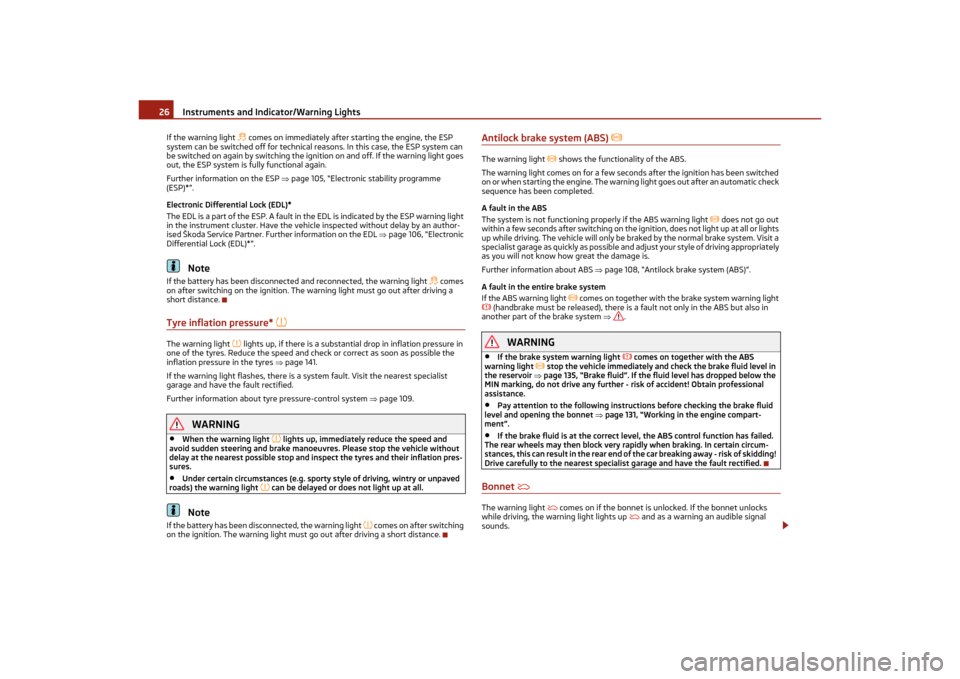
Tyre inflation pressure*
The warning light
lights up, if there is a substantial drop in inflation pressure in
one of the tyres. Reduce the speed and check or correct as soon as possible the
inflation pressure in the tyres page 141.
If the warning light flashes, there is a system fault. Visit the nearest specialist
garage and have the fault rectified.
Further information about tyre pressure-control system page 109.
WARNING
•
When the warning light
lights up, immediately reduce the speed and
avoid sudden steering and brake manoeu vres. Please stop the vehicle without
delay at the nearest possible stop and inspect the tyres and their inflation pres-
sures.
•
Under certain circumstances (e.g. sporty style of driving, wintry or unpaved
roads) the warning light
can be delayed or does not light up at all.
Note
If the battery has been disconnected, the warning light
comes on after switching
on the ignition. The warning light must go out after driving a short distance.
Antilock brake system (ABS)
The warning light
shows the functionality of the ABS.
The warning light comes on for a few seconds after the ignition has been switched
on or when starting the engine. The warning light goes out after an automatic check
sequence has been completed.
A fault in the ABS
The system is not functioning pr operly if the ABS warning light
does not go out
within a few seconds after switching on the ignition, does not light up at all or lights
up while driving. The vehicle will only be braked by the normal brake system. Visit a
specialist garage as quickly as possible an d adjust your style of driving appropriately
as you will not know how great the damage is.
Further information about ABS page 108, “Antilock brake system (ABS)”.
A fault in the entire brake system
If the ABS warning light
comes on together with th e brake system warning light
(handbrake must be released), there is a fault not only in the ABS but also in
another part of the brake system .
WARNING
•
If the brake system warning light
comes on together with the ABS
warning light
stop the vehicle immediately and check the brake fluid level in
the reservoir page 135, “Brake fluid”. If the fluid level has dropped below the
MIN marking, do not drive any further - risk of accident! Obtain professional
assistance.
•
Pay attention to the following instruct ions before checking the brake fluid
level and opening the bonnet page 131, “Working in the engine compart-
ment”.
•
If the brake fluid is at the correct leve l, the ABS control function has failed.
The rear wheels may then block very ra pidly when braking. In certain circum-
stances, this can result in the rear end of the car breaking away - risk of skidding!
Drive carefully to the nearest specialist garage and have the fault rectified.
Bonnet
The warning light
comes on if the bonnet is unlocked. If the bonnet unlocks
while driving, the warning light lights up
and as a warning an audible signal
sounds.
s2lk.2.book Page 26 Monday, April 18, 2011 7:41 AM
Page 28 of 183

Instruments and Indicator/Warning Lights27
Using the system
Safety
Driving Tips
General Maintenance
Breakdown assistance
Technical Data
The warning light comes on even when the ignition is switched off. The warning
light lights up for a
maximum of 5 minutes.
Seat belt warning light
The warning light
comes on after the ignition is switched on as a reminder to
fasten the seat belt. The warning light only goes out if the driver has fastened his
seat belt.
If the seat belt has not been fastened by the driver, a permanent warning signal
sounds at vehicle speeds greater than 20 km/h and simultaneously the warning
light flashes
.
If the seat belt is not fastened by the driver during the next 90 seconds, the warning
signal is deactivated and the warning light
lights up permanently.
Further information on the seat belts page 85, “Seat belts”.
Thickness of the brake pads*
The warning light
comes on for a few seconds when the ignition is switched on.
If the warning light comes on, contact a specialist garage immediately and have
the brake pads on all of the wheels inspected.
Boot lid
The warning light
comes on when the ignition is switched on if the luggage
compartment door is open. If th e boot lid opens while driving
, the warning light
lights up and an audible signal sounds.
The warning light comes on even when the ignition is switched off. The warning
light lights up for a maximum of 5 minutes.
Open door
The warning light
comes on if one or several door s are opened or if the boot lid
is opened. If one of the doors opens while driving, the warning light lights
up and
an audible signal sounds.
The warning light comes on even when the ignition is switched off. The warning
light lights up for a maximum of 5 minutes.
Brake system
The warning light
flashes or comes on if the brake fluid level is too low, if there
is a fault in the ABS or if the handbrake is applied.
If the warning light flashes and an audi ble signal sounds three times (handbrake
is not applied), stop and check the brake fluid level .
If there is a fault in the ABS which also influences the function of the brake system
(e.g. distribution of brake pressure), the ABS warning light
comes on and at the
same time the brake system warning light starts flashing
. Be aware that not only
the ABS but also another part of the brake system is defective .
An audible signal sounds three time s as an additional warning signal.
One should get used to high pedal forces, long braking distances and long free play
of the brake pedal when driving to the next specialist garage.
For further information on the brake system page 107, “Brakes”.
Handbrake applied
The warning light
also comes on if the handbrake is applied. An audible warning
is also given if you drive the vehicle for at least 3 seconds at a speed of more than
6 km/h.
WARNING
•
Pay attention to the following instruct ions before checking the brake fluid
level and opening the bonnet page 131, “Working in the engine compart-
ment”.
•
If the brake system warning light
does not go out a few seconds after
switching on the ignition or comes on when driving, stop immediately and check
the brake fluid in the reservoir page 135. If the fluid level has dropped below
the MIN marking, do not drive any further - risk of accident! Obtain professional
assistance.
Alternator
The warning light
comes on after the ignition has been switched on. It should go
out after the engine has started.
If the warning light does not go out after the engine has started, or comes on when
driving, drive to the nearest specialist garage. The vehicle battery will be discharged
in this case so switch off all no n-essential electrical components.
s2lk.2.book Page 27 Monday, April 18, 2011 7:41 AM
Page 29 of 183

Instruments and Indicator/Warning Lights
28Caution
If the warning light
comes on when driving and in addition the warning light
(cooling system fault) also comes on in display, you must then stop the car immedi-
ately and switch the engine off - risk of engine damage!
Engine oil level
Warning light
lights up
If the warning light lig h ts u p, the q ua n tit y o f o i l in th e e n gi ne i s p ro b a b l y to o lo w .
Check as soon as possible the oil level or top up page 132, “Replenishing engine
oil” with engine oil.
A peep sounds as an additional warning signal.
The warning light will go out if the bonnet is left open for more than 30 seconds. If
no engine oil has been replenished, the warning light will come on again after
driving about 100 km.
Warning light
flashes
A fault on the engine oil leve l sensor is indicated additionally by an audible signal
and the warning light coming on several times after the ignition has been switched
on.
In this case have the engine inspected without delay by a specialist garage.
Fuel reserve
The warning light
comes on, if the fuel level is still below 9 litres.
An audible signal sounds as an additional warning signal.
s2lk.2.book Page 28 Monday, April 18, 2011 7:41 AM
Page 31 of 183

Unlocking and locking
30Note
•
Pay attention to the correct pola rity when changing the battery.
•
The replacement battery must have the same specification as the original
battery.
•
If it is still not be possible to unlock or lock the vehicle with the remote control
even after replacing the batte ry this means that the system has to be synchronised
page 35.
Electronic immobiliserThe electronic immobiliser prevents the vehicle being operated by an
unauthorised person.An electronic chip is integrated in the head of the key. The immobiliser is deacti-
vated with the aid of this chip when the key is inserted in the ignition lock. The elec-
tronic immobiliser is automatically activa ted when you withdraw the ignition key
from the lock.
Note
It is only possible to start the engine of your car with a Genuine Škoda key with the
matching code.Child safety lockThe child safety lock prevents the rear door from being opened from
the inside.
The rear doors are equipped with a child safety lock. You can switch the child safety
lock on and off using the vehicle key.Switching child safety lock on– Use the vehicle key to turn the slit in the rear door to the left in the direction of
the arrow fig. 23 .Switching child safety lock off– Use the vehicle key to turn the slit to the right against the direction of the arrow.
So long as the child safety lock is switched on it is not possible to open the door
from the inside with the door opening leve r. In this case the door can be opened
only from the outside.Central locking systemDescriptionUnlocking or locking the vehicle causes all doors to be unlocked or locked at the
same time by the central locking system. The boot lid is unlocked when opening. It
can be opened by pressing the hand grip above the licence plate page 33.
Operation of the central lo cking system is possible:•
from the outside using the vehicle key page 32,
•
using the button for the central locking system page 32,
•
by using the remote control page 35.
Indicator light in the driver's door on vehicles without anti-theft alarm system
After the car is locked, the indica tor light flashes after 2 seconds.
After the car is locked with the deactivated safe securing system, the indicator light
flashes only after 30 seconds.
Indicator light in the driver's door on vehicles with anti-theft alarm system
After locking the vehicle the indicator light flashes for 2 seconds fast, then more
slowly.
If the vehicle is locked and the safe securing system page 31 is not operating, the
indicator light in the driver door flashes for about 2 seconds fast, goes out and starts
to flash slowly after about 30 seconds.
Fig. 23 Child safety locks on the rear
doors
s2lk.2.book Page 30 Monday, April 18, 2011 7:41 AM
Page 35 of 183

Unlocking and locking
34WARNING
•
Ensure that the lock is properly engaged after closing the boot lid. Other-
wise, the boot lid might open suddenly when driving even if the boot lid lock is
closed - risk of accident!
•
Never drive with the boot lid fully opened or slightly ajar otherwise exhaust
gases may get into the interior of the vehicle - risk of poisoning!
•
Do not press on the rear window when closing the boot lid, it could crack -
risk of injury!Note
•
After closing the boot lid, it is auto matically locked within 2 second and the
anti-theft alarm system* is activated. This applies only if the vehicle was locked
before closing the boot lid.
•
The function of the hand grip above the licence plate is deactivated when
starting off or as of a speed of more than 5 km/hour for vehicles with central locking.
The function of the hand grip is activated again when the vehicle has stopped and
a door is opened.
Emergency unlocking of the boot lid (Octavia)If there is a fault in the central locking, you can open the boot lid as follows:
– Fold the seat backrest forwards page 51.
– Take out the warning triangle* fig. 28 .
– Press the operating lever in the direction of arrow in order to unlock the boot lid.
The operating lever is located under the panel .
– Open the boot lid from the outside.
Emergency unlocking of the boot lid (Combi)If there is a fault in the central locking, you can open the boot lid as follows:
– Fold the seat backrest forwards page 51.
– Open up the cover of the lock upwards fig. 29 .
– Move the operating lever with the aid of a narrow object e.g. screwdriver up to the stop in the direction of arrow; the boot lid is then unlocked.
– Open the boot lid from the outside.Remote control*DescriptionYou can use the remote control:•
to unlock and lock the car,
•
unlocking boot lid,
•
electrically open and close the windows.
The transmitter with the battery is housed in the handle of the remote control key.
The receiver is located in the interior of the car. The operating range of the remote
control is approx. 10 m. But this range of the remote control can be reduced if the
batteries are weak.
The key has a fold-open key bit which can be used for unlocking and locking the car
manually and also for starting the engine.
Fig. 28 Emergency unlocking of the boot
lid
A
B
Fig. 29 Emergency unlocking of the boot
lid
A
s2lk.2.book Page 34 Monday, April 18, 2011 7:41 AM
Page 45 of 183
Lights and Visibility
44
•
the ignition is switched on.
•
auto switch-off - about 30 seconds after all the doors have been closed.
If the doors remain open, the switch in position
, the interior lighting switches
off automatically after around 10 minutes to stop the battery from running down.
Note
We recommend having these bulbs replaced by a specialist garage.Vehicle interior lighting version 2Switching on the interior lighting– Turn the switch to position
fig. 40 .
Switching off the interior lighting– Turn the switch to position O.Operation of the lamp using the door switch– Turn the switch to position
.
The same principles apply for interior lighting version 2 as for page 43, “Lighting
of the interior of the vehicle - Version 1”.
Luggage compartment lightThe lighting comes on automatically when the boot lid is opened. If the lid remains
open for more than about 10 minutes, th e luggage compartment lighting switches
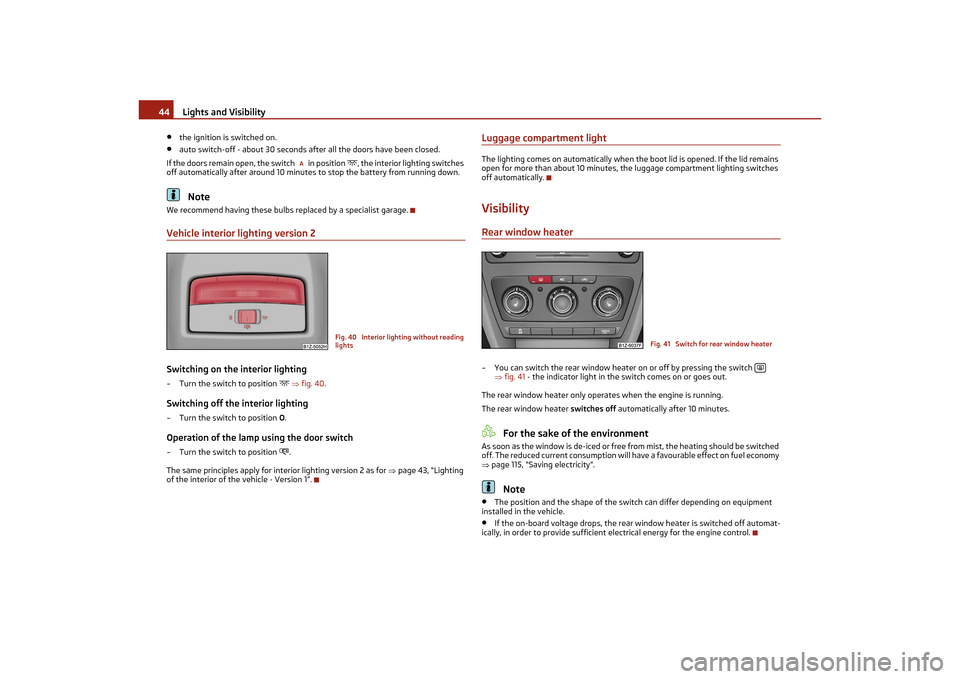
off automatically.VisibilityRear window heater– You can switch the rear window heater on or off by pressing the switch
fig. 41 - the indicator light in the switch comes on or goes out.
The rear window heater only operates when the engine is running.
The rear window heater switches off automatically after 10 minutes.
For the sake of the environment
As soon as the window is de-iced or free from mist, the heating should be switched
off. The reduced current consumption will ha ve a favourable effect on fuel economy
page 115, “Saving electricity”.
Note
•
The position and the shape of the switch can differ depending on equipment
installed in the vehicle.
•
If the on-board voltage drop s, the rear window heater is switched off automat-
ically, in order to provide sufficient electrical energy for the engine control.
A
Fig. 40 Interior lighting without reading
lights
Fig. 41 Switch for rear window heater
s2lk.2.book Page 44 Monday, April 18, 2011 7:41 AM
Page 49 of 183

Lights and Visibility
48
– With the other hand unlock the locking button in the direction of arrow and
remove the wiper blade.Attaching a wiper blade– Position the wiper blade onto the wiper arm and lock the locking button .
– Check whether the wiper blade is correctly attached.
The same remarks apply here as for page 47, “Replacing wiper blades for the
windscreen wipers”.Rear-view mirrorManual dimming interior rear-view mirrorBasic setting– Pull the lever on the bottom edge of the mirror forward.Dimming mirror– Pull the lever on the bottom edge of the mirror back.Exterior mirror
You can adjust the exterior mirrors electrically*.The exterior mirror heater only operates when the engine is running and up to an
outside temperature of +20 °C.
Heating of the external mirror – Turn the rotary knob to position
fig. 46 .
Adjusting left and right exterior mirrors simultaneously– Turn the rotary knob to position
. The movement of the mi rror surface is iden-
tical to the movement of the rotary knob.
Adjusting the right-hand exterior mirror– Turn the rotary knob to position
. The movement of the mirror surface is iden-
tical to the movement of the rotary knob.
Switching off operating control– Turn the rotary knob to position
.
WARNING
•
Convex (curved outward) or spherical (differently curved) exterior mirrors
increase the vision field. They do, howe ver, make objects appear smaller in the
mirror. These mirrors are only of limited use, therefore, for estimating distances
to the following vehicles.
•
Use whenever possible the interior rear mirror, for estimating the distances
to the following vehicles.Note
•
Do not touch the surfaces of the exterior mirrors if the exterior mirror heater is
switched on.
•
You can set the exterior mirrors by hand, if the power setting function fails at
any time by pressing on the edge of the mirror surface.
•
Contact your specialist garage if a faul t exists with the power setting of the
exterior mirrors.
A
A
Fig. 46 Inner part of door: Rotary knob
s2lk.2.book Page 48 Monday, April 18, 2011 7:41 AM