2011 MITSUBISHI TRITON ESP
[x] Cancel search: ESPPage 78 of 369
The front airbags are designed to deploy when the
vehicle suffers a moderate to
severe frontal impact.
A typical condition is shown in the illustration.
The front airbags will deploy if the severity of im-
pact is above the designed threshold level, compa-
rable to an approximately 25 km/h (16 mph) colli-
sion when impacting straight into a solid wall that
does not move or deform. If the severity of the im-
pact is below the above threshold level, the front air-
bags may not deploy. However, this threshold
speed will be considerably higher if the vehicle
strikes an object that absorbs the impact by either
deforming or moving (for example, another station-
ary vehicle, pole or a guard rail).
Because frontal collisions can easily move you out
of position, it is important to always properly wear
your seat belts. Your seat belts will help keep you
in a safe distance from the steering wheel and in-
strument panel during the initial stages of airbag de-
ployment. The initial stage of airbag inflation is the
most forceful, and can possibly cause serious or fa-
tal injuries. Moreover, the seat belts in your vehicle
are your primary means of protection in a collision.
The SRS airbags are designed to provide additional
protection. Therefore, for your safety and the safe-
ty of all occupants, be sure to always properly wear
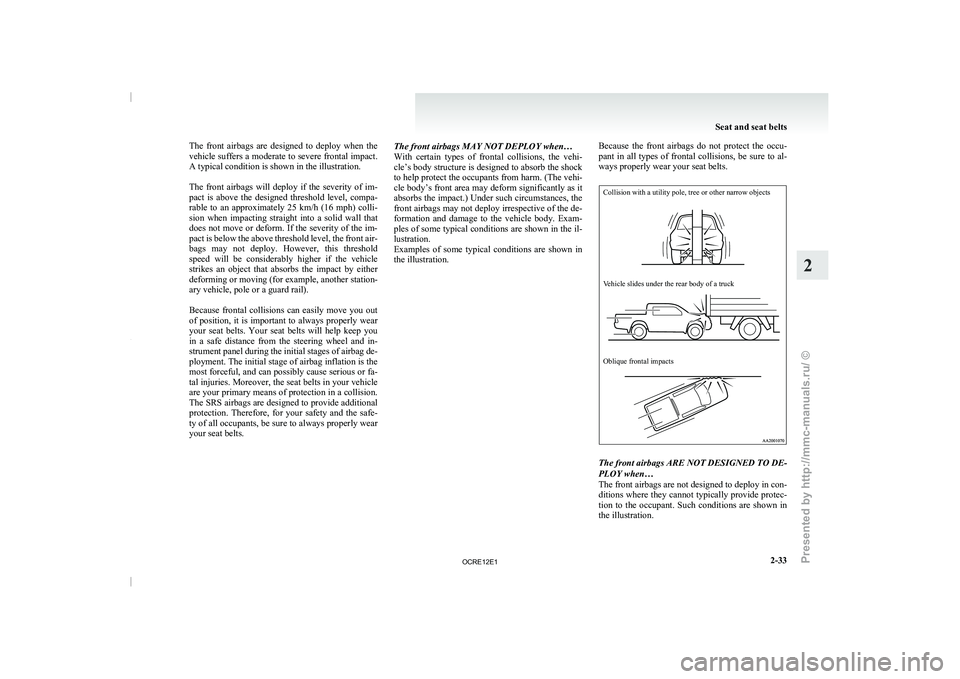
your seat belts. The front airbags MAY NOT DEPLOY when…
With certain types of frontal
collisions, the vehi-
cle’s body structure is designed to absorb the shock
to help protect the occupants from harm. (The vehi-
cle body’s front area may deform significantly as it
absorbs the impact.) Under such circumstances, the
front airbags may not deploy irrespective of the de-
formation and damage to the vehicle body. Exam-
ples of some typical conditions are shown in the il-
lustration.
Examples of some typical conditions are shown in
the illustration.
Because the front airbags do not protect the occu-
pant in all types of
frontal collisions, be sure to al-
ways properly wear your seat belts.
Collision with a utility pole, tree or other narrow objects
Vehicle slides under the rear body of a truck
Oblique frontal impacts The front airbags ARE NOT DESIGNED TO DE-
PLOY when…
The
front
airbags are
not
designed to deploy in con-
ditions where they cannot typically provide protec-
tion to the occupant. Such conditions are shown in
the illustration.
Seat and seat belts
2-33 2
OCRE12E1
Presented by http://mmc-manuals.ru/ \251
Page 81 of 369
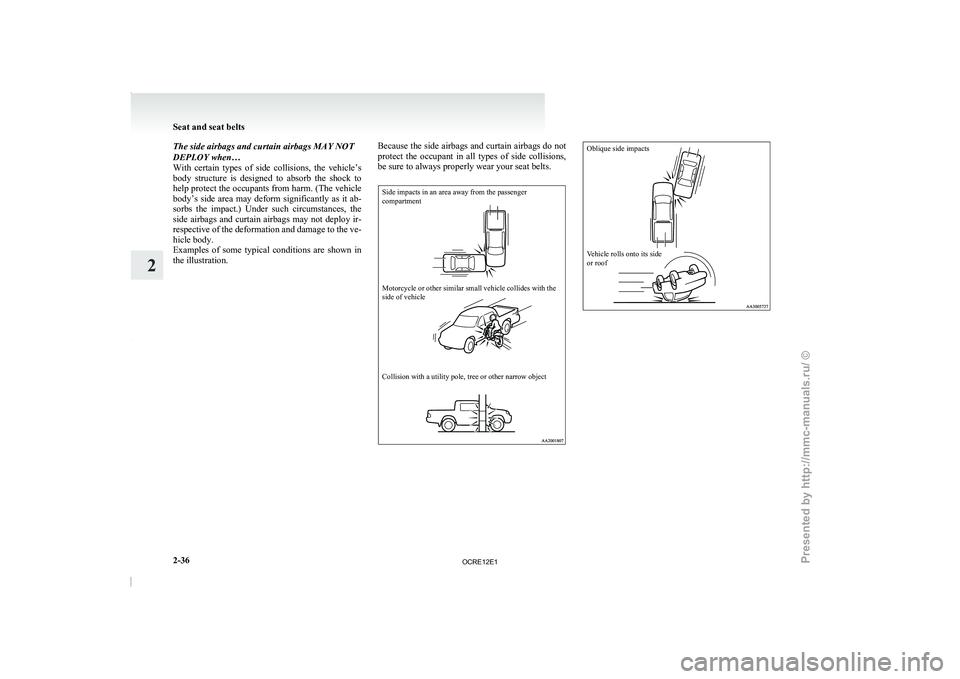
The side airbags and curtain airbags MAY NOT
DEPLOY when…
With certain types of side
collisions, the vehicle’s
body structure is designed to absorb the shock to
help protect the occupants from harm. (The vehicle
body’s side area may deform significantly as it ab-
sorbs the impact.) Under such circumstances, the
side airbags and curtain airbags may not deploy ir-
respective of the deformation and damage to the ve-
hicle body.
Examples of some typical conditions are shown in
the illustration.
Because the side airbags and curtain airbags do not
protect the occupant in all
types of side collisions,
be sure to always properly wear your seat belts.
Side impacts in an area away from the passenger
compartment
Motorcycle or other similar small vehicle collides with the
side of vehicle
Collision with a utility pole, tree or other narrow object
Oblique side impacts
Vehicle rolls onto its side
or roof Seat and seat belts
2-36
2
OCRE12E1
Presented by http://mmc-manuals.ru/ \251
Page 94 of 369

CAUTION
l
If the lamp does not illuminate
when the ignition switch is
turned to the “ON” position,
we recommend you to have the
system checked.
l If the lamp illuminates while
the engine is running, avoid
driving at high speeds and we
recommend you to have the sys-
tem checked.
During vehicle operation with
the lamp illuminated, the vehi-
cle may not accelerate when
you depress the accelerator ped-
al.
When the vehicle is stationary
with the lamp illuminated, you
must depress the brake pedal
more firmly than usual since
the engine idling speed is high-
er than usual and the vehicle
with an A/T has a stronger ten-
dency to creep forward. NOTE
l The
engine electronic control mod-
ule
accommodating the onboard di-
agnostic system has various fault
data (especially about the exhaust
emission) stored.
This data will be erased if a bat-
tery cable is disconnected which
will make a rapid diagnosis diffi-
cult. Do not disconnect a battery
cable when the check engine warn-
ing lamp is ON. Charge warning lamp
E00502700821
This lamp illuminates when the
ignition
switch is turned to the “ON” position,
and goes off after the engine has started. CAUTION
l
If the lamp comes
on
while the
engine is running, the probable
cause is as shown below.
Park the vehicle immediately at
a safe place and we recommend
you to have it checked. • Broken drive belt or abnor-mality in the charging sys-
tem. A broken drive belt cau-
ses poor braking efficiency.
Depress the brake pedal
harder than usual to park
the vehicle in a safe place. Oil pressure warning lamp
E00502800620
This lamp illuminates when the
ignition
switch is turned to the “ON” position,
and goes off after the engine has started.
If it illuminates while the engine is run-
ning, the oil pressure is too low.
If the warning lamp illuminates while
the engine is running, turn the engine off
and have it inspected. CAUTION
l
If this lamp illuminates
when
the
engine oil level is not low,
have it inspected.
l This warning lamp does not in-
dicate the amount of oil in the
crankcase. This must be deter-
mined by checking the oil level
on the dipstick, while the en-
gine is switched off.
l If you continue driving with
low engine oil level or with this
warning lamp illuminated, en-
gine seizure may occur.
NOTE l The
oil pressure warning lamp
should
not be treated as an indica-
tion of the engine’s oil level. The
oil level must be checked using
the dipstick. Instruments and controls
3-09 3
OCRE12E1
Presented by http://mmc-manuals.ru/ \251
Page 123 of 369

Have the vehicle inspected at a
MITSUBISHI MOTORS Authorized Service
Point.
•
When the wipers operate at a constant in-terval despite changes in the extent of rain.
• When the wipers do not operate even though it is raining.
l The wipers may automatically operate when
things such as insects or foreign objects are
affixed to the windscreen on top of the rain
sensor or when the windscreen is frozen. Ob-
jects affixed to the windscreen will stop the
wipers when the wipers cannot remove them.
To make the wipers operate again, place the
lever in the “LO” or “HI” position.
Also, the wipers may operate automatically
due to strong direct sunlight or electromag-
netic wave. To stop the wipers, place the lev-
er in the “OFF” position.
l Contact a MITSUBISHI MOTORS Author-
ized Service Point when replacing the wind-
screen or reinforcing the glass around the sen-
sor. To adjust the sensitivity of the rain sensor
With the lever in the
“AUTO” (rain sensor) posi-
tion, it is possible to adjust the sensitivity of the
rain sensor by turning the knob (A). "+"- Higher sensitivity to rain
"-"- Lower sensitivity to rain
NOTE l It
is possible to activate
the following func-
tions. For further information, we recom-
mend you to consult a MITSUBISHI
MOTORS Authorized Service Point. • Automatic operation (rain droplet sensi-tive) can be changed to intermittent oper-
ation (vehicle-speed sensitive).
• Automatic operation (rain droplet sensi- tive) can be changed to intermittent oper-
ation (except vehicle-speed sensitive).
Misting function
Move the lever in the direction of the arrow and re-
lease, to operate the wipers once.
Use this function when you are driving in mist or
drizzle. If the lever is held in the upward position (MIST),
the wipers continue operating until
the lever is re-
leased. The wipers will operate once if the lever is moved
to the “AUTO” position and
the knob (A) is turned
in the “+” direction when the ignition switch is
“ON” position. Windscreen washer
E00507200805
The windscreen washer can be operated with the ig-
nition switch in the “ON” or “ACC” position. Instruments and controls
3-38
3
OCRE12E1
Presented by http://mmc-manuals.ru/ \251
Page 127 of 369

Economical driving
E00600100620
For economical driving, there are
some technical re-
quirements that have to be met. The prerequisite
for low fuel consumption is a properly adjusted en-
gine. In order to achieve longer life of the vehicle
and the most economical operation, we recommend
you to have the vehicle checked at regular intervals
in accordance with the service standards.
Fuel economy and generation of exhaust gas and
noise are highly influenced by personal driving hab-
its as well as the particular operating conditions.
The following points should be observed in order
to minimize wear of brakes, tyres and engine as
well as to reduce environmental pollution.
Starting
Avoid rapid acceleration and sudden starts; such op-
eration will result in higher fuel consumption.
Shifting
Shift only at an appropriate speed and engine
speed. Always use the highest gear possible.
The transfer shift lever should be set to “2H” when
driving 4WD vehicles on normal roads and express
ways to obtain best possible fuel economy.
City traffic
Frequent starting and stopping increases the aver-
age fuel consumption. Use roads with smooth traf-
fic flow whenever possible. When driving on con-
gested roads, avoid use of a low gear at high en-
gine speeds.
Idling
The vehicle consumes fuel even during idling.
Avoid extended idling whenever possible. Speed
The higher the vehicle
speed,
the more fuel con-
sumed. Avoid driving at full speed. Even a slight re-
lease of the accelerator pedal will save a significant
amount of fuel.
Tyre inflation pressure
Check the tyre inflation pressures at regular inter-
vals. Low tyre inflation pressure increases road re-
sistance and fuel consumption. In addition, low
tyre pressures adversely affect tyre wear and driv-
ing stability.
Load
Do not drive with unnecessary articles in the cargo
area. Especially during city driving where frequent
starting and stopping is necessary, the increased
weight of the vehicle will greatly affect fuel con-
sumption.
Cold engine starting
Starting of a cold engine consumes more fuel.
Unnecessary fuel consumption is also caused by
keeping a hot engine running. After the engine is
started, commence driving as soon as possible.
Air conditioning*
The use of the air conditioning will increase the
fuel consumption. Driving, alcohol and drugs
E00600200012
Driving after drinking alcohol is
one of the most fre-
quent causes of accidents.
Your driving ability can be seriously impaired even
with blood alcohol levels far below the legal mini-
mum. If you have been drinking, don’t drive. Ride
with a designated non-drinking driver, call a cab or
a friend, or use public transportation.
Drinking coffee or taking a cold shower will not
make you sober.
Similarly, prescription and nonprescription drugs af-
fect your alertness, perception and reaction time.
Consult with your doctor or pharmacist before driv-
ing while under the influence of any of these medi-
cations. WARNING
l NEVER DRINK AND DRIVE.
Your perceptions are less
accurate,
your
reflexes are slower and your judgment is
impaired. Starting and driving
4-02
4
OCRE12E1
Presented by http://mmc-manuals.ru/ \251
Page 138 of 369

Starting
E00601600404
Tips for starting l Do not operate the
starter
motor continuous-
ly for anything longer than 10 seconds; do-
ing so could run down the battery. If the en-
gine does not start, turn the ignition switch
back to “LOCK” position, wait a few sec-
onds, and then try again.
Trying repeatedly with the starter motor still
turning will damage the starter mechanism.
l If the engine cannot be started because the
battery is weak or dead, refer to the “Emer-
gency starting” section for instructions on
starting the engine.
l The engine is well warmed up if the coolant
temperature gauge needle starts to move (the
engine speed decreases). Extended warming-
up operation will result in excessive fuel con-
sumption. WARNING
l Never
run
the engine
in
a closed or poor-
ly ventilated area any longer than is nee-
ded to move your vehicle in or out of the
area. Carbon monoxide gases are odour-
less and can be fatal. CAUTION
l
Never attempt to start the
engine by push-
ing or pulling the vehicle. Especially the
automatic transmission, since the struc-
ture is different from a manual transmis-
sion, it is not possible to start the engine
by using this technique. Never attempt
this or it could damage the automatic
transmission.
l Do not run the engine at high rpm or
drive the vehicle at high speed until the en-
gine has had a chance to warm up.
l Release the ignition key as soon as the en-
gine starts to avoid damaging the starter
motor.
l Do not stop the engine immediately after
high-speed or uphill driving. First allow
the engine to idle to give the turbocharg-
er a chance to cool down.
Starting the engine E00601701792
1. Insert the ignition key and fasten the seat belt.
2. Make sure the parking brake is applied.
3. Depress and hold the brake pedal.
4. On
vehicles with manual transmission, place
the gearshift lever in the “N” (Neutral) posi-
tion and depress the clutch pedal all the way. On vehicles with automatic transmission,
make
sure
the selector
lever
in the “P”
(PARK) position.
Vehicles with manual
transmission Vehicles with automatic
transmission NOTE
l On
vehicles with automatic transmission,
the
engine will not start if the selector lever is in
any position other than “P” (PARK) or “N”
(NEUTRAL) position.
For safety, start the engine with the selector
lever in the “P” (PARK) position because in
this position the rear wheels are locked in
place.
5. Turn the ignition key to the “ON” position. The diesel preheat indication lamp will first
illuminate, and then after a short time go out,
indicating that preheating is completed.
NOTE l If the engine is cold, the diesel preheat indi-
cation lamp is on for a longer time. Starting and driving
4-13 4
OCRE12E1
Presented by http://mmc-manuals.ru/ \251
Page 145 of 369

CAUTION
l
If the warning lamp comes on, reduce the
engine speed and stop the vehicle in a safe
area.
Then set the selector lever to “P” (PARK)
position and idle the engine until the warn-
ing lamp goes off.
When the warning lamp goes off, resume
normal driving.
If the warning lamp does not go off, we
recommend you to have your vehicle in-
spected.
Operation of the automatic transmis-
sion E00604200515CAUTION
l
Before selecting a gear with
the engine
running and the vehicle stationary, fully
depress the brake pedal to prevent the ve-
hicle from creeping.
The vehicle will begin to move as soon as
the gear is engaged, especially when the
engine speed is high, at fast idle or with
the air conditioning operating, the brakes
should only be released when you are
ready to drive away.
l Depress the brake pedal with the right
foot at all times.
Using the left foot could cause driver move-
ment delay in case of an emergency. CAUTION
l
To prevent sudden acceleration, never
race
the engine when shifting from the
“P” (PARK) or “N” (NEUTRAL) position.
l Operating the accelerator pedal while the
other foot is resting on the brake pedal
will affect braking efficiency and may
cause premature wear of brake pads.
Do not race the engine with brake pedal
pressed.
This can damage the transmission.
l Use the selector lever in the correct shift
position in accordance with driving condi-
tions.
Never coast downhill backward with the
“D” (DRIVE) position or coast forward
with the “R” (REVERSE) position.
The engine stops and the brake pedal ef-
fort or the steering wheel handling weight
increasing could lead to an accident.
Passing acceleration E00604500127
To gain extra acceleration in “D” (DRIVE) posi-
tion (when passing
another vehicle),
push the accel-
erator to the floor. The automatic transmission will
automatically downshift.
Waiting E00604600128
For short waiting periods, such as at traffic signals,
the vehicle can be left
in gear and held stationary
with the service brake.
For longer waiting periods with the engine running,
the selector lever should be placed in the “N” (NEU-
TRAL) position. CAUTION
l
Never hold the vehicle stationary
on a hill
using the accelerator pedal (without us-
ing the brake pedal). Always apply the
parking brake and/or service brakes.
l Unexpected acceleration may occur if the
selector lever is in a position other than
“P” (PARK) or “N” (NEUTRAL) position.
Prior to moving off after having stopped
the vehicle, make sure that the selector lev-
er is in “D” (DRIVE) position.
Parking E00604700246
To park the vehicle, first bring it to a complete
stop, fully engage
the parking
brake, and then
move the selector lever to the “P” (PARK) position.
If you are going to leave the vehicle unattended, al-
ways switch off the engine and remove the ignition
key.
NOTE
l On a slope, be sure to apply the parking
brake before moving the selector lever to the
“P” (PARK) position. If you move the selec-
tor lever to the “P” (PARK) position before
applying the parking brake, it may be diffi-
cult to disengage the selector lever from the
“P” (PARK) position when next you drive
the vehicle, requiring application of a strong
force to the selector lever to move from the
“P” (PARK) position. Starting and driving
4-20
4
OCRE12E1
Presented by http://mmc-manuals.ru/ \251
Page 149 of 369

When a malfunction occurs in the au-
tomatic transmission
E00615100152
When the selector lever position indicator blinks E00615200179
When the selector lever position indicator blinks
while you are driving, there
could be a malfunction
in the automatic transmission system.
through
or CAUTION
l
If the selector lever
position
indicator
blinks while you are driving, it is likely
that a safety device is operating because
of a malfunction in the automatic trans-
mission. We recommend you to have
your vehicle inspected as soon as possible. CAUTION
l
The selector lever position indicator
warn-
ing function does not operate with the se-
lector lever in the “P” (PARK), “R” (RE-
VERSE) or “N” (NEUTRAL) position.
When the A/T (automatic transmission) fluid tem-
perature warning lamp comes on E00615300141
The automatic transmission fluid temperature warn-
ing lamp comes
on when
the automatic transmis-
sion fluid temperature becomes abnormally high.
Normally the warning lamp comes on when the ig-
nition switch is turned to the “ON” position, and
then will go out after a few seconds. CAUTION
l
If the lamp comes on,
reduce the engine
speed and stop the vehicle in a safe area.
Then set the selector lever to the “P”
(PARK) position and idle the engine until
the warning lamp goes off. When the warn-
ing lamp goes off, resume normal driving.
If the warning lamp does not go off, we
recommend you to have your vehicle in-
spected.
Operation of the automatic transmis-
sion E00604200528 CAUTION
l
Before selecting a gear with
the engine
running and the vehicle stationary, fully
depress the brake pedal to prevent the ve-
hicle from creeping.
The vehicle will begin to move as soon as
the gear is engaged, especially when the
engine speed is high, at fast idle or with
the air conditioning operating, the brakes
should only be released when you are
ready to drive away.
l Depress the brake pedal with the right
foot at all times.
Using the left foot could cause driver move-
ment delay in case of an emergency.
l To prevent sudden acceleration, never
race the engine when shifting from the
“P” (PARK) or “N” (NEUTRAL) position. Starting and driving
4-24
4
OCRE12E1
Presented by http://mmc-manuals.ru/ \251