2010 MERCEDES-BENZ SLS COUPE fuel pump
[x] Cancel search: fuel pumpPage 269 of 361
Running-in notes
The first 1500 km
G
Ris
kofa ccident
New brake pads/linings only have optimal
braking performance after several hundred
kilometres .Until then, compensate for this by
applying greate rforce to the brake pedal. This
also applies when brake pads/linings or
brake discs have been changed.
If you treat the engine with sufficient care
from the very start,y ou will be rewarded with
excellent performance for the remainder of
the engine's life.
R You should therefore drive at varying road
and engine speeds for the first 1500 km.
R Do not drive faster than 140 km/h for the
first 1500 km.
R Only bring the engine up to a maximum
speed of 4500 rpm for a brief period.
R Avoid heavy loads, e.g. driving at full throt-
tle, during this time. Do not exceed 2
/ 3 of
the maximum permissible engine speed for
each gear.
R When driving in the manual drive program
M, change gear in good time.
R Do not use RACE START.
R Do not shift down a gear manually in order
to brake.
R Try to avoid depressing the accelerator
pedal beyond the pressure point (kick-
down).
R Only select shift range restriction 3,2or
1 when driving slowly, such as in moun-
tainous terrain.
After 1500 km, you may gradually bring the
vehicle up to full road and engine speeds.
i You should also observe these notes on
running in if the engine or the transmission
on your vehicle has been replaced. Refuelling
Refuelling
G
Risk of explosion
Fuel is highly flammable. Fire, naked flames
and smoking are therefore prohibited when
handling fuels.
Switch off the engine before refuelling. G
Risk of injury
Do not come into contact with fuels.
It is hazardous to your health if your skin
comes into direct contact with fuels or you
breathe in fuel vapours.
! Do not use diesel to refuel vehicles with a
petrol engine. Even small amounts of diesel
result in damage to the injection system.
Damage resulting from adding diesel is not
covered by the warranty.
! If the wrong fuel has been added by mis-
take, do not switch on the ignition. If you
do, the fuel could enter the fuel lines. The
fuel tank and the fuel lines must then be
drained. Informaqualified specialist work-
shop and have the fuel tank and the fuel
lines drained completely.
When you open or close the vehicle with the
key, the fuel filler flap is automatically
unlocked or locked.
The position of the fuel filler cap is to the rear
on the right .The position of the fuel filler cap
is displayed in the instrumentc luster0007.
The arrow nex tto the filling pump indicates
the side of the vehicle. 266
RefuellingOperation
BA 197 ECE RE 2010/6a; 1; 2, en-GB
sabbaeu
Version: 3.0.3.6 2010-05-07T14:19:43+02:00 - Seite 266
Page 270 of 361
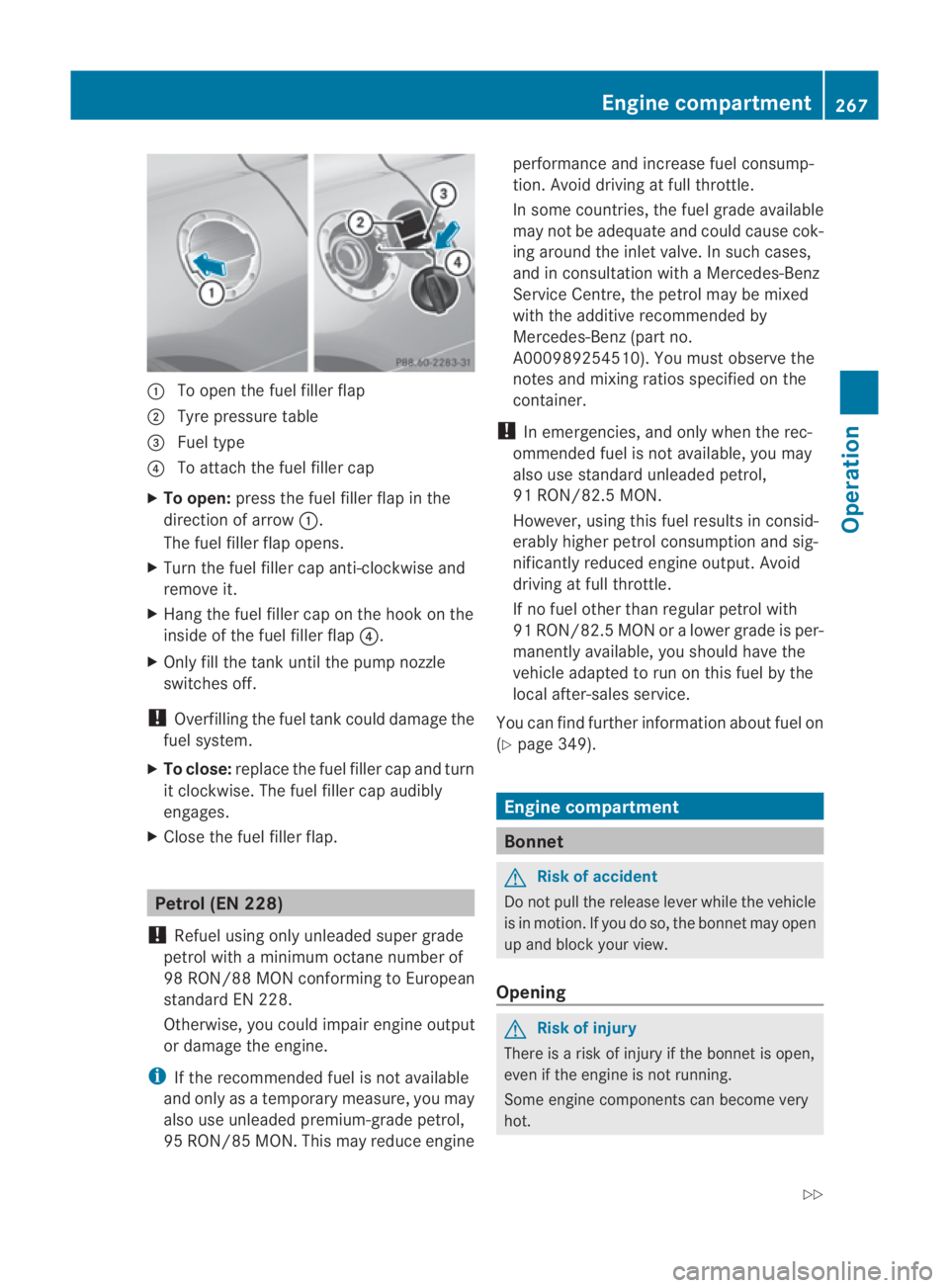
0001
To open the fuel filler flap
0002 Tyre pressure table
0015 Fuel type
0014 To attach the fuel filler cap
X To open: press the fuel filler flap in the
direction of arrow 0001.
The fuel filler flap opens.
X Turn the fuel filler cap anti-clockwise and
remove it.
X Hang the fuel filler cap on the hook on the
inside of the fuel filler flap 0014.
X Only fill the tank until the pump nozzle
switches off.
! Overfilling the fuel tank could damage the
fuel system.
X To close: replace the fuel filler cap and turn
it clockwise. The fuel filler cap audibly
engages.
X Close the fuel filler flap. Petrol (EN 228)
! Refuel using only unleaded super grade
petrol with a minimum octane number of
98 RON/88 MON conforming to European
standard EN 228.
Otherwise, you could impair engine output
or damage the engine.
i If the recommended fuel is not available
and only as a temporary measure, you may
also use unleaded premium-grade petrol,
95 RON/85 MON. This may reduce engine performance and increase fuel consump-
tion. Avoid driving at full throttle.
In some countries, the fuel grade available
may not be adequate and could cause cok-
ing around the inlet valve. In such cases,
and in consultation with
aMercedes-Benz
Service Centre, the petrol may be mixed
with the additive recommended by
Mercedes-Benz( part no.
A000989254510). You must observe the
notes and mixing ratios specified on the
container.
! In emergencies, and only when the rec-
ommended fuel is not available, you may
also use standard unleaded petrol,
91 RON/82.5 MON.
However, using this fuel results in consid-
erably higher petrol consumption and sig-
nificantly reduced engine output. Avoid
driving at full throttle.
If no fuel other than regular petrol with
91 RON/82.5 MON or a lower grade is per-
manently available, you should have the
vehicle adapted to run on this fuel by the
local after-sales service.
You can find further information about fuel on
(Y page 349). Engine compartment
Bonnet
G
Risk of accident
Do not pull the release lever while the vehicle
is in motion .Ifyou do so, the bonnet may open
up and block your view.
Opening G
Risk of injury
There is a risk of injury if the bonnet is open,
even if the engine is not running.
Some engine components can become very
hot. Engine compartment
267Operation
BA 197 ECE RE 2010/6a; 1; 2, en-GB
sabbaeu Version: 3.0.3.6 2010-05-07T14:19:43+02:00 - Seite 267 Z
Page 308 of 361
Display messages Possible causes/consequences and
0003 Solutions
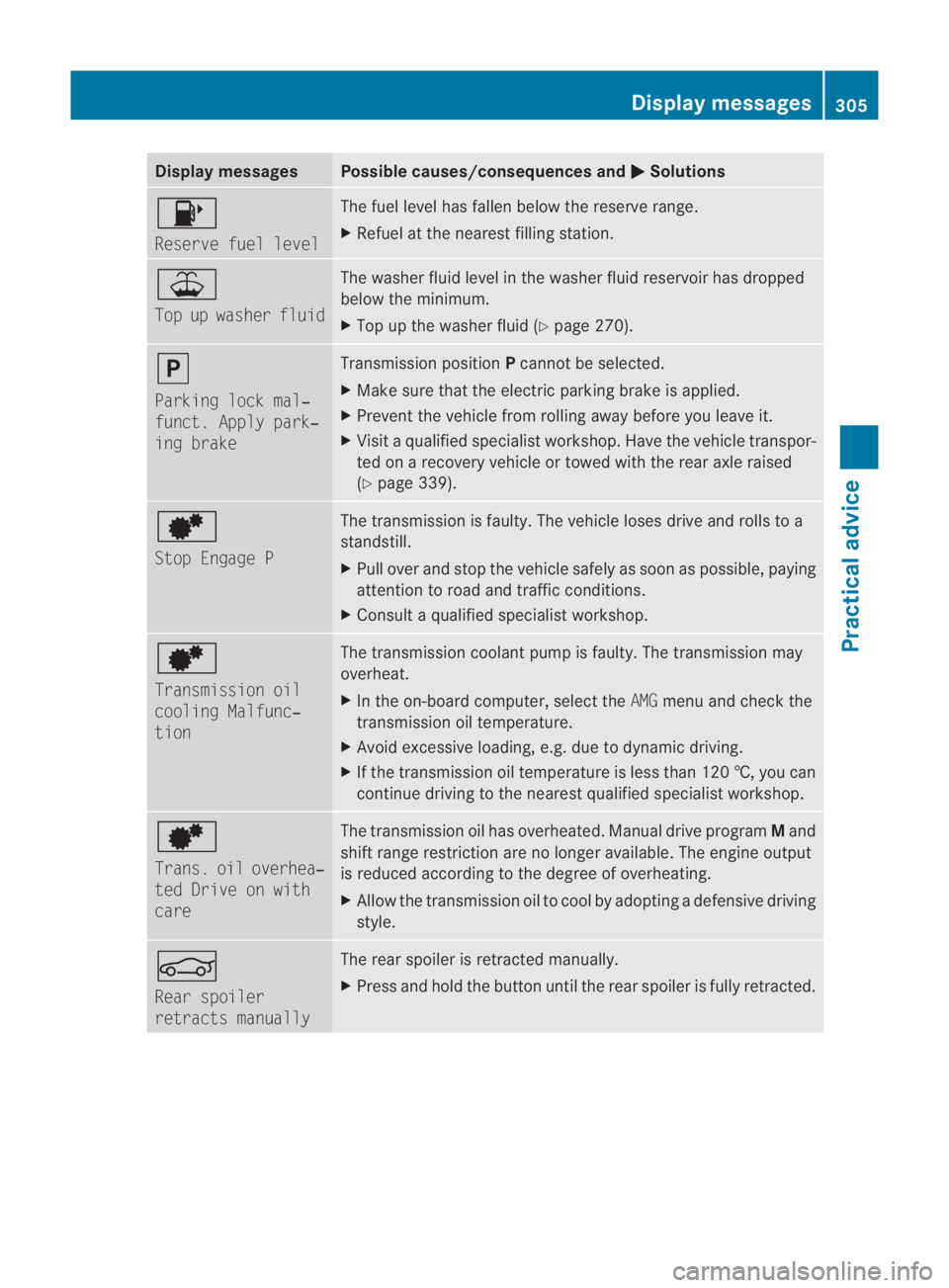
0007
Reserve fuel level The fuel level has fallen belo
wthe reserve range.
X Refuel at the nearest filling station. 0016
Top up washer fluid The washer fluid level in the washer fluid reservoir has dropped
below the minimum.
X
Top up the washer fluid (Y page 270).0009
Parking lock mal‐
funct. Apply park‐
ing brake Transmission position
Pcannot be selected.
X Make sure that the electric parking brake is applied.
X Prevent the vehicle from rolling away before you leave it.
X Visit a qualified specialist workshop. Have the vehicle transpor-
ted on a recovery vehicle or towed with the rear axle raised
(Y page 339). 0001
Stop Engage P The transmission is faulty. The vehicle loses drive and rolls to a
standstill.
X
Pull over and stop the vehicle safely as soon as possible, paying
attention to road and traffic conditions.
X Consult a qualified specialist workshop. 0001
Transmission oil
cooling Malfunc‐
tion The transmission coolant pump is faulty. The transmission may
overheat.
X In the on-board computer, select the AMGmenu and check the
transmission oil temperature.
X Avoid excessive loading, e.g. due to dynamic driving.
X If the transmission oil temperature is less than 120 †, you can
continue driving to the nearest qualified specialist workshop. 0001
Trans. oil overhea‐
ted Drive on with
care The transmission oil has overheated. Manual drive program
Mand
shift range restriction are no longer available. The engine output
is reduced according to the degree of overheating.
X Allow the transmission oil to cool by adopting a defensive driving
style. 0005
Rear spoiler
retracts manually The rear spoiler is retracted manually.
X
Press and hold the button until the rear spoiler is fully retracted. Display messages
305Practical advice
BA 197 ECE RE 2010/6a; 1; 2, en-GB
sabbaeu Version: 3.0.3.6 2010-05-07T14:19:43+02:00 - Seite 305 Z