Page 2626 of 3039
Do not place the driver or passenger air bag module with the trim
cover or deployment door facing down, as the forces of the deploying air
bag can cause it to ricochet and cause personal injury. Failure to follow
this instruction may result in personal injury.
Equipment required: Universal deployment tool-Part N° 418-135 and 12V
Battery.
2. The deployment procedure should be carried out outdoors away from
other personnel.
3. Remove any loose debris from around air bag. Make sure that no
flammable liquids are present.
4. Disconnect the battery ground and positive cables.
5. Disconnect the relevant air bag module electrical connector.
6. Connect the appropriate adaptor lead to the restraint device.
7. Connect the deployment lead to the adaptor lead. Pass wire of the
deployment tool through window, close all doors, leave window with lead
for deployment tool open.
8. WARNING: Before proceeding, make sure precautions have been taken
to warn personnel of a possible loud noise upon activation. Do not allow
anybody to approach closer to restraint device than six meters. Failure
to follow this instruction may result in personal injury.
Move as far from restraint device as possible and connect the tool clips
to a 12V vehicle battery.
9. WARNING: Do not handle the deployed device immediately after
activation - it may be hot. Allow the unit to cool for at least 20 minutes.
Cooling modules should be continuously monitored to make sure heat
does not create a fire with spilled liquids or other debris. Failure to
follow this instruction may result in personal injury.
Deploy the module by depressing both switches on the tool. If activation
does not occur, disconnect battery from tool and seek advise from Jaguar
Engineering and wait for further instructions.
10. Repeat procedure for all air bags in vehicle.
11. The vehicle is now to be scrapped in the normal manner with modules
installed.
Disposal of live air bag modules for all air bags, using tyres
1. Equipment required: Deployment tool 418-S135, Battery (12V), Safety
goggles to BS2092 grade 2, Rubber gloves to PrEN 374 class 2, Ear
protectors that have been measured to BS.EN 24869, Particulate
respirator to EN 149 grade FFP2S
2. The deployment procedure should be carried out outdoors, away from
other personnel.
3. Stack four scrap tyres, securing together with heavy gauge wire or cable.
Page 2627 of 3039
while disconnected from any electrical power source, connect deployment
harness and place air bag adaptor portion under tyre stack, ready for
connection to air bag.
4. WARNING: Power must not be connected during this step. Failure to
follow this instruction may result in personal injury.
CAUTION: Make sure the connector is not in contact with the
inflator or it will be damaged during the test.
Connect air bag to air bag connector, make sure the locking sleeve is
fully engaged. position the air bag with the cover facing upwards.
5. Make sure battery connections of deployment harness are ten meters
away from the tyre stack
6. Remove any loose from around the air bag . Make sure that no
flammable liquids are present.
7. WARNING: Before proceeding, make sure precautions have been taken
to warn personnel of a possible loud noise upon activation. Do not allow
anybody to approach closer to restraint device than six meters. Failure
to follow this instruction may result in personal injury.
Move as far from restraint device as possible and connect the tool clips
to a 12V vehicle battery.
8. WARNING: Do not handle the deployed device immediately after
activation - it may be hot. Allow the unit to cool for at least 20 minutes.
Cooling modules should be continuously monitored to make sure heat
does not create a fire with spilled liquids or other debris. Failure to
follow this instruction may result in personal injury.
Deploy the module by depressing both switches on the tool. If activation
does not occur, disconnect battery from tool and seek advise from Jaguar
Engineering and wait for further instructions.
9. Allow the air bag to cool for at least 20 minutes. Cooling modules should
be continuously monitored to make sure heat generated a fire with
spilled liquids or other debris.
10. Remove the air bag from the tyre stack and seal in a plastic bag, ready
for disposal.
11. In the event of any problems or queries arising from this procedure,
contact Jaguar Engineering.
Page 2631 of 3039
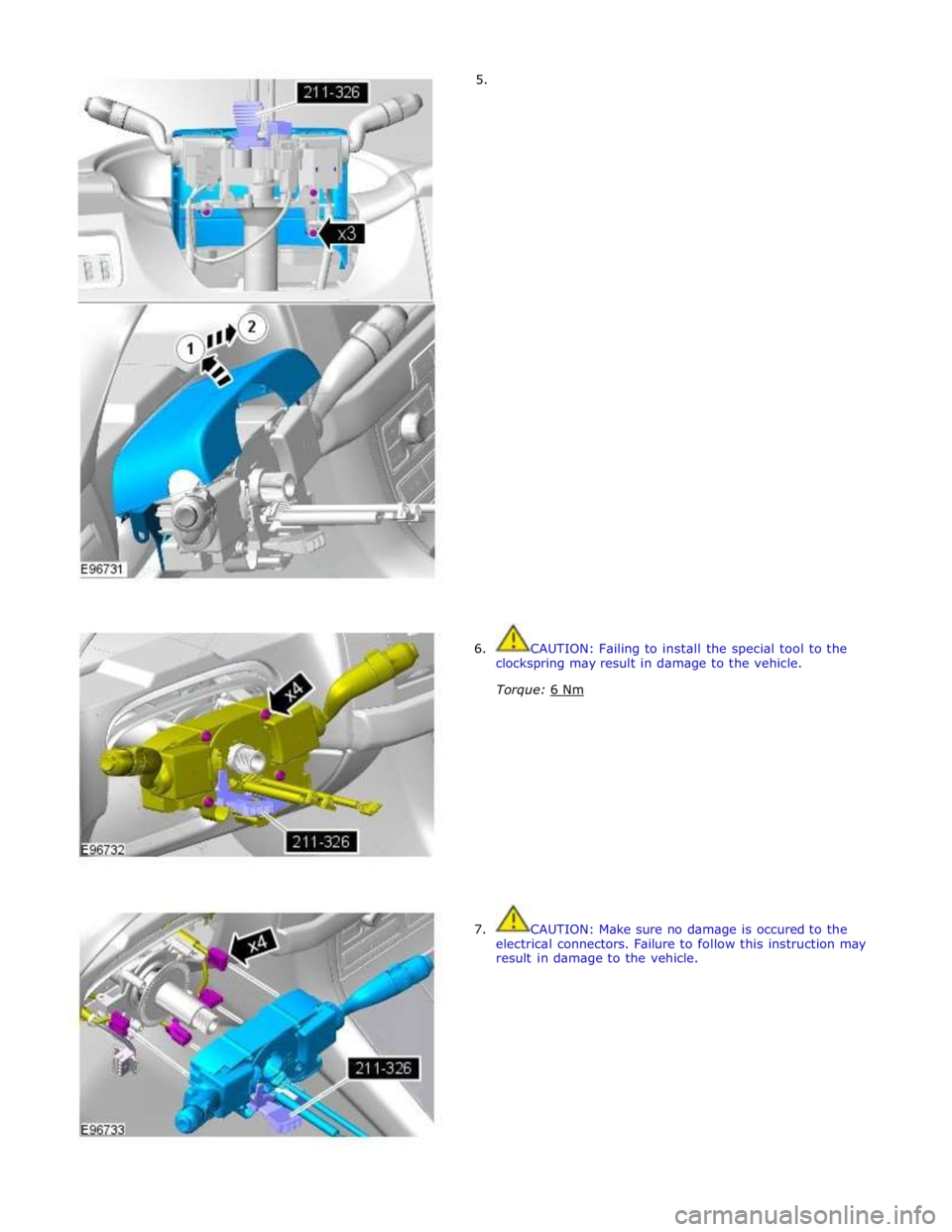
7. CAUTION: Make sure no damage is occured to the
electrical connectors. Failure to follow this instruction may
result in damage to the vehicle.
Page 2638 of 3039
Published: 11-May-2011
Supplemental Restraint System - Occupant Classification Sensor
Removal and Installation
Removal
WARNINGS:
To avoid accidental deployment, the restraints control module backup power supply must be depleted. Wait at least one
minute after disconnecting the battery ground cable(s) before commencing any repair or adjustment to the supplemental
restraint system (SRS), or any component(s) adjacent to the SRS sensors. Failure to follow these instructions may result in
personal injury.
Always wear safety glasses when working on an air bag equipped vehicle and when handling an air bag module. Failure to
follow this instruction may result in personal injury.
To minimize the possibility of premature deployment, do not use radio key code savers when working on the
supplemental restraint system. Failure to follow this instruction may result in personal injury.
To minimize the possibility of injury in the event of premature deployment, always carry a live air bag module with the
bag and trim cover pointed away from the body. Failure to follow this instruction may result in personal injury.
To minimize the possibility of premature deployment, live air bag modules must only be placed on work benches which
have been ground bonded and with the trim cover facing up. Failure to follow these instructions may result in personal injury.
Never probe the electrical connectors of air bag modules or any other supplemental restraint system component. Failure
to follow this instruction may result in personal injury.
Painting over the driver air bag module trim cover or instrument panel could lead to deterioration of the trim cover and air
bags. Do not for any reason attempt to paint discoloured or damaged air bag module trim covers or instrument panel. Install a
new component. Failure to follow this instruction may result in personal injury.
CAUTIONS:
The front passenger seat occupant classification sensor is available only as a service kit. No attempt should be made to
replace individual components. Failure to follow this instruction may result in personal injury.
Check for correct operation of the front seat after completion of the procedure to make sure that the wiring harness has
not become trapped or stretched.
NOTES:
Note the routing of the seat harness.
Some variation in the illustrations may occur, but the essential information is always correct.
1. Make the air bag supplemental restraint system (SRS) safe.
Refer to: Standard Workshop Practices (100-00 General Information, Description and Operation).
2. Refer to: Battery Disconnect and Connect (414-01 Battery, Mounting and Cables, General Procedures).
3. Refer to: Front Seat Backrest Cover (501-10 Seating, Removal and Installation).
Page 2639 of 3039
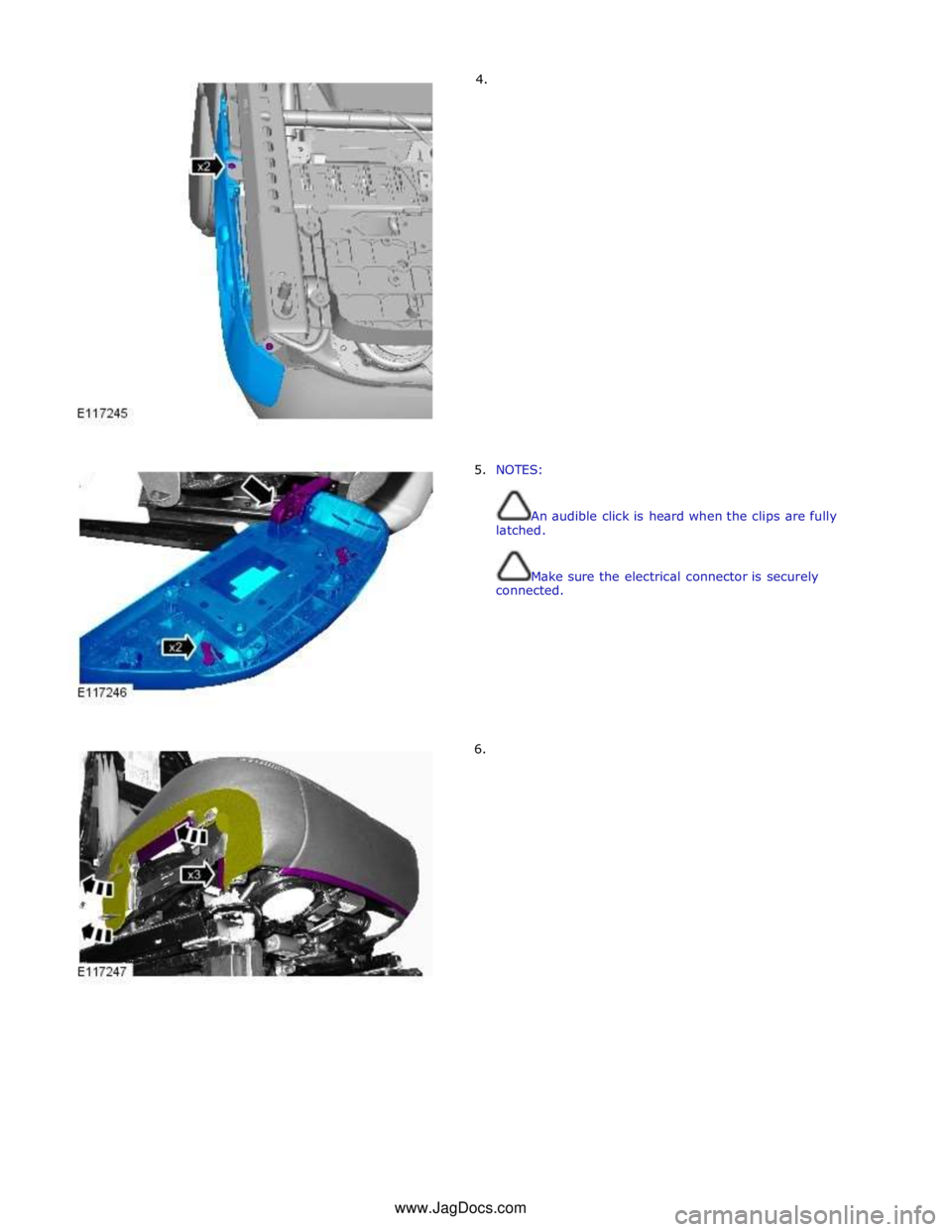
4.
5. NOTES:
An audible click is heard when the clips are fully
latched.
Make sure the electrical connector is securely
connected.
6. www.JagDocs.com
Page 2644 of 3039
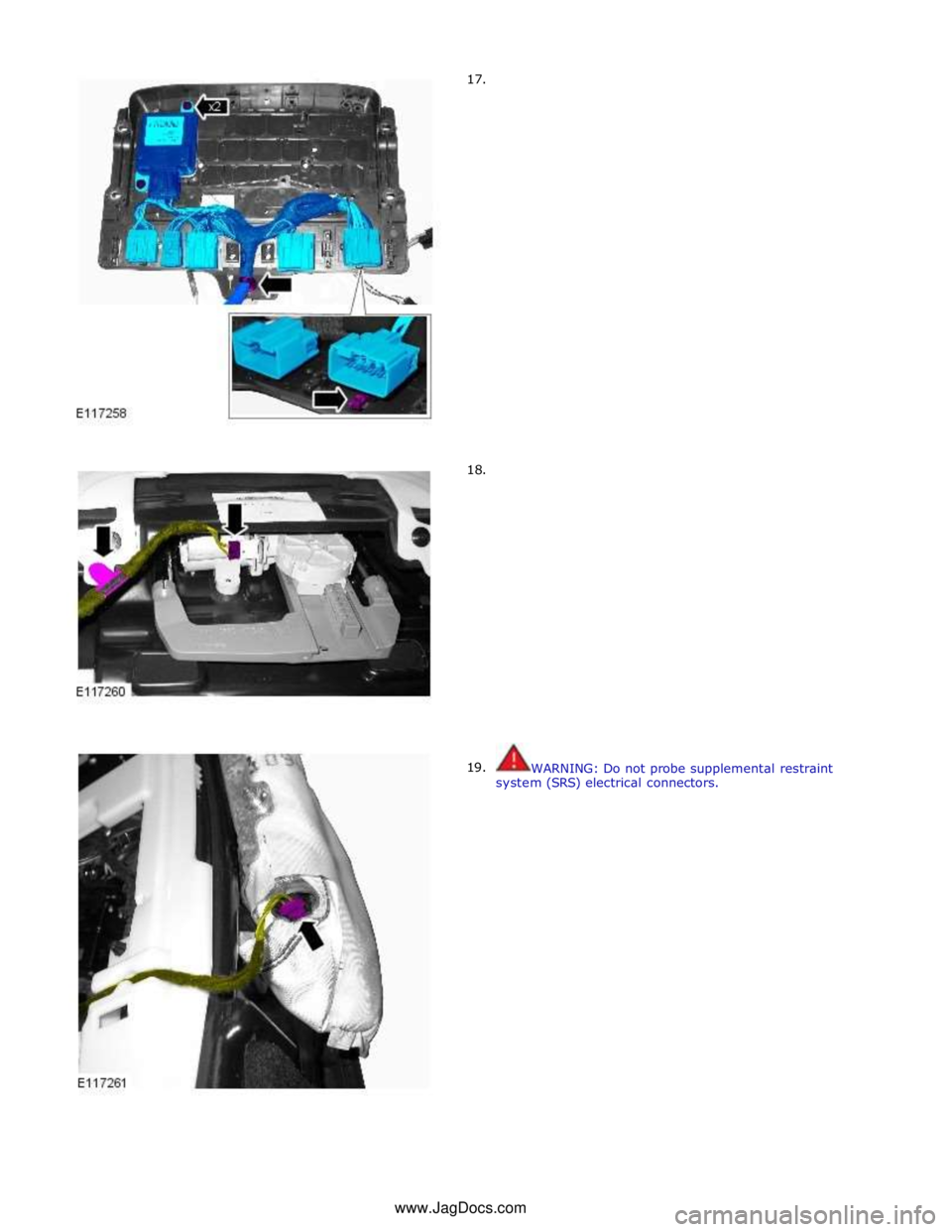
17.
18.
19.
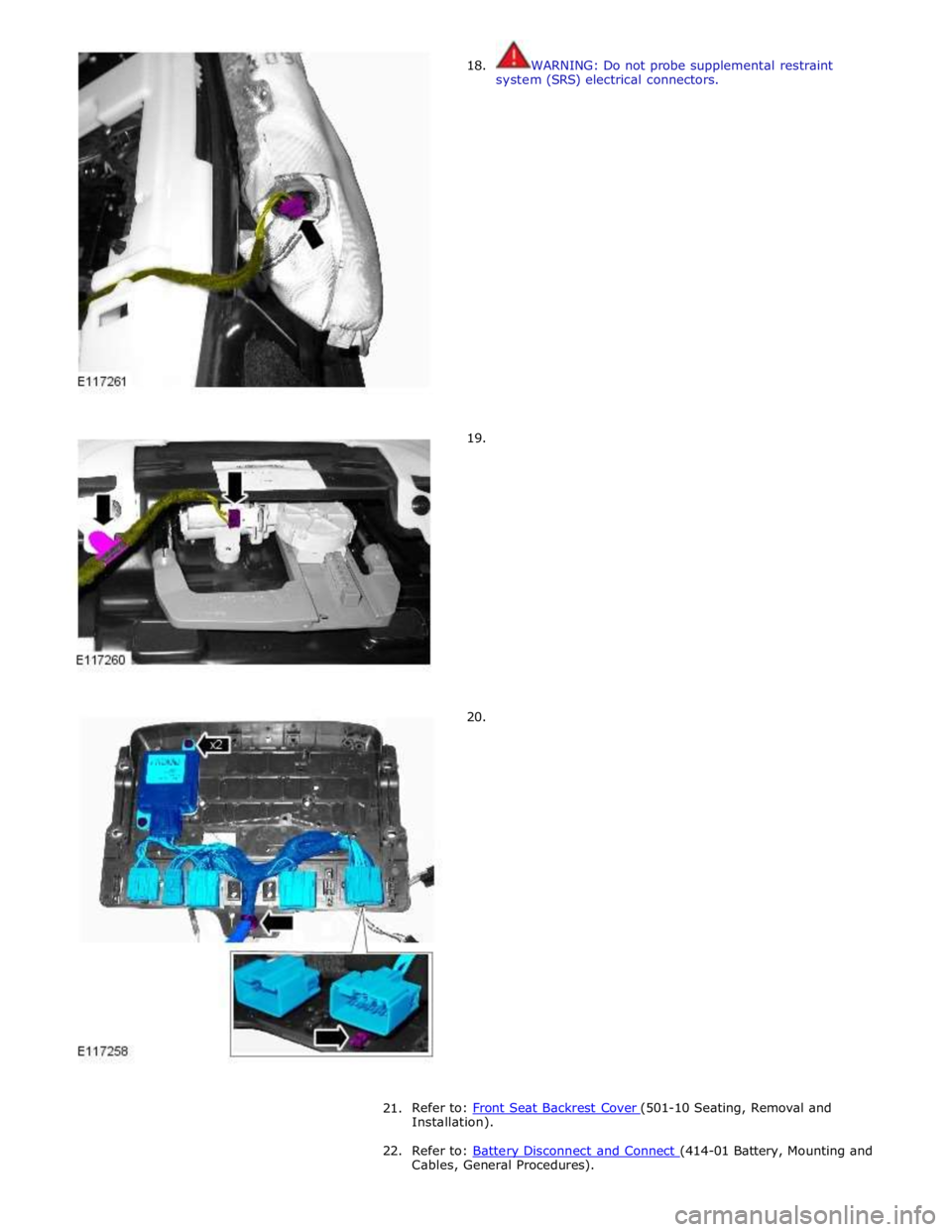
WARNING: Do not probe supplemental restraint
system (SRS) electrical connectors. www.JagDocs.com
Page 2650 of 3039
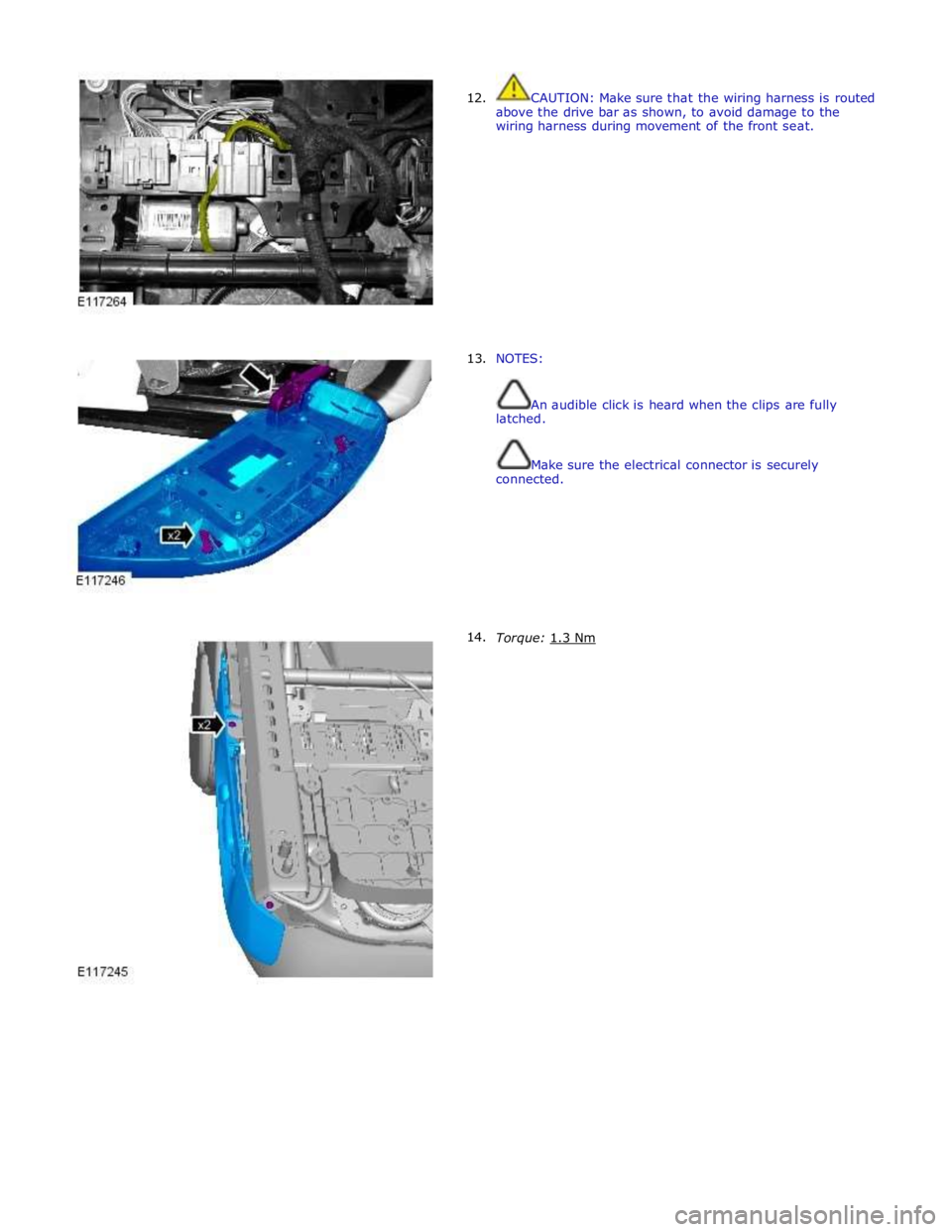
12.
13.
14. CAUTION: Make sure that the wiring harness is routed
above the drive bar as shown, to avoid damage to the
wiring harness during movement of the front seat.
NOTES:
An audible click is heard when the clips are fully
latched.
Make sure the electrical connector is securely
connected.
Torque: 1.3 Nm
Page 2652 of 3039
18.
19.
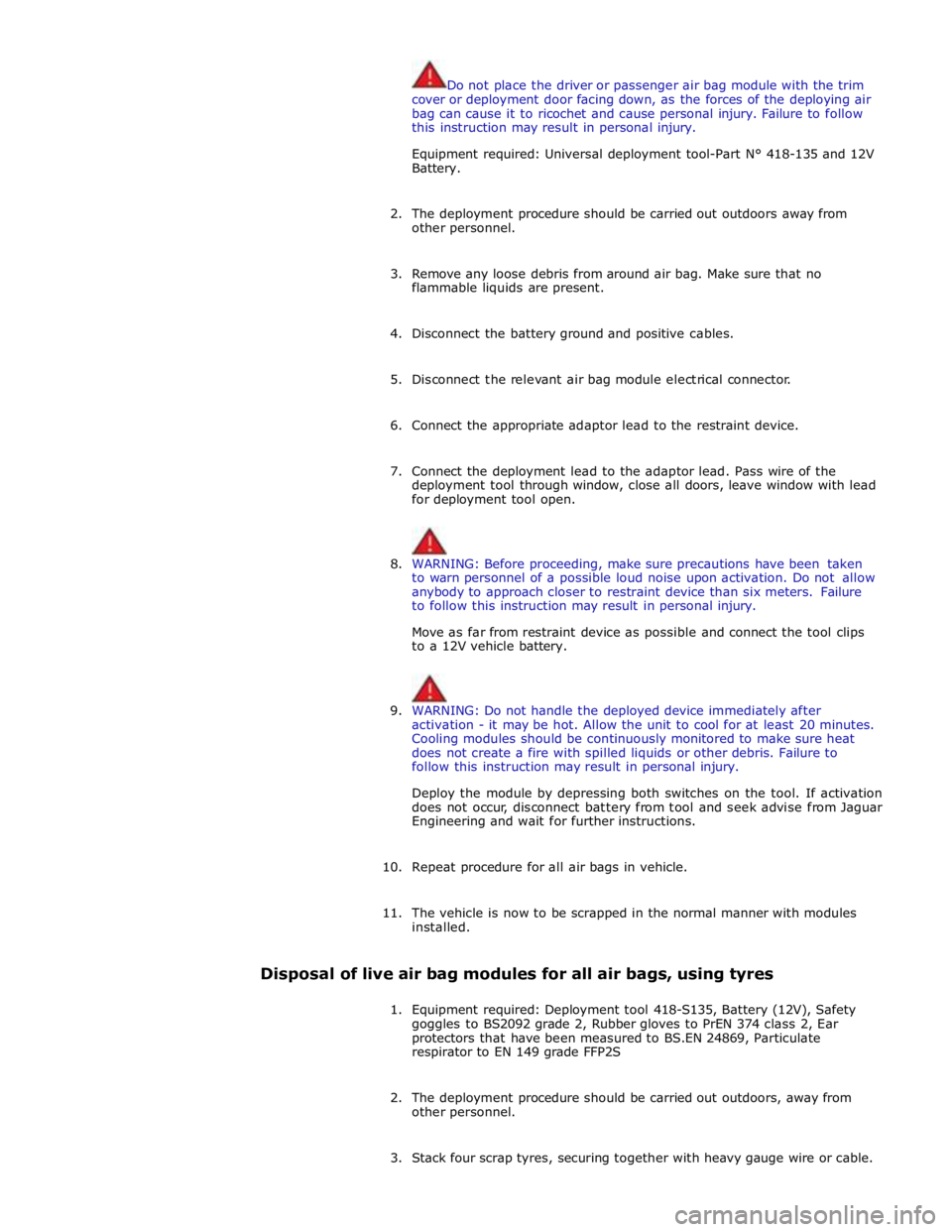
20. WARNING: Do not probe supplemental restraint
system (SRS) electrical connectors.
21.
Refer to: Front Seat Backrest Cover (501-10 Seating, Removal and Installation).
22. Refer to: Battery Disconnect and Connect (414-01 Battery, Mounting and Cables, General Procedures).