2010 JAGUAR XFR air condition
[x] Cancel search: air conditionPage 459 of 3039
C10: CHECK THE INITIATOR CIRCUIT FOR HIGH RESISTANCE 1 Measure the resistance between: C3MC39A, harness side C1MC41, harness side Pin 15 Pin 1 Is the resistance greater than 5 ohms?
Yes
REPAIR the high resistance circuit. This circuit contains
intermediate connector, C13-B. For additional information, refer to
the wiring diagram. Clear the DTC and run an On Demand Self Test
(ODST) using the manufacturer approved diagnostic system to
confirm rectification.
No
INSTALL a new right hand front low-frequency initiator. REFER to:
Tire Pressure Monitoring System (TPMS) Front Antenna (204-04 Wheels and Tires, Removal and Installation).
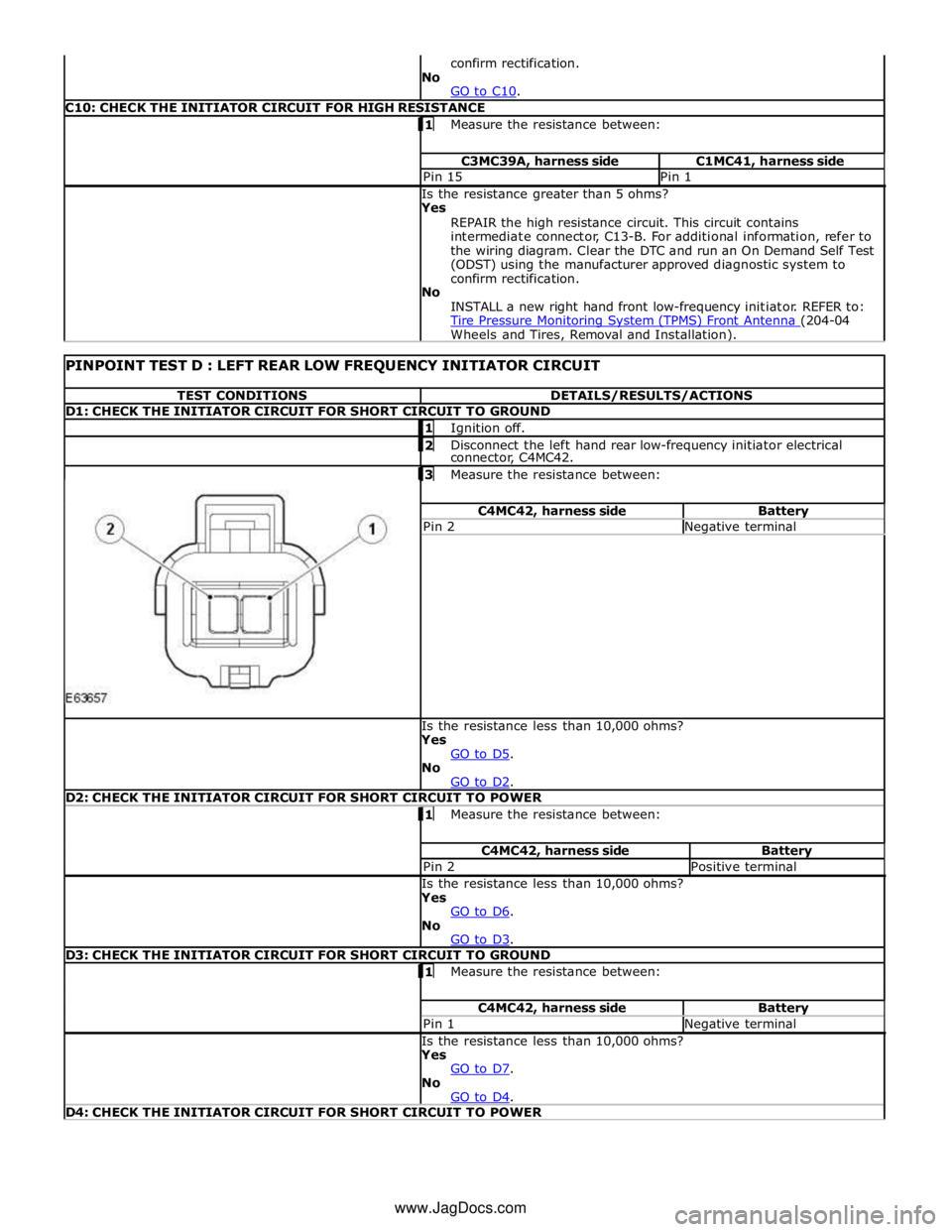
PINPOINT TEST D : LEFT REAR LOW FREQUENCY INITIATOR CIRCUIT TEST CONDITIONS DETAILS/RESULTS/ACTIONS D1: CHECK THE INITIATOR CIRCUIT FOR SHORT CIRCUIT TO GROUND 1 Ignition off. 2 Disconnect the left hand rear low-frequency initiator electrical connector, C4MC42.
3 Measure the resistance between: C4MC42, harness side Battery Pin 2 Negative terminal Is the resistance less than 10,000 ohms?
Yes
GO to D5. No
GO to D2. D2: CHECK THE INITIATOR CIRCUIT FOR SHORT CIRCUIT TO POWER 1 Measure the resistance between: C4MC42, harness side Battery Pin 2 Positive terminal Is the resistance less than 10,000 ohms?
Yes
GO to D6. No
GO to D3. D3: CHECK THE INITIATOR CIRCUIT FOR SHORT CIRCUIT TO GROUND 1 Measure the resistance between: C4MC42, harness side Battery Pin 1 Negative terminal Is the resistance less than 10,000 ohms?
Yes
GO to D7. No
GO to D4. D4: CHECK THE INITIATOR CIRCUIT FOR SHORT CIRCUIT TO POWER www.JagDocs.com
Page 462 of 3039
Measure the resistance between: C3MC39A, harness side C4MC42, harness side Pin 5 Pin 1 Is the resistance greater than 5 ohms?
Yes
REPAIR the high resistance circuit. This circuit contains
intermediate connector, C44-W. For additional information, refer to
the wiring diagram. Clear the DTC and run an On Demand Self Test
(ODST) using the manufacturer approved diagnostic system to
confirm rectification.
No
INSTALL a new rear left hand low-frequency initiator. REFER to:
Tire Pressure Monitoring System (TPMS) Rear Antenna (204-04 Wheels and Tires, Removal and Installation).
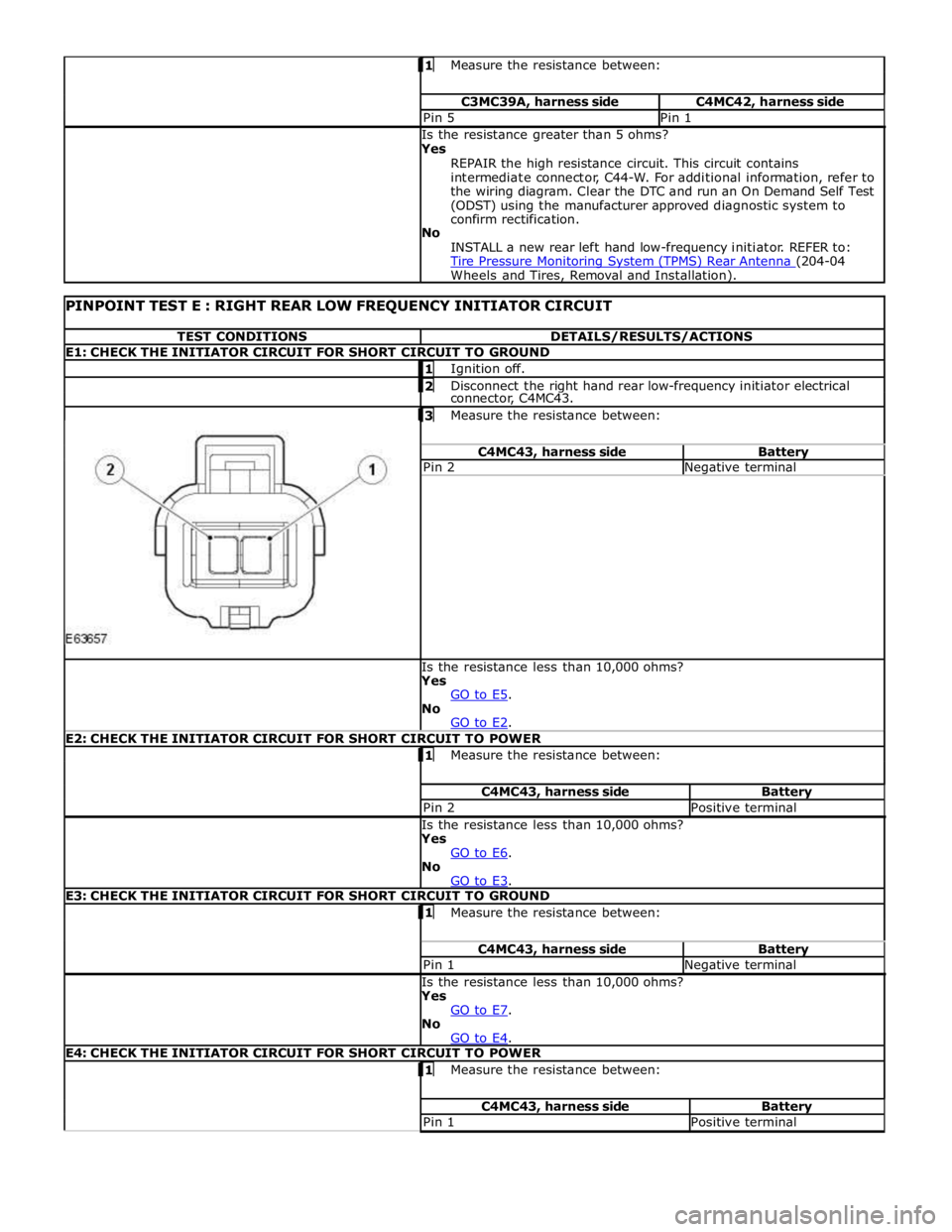
PINPOINT TEST E : RIGHT REAR LOW FREQUENCY INITIATOR CIRCUIT TEST CONDITIONS DETAILS/RESULTS/ACTIONS E1: CHECK THE INITIATOR CIRCUIT FOR SHORT CIRCUIT TO GROUND 1 Ignition off. 2 Disconnect the right hand rear low-frequency initiator electrical connector, C4MC43.
3 Measure the resistance between: C4MC43, harness side Battery Pin 2 Negative terminal Is the resistance less than 10,000 ohms?
Yes
GO to E5. No
GO to E2. E2: CHECK THE INITIATOR CIRCUIT FOR SHORT CIRCUIT TO POWER 1 Measure the resistance between: C4MC43, harness side Battery Pin 2 Positive terminal Is the resistance less than 10,000 ohms?
Yes
GO to E6. No
GO to E3. E3: CHECK THE INITIATOR CIRCUIT FOR SHORT CIRCUIT TO GROUND 1 Measure the resistance between: C4MC43, harness side Battery Pin 1 Negative terminal Is the resistance less than 10,000 ohms?
Yes
GO to E7. No
GO to E4. E4: CHECK THE INITIATOR CIRCUIT FOR SHORT CIRCUIT TO POWER 1 Measure the resistance between: C4MC43, harness side Battery Pin 1 Positive terminal
Page 465 of 3039

Measure the resistance between: C3MC39A, harness side C4MC43, harness side Pin 7 Pin 1 Is the resistance greater than 5 ohms?
Yes
REPAIR the high resistance circuit. This circuit contains
intermediate connector, C44-Y. For additional information, refer to
the wiring diagram. Clear the DTC and run an On Demand Self Test
(ODST) using the manufacturer approved diagnostic system to
confirm rectification.
No
INSTALL a new rear right hand low-frequency initiator. REFER to:
Tire Pressure Monitoring System (TPMS) Rear Antenna (204-04 Wheels and Tires, Removal and Installation).
PINPOINT TEST F : MISSING, INCOMPATIBLE OR DEFECTIVE RUNNING TIRE LOW PRESSURE SENSOR
OR RECEIVER TEST
CONDITIONS DETAILS/RESULTS/ACTIONS F1: CHECK FOR CORRECT WHEEL AND TIRE ASSEMBLY AND TIRE LOW PRESSURE SENSOR 1 Establish that a full size running wheel and tire assembly has a tire low pressure sensor installed. As a visual confirmation, a tire low pressure sensor has a metal valve stem rather than a rubber one and
cannot be installed to a mini/space saver spare wheel. Is a full size wheel and tire assembly with tire low pressure sensor installed?
Yes
GO to F2. No
Install the correct wheel and tire assembly or tire low pressure sensor, of correct frequency, in accordance
with that defined in the manufacturer approved diagnostic system new tire low pressure sensor
application. F2: CHECK FOR ADDITIONAL DTCS 1 Remove the Tire Pressure Monitoring System power supply fuse and re-install it. Clear DTCs and leave the vehicle stationary for 15 minutes, then drive it at a speed greater than 15.5 mph (25 kph)
continuously for at least 10 minutes.
(Note: If the vehicle speed drops below this value, the drive time to complete the test will need to be increased.)
The use of the manufacturer approved diagnostic system, and the datalogger signal ’Tire pressure
monitor system status – learn mode status’ will verify the completion of the test when the value returns
to ‘Inactive’. 2 Check for additional DTCs C1A5631, C1A5831, C1A6031, C1A6231, with identical time stamps. Have all four DTCs logged with identical time stamps in the tire pressure monitoring system module?
Yes
Replace the tire pressure monitoring system radio frequency receiver.
REFER to: Tire Pressure Monitoring System (TPMS) Receiver (204-04 Wheels and Tires, Removal and Installation).
No
GO to F3. F3: VERIFY THE POSITION OF THE DEFECTIVE TIRE LOW PRESSURE SENSOR 1 Check tire pressure monitoring system DTCs. Are any C1AXX31 DTCs logged?
Yes
Install the correct tire low pressure sensor, of correct frequency, in accordance with that defined in the
manufacturer approved diagnostic system new tire low pressure sensor application, to the position
identified by the logged DTC.
REFER to: Tire Low Pressure Sensor (204-04 Wheels and Tires, Removal and Installation). No
No further action is required.
(Note: The use of the manufacturer approved diagnostic system, and the datalogger signal ’Tire pressure monitor system status – learn completed successfully’ will verify the successful completion of the test.)
PINPOINT TEST G : LOCALIZATION FAILURE TEST
CONDITIONS DETAILS/RESULTS/ACTIONS G1: CHECK FOR ADDITIONAL DTCS 1 Check for additional DTCs: C1A5711, C1A5712, C1A5713. C1A5911, C1A5912, C1A5913, C1A6111, C1A6112, C1A6113, C1A6311, C1A6312, C1A6313. Are any of the DTCs listed above also logged?
Yes
Refer to the DTC Index and remedial actions.
No
GO to G2. G2: CHECK FOR ADDITIONAL DTCS
Page 466 of 3039

1 Check for additional DTCs: C1A5631, C1A5831, C1A6031 or C1A6231 Is a C1A5631, C1A5831, C1A6031 or C1A6231 DTC also logged?
Yes
Refer to the DTC Index and remedial actions.
No
GO to G3. G3: CHECK INITIATOR INSTALLATION 1 Check for correct installation of Initiator. REFER to: (204-04 Wheels and Tires) Tire Pressure Monitoring System (TPMS) Front Antenna (Removal and Installation), Tire Pressure Monitoring System (TPMS) Rear Antenna (Removal and Installation). Is the Initiator correctly installed?
Yes
GO to G4. No
Rectify as required. REFER to: (204-04 Wheels and Tires)
Tire Pressure Monitoring System (TPMS) Front Antenna (Removal and Installation), Tire Pressure Monitoring System (TPMS) Rear Antenna (Removal and Installation). G4: CHECK FOR SHORT CIRCUIT IN INITIATOR HARNESS 1 Locate and remove module blue connector L. 2 Measure the resistance across the relevant initiator circuits within the blue connector. Is the resistance less than 1 Ohm?
Yes
A value of less than 1 Ohm indicates a short circuit, rectify the short circuit as required.
No
Install the correct tire low pressure sensor, of correct frequency, in accordance with that defined in the
manufacturer approved diagnostic system new tire low pressure sensor application, to the position
identified by the logged DTC.
REFER to: Tire Low Pressure Sensor (204-04 Wheels and Tires, Removal and Installation).
PINPOINT TEST H : SPARE TIRE LOW PRESSURE SENSOR NO OPERATION TEST
CONDITIONS DETAILS/RESULTS/ACTIONS H1: ESTABLISH THE TYPE OF SPARE WHEEL AND TIRE ASSEMBLY INSTALLED 1 Establish the type of spare wheel and tire assembly Installed. Is the spare wheel a mini/space saver type? Yes
Tire low pressure sensors are not installed to mini/space-saver spare wheels. Tire low pressure sensors
are installed to full size spare wheels only. The DTC is to be ignored and no repair action is required.
No
GO to H2. H2: ESTABLISH THAT THE SPARE WHEEL HAS A TIRE LOW PRESSURE SENSOR INSTALLED 1 Establish that the spare wheel has a tire low pressure sensor installed, considering the following additional information:
a) As a visual confirmation, the tire low pressure sensor has a metal valve stem rather than a rubber
one. Is a tire low pressure sensor installed? Yes
GO to H3. No
A new spare tire low pressure sensor should be installed. Note: Refer to the note above the DTC index
about replacing components which may remain under manufacturer warranty. Refer to the relevant section
of the workshop manual. H3: CONFIRM OPERATION OF THE SPARE WHEEL PRESSURE SENSOR 1 Deflate the spare tire, in close proximity to the vehicle, until it is completely deflated. 2 Complete an ignition cycle to ignition on and verify that the instrument cluster reports a spare tire pressure warning for approximately 20 seconds. 3 Re-inflate the spare tire, in close proximity to the vehicle, to the recommended spare tire pressure. 4 Complete an ignition cycle to ignition on and verify that the instrument cluster no longer reports a spare tire pressure warning. Does the instrument cluster continue to report a spare tire pressure warning? Yes
GO to H4. No
No repair action is required. It is possible that the customer may have placed items in the vehicle's luggage compartment that prevented correct RF reception. H4: VERIFY THAT THE SPARE TIRE LOW PRESSURE SENSOR ID HAS BEEN CORRECTLY PROGRAMMED TO THE
MODULE 1 Remove tire low pressure sensor. Record the 8 character hexadecimal ID written on the casing. 2 Use the approved diagnostic system to read the spare tire sensor ID from the module. Refer to the relevant procedure in the workshop manual. 3 Compare the IDs from steps 1 & 2.
Page 467 of 3039

TEST CONDITIONS DETAILS/RESULTS/ACTIONS I1: C1D1912 VERIFY EXTERNAL RECEIVER DATA LINE CIRCUIT SHORT TO POWER 1 Ignition off. 2 Disconnect the Tire Pressure Monitoring System Receiver electrical connector, C3MC45. 3 Measure the resistance between C3MC45, harness side Battery Pin 1 Positive terminal Is the resistance less than 5 Ohms?
Yes
GO to I2. No
GO to I3. I2: C1D1912 CHECK THE EXTERNAL RECEIVER DATA LINE CIRCUIT FOR SHORT CIRCUIT TO POWER 1 Disconnect the Tire Pressure Monitoring System Control Module electrical connector, C3MC39B. 2 Measure the resistance between C3MC45, harness side Battery Pin 1 Positive terminal Is the resistance less than 5 Ohms?
Yes
REPAIR the short circuit in wiring harness.
No
GO to I4. I3: C1D1912 CHECK THE TIRE PRESSURE MONITORING SYSTEM EXTERNAL RECEIVER FOR SHORT CIRCUIT TO
POWER 1 Reconnect the Tire Pressure Monitoring System Receiver electrical connector, C3MC45. 2 Using manufacturer approved diagnostic system run On Demand Self Test (0x0202). Is the DTC C1D1912 set?
Yes
Replace Tire Pressure Monitoring Receiver.
No
Investigate possible cause of intermittent failure. I4: C1D1912 CHECK THE TIRE PRESSURE MONITORING SYSTEM CONTROL MODULE FOR SHORT CIRCUIT TO POWER 1 Reconnect the Tire Pressure Monitoring System Control Module electrical connector, C3MC39B. 2 Reconnect the Tire Pressure Monitoring System Receiver electrical connector, C3MC45. 3 Using manufacturer approved diagnostic system run On Demand Self Test (0x0202). Is the DTC C1D1912 set?
Yes
Replace Tire Pressure Monitoring System Control Module.
No
Investigate possible cause of intermittent failure.
PINPOINT TEST J : C1D1987 TIRE PRESSURE MONITORING SYSTEM EXTERNAL RECEIVER DATA LINE
MISSING MESSAGE TEST
CONDITIONS DETAILS/RESULTS/ACTIONS J1: C1D1987 VERIFY EXTERNAL RECEIVER DATA LINE MISSING MESSAGE 1 Using manufacturer approved diagnostic system run On Demand Self Test (0x0202). Is the DTC C1D1987 set? Yes
GO to J2. No
GO to J5. J2: C1D1987 CHECK EXTERNAL RECEIVER DATA LINE CIRCUIT Do the IDs match?
Yes
Replace the spare tire low pressure sensor. Refer to the relevant installation section in the workshop
manual.
The identification for the sensor must be programmed into the tire pressure monitoring system module
using the manufacturer approved diagnostic system. The identification code is provided on a label with
the complete assembly and is also printed on the casing of each sensor.
No
Program the spare tire sensor ID, recorded in step 1, to the module using the approved diagnostic
system. The identification code is provided on a label with the complete assembly and is also printed on
the casing of each sensor.
Repeat test to ensure correct operation.GO to H3.
Page 499 of 3039

Driveline System - General Information - Driveline System
Diagnosis and Testing
Principle of Operation Published: 11-May-2011
For a detailed description of driveline operation, refer to the relevant Description and Operation section in the workshop
manual. REFER to:
Driveshaft (205-01 Driveshaft, Description and Operation), Driveshaft (205-01 Driveshaft, Description and Operation), Driveshaft (205-01 Driveshaft, Description and Operation), Rear Drive Axle and Differential (205-02, Description and Operation),
Rear Drive Axle and Differential (205-02, Description and Operation),
Rear Drive Axle and Differential (205-02, Description and Operation),
Rear Drive Halfshafts (205-05 Rear Drive Halfshafts, Description and Operation), Rear Drive Halfshafts (205-05 Rear Drive Halfshafts, Description and Operation), Rear Drive Halfshafts (205-05 Rear Drive Halfshafts, Description and Operation).
Inspection and Verification
CAUTION: Only serviceable items can be renewed or adjusted. Failure to follow this instruction may result in the warranty
of the component being rejected.
Certain driveline trouble symptoms are also common to the engine, transmission, wheel bearings, tires, and other parts of the
vehicle. For this reason, make sure that the cause of the trouble is in the driveline before adjusting, repairing, or installing any
new components. For additional information, refer to Workshop Manual section 100-04 Noise, Vibration and Harshness.
1. Verify the customer concern by carrying out a road test of the vehicle.
2. Visually inspect for obvious signs of mechanical damage and system integrity.
3. If an obvious cause for an observed or reported concern is found, correct the cause (if possible) before proceeding to
the next step.
4. If the concern is not visually evident, verify the symptom and refer to the Symptom Chart.
Identify the Condition
Gear Howl and Whine
Howling or whining of the ring gear and pinion is due to an incorrect gear pattern, gear damage or incorrect bearing preload.
Bearing Whine
Bearing whine is a high-pitched sound similar to a whistle. It is usually caused by worn/damaged pinion bearings, which are
operating at driveshaft speed. Bearing noise occurs at all driving speeds. This distinguishes it from gear whine which is speed
dependent.
As noted, pinion bearings make a high-pitched, whistling noise, usually at all speeds. If however there is only one pinion
bearing that is worn/damaged, the noise may vary in different driving phases.
A wheel bearing noise can be mistaken for a pinion bearing noise.
Chuckle
Chuckle that occurs on the coast driving phase is usually caused by excessive clearance between the differential gear hub and
the differential case bore. www.JagDocs.com
Page 501 of 3039

Clunk
Clunk is a metallic noise heard when the automatic transmission is engaged in REVERSE or DRIVE. The noise may also occur
when the throttle is applied or released. Clunk is caused by transmission calibration, backlash in the driveline or loose
suspension components and is felt or heard in the vicinity of the rear drive axle.
Bearing Rumble
Bearing rumble sounds like marbles being tumbled. This condition is usually caused by a worn/damaged wheel bearing. The
lower pitch is because the wheel bearing turns at only about one-third of the driveshaft speed. Wheel bearing noise also may
be high-pitched, similar to gear noise, but will be evident in all four driving modes.
Symptom Chart
Symptom Possible Cause Action Noise is at constant tone over
a narrow vehicle speed range.
Usually heard on light drive
and coast conditions
Rear drive axle
For additional information, GO to Pinpoint
Test A. Noise is the same on drive or
coast
Road
Worn or damaged driveshaft joint
Driveshaft center bearing
Wheel bearing
No action required for road noise
Install new components as required Noise is produced with the
vehicle standing and driving
Engine
Transmission
For additional information, REFER to:
Engine - 3.0L/4.2L (303-00 Engine System - General Information, Diagnosis and Testing),
Engine - 2.7L Diesel (303-00 Engine System - General Information, Diagnosis and Testing),
Diagnostic Strategy (307-01A Automatic Transmission/Transaxle - V6 3.0L Petrol,
Diagnosis and Testing). Loud clunk in the driveline
when shifting from reverse to
forward
Transmission calibration
Transmission Mount
Transmission
Suspension components
Backlash in the driveline
Engine idle speed set too high
Engine mount
Using the Manufacturer approved diagnostic
system, re-configure the Transmission
Control Module (TCM) with the latest
available calibration
Inspect and install new transmission mounts
as required
For additional transmission information,
REFER to: Diagnostic Strategy (307-01A Automatic Transmission/Transaxle - V6 3.0L
Petrol, Diagnosis and Testing).
Inspect and install new suspension
components as required
Inspect and install new driveline components
as required
Check and adjust the idle speed as required
Inspect and install new engine mounts as
required Clicking, popping, or grinding
noises
Inadequate or contaminated
lubrication in the rear drive
halfshaft constant velocity (CV)
joint
Another component contacting the
Inspect, clean and lubricate with new grease
as required
Inspect and repair as required
Inspect and install new components as
required
Page 583 of 3039

If the concern becomes evident during this check, verify it fits the description given before the road test. If the concern is not
evident, attempt to duplicate the condition using the information from the description.
If a concern exists, use the Symptom Chart in order to isolate it to a specific sub-system and condition description. From this
description, a list of possible sources can be used to further narrow the cause to a specific component or condition.
Symptom Chart
Symptom Possible Cause Action Brakes noisy
Brake pads
Brake discs GO to Pinpoint Test A. Vibration when brakes are
applied
Wheels/tires out of balance
Wheel hub nuts loose
Brake caliper mounting bolts loose
Brake pads
Foreign material/scratches/corrosion
on brake disc contact surfaces
Excessive brake disc thickness
variation
Excessive brake disc runout
Wheel bearing wear or failure
Suspension bushing wear or failure
Steering bushing wear or failure GO to Pinpoint Test B. The brakes pull or drift
Tire pressures/wear
Brake calipers
Brake pads
Brake discs
Wheel alignment adjustment
Wheel bearing
Suspension bushings and ball joints GO to Pinpoint Test C. The pedal feels spongy
Air in brake hydraulic system
Leak in hydraulic system
Brake booster/master cylinder
Brake pads GO to Pinpoint Test D. The pedal goes down fast
Air in brake hydraulic system
Leak in hydraulic system
Brake booster/master cylinder
Brake pads GO to Pinpoint Test E. The pedal goes down
slowly
Air in brake hydraulic system
Brake booster/master cylinder GO to Pinpoint Test F. Excessive brake pedal
effort required
Brake pads
Brake booster GO to Pinpoint Test G. Brake lockup during light
brake pedal force
Brake pads
Brake calipers GO to Pinpoint Test H. Brakes drag
Parking brake control
applied/malfunction
Seized parking brake cables
Seized brake caliper slide pins
Seized brake caliper
Brake booster
Pedal gear GO to Pinpoint Test I. Excessive/Erratic brake
pedal travel
Hydraulic system
Brake pads Brake
discs
Hub and bearing assembly GO to Pinpoint Test J. The red brake warning
indicator is always on
Fluid level
Brake master cylinder fluid level
sensor
Parking brake control Fill the system to specification. Check for leaks.
Install a new brake master cylinder fluid reservoir as
required.
REFER to: Brake Fluid Reservoir (206-06 Hydraulic Brake Actuation, Removal and Installation).