Page 342 of 3039
Front Suspension - Front Lower Arm
Removal and Installation
Removal Published: 11-May-2011
1. WARNING: Do not work on or under a vehicle supported only by a
jack. Always support the vehicle on safety stands.
Raise and support the vehicle.
2. Remove the air deflector.
For additional information, refer to: Air Deflector (501-02 Front End Body Panels, Removal and Installation).
3. Remove the front wheel and tire.
For additional information, refer to: Wheel and Tire (204-04 Wheels and Tires, Removal and Installation).
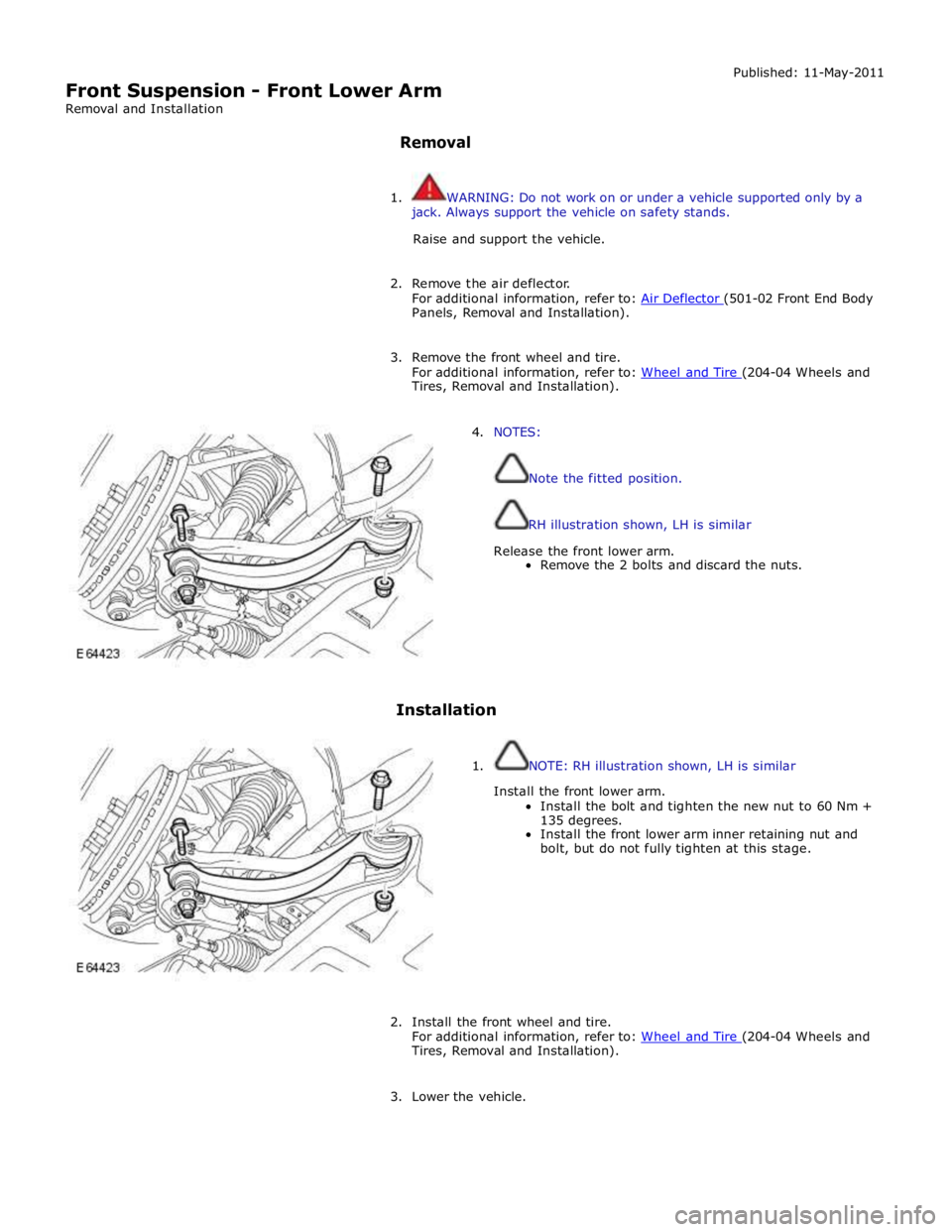
4. NOTES:
Note the fitted position.
RH illustration shown, LH is similar
Release the front lower arm.
Remove the 2 bolts and discard the nuts.
Installation
1. NOTE: RH illustration shown, LH is similar
Install the front lower arm.
Install the bolt and tighten the new nut to 60 Nm +
135 degrees.
Install the front lower arm inner retaining nut and
bolt, but do not fully tighten at this stage.
2. Install the front wheel and tire.
For additional information, refer to: Wheel and Tire (204-04 Wheels and Tires, Removal and Installation).
3. Lower the vehicle.
Page 349 of 3039
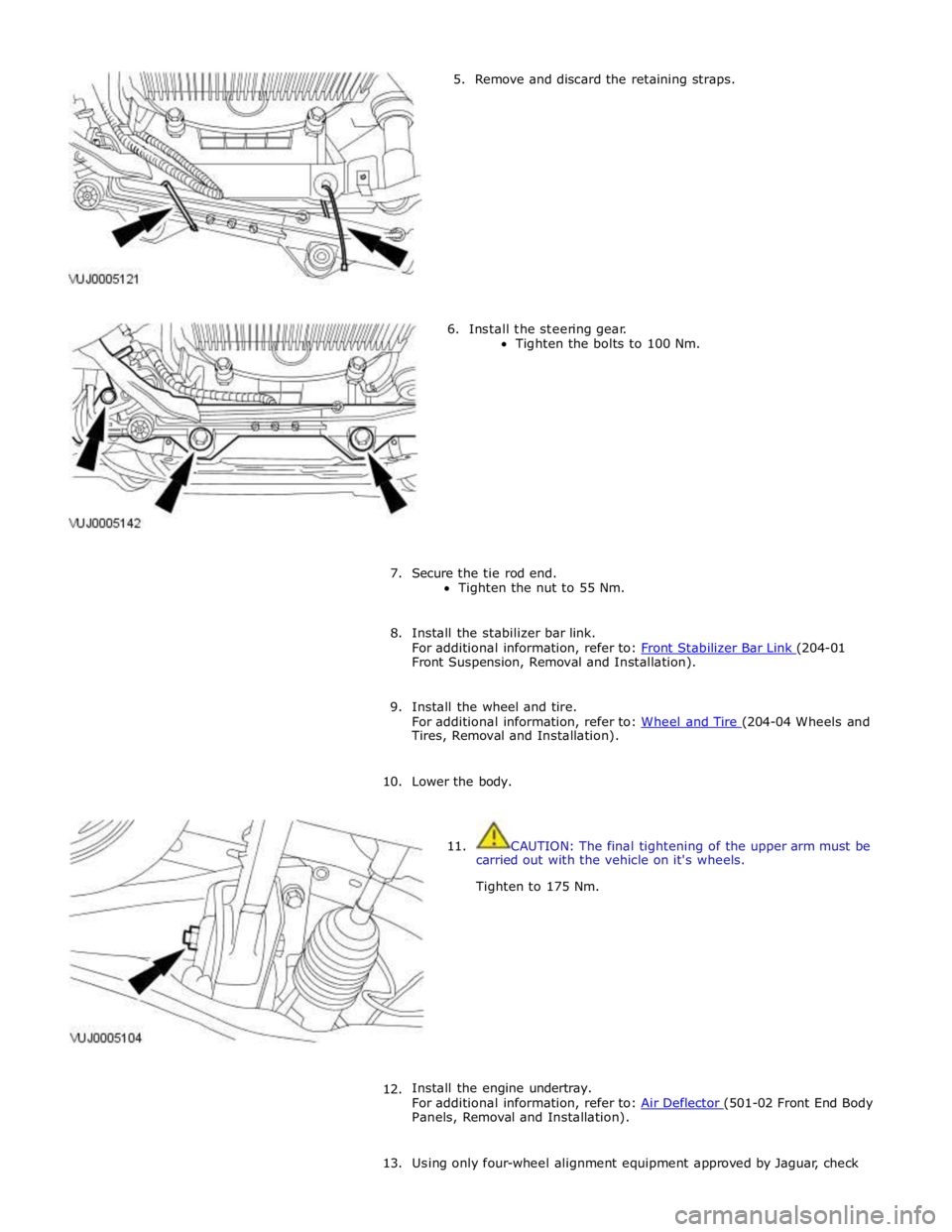
5. Remove and discard the retaining straps.
6. Install the steering gear.
Tighten the bolts to 100 Nm.
7. Secure the tie rod end.
Tighten the nut to 55 Nm.
8. Install the stabilizer bar link.
For additional information, refer to: Front Stabilizer Bar Link (204-01 Front Suspension, Removal and Installation).
9. Install the wheel and tire.
For additional information, refer to: Wheel and Tire (204-04 Wheels and Tires, Removal and Installation).
10. Lower the body.
11. CAUTION: The final tightening of the upper arm must be
carried out with the vehicle on it's wheels.
Tighten to 175 Nm.
12.
Install the engine undertray.
For additional information, refer to: Air Deflector (501-02 Front End Body Panels, Removal and Installation).
13. Using only four-wheel alignment equipment approved by Jaguar, check
Page 375 of 3039
7. CAUTIONS:
Discard the bolts.
Make sure that the area around the component is
clean and free of foreign material.
Do not attempt to release the wheel hub by hitting it
with a hammer directly, loosen the wheel hub retaining
bolts partially before applying an even amount of force to
the head of each bolts to release the wheel hub from the
wheel knuckle. Failure to follow this instruction may cause
damage to the component.
NOTES:
Some variation in the illustrations may occur, but the
essential information is always correct.
LH illustration shown, RH is similar.
Install the components to their original fitted
positions.
Torque: 90 Nm
Installation
1. To install, reverse the removal procedure. www.JagDocs.com
Page 400 of 3039
5. CAUTION: Do not allow the brake caliper to hang on the
brake hose.
NOTE: Make sure that new bolts are installed.
Release the rear brake caliper and tie aside.
6. Release the lower arm from the wheel hub assembly.
7. Remove the lower arm.
Installation
1. CAUTION: Nuts and bolts must be tightened with the
weight of the vehicle on the suspension.
Install the lower arm.
Page 401 of 3039
2. CAUTION: Nuts and bolts must be tightened with the
weight of the vehicle on the suspension.
Secure the lower arm to the wheel hub assembly.
3. CAUTION: Do not allow the brake caliper to hang on the
brake hose.
NOTE: Make sure that new bolts are installed.
Secure the rear brake caliper.
Tighten the bolts to 103 Nm.
4. Secure the rear stabilizer bar link.
Tighten the nut to 48 Nm.
5. CAUTION: Nuts and bolts must be tightened with the
weight of the vehicle on the suspension.
Secure the shock absorber and spring assembly to the lower
arm.
6. Install the wheel and tire.
For additional information, refer to: W heel and Tire (204-04 Wheels and Tires, Removal and Installation).
Page 413 of 3039
7. NOTE: Left-hand shown, right-hand similar.
Release the brake caliper.
Remove and discard the 2 bolts.
Tie the brake caliper aside.
8. NOTE: Left-hand shown, right-hand similar.
Disconnect the rear wheel speed sensor.
9. Disconnect the electronic parking brake actuator electrical
connector.
10. NOTE: Left-hand shown, right-hand similar.
Disconnect both parking brake cables from the rear brake
calipers.
Page 536 of 3039

60 Oil seal The multi-plate clutch is contained in a clutch basket attached to the differential carrier with the crown wheel securing bolts.
Alternate plates of the clutch pack are keyed to the clutch basket and the LH sun gear. A pressure disc is installed on the outer end of the clutch pack and keyed to the clutch basket. A thrust race on the end of the clutch basket incorporates lugs which
extend through the clutch basket onto the pressure disc.
The actuator assembly is mounted on bearings on the outboard end of the clutch basket, against the thrust race. The actuator
assembly consists of input and output actuators separated by five ball bearings. A locking pin in the cover engages with a slot
in the output actuator to prevent it turning, but allow it to move axially. The input actuator engages with the reduction gearbox
and is free to rotate relative to the cover. Ball bearings locate in curved grooves in the mating faces of the input and
output actuators. The bottom surface of each groove incorporates a ramp. Rotation of the input actuator forces the ball
bearings up the ramps in the grooves and induces an axial movement in the output actuator. The thrust race and pressure disc
transfer the axial movement from the output actuator to the clutch pack.
Item Description 1 Actuator 2 Multi-plate clutch 3 Differential The motor is a 12 V dc motor that adjusts the frictional loading of the multi-plate clutch, via the reduction gearbox and the
actuator assembly, under the control of the DLM. Adjusting the frictional loading of the multi-plate clutch adjusts the locking
torque between the crown wheel drive gear and the sun wheel.
Four bolts attach the motor to the reduction gearbox, which is located in position on the cover with two dowels, and secured
with four bolts. An O-ring seals the joint between the motor and the reduction gearbox.
The motor is driven by a 12 V dc feed direct from the DLM. The motor also incorporates the following connections with the
DLM:
A motor temperature sensor, to prevent excessive use from damaging the motor.
Two Hall effect motor position sensors, to enable closed loop control of the motor.
The temperature sensor provides a differential oil temperature signal to the DLM, to prevent excessive use from damaging the
multi-plate clutch.
Differential Locking Module (DLM)
The DLM controls operation of the electronic differential. The DLM is attached to a bracket located on the LH side of the luggage compartment, immediately forward of the fender tail lamp, behind the trim.
Page 583 of 3039

If the concern becomes evident during this check, verify it fits the description given before the road test. If the concern is not
evident, attempt to duplicate the condition using the information from the description.
If a concern exists, use the Symptom Chart in order to isolate it to a specific sub-system and condition description. From this
description, a list of possible sources can be used to further narrow the cause to a specific component or condition.
Symptom Chart
Symptom Possible Cause Action Brakes noisy
Brake pads
Brake discs GO to Pinpoint Test A. Vibration when brakes are
applied
Wheels/tires out of balance
Wheel hub nuts loose
Brake caliper mounting bolts loose
Brake pads
Foreign material/scratches/corrosion
on brake disc contact surfaces
Excessive brake disc thickness
variation
Excessive brake disc runout
Wheel bearing wear or failure
Suspension bushing wear or failure
Steering bushing wear or failure GO to Pinpoint Test B. The brakes pull or drift
Tire pressures/wear
Brake calipers
Brake pads
Brake discs
Wheel alignment adjustment
Wheel bearing
Suspension bushings and ball joints GO to Pinpoint Test C. The pedal feels spongy
Air in brake hydraulic system
Leak in hydraulic system
Brake booster/master cylinder
Brake pads GO to Pinpoint Test D. The pedal goes down fast
Air in brake hydraulic system
Leak in hydraulic system
Brake booster/master cylinder
Brake pads GO to Pinpoint Test E. The pedal goes down
slowly
Air in brake hydraulic system
Brake booster/master cylinder GO to Pinpoint Test F. Excessive brake pedal
effort required
Brake pads
Brake booster GO to Pinpoint Test G. Brake lockup during light
brake pedal force
Brake pads
Brake calipers GO to Pinpoint Test H. Brakes drag
Parking brake control
applied/malfunction
Seized parking brake cables
Seized brake caliper slide pins
Seized brake caliper
Brake booster
Pedal gear GO to Pinpoint Test I. Excessive/Erratic brake
pedal travel
Hydraulic system
Brake pads Brake
discs
Hub and bearing assembly GO to Pinpoint Test J. The red brake warning
indicator is always on
Fluid level
Brake master cylinder fluid level
sensor
Parking brake control Fill the system to specification. Check for leaks.
Install a new brake master cylinder fluid reservoir as
required.
REFER to: Brake Fluid Reservoir (206-06 Hydraulic Brake Actuation, Removal and Installation).