Page 1549 of 3039
Published: 11-May-2011
Exhaust System - V8 5.0L Petrol/V8 S/C 5.0L Petrol - Exhaust System
Diagnosis and Testing
Principle of Operation
For a detailed description of the exhaust system, refer to the relevant Description and Operation section of the workshop
manual. REFER to: (309-00C Exhaust System - V8 5.0L Petrol/V8 S/C 5.0L Petrol)
Exhaust System (Description and Operation), Exhaust System (Description and Operation), Exhaust System (Description and Operation).
Inspection and Verification
CAUTION: Diagnosis by substitution from a donor vehicle is NOT acceptable. Substitution of control modules does not
guarantee confirmation of a fault and may also cause additional faults in the vehicle being checked and/or the donor vehicle.
NOTE: Check and rectify basic faults before beginning diagnostic routines involving pinpoint tests.
1. Verify the customer concern.
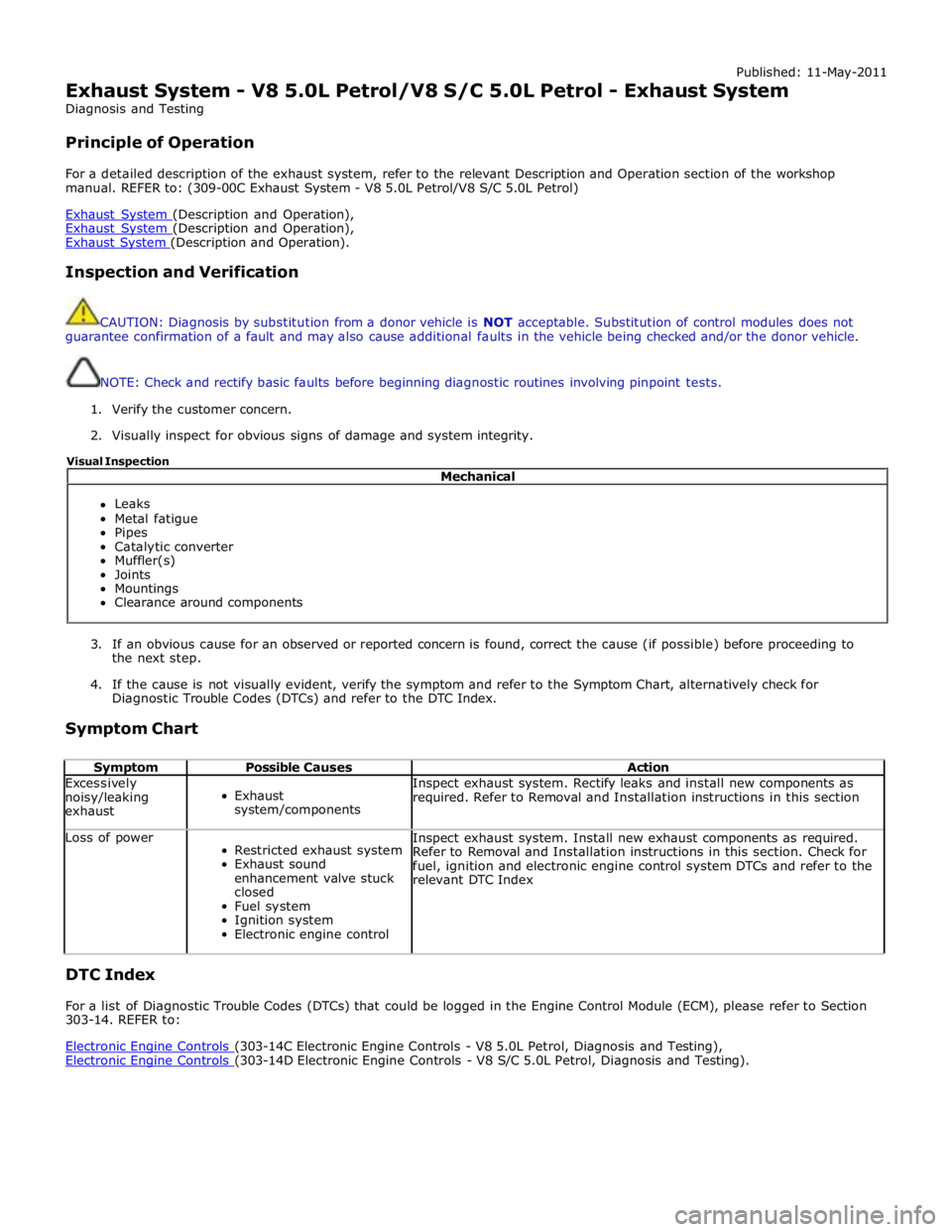
2. Visually inspect for obvious signs of damage and system integrity.
3. If an obvious cause for an observed or reported concern is found, correct the cause (if possible) before proceeding to
the next step.
4. If the cause is not visually evident, verify the symptom and refer to the Symptom Chart, alternatively check for
Diagnostic Trouble Codes (DTCs) and refer to the DTC Index.
Symptom Chart
Symptom Possible Causes Action Excessively
noisy/leaking
exhaust
Exhaust
system/components Inspect exhaust system. Rectify leaks and install new components as
required. Refer to Removal and Installation instructions in this section Loss of power
Restricted exhaust system
Exhaust sound
enhancement valve stuck
closed
Fuel system
Ignition system
Electronic engine control Inspect exhaust system. Install new exhaust components as required.
Refer to Removal and Installation instructions in this section. Check for
fuel, ignition and electronic engine control system DTCs and refer to the
relevant DTC Index
DTC Index
For a list of Diagnostic Trouble Codes (DTCs) that could be logged in the Engine Control Module (ECM), please refer to Section
303-14. REFER to:
Electronic Engine Controls (303-14C Electronic Engine Controls - V8 5.0L Petrol, Diagnosis and Testing), Electronic Engine Controls (303-14D Electronic Engine Controls - V8 S/C 5.0L Petrol, Diagnosis and Testing). Mechanical
Leaks
Metal fatigue
Pipes
Catalytic converter
Muffler(s)
Joints
Mountings
Clearance around components Visual Inspection
Page 1564 of 3039
Fuel tank gross capacity - all vehicles 77 liters Fuel tank capacity - vehicles with 3.0L, 4.2L, 2.7L Diesel 69.5 (total) / 64 (usable) liters Fuel tank capacity - vehicles with 3.0L Diesel 71.1 (total) / 68.1 (usable) liters Fuel tank capacity - vehicles with 5.0L 71.1 (total) / 69.5 (useable) liters Fuel tank capacity - when fuel gauge indicates empty - vehicles with 3.0L Diesel 64 liters Reserve capacity - when fuel gauge indicates empty - vehicles with 3.0L, 4.2L, 2.7L Diesel 5.5 liters Reserve capacity - when fuel gauge indicates empty - vehicles with 5.0L, 3.0L Diesel 7 liters
Page 1565 of 3039
Published: 01-Aug-2012
Fuel System - General Information - Fuel System Pressure Release V8 5.0L
Petrol/V8 S/C 5.0L Petrol
General Procedures
Draining
1. Remove the fuel pump fuse.
2. Remove the fuel filler cap.
3. CAUTION: When depressurising the fuel system, make sure that
there is no throttle input. Failure to follow this instruction may cause
damage to the vehicle.
Start the engine and allow it to idle until the engine stalls.
4. Crank the engine for approximately five seconds to make sure that the
fuel rail pressure is released.
Filling
1. NOTE: Make sure all repairs have been carried out before
proceeding to the following steps.
Install the fuel pump fuse.
2. Install the fuel filler cap.
3. Read and clear stored DTC fault codes.
Page 1566 of 3039
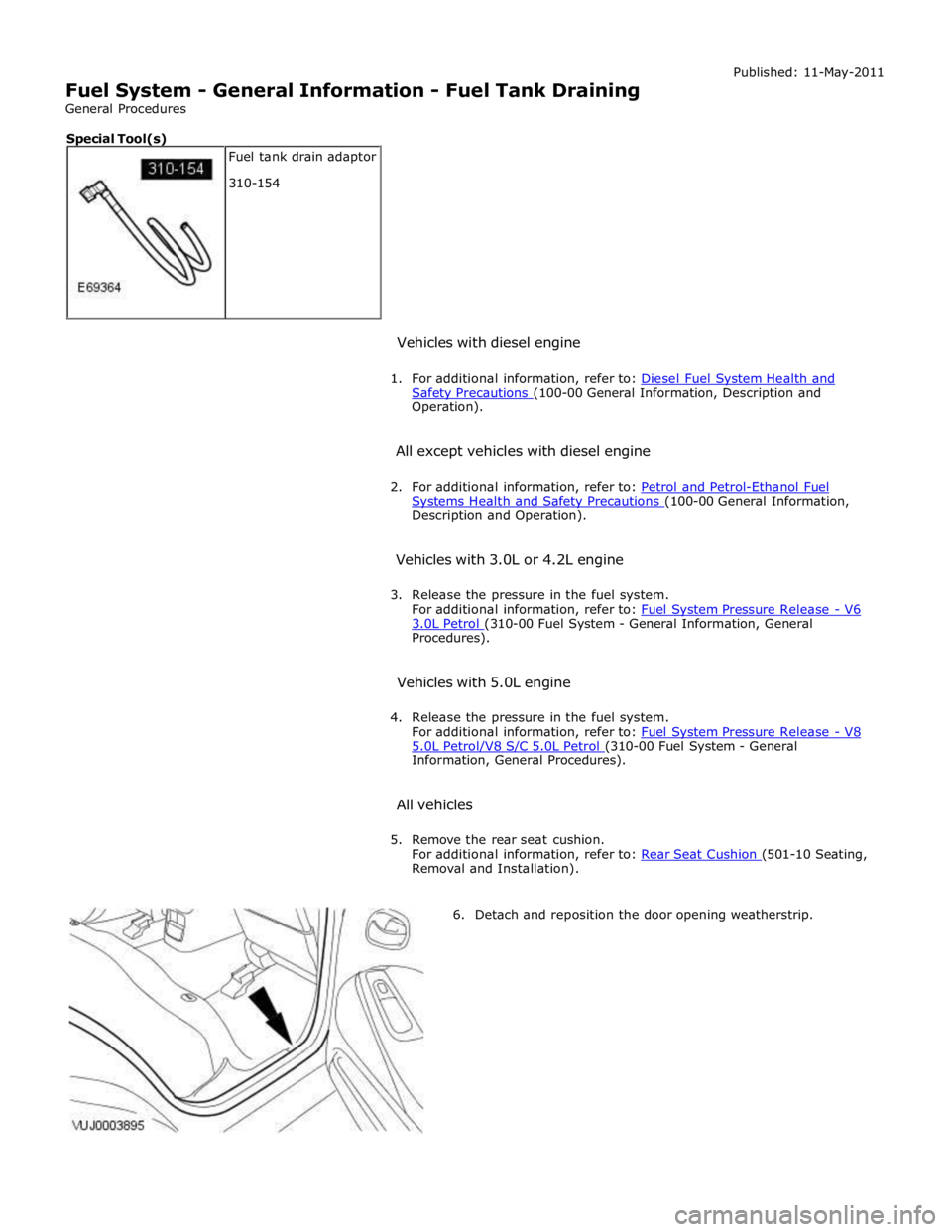
Safety Precautions (100-00 General Information, Description and Operation).
All except vehicles with diesel engine
2. For additional information, refer to: Petrol and Petrol-Ethanol Fuel Systems Health and Safety Precautions (100-00 General Information, Description and Operation).
Vehicles with 3.0L or 4.2L engine
3. Release the pressure in the fuel system.
For additional information, refer to: Fuel System Pressure Release - V6 3.0L Petrol (310-00 Fuel System - General Information, General Procedures).
Vehicles with 5.0L engine
4. Release the pressure in the fuel system.
For additional information, refer to: Fuel System Pressure Release - V8 5.0L Petrol/V8 S/C 5.0L Petrol (310-00 Fuel System - General Information, General Procedures).
All vehicles
5. Remove the rear seat cushion.
For additional information, refer to: Rear Seat Cushion (501-10 Seating, Removal and Installation).
6. Detach and reposition the door opening weatherstrip. Fuel tank drain adaptor
310-154 Special Tool(s)
Page 1568 of 3039
11.
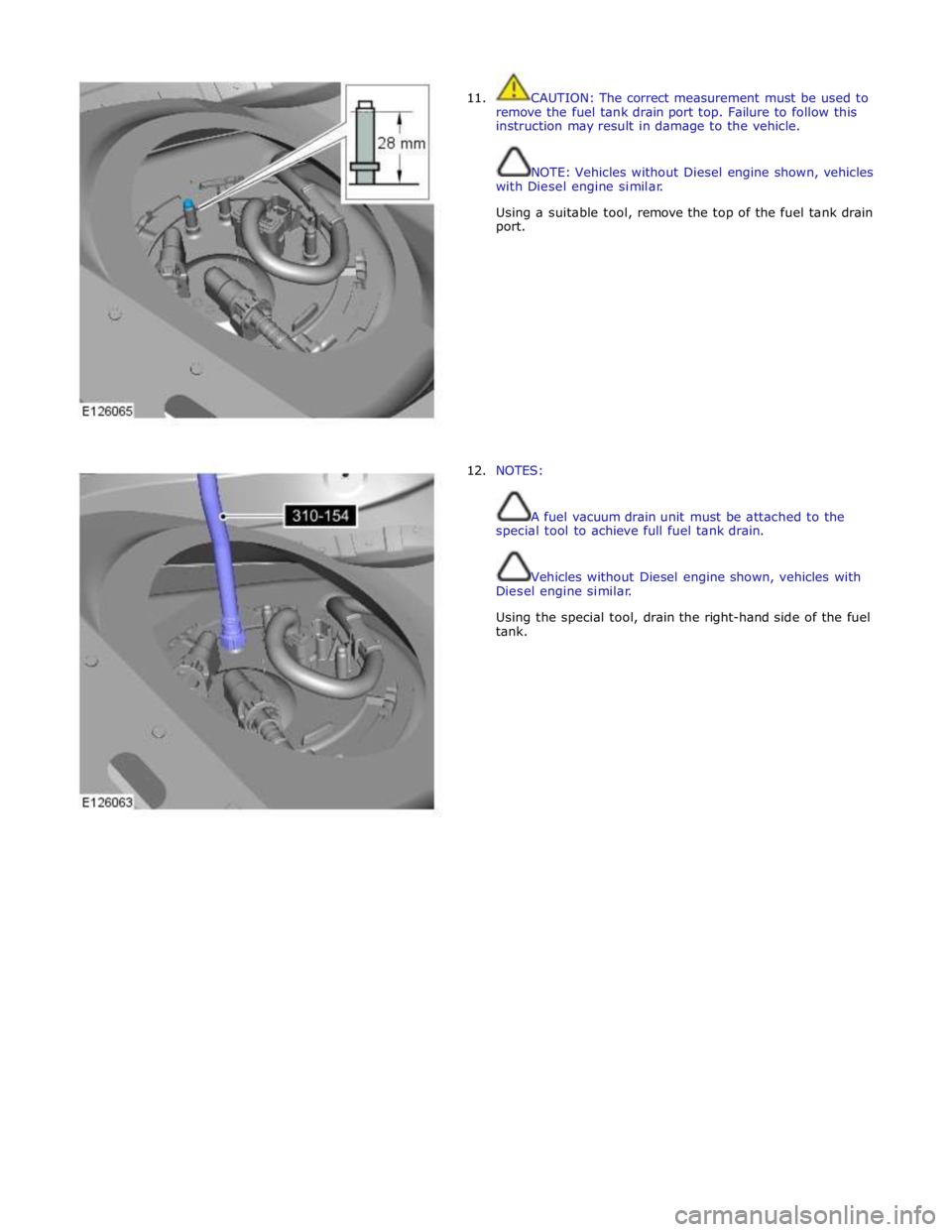
12. CAUTION: The correct measurement must be used to
remove the fuel tank drain port top. Failure to follow this
instruction may result in damage to the vehicle.
NOTE: Vehicles without Diesel engine shown, vehicles
with Diesel engine similar.
Using a suitable tool, remove the top of the fuel tank drain
port.
NOTES:
A fuel vacuum drain unit must be attached to the
special tool to achieve full fuel tank drain.
Vehicles without Diesel engine shown, vehicles with
Diesel engine similar.
Using the special tool, drain the right-hand side of the fuel
tank.
Page 1569 of 3039
13.
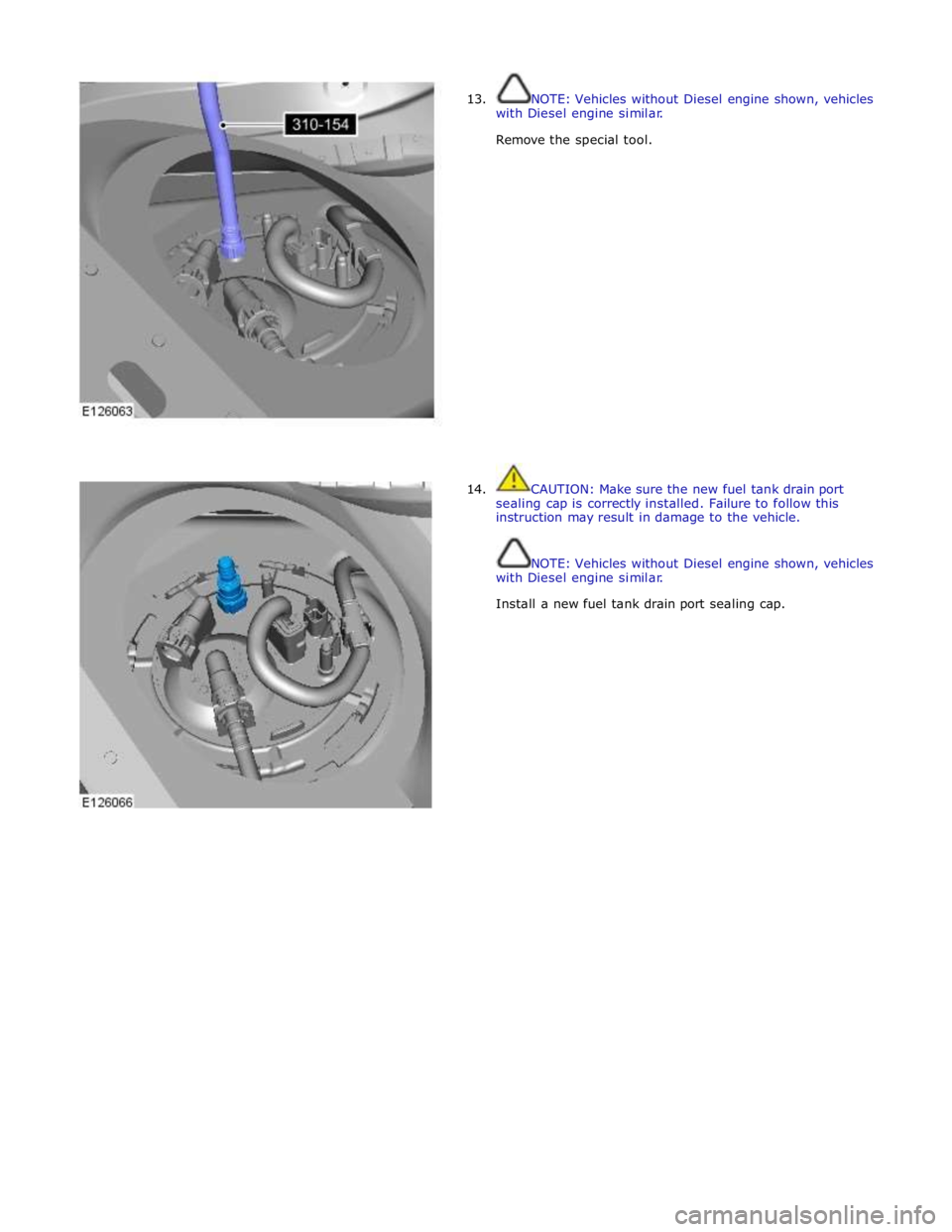
14. NOTE: Vehicles without Diesel engine shown, vehicles
with Diesel engine similar.
Remove the special tool.
CAUTION: Make sure the new fuel tank drain port
sealing cap is correctly installed. Failure to follow this
instruction may result in damage to the vehicle.
NOTE: Vehicles without Diesel engine shown, vehicles
with Diesel engine similar.
Install a new fuel tank drain port sealing cap.
Page 1570 of 3039
15.
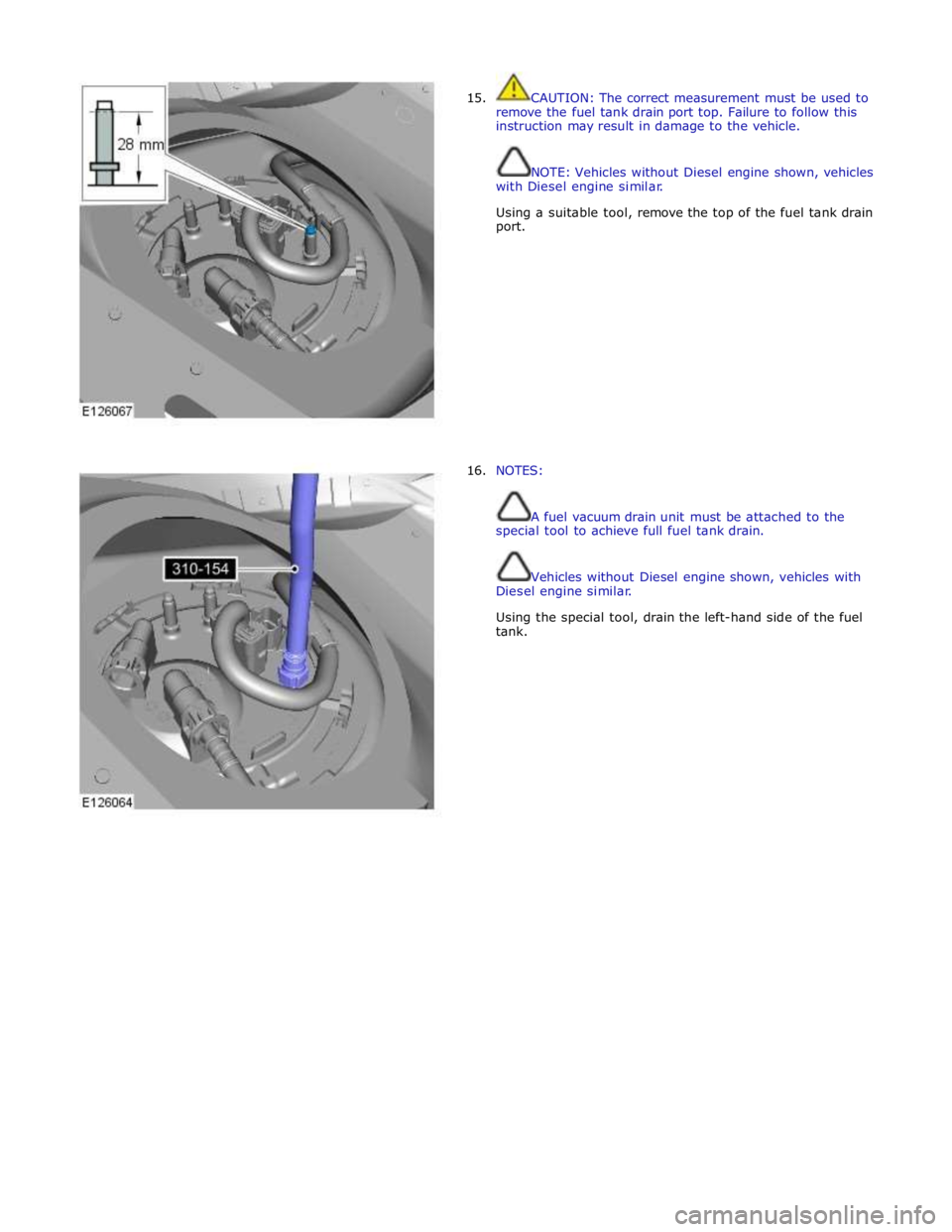
16. CAUTION: The correct measurement must be used to
remove the fuel tank drain port top. Failure to follow this
instruction may result in damage to the vehicle.
NOTE: Vehicles without Diesel engine shown, vehicles
with Diesel engine similar.
Using a suitable tool, remove the top of the fuel tank drain
port.
NOTES:
A fuel vacuum drain unit must be attached to the
special tool to achieve full fuel tank drain.
Vehicles without Diesel engine shown, vehicles with
Diesel engine similar.
Using the special tool, drain the left-hand side of the fuel
tank.
Page 1571 of 3039
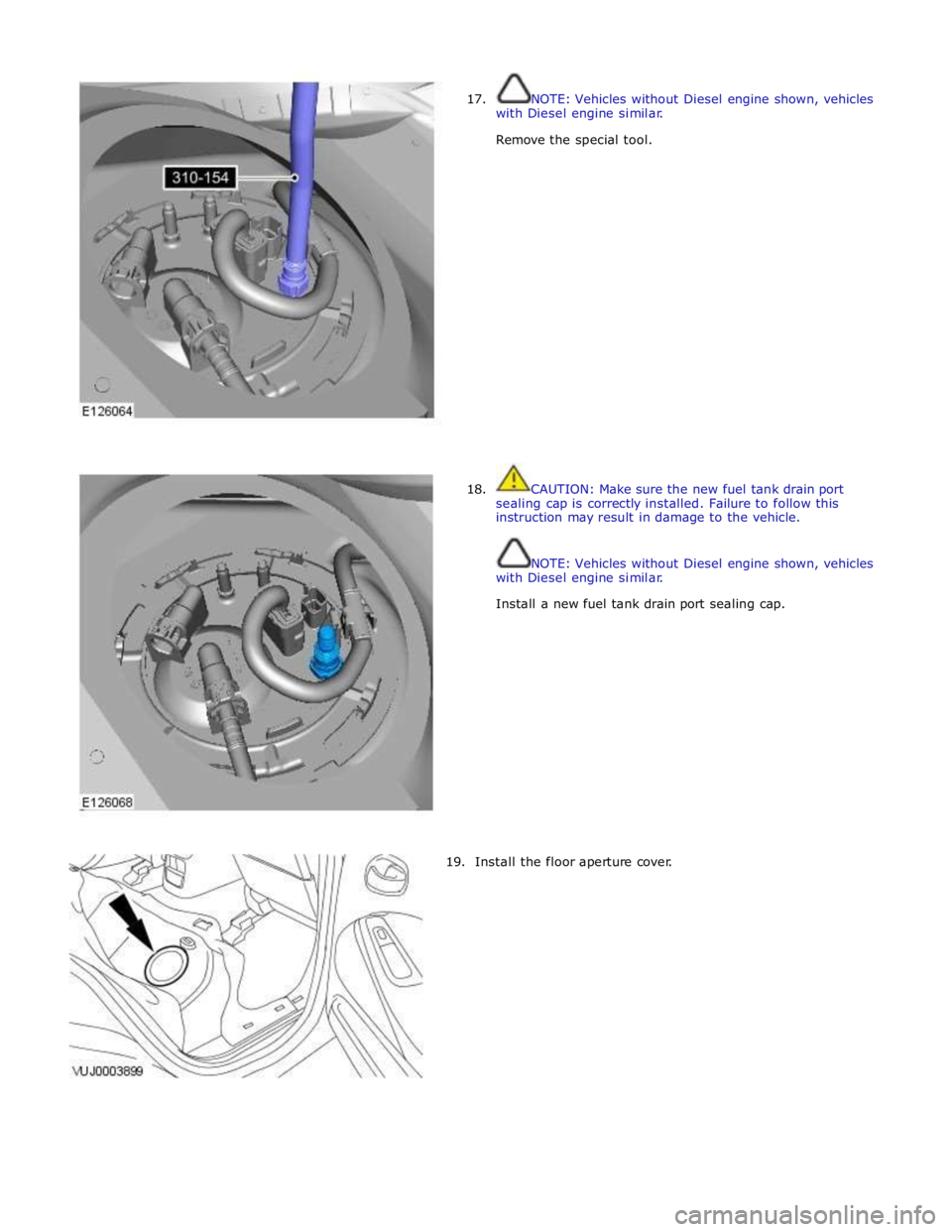
17.
18. NOTE: Vehicles without Diesel engine shown, vehicles
with Diesel engine similar.
Remove the special tool.
CAUTION: Make sure the new fuel tank drain port
sealing cap is correctly installed. Failure to follow this
instruction may result in damage to the vehicle.
NOTE: Vehicles without Diesel engine shown, vehicles
with Diesel engine similar.
Install a new fuel tank drain port sealing cap.
19.
Install the floor aperture cover.