Page 52 of 530

•There are also pinch sensors attached to the side of the
liftgate opening. Light pressure anywhere along these
strips will cause the liftgate to return to the open
position.
•The power liftgate must be in the full open or close
positions for any of the buttons to operate. If the
liftgate is not in the full open or close positions, it must
be opened or closed manually.
•If the liftgate release button is activated while the
power liftgate is closing, the liftgate will reverse to the
full open position.
•The power liftgate buttons will not operate if the shift
lever is in gear or the vehicle speed is above 0 mph
(0 km/h).
•The power liftgate will not operate in temperatures
below�12°F (�24°C) or temperatures above 143°F (62°C). Be sure to remove any buildup of snow or ice
from the liftgate before pressing any of the power
liftgate buttons.
•If the power liftgate encounters multiple obstructions
within the same cycle, the system will automatically
stop and must be opened or closed manually.
WARNING!
•Driving with the liftgate open can allow poison-
ous exhaust gases into your vehicle. You and your
passengers could be injured by these fumes. Keep
the liftgate closed when you are operating the
vehicle.
•If you are required to drive with the liftgate open,
make sure that all windows are closed, and the
climate control blower switch is set at high speed.
DO NOT use the recirculation mode.
2
THINGS TO KNOW BEFORE STARTING YOUR VEHICLE 51
Page 53 of 530
Gas props support the liftgate in the open position.
However, because the gas pressure drops with tempera-
ture, it may be necessary to assist the props when
opening the liftgate in cold weather.
OCCUPANT RESTRAINTS
Some of the most important safety features in your
vehicle are the restraint systems:
•Three-point lap and shoulder belts for all seating
positions
•Advanced Front Airbags for driver and front passen-
ger
•Supplemental Active Head Restraints (AHR) located
on top of the front seats (integrated into the head
restraint) — if equipped
•Supplemental Side Airbag Inflatable Curtains (SABIC)
that span the front, second, and third row seating for
the driver and passengers seated next to a window —
if equipped
•Supplemental Seat-Mounted Side Airbags — if
equipped
•An energy-absorbing steering column and steering
wheel
•Knee bolsters/blockers for front seat occupants
•Front seat belts incorporate pretensioners to enhance
occupant protection by managing occupant energy
during an impact event — if equipped
52 THINGS TO KNOW BEFORE STARTING YOUR VEHICLE
Page 85 of 530
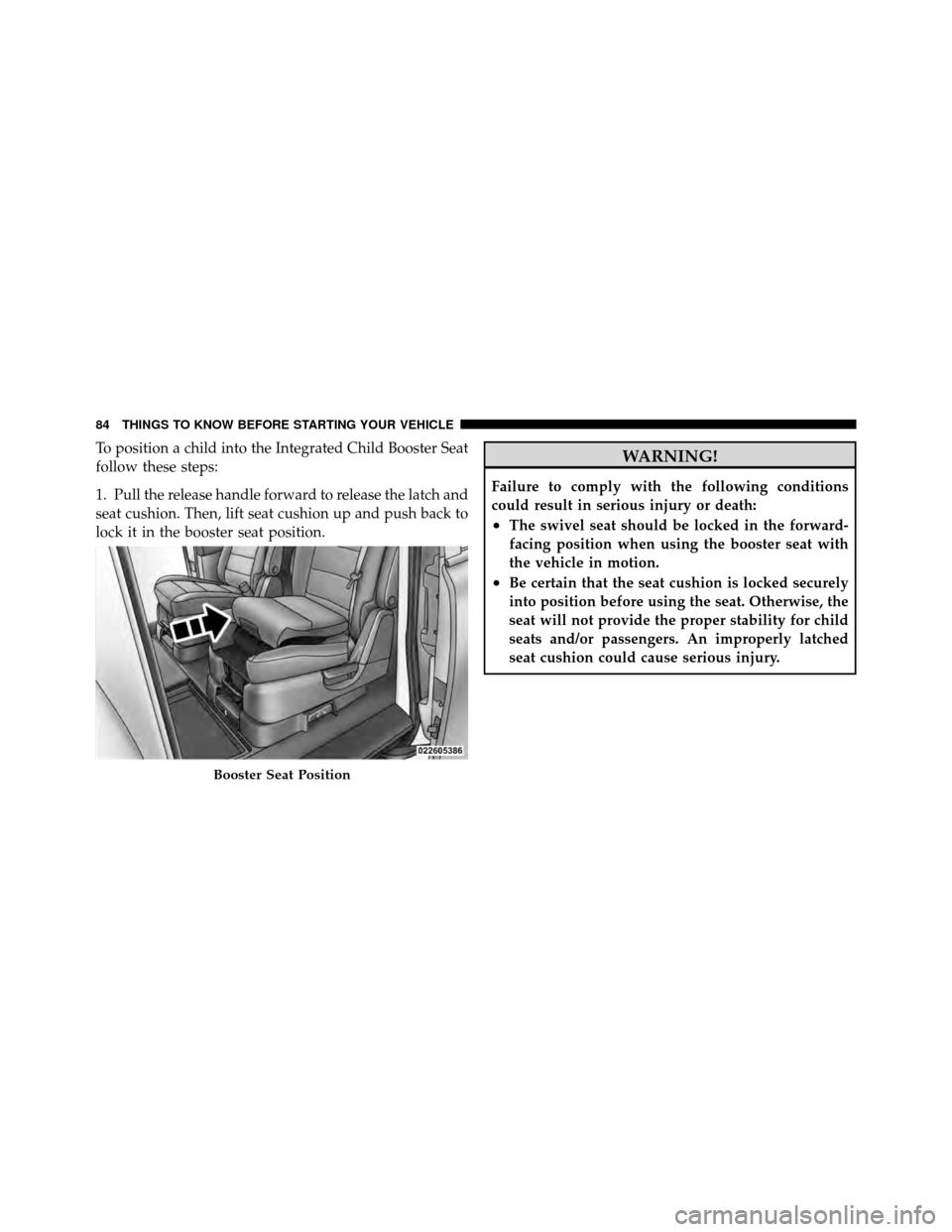
To position a child into the Integrated Child Booster Seat
follow these steps:
1. Pull the release handle forward to release the latch and
seat cushion. Then, lift seat cushion up and push back to
lock it in the booster seat position.WARNING!
Failure to comply with the following conditions
could result in serious injury or death:
•The swivel seat should be locked in the forward-
facing position when using the booster seat with
the vehicle in motion.
•Be certain that the seat cushion is locked securely
into position before using the seat. Otherwise, the
seat will not provide the proper stability for child
seats and/or passengers. An improperly latched
seat cushion could cause serious injury.
Booster Seat Position
84 THINGS TO KNOW BEFORE STARTING YOUR VEHICLE
Page 102 of 530

If you are required to drive with the liftgate open, make
sure that all windows are closed and the climate control
BLOWER switch is set at high speed. DO NOT use the
recirculation mode.
The best protection against carbon monoxide entry into
the vehicle body is a properly maintained engine exhaust
system.
Whenever a change is noticed in the sound of the exhaust
system, when exhaust fumes can be detected inside the
vehicle, or when the underside or rear of the vehicle is
damaged, have a competent mechanic inspect the com-
plete exhaust system and adjacent body areas for broken,
damaged, deteriorated, or mispositioned parts. Open
seams or loose connections could permit exhaust fumes
to seep into the passenger compartment. In addition,
inspect the exhaust system each time the vehicle is raised
for lubrication or oil change. Replace as required.Safety Checks You Should Make Inside the
Vehicle
Seat Belts
Inspect the belt system periodically, checking for cuts,
frays, and loose parts. Damaged parts must be replaced
immediately. Do not disassemble or modify the system.
Front seat belt assemblies must be replaced after a
collision. Rear seat belt assemblies must be replaced after
a collision if they have been damaged (i.e., bent retractor,
torn webbing, etc.). If there is any question regarding belt
or retractor condition, replace the belt.2
THINGS TO KNOW BEFORE STARTING YOUR VEHICLE 101
Page 125 of 530
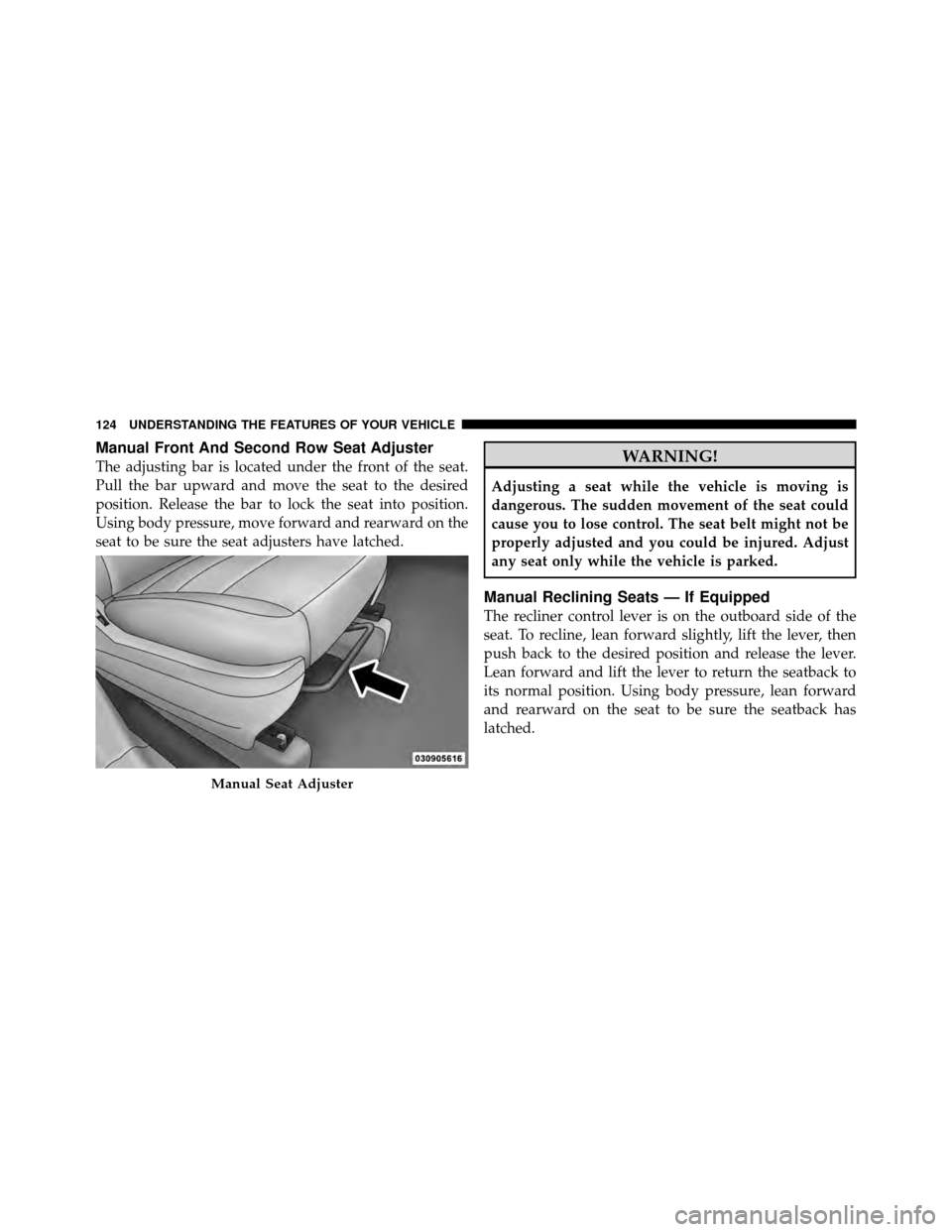
Manual Front And Second Row Seat Adjuster
The adjusting bar is located under the front of the seat.
Pull the bar upward and move the seat to the desired
position. Release the bar to lock the seat into position.
Using body pressure, move forward and rearward on the
seat to be sure the seat adjusters have latched.WARNING!
Adjusting a seat while the vehicle is moving is
dangerous. The sudden movement of the seat could
cause you to lose control. The seat belt might not be
properly adjusted and you could be injured. Adjust
any seat only while the vehicle is parked.
Manual Reclining Seats — If Equipped
The recliner control lever is on the outboard side of the
seat. To recline, lean forward slightly, lift the lever, then
push back to the desired position and release the lever.
Lean forward and lift the lever to return the seatback to
its normal position. Using body pressure, lean forward
and rearward on the seat to be sure the seatback has
latched.
Manual Seat Adjuster
124 UNDERSTANDING THE FEATURES OF YOUR VEHICLE
Page 136 of 530
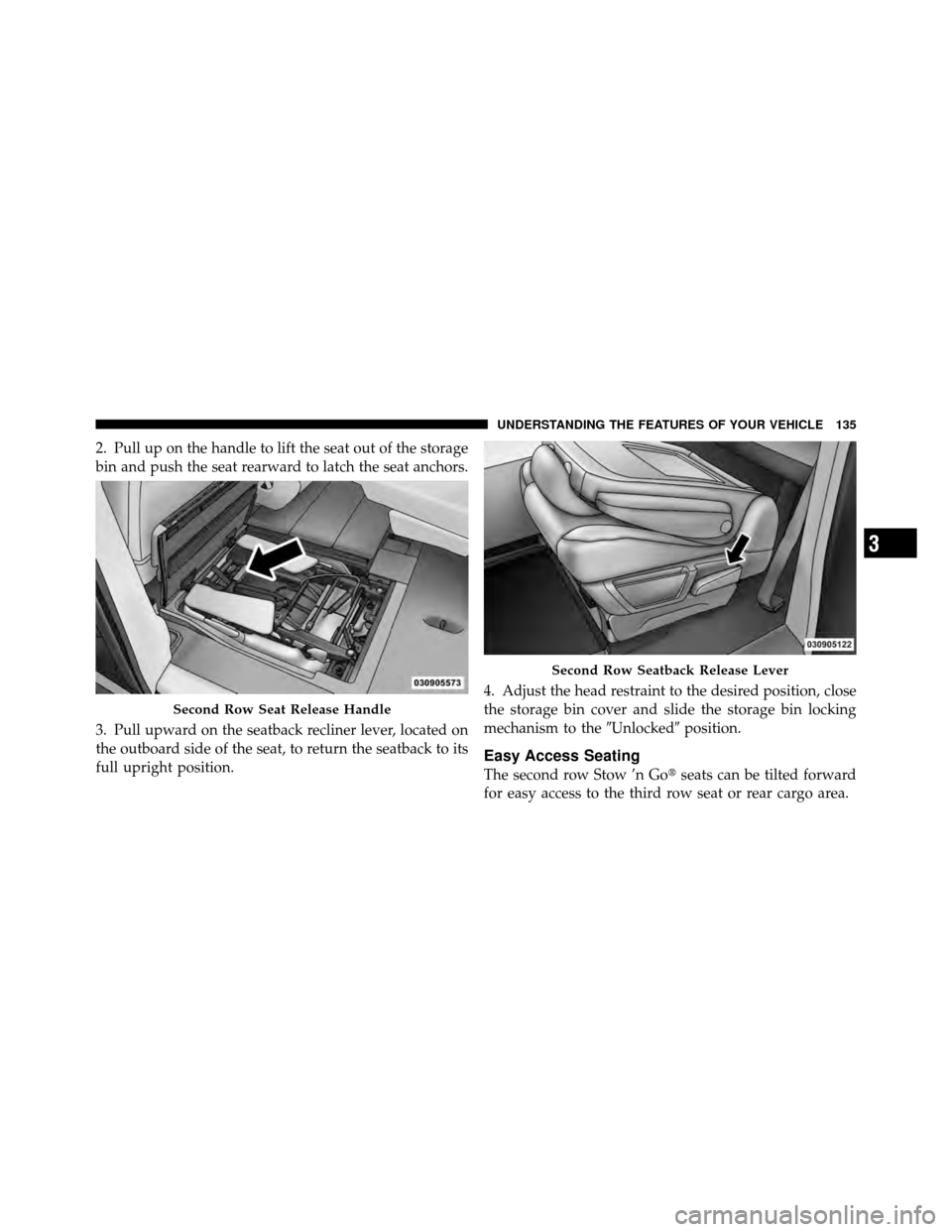
2. Pull up on the handle to lift the seat out of the storage
bin and push the seat rearward to latch the seat anchors.
3. Pull upward on the seatback recliner lever, located on
the outboard side of the seat, to return the seatback to its
full upright position.4. Adjust the head restraint to the desired position, close
the storage bin cover and slide the storage bin locking
mechanism to the
�Unlocked�position.
Easy Access Seating
The second row Stow ’n Go� seats can be tilted forward
for easy access to the third row seat or rear cargo area.
Second Row Seat Release Handle
Second Row Seatback Release Lever
3
UNDERSTANDING THE FEATURES OF YOUR VEHICLE 135
Page 138 of 530
•Seats are removableWARNING!
When the seatback release handle is lifted, the seat-
back will rotate forward. To avoid injury, if you are
not seated in the seat, stay clear from the area in the
path of the rotating seatback.
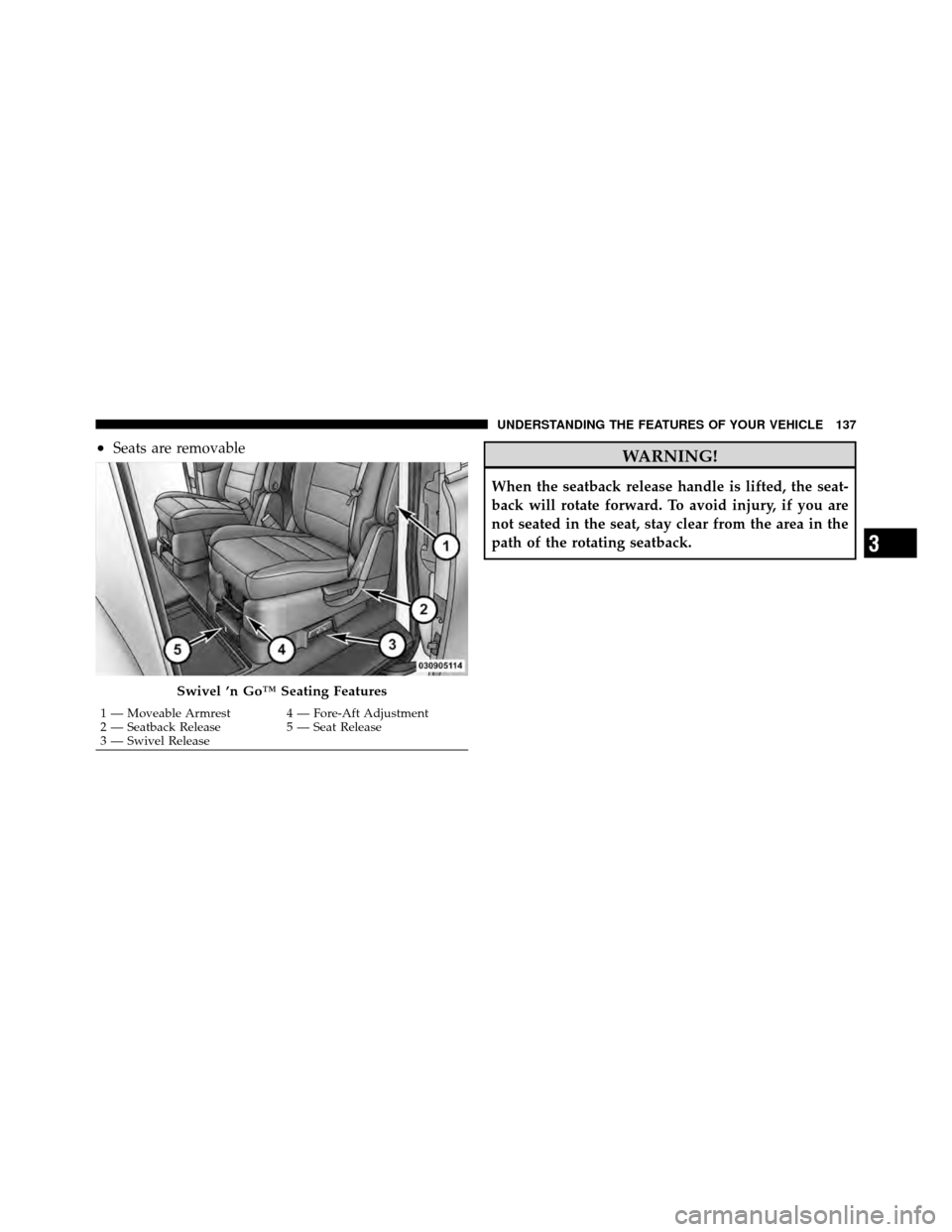
Swivel ’n Go™ Seating Features
1 — Moveable Armrest 4 — Fore-Aft Adjustment
2 — Seatback Release 5 — Seat Release
3 — Swivel Release
3
UNDERSTANDING THE FEATURES OF YOUR VEHICLE 137
Page 140 of 530
WARNING! (Continued)
•Make sure the Swivel ’n Go™ seat is in a locked
position with the release handle fully engaged.
Test the seat after it is locked to see that it doesn’t
swivel.
Removing Swivel ’n Go™ Premium Seating —
If Equipped
1. Remove any obstructions from the floor behind the
seat, and stow the third row seat.
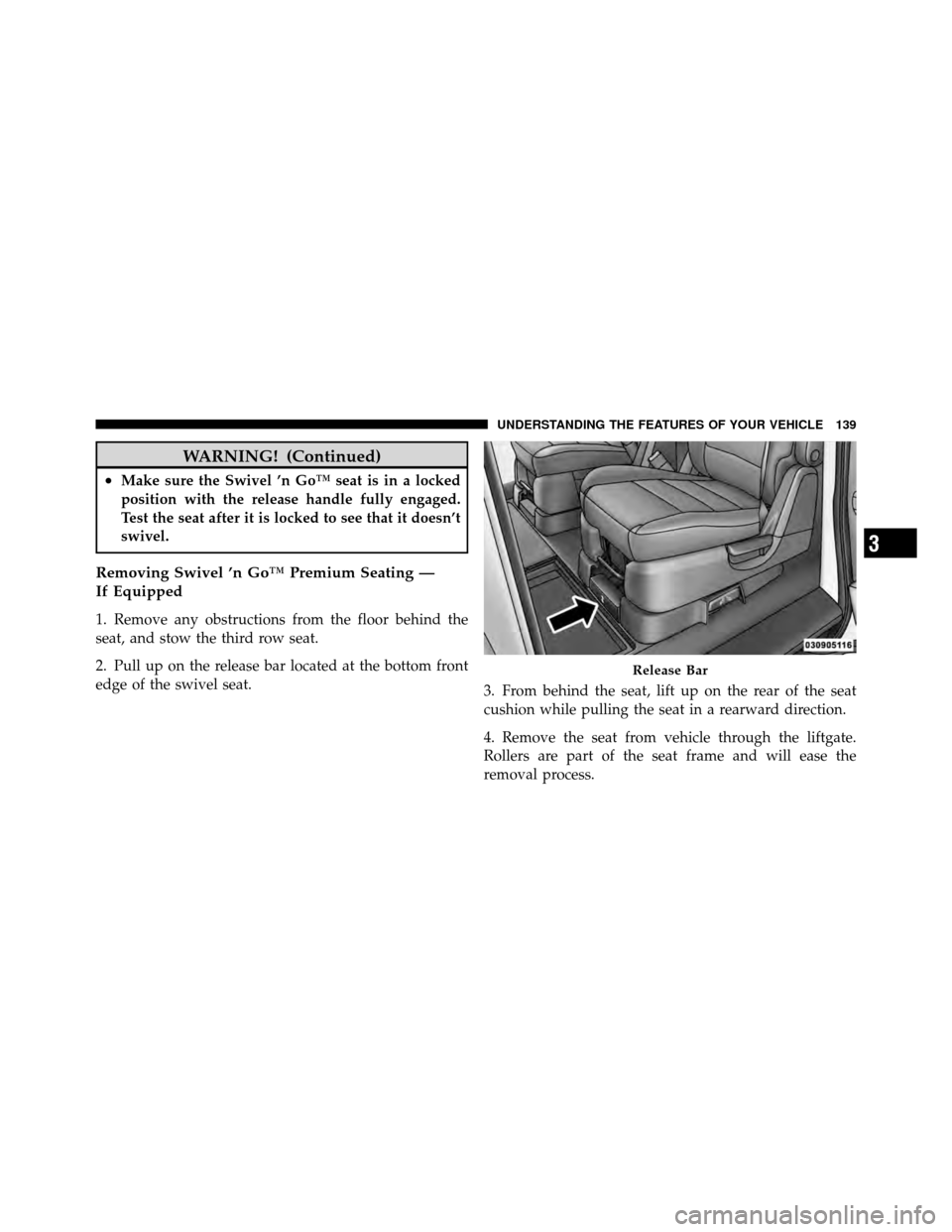
2. Pull up on the release bar located at the bottom front
edge of the swivel seat.3. From behind the seat, lift up on the rear of the seat
cushion while pulling the seat in a rearward direction.
4. Remove the seat from vehicle through the liftgate.
Rollers are part of the seat frame and will ease the
removal process.
Release Bar
3
UNDERSTANDING THE FEATURES OF YOUR VEHICLE 139