Page 428 of 530
CAUTION! (Continued)
•Always use wheel lift equipment when towing
from the front. The only other approved method of
towing is with a flatbed truck.
•Do not tow the vehicle from the rear. Damage to
the rear sheet metal, liftgate and fascia will occur.
•Do not push or tow this vehicle with another
vehicle as damage to the bumper fascia and trans-
mission may result.
•If the vehicle being towed requires steering, the
ignition switch must be in the ON position, not in
the LOCK or ACC positions.
If it is necessary to use the accessories while being towed
(wipers, defrosters, etc.), the key must be in the ON
position, not the ACC position. Make certain the trans-
mission remains in NEUTRAL.
Towing Without The Ignition Key
Special care must be taken when the vehicle is towed
with the ignition in the OFF position. The only approved
method of towing without the ignition key is with a
flatbed truck. Proper towing equipment is necessary to
prevent damage to the vehicle.
Towing This Vehicle Behind Another Vehicle (Flat
Towing With All Four Wheels On The Ground)
Flat towing of vehicles equipped with an automatic
transmission, is only permitted within the limitations
described in this section.
Towing This Vehicle Behind Another Vehicle With
A Tow Dolly
The manufacturer does not recommend that you tow a
front wheel drive vehicle on a tow dolly. Vehicle damage
may occur.
6
WHAT TO DO IN EMERGENCIES 427
Page 448 of 530
CAUTION!
The A/C air filter is labeled with an arrow to indicate
airflow direction through the filter. Failure to prop-
erly install the filter will result in the need to replace
it more often.
7. Rotate the glove compartment door back into position.
Body Lubrication
Locks and all body pivot points, including such items as
seat tracks, door hinge pivot points and rollers, liftgate,
tailgate, sliding doors and hood hinges, should be lubri-
cated periodically with a lithium-based grease, such as
MOPAR� Spray White Lube or equivalent, to assure
quiet, easy operation and to protect against rust and
wear. Prior to the application of any lubricant, the parts
concerned should be wiped clean to remove dust and
grit; after lubricating excess oil and grease should be
removed. Particular attention should also be given to hood latching components to ensure proper function.
When performing other underhood services, the hood
latch, release mechanism and safety catch should be
cleaned and lubricated.
The external lock cylinders should be lubricated twice a
year, preferably in the Fall and Spring. Apply a small
amount of a high quality lubricant such as MOPAR�
Lock Cylinder Lubricant or equivalent directly into the
lock cylinder.Windshield Wiper Blades
Clean the rubber edges of the wiper blades and the
windshield periodically with a sponge or soft cloth and a
mild nonabrasive cleaner. This will remove accumula-
tions of salt or road film.
Operation of the wipers on dry glass for long periods
may cause deterioration of the wiper blades. Always use
washer fluid when using the wipers to remove salt or dirt
from a dry windshield.
7
MAINTAINING YOUR VEHICLE 447
Page 467 of 530
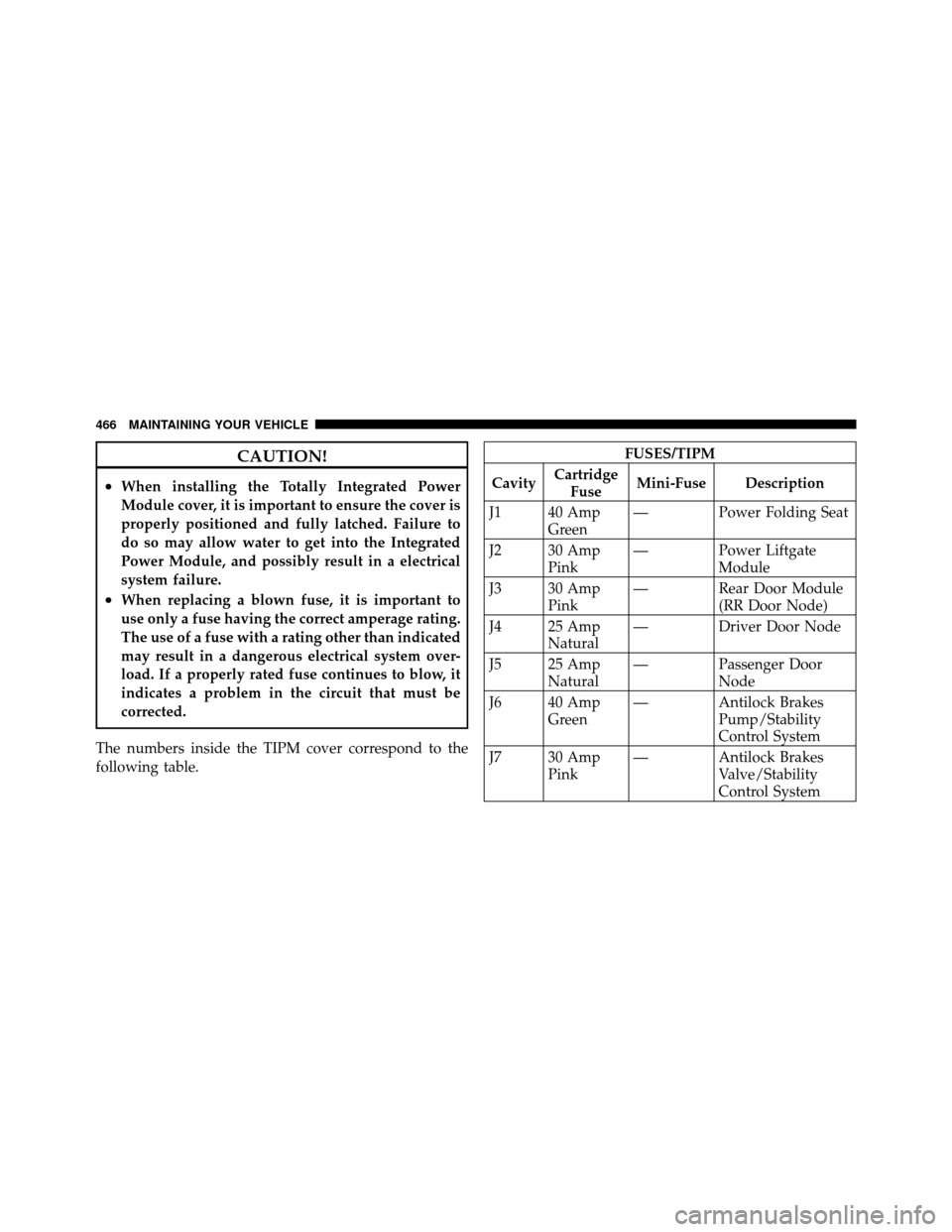
CAUTION!
•When installing the Totally Integrated Power
Module cover, it is important to ensure the cover is
properly positioned and fully latched. Failure to
do so may allow water to get into the Integrated
Power Module, and possibly result in a electrical
system failure.
•When replacing a blown fuse, it is important to
use only a fuse having the correct amperage rating.
The use of a fuse with a rating other than indicated
may result in a dangerous electrical system over-
load. If a properly rated fuse continues to blow, it
indicates a problem in the circuit that must be
corrected.
The numbers inside the TIPM cover correspond to the
following table.
FUSES/TIPM
Cavity Cartridge
Fuse Mini-Fuse Description
J1 40 Amp Green — Power Folding Seat
J2 30 Amp Pink — Power Liftgate
Module
J3 30 Amp Pink — Rear Door Module
(RR Door Node)
J4 25 Amp Natural — Driver Door Node
J5 25 Amp Natural — Passenger Door
Node
J6 40 Amp Green — Antilock Brakes
Pump/Stability
Control System
J7 30 Amp Pink — Antilock Brakes
Valve/Stability
Control System
466 MAINTAINING YOUR VEHICLE
Page 471 of 530
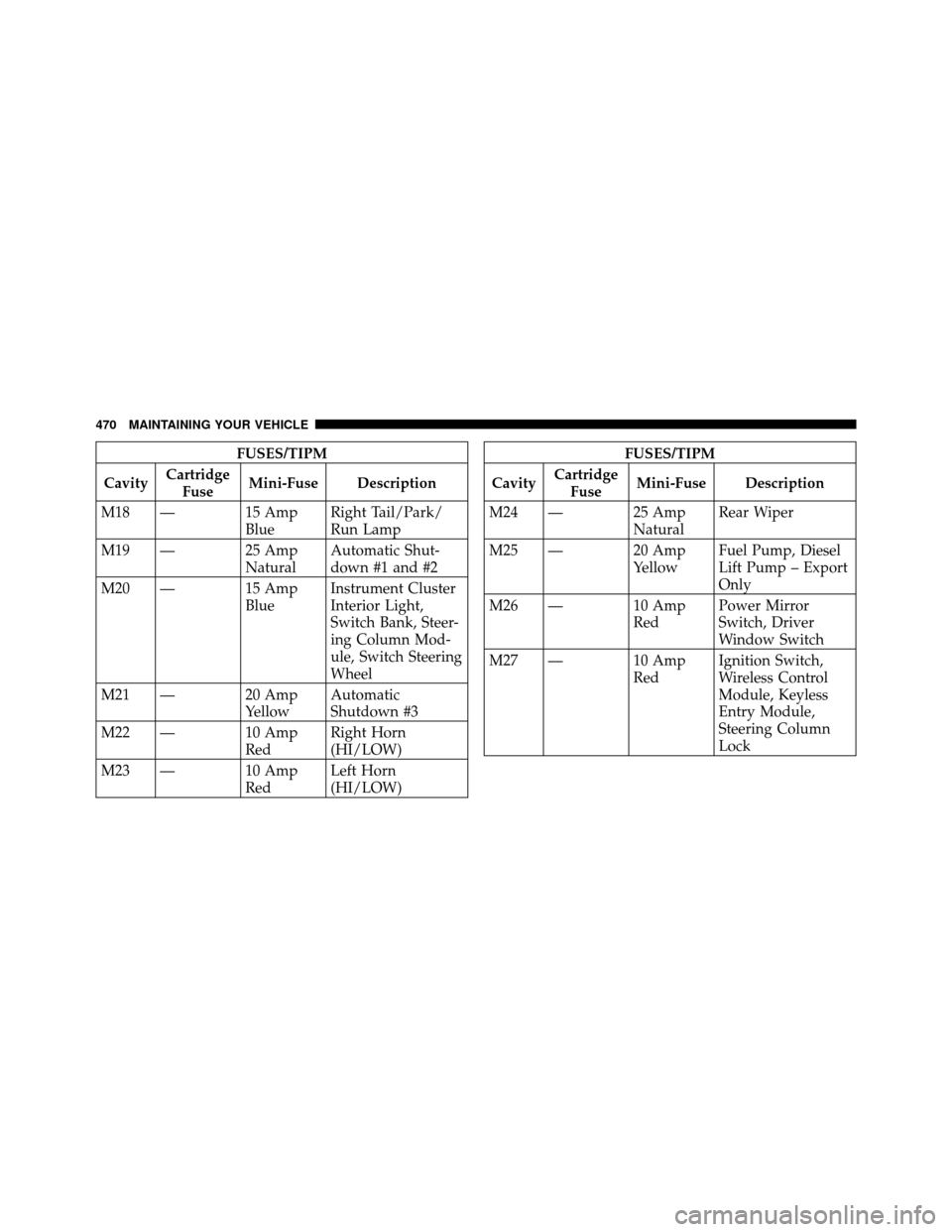
FUSES/TIPM
Cavity Cartridge
Fuse Mini-Fuse Description
M18 — 15 Amp BlueRight Tail/Park/
Run Lamp
M19 — 25 Amp NaturalAutomatic Shut-
down #1 and #2
M20 — 15 Amp BlueInstrument Cluster
Interior Light,
Switch Bank, Steer-
ing Column Mod-
ule, Switch Steering
Wheel
M21 — 20 Amp YellowAutomatic
Shutdown #3
M22 — 10 Amp RedRight Horn
(HI/LOW)
M23 — 10 Amp RedLeft Horn
(HI/LOW)FUSES/TIPM
Cavity Cartridge
Fuse Mini-Fuse Description
M24 — 25 Amp NaturalRear Wiper
M25 — 20 Amp YellowFuel Pump, Diesel
Lift Pump – Export
Only
M26 — 10 Amp RedPower Mirror
Switch, Driver
Window Switch
M27 — 10 Amp RedIgnition Switch,
Wireless Control
Module, Keyless
Entry Module,
Steering Column
Lock
470 MAINTAINING YOUR VEHICLE
Page 473 of 530
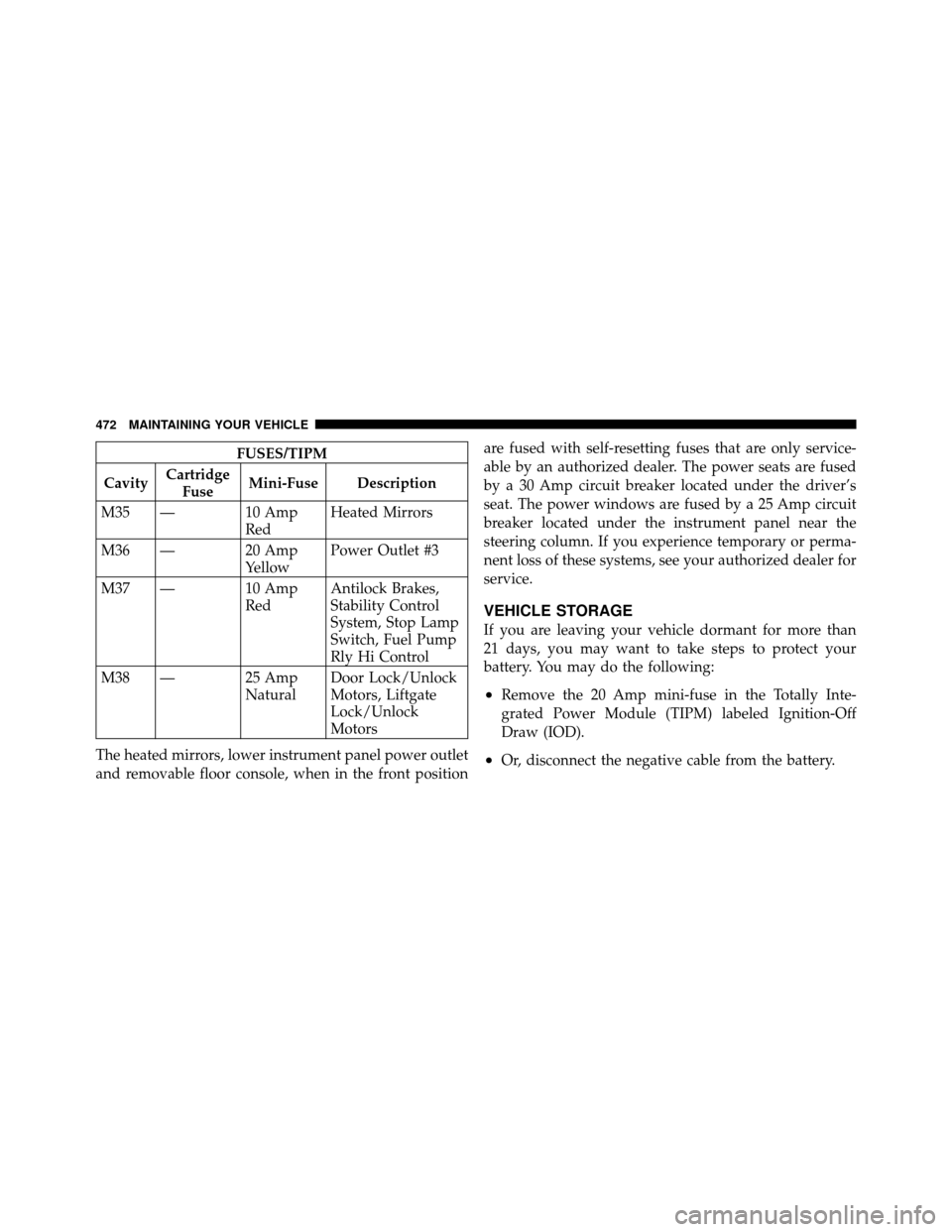
FUSES/TIPM
Cavity Cartridge
Fuse Mini-Fuse Description
M35 — 10 Amp RedHeated Mirrors
M36 — 20 Amp YellowPower Outlet #3
M37 — 10 Amp RedAntilock Brakes,
Stability Control
System, Stop Lamp
Switch, Fuel Pump
Rly Hi Control
M38 — 25 Amp NaturalDoor Lock/Unlock
Motors, Liftgate
Lock/Unlock
Motors
The heated mirrors, lower instrument panel power outlet
and removable floor console, when in the front position are fused with self-resetting fuses that are only service-
able by an authorized dealer. The power seats are fused
by a 30 Amp circuit breaker located under the driver’s
seat. The power windows are fused by a 25 Amp circuit
breaker located under the instrument panel near the
steering column. If you experience temporary or perma-
nent loss of these systems, see your authorized dealer for
service.
VEHICLE STORAGE
If you are leaving your vehicle dormant for more than
21 days, you may want to take steps to protect your
battery. You may do the following:
•Remove the 20 Amp mini-fuse in the Totally Inte-
grated Power Module (TIPM) labeled Ignition-Off
Draw (IOD).
•Or, disconnect the negative cable from the battery.
472 MAINTAINING YOUR VEHICLE
Page 474 of 530
•Anytime you store your vehicle, or keep it out of
service for two weeks or more, run the air conditioning
system at idle for about five minutes in the fresh air
and high blower setting. This will ensure adequate
system lubrication to minimize the possibility of com-
pressor damage when the system is started again.
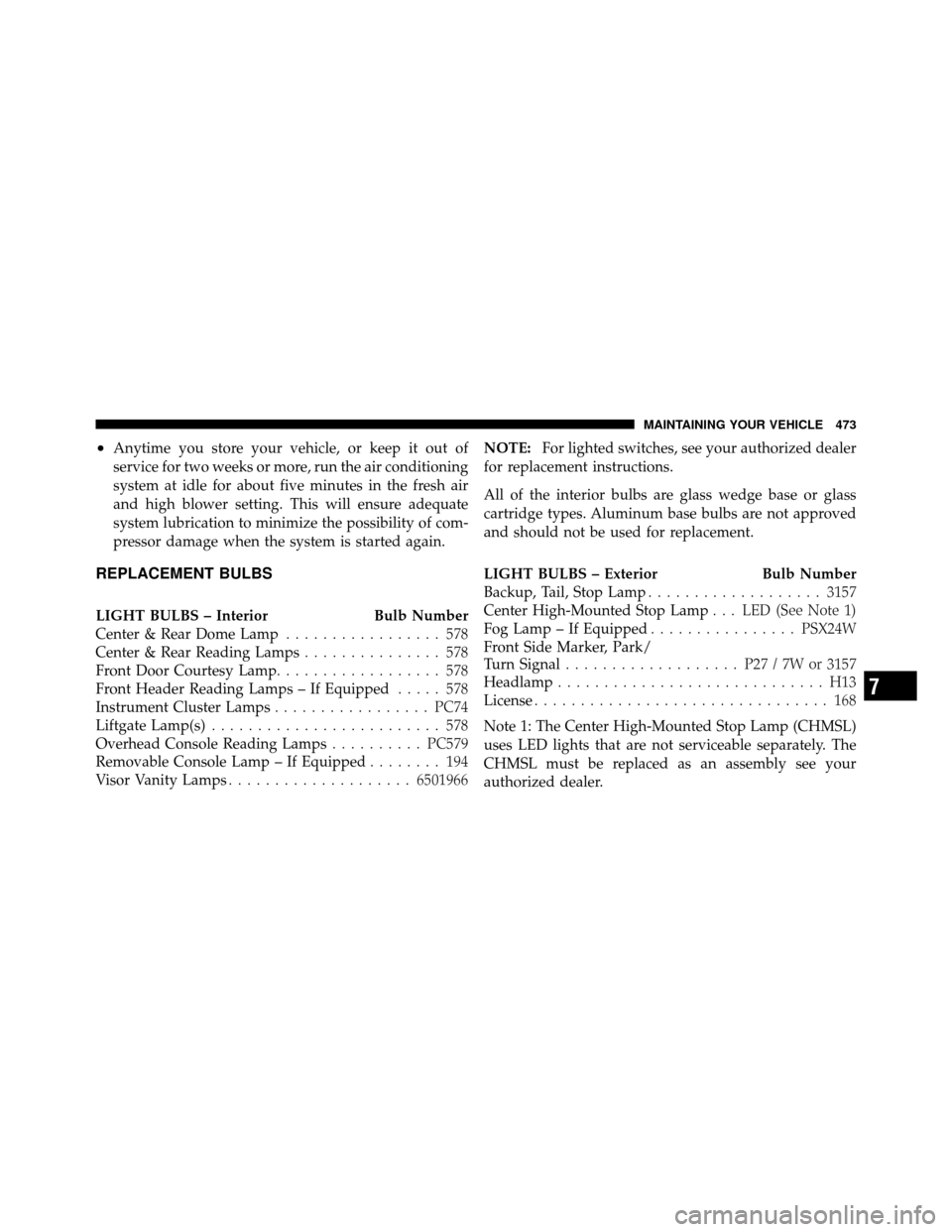
REPLACEMENT BULBS
LIGHT BULBS – InteriorBulb Number
Center & Rear Dome Lamp ................. 578
Center & Rear Reading Lamps ............... 578
Front Door Courtesy Lamp .................. 578
Front Header Reading Lamps – If Equipped ..... 578
Instrument Cluster Lamps .................PC74
Liftgate Lamp(s) ......................... 578
Overhead Console Reading Lamps ..........PC579
Removable Console Lamp – If Equipped ........ 194
Visor Vanity Lamps .................... 6501966NOTE:
For lighted switches, see your authorized dealer
for replacement instructions.
All of the interior bulbs are glass wedge base or glass
cartridge types. Aluminum base bulbs are not approved
and should not be used for replacement.
LIGHT BULBS – Exterior Bulb Number
Backup, Tail, Stop Lamp ................... 3157
Center High-Mounted Stop Lamp . . . LED (See Note 1)
Fog Lamp – If Equipped ................PSX24W
Front Side Marker, Park/
Turn Signal ................... P27/7Wor 3157
Headlamp ............................. H13
License ................................ 168
Note 1: The Center High-Mounted Stop Lamp (CHMSL)
uses LED lights that are not serviceable separately. The
CHMSL must be replaced as an assembly see your
authorized dealer.
7
MAINTAINING YOUR VEHICLE 473
Page 476 of 530
1. From behind the bumper fascia, or the access panel on
the air dam, twist the bulb counterclockwise, and remove
bulb.
CAUTION!
Do not touch the new bulb with your fingers. Oil
contamination will severely shorten bulb life. If the
bulb comes in contact with an oily surface, clean the
bulb with rubbing alcohol.
2. Disconnect the wire harness from the bulb.
3. Reconnect the wiring harness to the new bulb and
reinstall the bulb by twisting clockwise.
Rear Tail, Stop, Turn Signal, Side Marker and
Backup Lamps
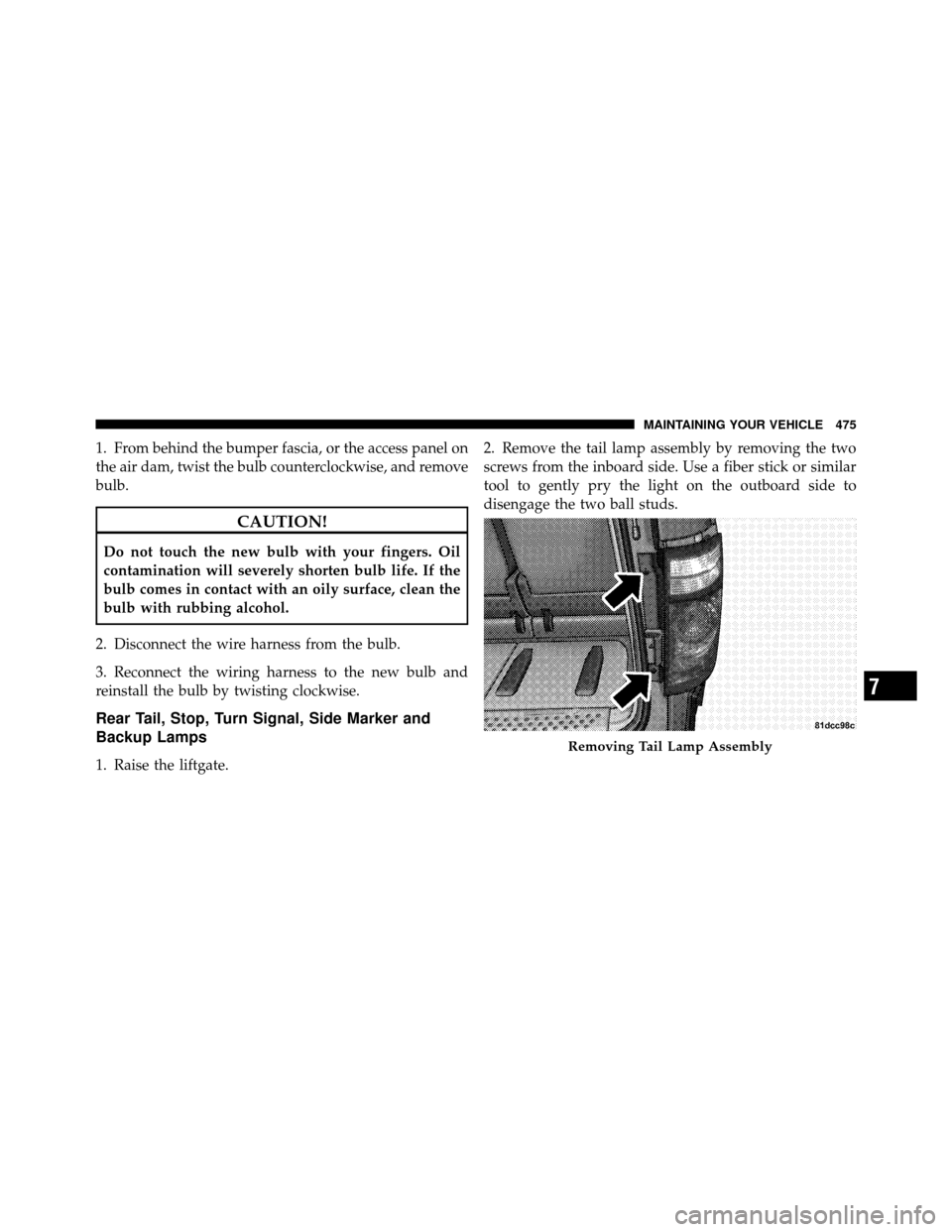
1. Raise the liftgate. 2. Remove the tail lamp assembly by removing the two
screws from the inboard side. Use a fiber stick or similar
tool to gently pry the light on the outboard side to
disengage the two ball studs.
Removing Tail Lamp Assembly
7
MAINTAINING YOUR VEHICLE 475
Page 519 of 530
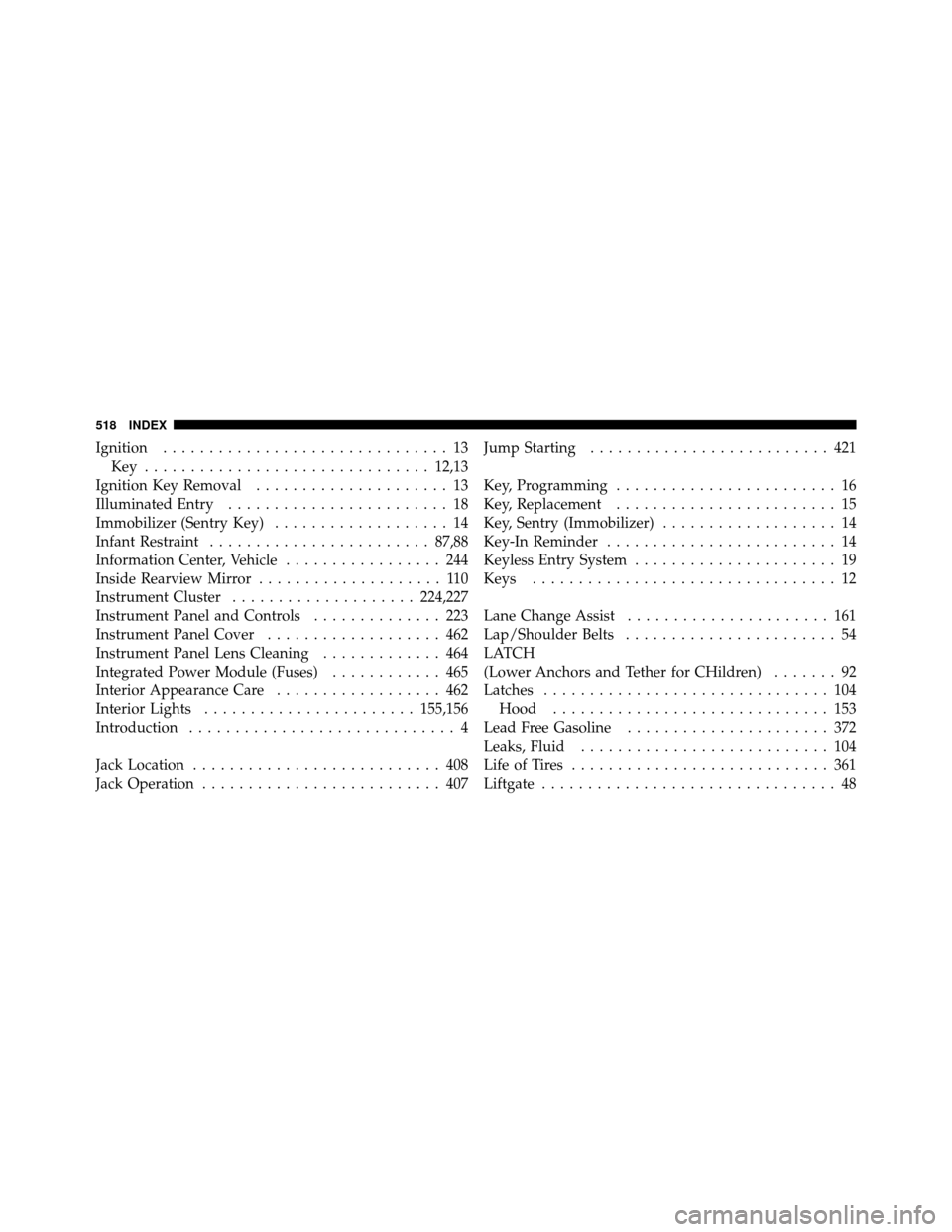
Ignition............................... 13
Key ............................... 12,13
Ignition Key Removal ..................... 13
Illuminated Entry ........................ 18
Immobilizer (Sentry Key) ................... 14
Infant Restraint ........................ 87,88
Information Center, Vehicle ................. 244
Inside Rearview Mirror .................... 110
Instrument Cluster .................... 224,227
Instrument Panel and Controls .............. 223
Instrument Panel Cover ................... 462
Instrument Panel Lens Cleaning ............. 464
Integrated Power Module (Fuses) ............ 465
Interior Appearance Care .................. 462
Interior Lights ....................... 155,156
Introduction ............................. 4
Jack Location ........................... 408
Jack Operation .......................... 407 Jump Starting
.......................... 421
Key, Programming ........................ 16
Key, Replacement ........................ 15
Key, Sentry (Immobilizer) ................... 14
Key-In Reminder ......................... 14
Keyless Entry System ...................... 19
Keys ................................. 12
Lane Change Assist ...................... 161
Lap/Shoulder Belts ....................... 54
LATCH
(Lower Anchors and Tether for CHildren) ....... 92
Latches ............................... 104
Hood .............................. 153
Lead Free Gasoline ...................... 372
Leaks, Fluid ........................... 104
Life of Tires ............................ 361
Liftgate ................................ 48
518 INDEX