Page 28 of 432
OnStar
®
OnStar
®
uses several innovative technologies and live
advisors to provide a wide range of safety, security,
navigation, diagnostics, and calling services.
Automatic Crash ResponseIn a crash, built in sensors can automatically alert an
OnStar advisor who is immediately connected to
the vehicle to see if you need help.How OnStar Service Works
Q
:This blue button connects you to a specially
trained OnStar advisor to verify your account information
and to answer questions.
]
:Push this red emergency button to get priority help
from specially trained OnStar emergency advisors.
X
:Push this button for hands-free, voice-activated
calling and to give voice commands for turn-by-turn
navigation.
Crisis Assist, Stolen Vehicle Assistance, Vehicle
Diagnostics, Remote Door Unlock, Roadside Assistance,
Turn-by-Turn Navigation and Hands-Free Calling are
available on most vehicles. Not all OnStar services are
available on all vehicles. For more information see the
OnStar Owner’s Guide or visit www.onstar.com (U.S.)
or www.onstar.ca (Canada), contact OnStar at
1-888-4-ONSTAR (1-888-466-7827) or TTY
1-877-248-2080, or press
Q
to speak with an
OnStar advisor 24 hours a day, 7 days a week.
For a full description of OnStar services and system
limitations, see the OnStar Owner’s Guide in the
glove box.
OnStar service is subject to the OnStar terms and
conditions included in the OnStar Subscriber
Information.
OnStar service cannot work unless the vehicle is in a
place where OnStar has an agreement with a wireless
service provider for service in that area. OnStar service
also cannot work unless the vehicle is in a place where
the wireless service provider OnStar has hired for that
area has coverage, network capacity and reception when
the service is needed, and technology that is compatible
with the OnStar service. Not all services are available
everywhere, particularly in remote or enclosed areas, or
at all times.
1-22
Page 33 of 432
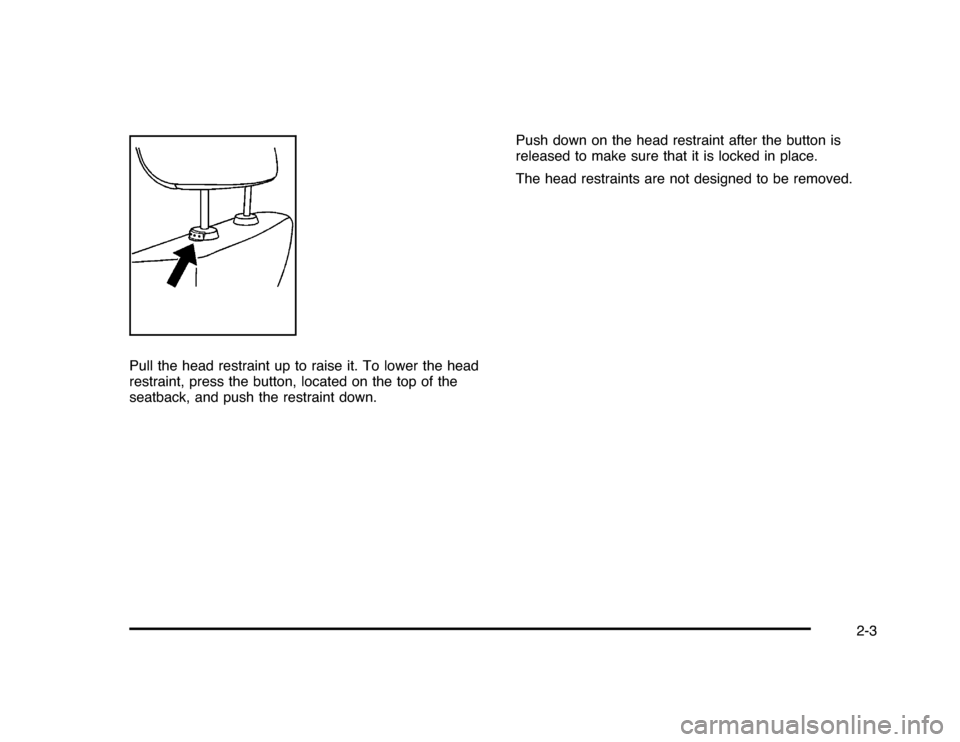
Pull the head restraint up to raise it. To lower the head
restraint, press the button, located on the top of the
seatback, and push the restraint down.Push down on the head restraint after the button is
released to make sure that it is locked in place.
The head restraints are not designed to be removed.
2-3
Page 34 of 432
Front SeatsManual Seats
{
WARNING:
You can lose control of the vehicle if you try to
adjust a manual driver’s seat while the vehicle is
moving. The sudden movement could startle and
confuse you, or make you push a pedal when you
do not want to. Adjust the driver’s seat only when
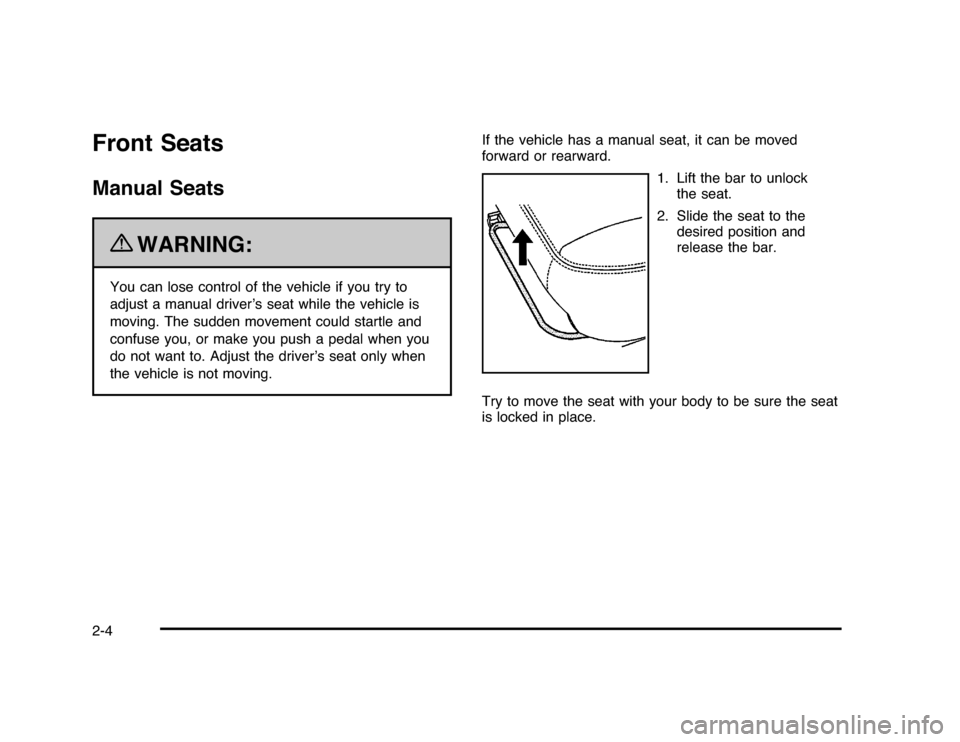
the vehicle is not moving.If the vehicle has a manual seat, it can be moved
forward or rearward.
1. Lift the bar to unlock
the seat.
2. Slide the seat to the
desired position and
release the bar.
Try to move the seat with your body to be sure the seat
is locked in place.
2-4
Page 36 of 432
Heated Seats
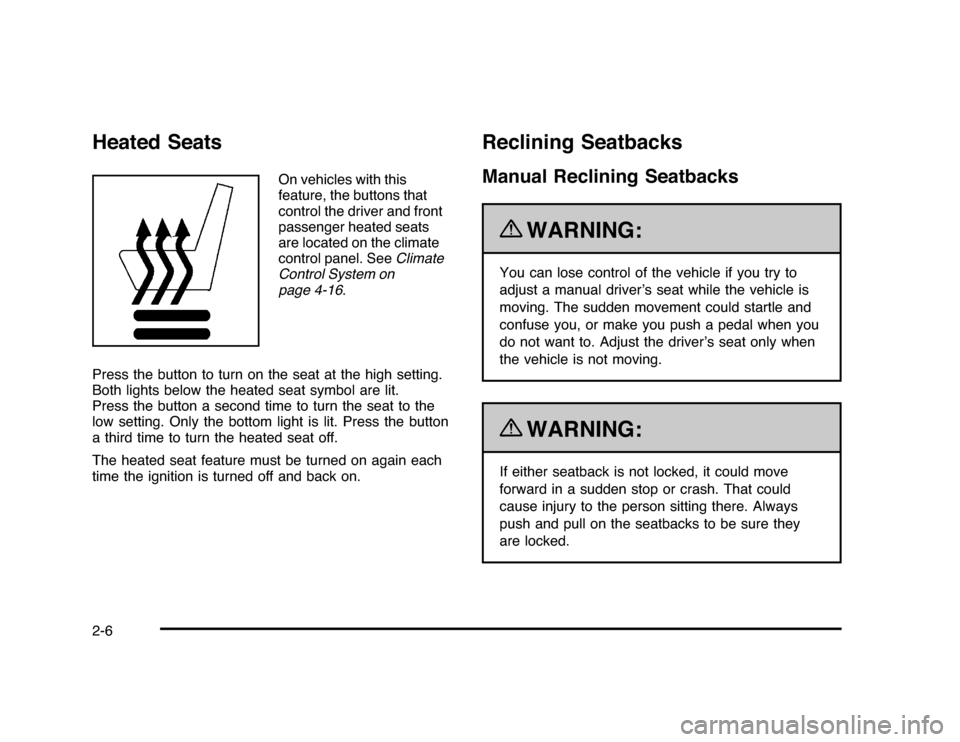
On vehicles with this
feature, the buttons that
control the driver and front
passenger heated seats
are located on the climate
control panel. SeeClimate
Control System on
page 4-16.
Press the button to turn on the seat at the high setting.
Both lights below the heated seat symbol are lit.
Press the button a second time to turn the seat to the
low setting. Only the bottom light is lit. Press the button
a third time to turn the heated seat off.
The heated seat feature must be turned on again each
time the ignition is turned off and back on.
Reclining SeatbacksManual Reclining Seatbacks
{
WARNING:
You can lose control of the vehicle if you try to
adjust a manual driver’s seat while the vehicle is
moving. The sudden movement could startle and
confuse you, or make you push a pedal when you
do not want to. Adjust the driver’s seat only when
the vehicle is not moving.{
WARNING:
If either seatback is not locked, it could move
forward in a sudden stop or crash. That could
cause injury to the person sitting there. Always
push and pull on the seatbacks to be sure they
are locked.
2-6
Page 37 of 432
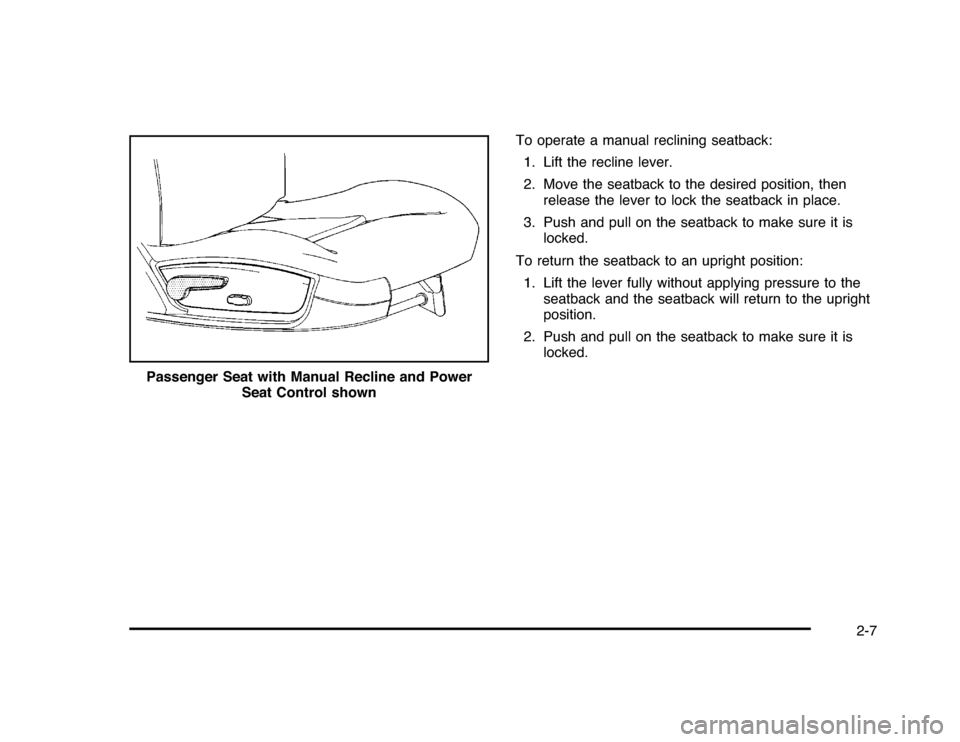
To operate a manual reclining seatback:
1. Lift the recline lever.
2. Move the seatback to the desired position, then
release the lever to lock the seatback in place.
3. Push and pull on the seatback to make sure it is
locked.
To return the seatback to an upright position:
1. Lift the lever fully without applying pressure to the
seatback and the seatback will return to the upright
position.
2. Push and pull on the seatback to make sure it is
locked.
Passenger Seat with Manual Recline and Power
Seat Control shown
2-7
Page 41 of 432
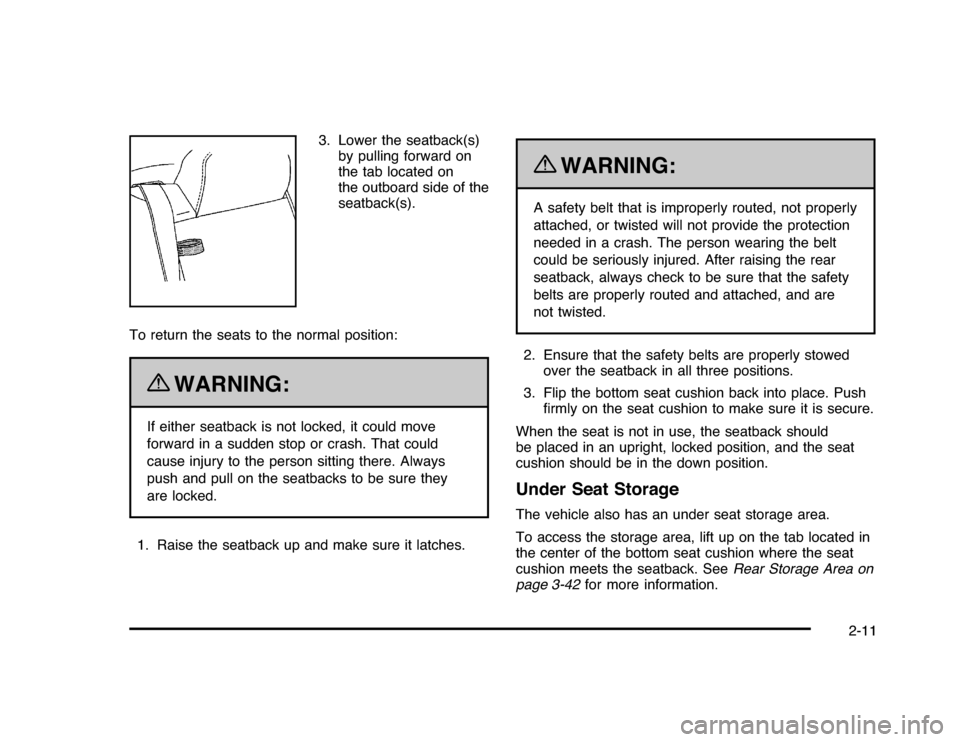
3. Lower the seatback(s)
by pulling forward on
the tab located on
the outboard side of the
seatback(s).
To return the seats to the normal position:
{
WARNING:
If either seatback is not locked, it could move
forward in a sudden stop or crash. That could
cause injury to the person sitting there. Always
push and pull on the seatbacks to be sure they
are locked.
1. Raise the seatback up and make sure it latches.
{
WARNING:
A safety belt that is improperly routed, not properly
attached, or twisted will not provide the protection
needed in a crash. The person wearing the belt
could be seriously injured. After raising the rear
seatback, always check to be sure that the safety
belts are properly routed and attached, and are
not twisted.
2. Ensure that the safety belts are properly stowed
over the seatback in all three positions.
3. Flip the bottom seat cushion back into place. Push
firmly on the seat cushion to make sure it is secure.
When the seat is not in use, the seatback should
be placed in an upright, locked position, and the seat
cushion should be in the down position.
Under Seat StorageThe vehicle also has an under seat storage area.
To access the storage area, lift up on the tab located in
the center of the bottom seat cushion where the seat
cushion meets the seatback. SeeRear Storage Area on
page 3-42for more information.
2-11
Page 47 of 432
How to Wear Safety Belts ProperlyThis section is only for people of adult size.
Be aware that there are special things to know about
safety belts and children. And there are different
rules for smaller children and infants. If a child will be
riding in the vehicle, seeOlder Children on page 2-32
orInfants and Young Children on page 2-35. Follow
those rules for everyone’s protection.
It is very important for all occupants to buckle up.
Statistics show that unbelted people are hurt more often
in crashes than those who are wearing safety belts.
Occupants who are not buckled up can be thrown out
of the vehicle in a crash. And they can strike others
in the vehicle who are wearing safety belts.
First, before you or your passenger(s) wear a safety
belt, there is important information you should know.
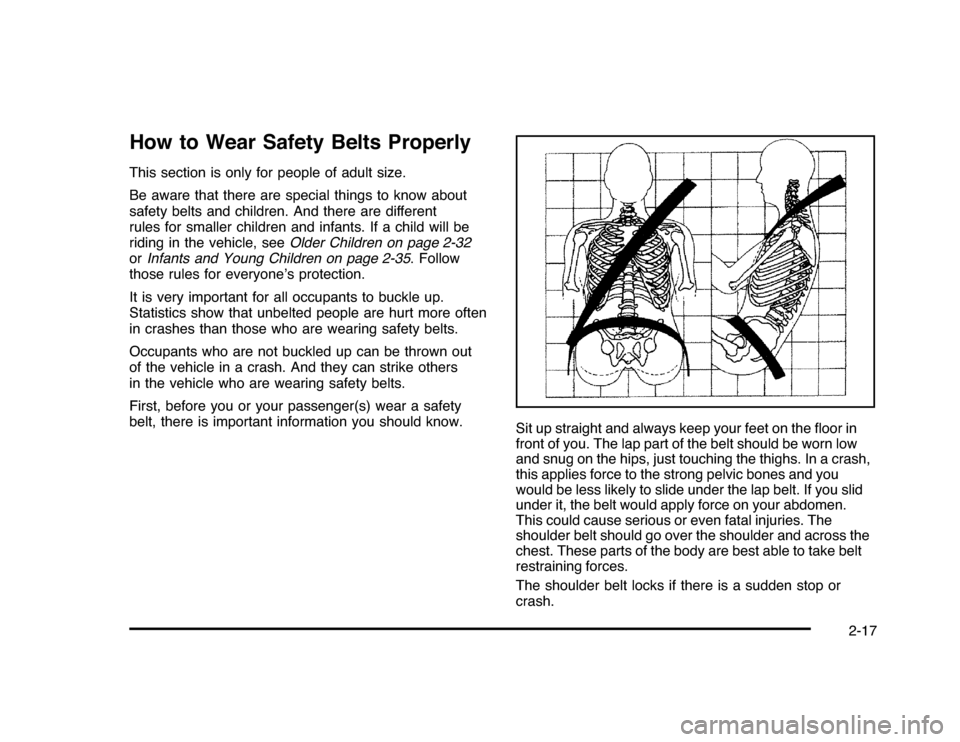
Sit up straight and always keep your feet on the floor in
front of you. The lap part of the belt should be worn low
and snug on the hips, just touching the thighs. In a crash,
this applies force to the strong pelvic bones and you
would be less likely to slide under the lap belt. If you slid
under it, the belt would apply force on your abdomen.
This could cause serious or even fatal injuries. The
shoulder belt should go over the shoulder and across the
chest. These parts of the body are best able to take belt
restraining forces.
The shoulder belt locks if there is a sudden stop or
crash.
2-17
Page 55 of 432
Lap-Shoulder BeltAll seating positions in the vehicle have a lap-shoulder
except for the center front passenger position, if
your vehicle has one, which has a lap belt. SeeLap
Belt on page 2-30for more information.
The following instructions explain how to wear a
lap-shoulder belt properly.
1. Adjust the seat, if the seat is adjustable, so you can
sit up straight. To see how, see “Seats” in the Index.
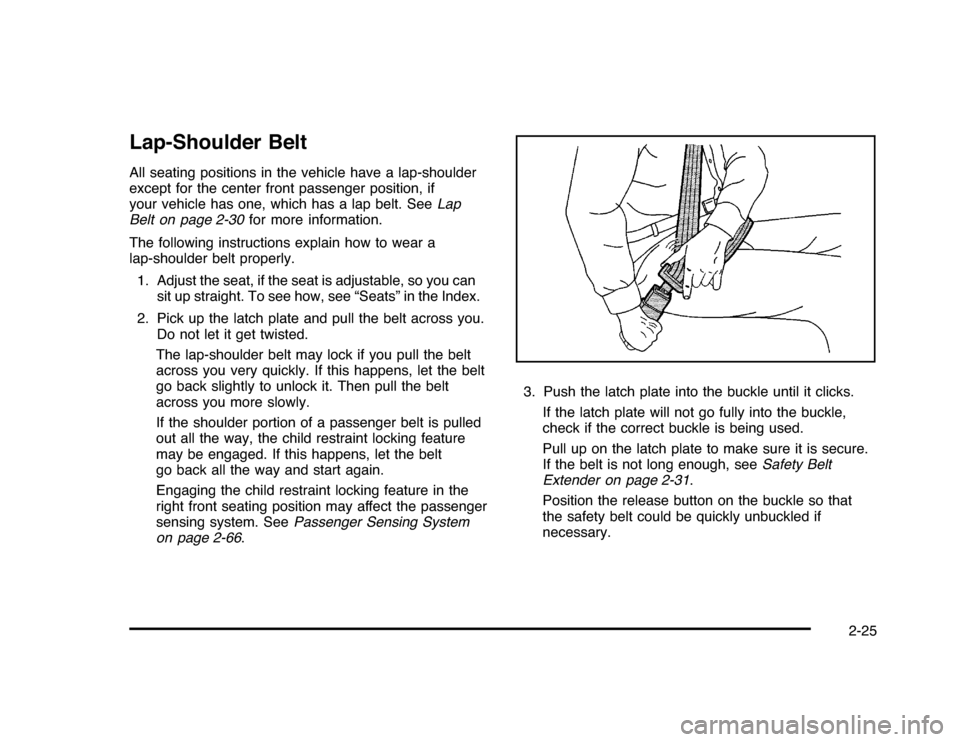
2. Pick up the latch plate and pull the belt across you.
Do not let it get twisted.
The lap-shoulder belt may lock if you pull the belt
across you very quickly. If this happens, let the belt
go back slightly to unlock it. Then pull the belt
across you more slowly.
If the shoulder portion of a passenger belt is pulled
out all the way, the child restraint locking feature
may be engaged. If this happens, let the belt
go back all the way and start again.
Engaging the child restraint locking feature in the
right front seating position may affect the passenger
sensing system. SeePassenger Sensing System
on page 2-66.3. Push the latch plate into the buckle until it clicks.
If the latch plate will not go fully into the buckle,
check if the correct buckle is being used.
Pull up on the latch plate to make sure it is secure.
If the belt is not long enough, seeSafety Belt
Extender on page 2-31.
Position the release button on the buckle so that
the safety belt could be quickly unbuckled if
necessary.
2-25