2010 CHEVROLET IMPALA door lock
[x] Cancel search: door lockPage 1 of 432

In Brief........................................................... 1-1
Instrument Panel
........................................ 1-2
Initial Drive Information
............................... 1-4
Vehicle Features
......................................1-15
Performance and Maintenance
...................1-19
Seats and Restraint System............................. 2-1
Head Restraints
......................................... 2-2
Front Seats
............................................... 2-4
Rear Seats
..............................................2-10
Safety Belts
.............................................2-12
Child Restraints
.......................................2-32
Airbag System
.........................................2-56
Restraint System Check
............................2-74
Features and Controls..................................... 3-1
Keys
........................................................ 3-3
Doors and Locks
....................................... 3-9
Windows
.................................................3-14
Theft-Deterrent Systems
............................3-16
Starting and Operating Your Vehicle
...........3-19
Mirrors
....................................................3-33Universal Home Remote System
................3-35
Storage Areas
.........................................3-42
Sunroof
..................................................3-43
Instrument Panel............................................. 4-1
Instrument Panel Overview
.......................... 4-3
Climate Controls
......................................4-16
Warning Lights, Gages, and Indicators
. . . . . . . . 4-21
Driver Information Center (DIC)
..................4-37
Audio System(s)
.......................................4-57
Driving Your Vehicle....................................... 5-1
Your Driving, the Road, and the Vehicle
....... 5-2
Towing
...................................................5-26
Service and Appearance Care.......................... 6-1
Service
..................................................... 6-3
Fuel
......................................................... 6-5
Checking Things Under the Hood
...............6-12
Headlamp Aiming
.....................................6-43
Bulb Replacement
....................................6-43
Windshield Wiper Blade Replacement
. . . . . . . . . 6-49
2010 Chevrolet Impala Owner Manual
M
Page 7 of 432

Instrument Panel..............................................1-2
Initial Drive Information....................................1-4
Remote Keyless Entry (RKE) System................1-4
Remote Vehicle Start......................................1-4
Door Locks....................................................1-5
Trunk Release...............................................1-5
Windows.......................................................1-6
Seat Adjustment.............................................1-6
Second Row Seats.........................................1-8
Head Restraint Adjustment...............................1-8
Safety Belt....................................................1-9
Sensing System for Passenger Airbag...............1-9
Mirror Adjustment.........................................1-10
Steering Wheel Adjustment............................1-11
Interior Lighting............................................1-11
Exterior Lighting...........................................1-12
Windshield Wiper/Washer...............................1-13
Climate Controls...........................................1-14Vehicle Features.............................................1-15
Radio(s)......................................................1-15
Satellite Radio..............................................1-16
Portable Audio Devices ..................................1-16
Steering Wheel Controls . . ..............................1-17
Bluetooth
®
...................................................1-17
Cruise Control..............................................1-18
Power Outlets..............................................1-18
Performance and Maintenance.........................1-19
Traction Control System (TCS).......................1-19
Electronic Stability Control (ESC)....................1-19
Tire Pressure Monitor....................................1-20
Engine Oil Life System ..................................1-20
Fuel E85 (85% Ethanol) . . ..............................1-20
Driving for Better Fuel Economy . . ...................1-21
Roadside Assistance Program........................1-21
OnStar
®
......................................................1-22
Section 1 In Brief
1-1
Page 10 of 432

Initial Drive InformationThis section provides a brief overview about some of
the important features that may or may not be on your
specific vehicle.
For more detailed information, refer to each of the
features which can be found later in this owner manual.Remote Keyless Entry (RKE)
SystemThe RKE transmitter is used to remotely lock and
unlock the doors from up to 60 m (195 feet) away from
the vehicle.
Press
K
to unlock the
driver door. Press again
within five seconds to
unlock all remaining doors.Press
Q
to lock all doors.
Lock and unlock feedback can be personalized.
Press and hold
V
for approximately one second to
open the trunk.
Press
L
and release to locate the vehicle.
Press
L
and hold for more than two seconds to sound
the panic alarm.
Press
L
again to cancel the panic alarm.
SeeKeys on page 3-3andRemote Keyless Entry
(RKE) System Operation on page 3-4.
Remote Vehicle StartWith this feature the engine can be started from outside
of the vehicle.Starting the Vehicle1. Aim the RKE transmitter at the vehicle.
2. Press
Q
.
3. Immediately after completing Step 2, press and
hold
/
until the turn signal lamps flash.
When the vehicle starts, the parking lamps will turn
on and remain on as long as the engine is running.
The doors will be locked and the climate control system
may come on.
1-4
Page 11 of 432

The engine will continue to run for 10 minutes. Repeat
the steps for a 10-minute time extension. Remote
start can be extended only once.Canceling a Remote StartTo cancel a remote start:•
Aim the RKE transmitter at the vehicle and press
and hold
/
until the parking lamps turn off.
•
Turn on the hazard warning flashers.
•
Turn the ignition switch out of LOCK/OFF position
and then back to LOCK/OFF.
SeeRemote Vehicle Start on page 3-7.
Door LocksFrom outside the vehicle, use the key in the door or the
Remote Keyless Entry (RKE) transmitter to lock or
unlock the vehicle. From the inside, pull up or push
down on the manual door lock knobs.
SeeDoor Locks on page 3-9.
Power Door LocksPower door lock switches are located on the front doors
near the handle.Q
:Press the bottom of the switch to lock all doors.
K
:Press the top of the switch to unlock all doors.
For more information, see:•
Power Door Locks on page 3-10.
•
Delayed Locking on page 3-10.
Trunk ReleaseIn addition to the trunk release button on the RKE
transmitter, there is a remote release
G
button
located on the left side of the instrument panel.
For more information seeTrunk on page 3-12.
1-5
Page 12 of 432
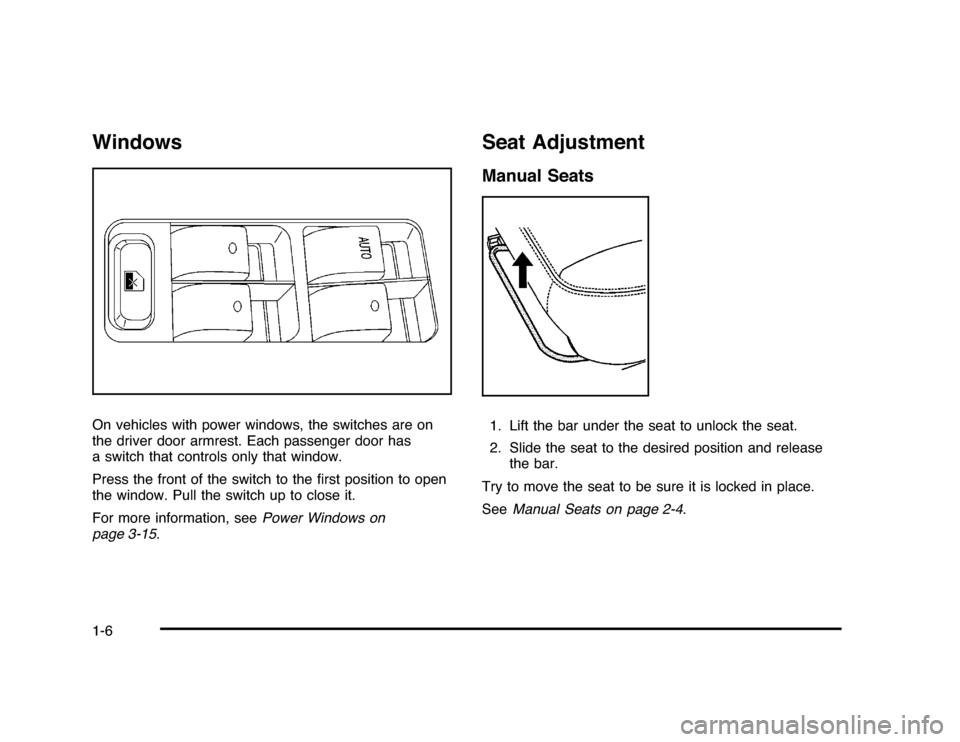
WindowsOn vehicles with power windows, the switches are on
the driver door armrest. Each passenger door has
a switch that controls only that window.
Press the front of the switch to the first position to open
the window. Pull the switch up to close it.
For more information, seePower Windows on
page 3-15.
Seat AdjustmentManual Seats1. Lift the bar under the seat to unlock the seat.
2. Slide the seat to the desired position and release
the bar.
Try to move the seat to be sure it is locked in place.
SeeManual Seats on page 2-4.
1-6
Page 17 of 432
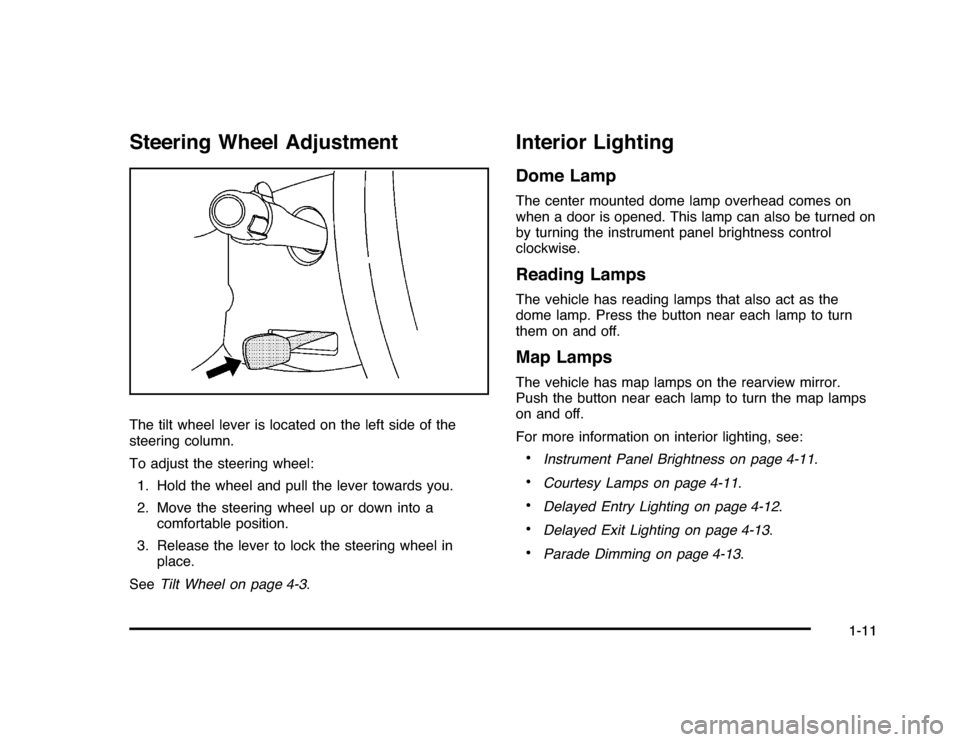
Steering Wheel AdjustmentThe tilt wheel lever is located on the left side of the
steering column.
To adjust the steering wheel:
1. Hold the wheel and pull the lever towards you.
2. Move the steering wheel up or down into a
comfortable position.
3. Release the lever to lock the steering wheel in
place.
SeeTilt Wheel on page 4-3.
Interior LightingDome LampThe center mounted dome lamp overhead comes on
when a door is opened. This lamp can also be turned on
by turning the instrument panel brightness control
clockwise.Reading LampsThe vehicle has reading lamps that also act as the
dome lamp. Press the button near each lamp to turn
them on and off.Map LampsThe vehicle has map lamps on the rearview mirror.
Push the button near each lamp to turn the map lamps
on and off.
For more information on interior lighting, see:•
Instrument Panel Brightness on page 4-11.
•
Courtesy Lamps on page 4-11.
•
Delayed Entry Lighting on page 4-12.
•
Delayed Exit Lighting on page 4-13.
•
Parade Dimming on page 4-13.
1-11
Page 28 of 432
OnStar
®
OnStar
®
uses several innovative technologies and live
advisors to provide a wide range of safety, security,
navigation, diagnostics, and calling services.
Automatic Crash ResponseIn a crash, built in sensors can automatically alert an
OnStar advisor who is immediately connected to
the vehicle to see if you need help.How OnStar Service Works
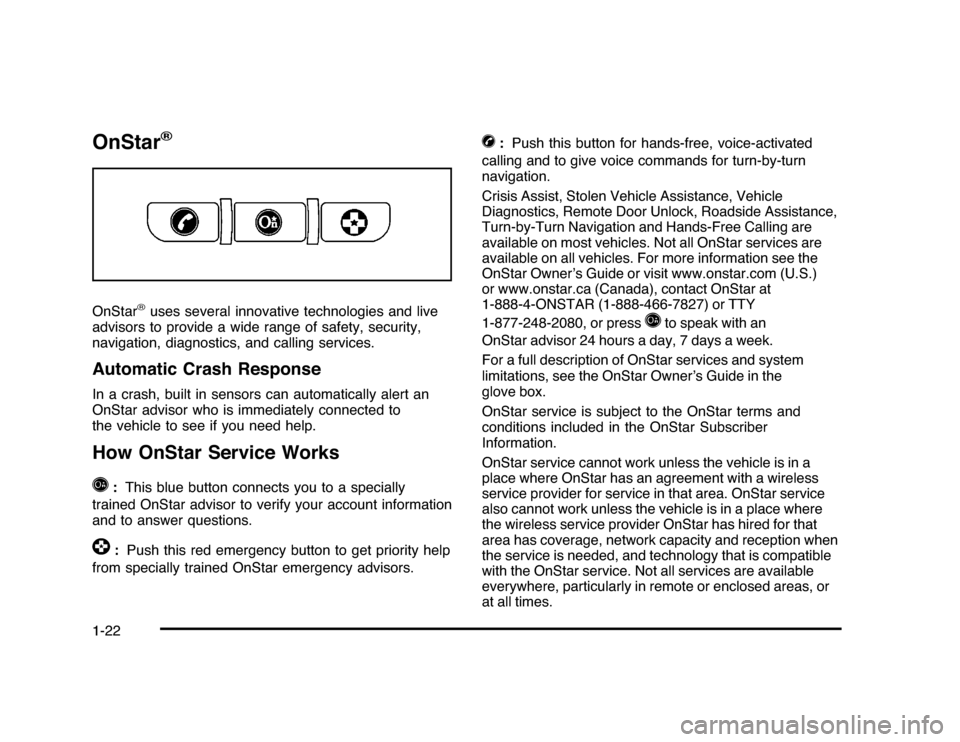
Q
:This blue button connects you to a specially
trained OnStar advisor to verify your account information
and to answer questions.
]
:Push this red emergency button to get priority help
from specially trained OnStar emergency advisors.
X
:Push this button for hands-free, voice-activated
calling and to give voice commands for turn-by-turn
navigation.
Crisis Assist, Stolen Vehicle Assistance, Vehicle
Diagnostics, Remote Door Unlock, Roadside Assistance,
Turn-by-Turn Navigation and Hands-Free Calling are
available on most vehicles. Not all OnStar services are
available on all vehicles. For more information see the
OnStar Owner’s Guide or visit www.onstar.com (U.S.)
or www.onstar.ca (Canada), contact OnStar at
1-888-4-ONSTAR (1-888-466-7827) or TTY
1-877-248-2080, or press
Q
to speak with an
OnStar advisor 24 hours a day, 7 days a week.
For a full description of OnStar services and system
limitations, see the OnStar Owner’s Guide in the
glove box.
OnStar service is subject to the OnStar terms and
conditions included in the OnStar Subscriber
Information.
OnStar service cannot work unless the vehicle is in a
place where OnStar has an agreement with a wireless
service provider for service in that area. OnStar service
also cannot work unless the vehicle is in a place where
the wireless service provider OnStar has hired for that
area has coverage, network capacity and reception when
the service is needed, and technology that is compatible
with the OnStar service. Not all services are available
everywhere, particularly in remote or enclosed areas, or
at all times.
1-22
Page 91 of 432
{
WARNING:
If something is between an occupant and an
airbag, the airbag might not inflate properly or it
might force the object into that person causing
severe injury or even death. The path of an
inflating airbag must be kept clear. Do not put
anything between an occupant and an airbag, and
do not attach or put anything on the steering
wheel hub or on or near any other airbag
covering.
Do not use seat accessories that block the
inflation path of a seat-mounted side impact
airbag.
Never secure anything to the roof of a vehicle with
roof-rail airbags by routing a rope or tie down
through any door or window opening. If you do,
the path of an inflating roof-rail airbag will be
blocked.
When Should an Airbag Inflate?Frontal airbags are designed to inflate in moderate to
severe frontal or near-frontal crashes to help reduce the
potential for severe injuries mainly to the driver’s or
right front passenger’s head and chest. However, they
are only designed to inflate if the impact exceeds a
predetermined deployment threshold. Deployment
thresholds are used to predict how severe a crash is
likely to be in time for the airbags to inflate and
help restrain the occupants.
Whether the frontal airbags will or should deploy is not
based on how fast your vehicle is traveling. It depends
largely on what you hit, the direction of the impact,
and how quickly your vehicle slows down.
2-61