2010 CHEVROLET CORVETTE flat tire
[x] Cancel search: flat tirePage 389 of 472
You need a new tire if any of the following statements
are true:
.You can see the indicators at three or more places
around the tire.
.You can see cord or fabric showing through the
tire's rubber.
.The tread or sidewall is cracked, cut or snagged
deep enough to show cord or fabric.
.The tire has a bump, bulge or split.
.The tire has a puncture, cut or other damage that
cannot be repaired well because of the size or
location of the damage.
The rubber in tires degrades over time, even if they
are not being used. This is also true for the spare tire,
if your vehicle has one. Multiple conditions affect how
fast this aging takes place, including temperatures,
loading conditions, and inflation pressure maintenance.
With proper care and maintenance tires will typically
wear out before they degrade due to age. If you are
unsure about the need to replace your tires as they get
older, consult the tire manufacturer for more information.
Buying New Tires
GM has developed and matched specific tires for your
vehicle. The original equipment tires installed on your
vehicle, when it was new, were designed to meet
General Motors Tire Performance Criteria Specification
(TPC Spec) system rating. If you need replacement
tires, GM strongly recommends that you get tires with
the same TPC Spec rating. This way, your vehicle will
continue to have tires that are designed to give the
same performance and vehicle safety, during normal
use, as the original tires.
GM's exclusive TPC Spec system considers over a
dozen critical specifications that impact the overall
performance of your vehicle, including brake system
performance, ride and handling, traction control, and
tire pressure monitoring performance. GM's TPC Spec
number is molded onto the tire's sidewall near the tire
size. If the tires have an all‐season tread design, the
TPC Spec number will be followed by an MS for mud
and snow. See Tire Sidewall Labeling
on page 6‑64,
for additional information.
6-77
Page 393 of 472
Temperature–A, B, C
The temperature grades are A (the highest), B,
and C, representing the tire's resistance to the
generation of heat and its ability to dissipate
heat when tested under controlled conditions
on a specified indoor laboratory test wheel.
Sustained high temperature can cause the
material of the tire to degenerate and reduce
tire life, and excessive temperature can lead to
sudden tire failure. The grade C corresponds to
a level of performance which all passenger car
tires must meet under the Federal Motor Safety
Standard No. 109. Grades B and A represent
higher levels of performance on the laboratory
test wheel than the minimum required by law.
Warning: The temperature grade for this tire is
established for a tire that is properly inflated and
not overloaded. Excessive speed, underinflation,
or excessive loading, either separately or in
combination, can cause heat buildup and possible
tire failure.
Wheel Alignment and Tire Balance
The tires and wheels on your vehicle were aligned and
balanced carefully at the factory to give you the longest
tire life and best overall performance. Adjustments
to wheel alignment and tire balancing will not be
necessary on a regular basis. However, if you notice
unusual tire wear or your vehicle pulling to one side
or the other, the alignment might need to be checked.
If you notice your vehicle vibrating when driving on
a smooth road, the tires and wheels might need to
be rebalanced. See your dealer/retailer for proper
diagnosis.
Wheel Replacement
Replace any wheel that is bent, cracked, or badly
rusted or corroded. If wheel nuts keep coming loose,
the wheel, wheel bolts, and wheel nuts should be
replaced. If the wheel leaks air, replace it (except some
aluminum wheels, which can sometimes be repaired).
See your dealer/retailer if any of these conditions exist.
Your dealer/retailer will know the kind of wheel
you need.
Each new wheel should have the same load-carrying
capacity, diameter, width, offset, and be mounted the
same way as the one it replaces.
6-81
Page 401 of 472
If a Tire Goes Flat
It is unusual for a tire to blow out while you are driving,
especially if you maintain the tires properly. If air goes
out of a tire, it is much more likely to leak out slowly.
See Tires
on page 6‑62for additional information.
But if you should ever have a blowout, here are a few
tips about what to expect and what to do:
If a front tire fails, the flat tire creates a drag that pulls
the vehicle toward that side. Take your foot off the
accelerator pedal and grip the steering wheel firmly.
Steer to maintain lane position, and then gently brake
to a stop well out of the traffic lane.
A rear blowout, particularly on a curve, acts much like a
skid and may require the same correction you would
use in a skid. In any rear blowout remove your foot from
the accelerator pedal. Get the vehicle under control by
steering the way you want the vehicle to go. It may be
very bumpy and noisy, but you can still steer. Gently
brake to a stop, well off the road if possible.
The vehicle has no spare tire, no tire changing
equipment, and no place to store a tire. The vehicle, when new, had run-flat tires. This type of
tire can operate effectively with no air pressure, so you
will not need to stop on the side of the road to change
a flat tire. You can just keep on driving. The shorter
the distance you drive and the slower the speed, the
greater the chance that the run-flat tire will not have to
be replaced. Run-flat tires perform so well without any
air that a Tire Pressure Monitor System (TPMS) is used
to alert you if a tire has lost pressure. See
Run-Flat
Tires
on page 6‑69and Tire Pressure Monitor Systemon page 6‑72.
{WARNING:
Special tools and procedures are required to
service a run-flat tire. If these special tools and
procedures are not used you or others could
be injured and the vehicle could be damaged.
Always be sure the proper tools and procedures,
as described in the service manual, are used.
To order a service manual, see Service Publications
Ordering Information on page 8‑16.
6-89
Page 425 of 472
Scheduled Maintenance
When the Change Engine Oil Message
Displays
Change engine oil and filter. See Engine Oilon
page 6‑19. An Emission Control Service.
When the Change Engine Oil message displays,
service is required for the vehicle as soon as possible,
within the next 1 000 km/600 miles. If driving under the
best conditions, the engine oil life system might not
indicate the need for vehicle service for more than a
year. The engine oil and filter must be changed at least
once a year and the oil life system must be reset. Your
dealer/retailer has trained service technicians who will
perform this work and reset the system. If the engine
oil life system is reset accidentally, service the vehicle
within 5 000 km/3,000 miles since the last service.
Reset the oil life system whenever the oil is changed.
See Engine Oil Life System on page 6‑25. When the Change Engine Oil message displays,
certain services, checks, and inspections are
required. The services described for Maintenance
I
should be performed at every engine oil change.
The services described for Maintenance IIshould
be performed when:.Maintenance Iwas performed the last time the
engine oil was changed.
.It has been 10 months or more since the Change
Engine Oil message has displayed or since the last
service.
Maintenance I
.Change engine oil and filter. See Engine Oilon
page 6‑19. An Emission Control Service.
.Engine coolant level check. See Engine Coolanton page 6‑34.
.Windshield washer fluid level check. See
Windshield Washer Fluid on page 6‑42.
.Tire inflation check. See Inflation - Tire Pressureon page 6‑70.
7-3
Page 427 of 472
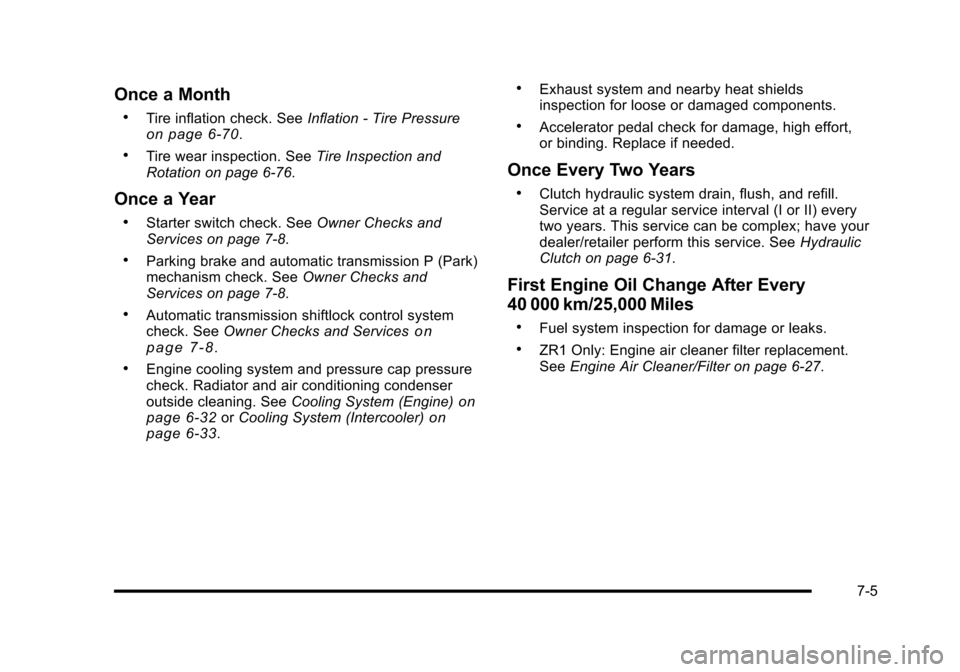
Once a Month
.Tire inflation check. SeeInflation - Tire Pressureon page 6‑70.
.Tire wear inspection. See Tire Inspection and
Rotation on page 6‑76.
Once a Year
.Starter switch check. See Owner Checks and
Services on page 7‑8.
.Parking brake and automatic transmission P (Park)
mechanism check. See Owner Checks and
Services on page 7‑8.
.Automatic transmission shiftlock control system
check. See Owner Checks and Serviceson
page 7‑8.
.Engine cooling system and pressure cap pressure
check. Radiator and air conditioning condenser
outside cleaning. See Cooling System (Engine)
on
page 6‑32or Cooling System (Intercooler)on
page 6‑33.
.Exhaust system and nearby heat shields
inspection for loose or damaged components.
.Accelerator pedal check for damage, high effort,
or binding. Replace if needed.
Once Every Two Years
.Clutch hydraulic system drain, flush, and refill.
Service at a regular service interval (I or II) every
two years. This service can be complex; have your
dealer/retailer perform this service. See Hydraulic
Clutch on page 6‑31.
First Engine Oil Change After Every
40 000 km/25,000 Miles
.Fuel system inspection for damage or leaks.
.ZR1 Only: Engine air cleaner filter replacement.
See Engine Air Cleaner/Filter on page 6‑27.
7-5
Page 429 of 472
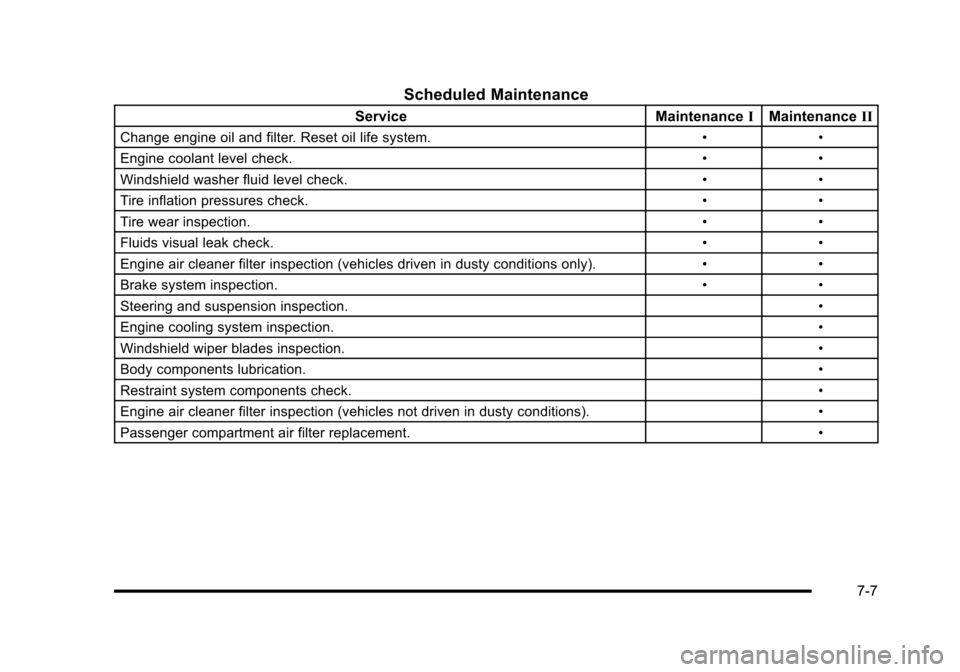
Scheduled Maintenance
ServiceMaintenanceIMaintenance II
Change engine oil and filter. Reset oil life system. ••
Engine coolant level check. ••
Windshield washer fluid level check. ••
Tire inflation pressures check. ••
Tire wear inspection. ••
Fluids visual leak check. ••
Engine air cleaner filter inspection (vehicles driven in dusty conditions only). ••
Brake system inspection. ••
Steering and suspension inspection. •
Engine cooling system inspection. •
Windshield wiper blades inspection. •
Body components lubrication. •
Restraint system components check. •
Engine air cleaner filter inspection (vehicles not driven in dusty conditions). •
Passenger compartment air filter replacement. •
7-7
Page 446 of 472
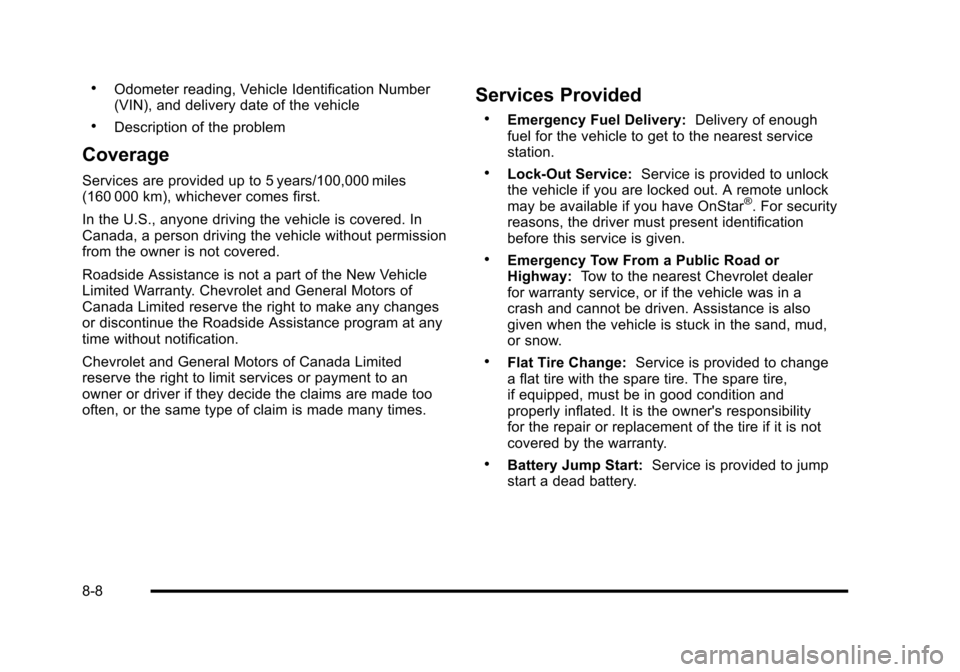
.Odometer reading, Vehicle Identification Number
(VIN), and delivery date of the vehicle
.Description of the problem
Coverage
Services are provided up to 5 years/100,000 miles
(160 000 km), whichever comes first.
In the U.S., anyone driving the vehicle is covered. In
Canada, a person driving the vehicle without permission
from the owner is not covered.
Roadside Assistance is not a part of the New Vehicle
Limited Warranty. Chevrolet and General Motors of
Canada Limited reserve the right to make any changes
or discontinue the Roadside Assistance program at any
time without notification.
Chevrolet and General Motors of Canada Limited
reserve the right to limit services or payment to an
owner or driver if they decide the claims are made too
often, or the same type of claim is made many times.
Services Provided
.Emergency Fuel Delivery: Delivery of enough
fuel for the vehicle to get to the nearest service
station.
.Lock‐Out Service: Service is provided to unlock
the vehicle if you are locked out. A remote unlock
may be available if you have OnStar
®. For security
reasons, the driver must present identification
before this service is given.
.Emergency Tow From a Public Road or
Highway: Tow to the nearest Chevrolet dealer
for warranty service, or if the vehicle was in a
crash and cannot be driven. Assistance is also
given when the vehicle is stuck in the sand, mud,
or snow.
.Flat Tire Change: Service is provided to change
a flat tire with the spare tire. The spare tire,
if equipped, must be in good condition and
properly inflated. It is the owner's responsibility
for the repair or replacement of the tire if it is not
covered by the warranty.
.Battery Jump Start: Service is provided to jump
start a dead battery.
8-8
Page 459 of 472

A
Accessories and Modifications . . . . . . . . . . . . . . . . . . . . . . .6-3
Accessory Power . . . . . . . . . . . . . . . . . . . . . . . . . . . . . . . . . . 3-24
Accessory Power Outlets . . . . . . . . . . . . . . . . . . . . . . . . . . 4-20
Active Handling System . . . . . . . . . . . . . . . . . . . . . . . . . . . . .5-8
Active Handling System Light . . . . . . . . . . . . . . . . . . . . . . 4-39
Add-On Electrical Equipment . . . . . . . . . . . . . . . . . . . . . 6-100
Additives, Fuel . . . . . . . . . . . . . . . . . . . . . . . . . . . . . . . . . . . . . . .6-8
Air Cleaner/Filter, Engine . . . . . . . . . . . . . . . . . . . . . . . . . . 6-27
Air Dam, Front . . . . . . . . . . . . . . . . . . . . . . . . . . . . . . . . . . . . . 3-22
Air Filter, Passenger Compartment . . . . . . . . . . . . . . . . 4-28
AirbagAdding Equipment to Your Airbag-EquippedVehicle . . . . . . . . . . . . . . . . . . . . . . . . . . . . . . . . . . . . . . . . . . 2-59
Airbag System How Does an Airbag Restrain? . . . . . . . . . . . . . . . . . . . 2-50
Passenger Sensing System . . . . . . . . . . . . . . . . . . . . . . 2-53
Servicing Your Airbag-Equipped Vehicle . . . . . . . . . . 2-58
What Makes an Airbag Inflate? . . . . . . . . . . . . . . . . . . . 2-50
What Will You See After an Airbag Inflates? . . . . . . 2-51
When Should an Airbag Inflate? . . . . . . . . . . . . . . . . . . 2-48
Where Are the Airbags? . . . . . . . . . . . . . . . . . . . . . . . . . . 2-46
Airbags Passenger Status Indicator . . . . . . . . . . . . . . . . . . . . . . . 4-34
Readiness Light . . . . . . . . . . . . . . . . . . . . . . . . . . . . . . . . . . 4-33
System Check . . . . . . . . . . . . . . . . . . . . . . . . . . . . . . . . . . . . 2-44 Antenna
Diversity . . . . . . . . . . . . . . . . . . . . . . . . . . . . . . . . . . . . . . . . .4-109
Antenna, XM™ Satellite Radio Antenna
System . . . . . . . . . . . . . . . . . . . . . . . . . . . . . . . . . . . . . . . . . . 4-109
Antilock Brake System (ABS) . . . . . . . . . . . . . . . . . . . . . . . .5-5 Warning Light . . . . . . . . . . . . . . . . . . . . . . . . . . . . . . . . . . . . . 4-37
Appearance Care
Aluminum or Chrome-Plated Wheels . . . . . . . . . . . . . 6-97
Care of Safety Belts . . . . . . . . . . . . . . . . . . . . . . . . . . . . . . 6-93
Cargo Cover and Convenience Net . . . . . . . . . . . . . . . 6-93
Chemical Paint Spotting . . . . . . . . . . . . . . . . . . . . . . . . . . 6-99
Cleaning Exterior Lamps/Lenses . . . . . . . . . . . . . . . . . 6-94
Coated Moldings . . . . . . . . . . . . . . . . . . . . . . . . . . . . . . . . . 6-92
Convertible Top . . . . . . . . . . . . . . . . . . . . . . . . . . . . . . . . . . . 6-97
Fabric/Carpet . . . . . . . . . . . . . . . . . . . . . . . . . . . . . . . . . . . . . 6-91
Fiberglass Springs . . . . . . . . . . . . . . . . . . . . . . . . . . . . . . . . 6-99
Finish Care . . . . . . . . . . . . . . . . . . . . . . . . . . . . . . . . . . . . . . . 6-95
Finish Damage . . . . . . . . . . . . . . . . . . . . . . . . . . . . . . . . . . . 6-98
Instrument Panel, Vinyl, and Other PlasticSurfaces . . . . . . . . . . . . . . . . . . . . . . . . . . . . . . . . . . . . . . . . 6-93
Interior Cleaning . . . . . . . . . . . . . . . . . . . . . . . . . . . . . . . . . . 6-90
Leather . . . . . . . . . . . . . . . . . . . . . . . . . . . . . . . . . . . . . . . . . . . 6-92
Removable Roof Panel . . . . . . . . . . . . . . . . . . . . . . . . . . . 6-96
Tires . . . . . . . . . . . . . . . . . . . . . . . . . . . . . . . . . . . . . . . . . . . . . . 6-98
Underbody Maintenance . . . . . . . . . . . . . . . . . . . . . . . . . . 6-98
Washing Your Vehicle . . . . . . . . . . . . . . . . . . . . . . . . . . . . 6-94
Weatherstrips . . . . . . . . . . . . . . . . . . . . . . . . . . . . . . . . . . . . . 6-93
Windshield and Wiper Blades . . . . . . . . . . . . . . . . . . . . . 6-96
i - 1