2010 CHEVROLET CORVETTE manual transmission
[x] Cancel search: manual transmissionPage 126 of 472
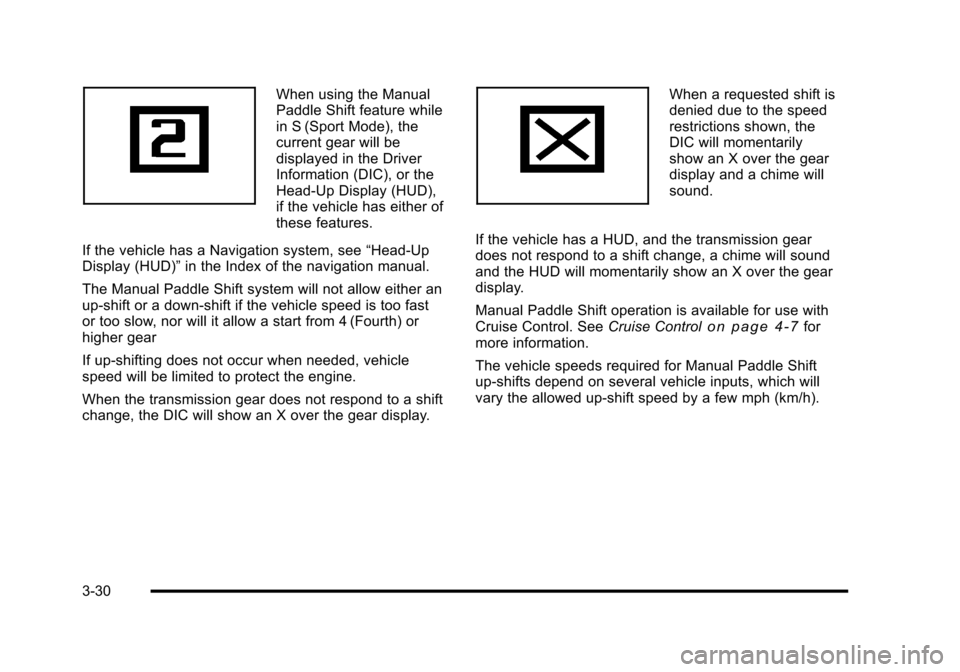
When using the Manual
Paddle Shift feature while
in S (Sport Mode), the
current gear will be
displayed in the Driver
Information (DIC), or the
Head-Up Display (HUD),
if the vehicle has either of
these features.
If the vehicle has a Navigation system, see “Head-Up
Display (HUD)” in the Index of the navigation manual.
The Manual Paddle Shift system will not allow either an
up-shift or a down-shift if the vehicle speed is too fast
or too slow, nor will it allow a start from 4 (Fourth) or
higher gear
If up-shifting does not occur when needed, vehicle
speed will be limited to protect the engine.
When the transmission gear does not respond to a shift
change, the DIC will show an X over the gear display. When a requested shift is
denied due to the speed
restrictions shown, the
DIC will momentarily
show an X over the gear
display and a chime will
sound.
If the vehicle has a HUD, and the transmission gear
does not respond to a shift change, a chime will sound
and the HUD will momentarily show an X over the gear
display.
Manual Paddle Shift operation is available for use with
Cruise Control. See Cruise Control
on page 4‑7for
more information.
The vehicle speeds required for Manual Paddle Shift
up-shifts depend on several vehicle inputs, which will
vary the allowed up-shift speed by a few mph (km/h).
3-30
Page 128 of 472
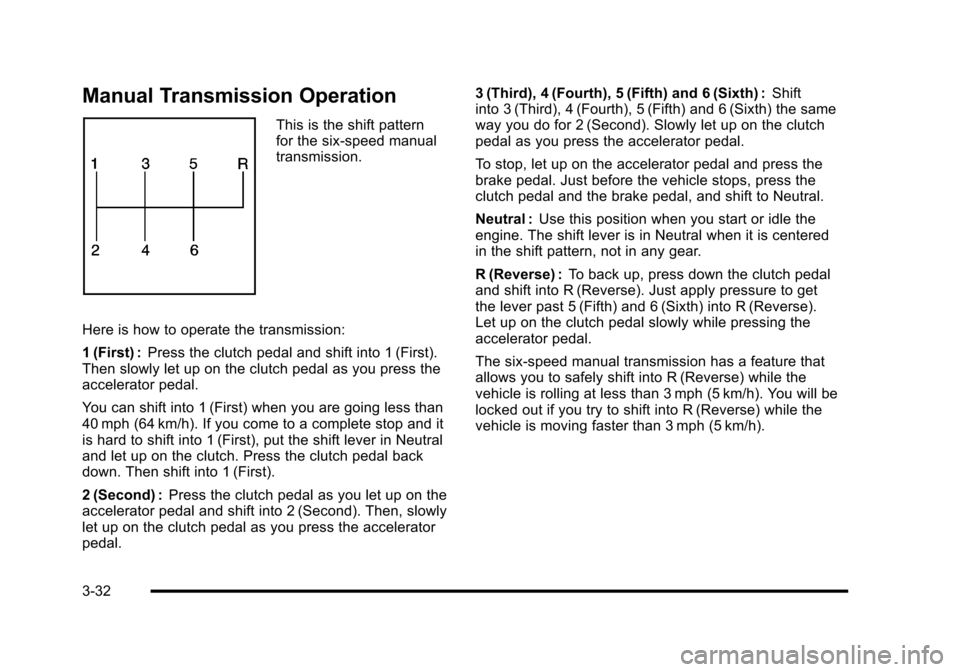
Manual Transmission Operation
This is the shift pattern
for the six-speed manual
transmission.
Here is how to operate the transmission:
1 (First) : Press the clutch pedal and shift into 1 (First).
Then slowly let up on the clutch pedal as you press the
accelerator pedal.
You can shift into 1 (First) when you are going less than
40 mph (64 km/h). If you come to a complete stop and it
is hard to shift into 1 (First), put the shift lever in Neutral
and let up on the clutch. Press the clutch pedal back
down. Then shift into 1 (First).
2 (Second) : Press the clutch pedal as you let up on the
accelerator pedal and shift into 2 (Second). Then, slowly
let up on the clutch pedal as you press the accelerator
pedal. 3 (Third), 4 (Fourth), 5 (Fifth) and 6 (Sixth) :
Shift
into 3 (Third), 4 (Fourth), 5 (Fifth) and 6 (Sixth) the same
way you do for 2 (Second). Slowly let up on the clutch
pedal as you press the accelerator pedal.
To stop, let up on the accelerator pedal and press the
brake pedal. Just before the vehicle stops, press the
clutch pedal and the brake pedal, and shift to Neutral.
Neutral : Use this position when you start or idle the
engine. The shift lever is in Neutral when it is centered
in the shift pattern, not in any gear.
R (Reverse) : To back up, press down the clutch pedal
and shift into R (Reverse). Just apply pressure to get
the lever past 5 (Fifth) and 6 (Sixth) into R (Reverse).
Let up on the clutch pedal slowly while pressing the
accelerator pedal.
The six-speed manual transmission has a feature that
allows you to safely shift into R (Reverse) while the
vehicle is rolling at less than 3 mph (5 km/h). You will be
locked out if you try to shift into R (Reverse) while the
vehicle is moving faster than 3 mph (5 km/h).
3-32
Page 129 of 472
Shift Speeds (Manual Transmission)
{WARNING:
If you skip a gear when you downshift, you could
lose control of the vehicle. You could injure
yourself or others. Do not shift down more than
one gear at a time when you downshift.
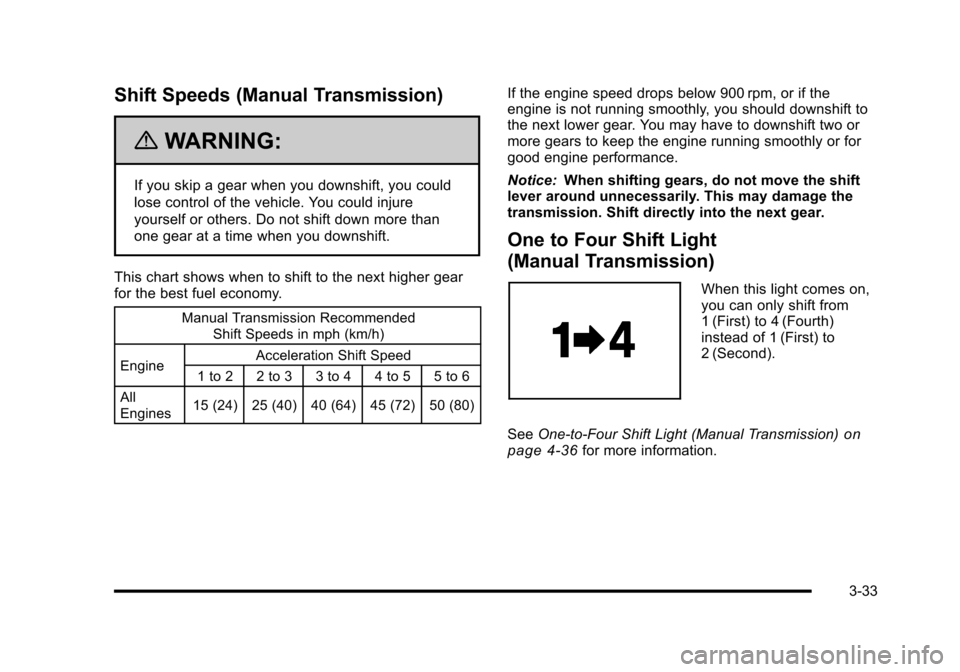
This chart shows when to shift to the next higher gear
for the best fuel economy.
Manual Transmission Recommended Shift Speeds in mph (km/h)
Engine Acceleration Shift Speed
1 to 2 2 to 3 3 to 4 4 to 5 5 to 6
All
Engines 15 (24) 25 (40) 40 (64) 45 (72) 50 (80)
If the engine speed drops below 900 rpm, or if the
engine is not running smoothly, you should downshift to
the next lower gear. You may have to downshift two or
more gears to keep the engine running smoothly or for
good engine performance.
Notice:
When shifting gears, do not move the shift
lever around unnecessarily. This may damage the
transmission. Shift directly into the next gear.
One to Four Shift Light
(Manual Transmission)
When this light comes on,
you can only shift from
1 (First) to 4 (Fourth)
instead of 1 (First) to
2 (Second).
See One-to-Four Shift Light (Manual Transmission)
on
page 4‑36for more information.
3-33
Page 130 of 472
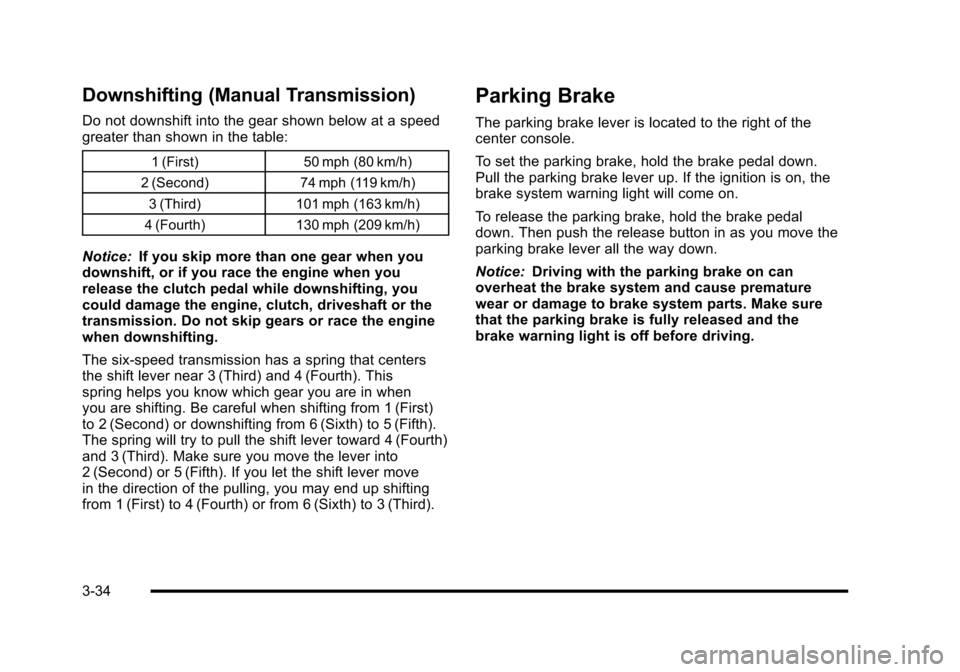
Downshifting (Manual Transmission)
Do not downshift into the gear shown below at a speed
greater than shown in the table:
1 (First)50 mph (80 km/h)
2 (Second) 74 mph (119 km/h)
3 (Third) 101 mph (163 km/h)
4 (Fourth) 130 mph (209 km/h)
Notice: If you skip more than one gear when you
downshift, or if you race the engine when you
release the clutch pedal while downshifting, you
could damage the engine, clutch, driveshaft or the
transmission. Do not skip gears or race the engine
when downshifting.
The six-speed transmission has a spring that centers
the shift lever near 3 (Third) and 4 (Fourth). This
spring helps you know which gear you are in when
you are shifting. Be careful when shifting from 1 (First)
to 2 (Second) or downshifting from 6 (Sixth) to 5 (Fifth).
The spring will try to pull the shift lever toward 4 (Fourth)
and 3 (Third). Make sure you move the lever into
2 (Second) or 5 (Fifth). If you let the shift lever move
in the direction of the pulling, you may end up shifting
from 1 (First) to 4 (Fourth) or from 6 (Sixth) to 3 (Third).
Parking Brake
The parking brake lever is located to the right of the
center console.
To set the parking brake, hold the brake pedal down.
Pull the parking brake lever up. If the ignition is on, the
brake system warning light will come on.
To release the parking brake, hold the brake pedal
down. Then push the release button in as you move the
parking brake lever all the way down.
Notice: Driving with the parking brake on can
overheat the brake system and cause premature
wear or damage to brake system parts. Make sure
that the parking brake is fully released and the
brake warning light is off before driving.
3-34
Page 132 of 472
Torque Lock (Automatic Transmission)
If you are parking on a hill and you do not shift the
transmission into P (Park) properly, the weight of the
vehicle may put too much force on the parking pawl
in the transmission. You may find it difficult to pull the
shift lever out of P (Park). This is called “torque lock.”
To prevent torque lock, set the parking brake and then
shift into P (Park) properly before you leave the driver
seat. To find out how, see “Shifting Into P (Park)”listed
previously in this section.
When you are ready to drive, move the shift lever out
of P (Park) before you release the parking brake.
If torque lock does occur, you may need to have
another vehicle push yours a little uphill to take some
of the pressure from the transmission parking pawl, so
you can pull the shift lever out of P (Park).
Shifting Out of Park
Shift lock release prevents shifting out of P (Park)
unless the vehicle is running or in Accessory mode and
the brake pedal is applied.
The shift lock release is always functional except in the
case of an uncharged or low voltage (less than 9‐volt)
battery. See Jump Starting
on page 6‑50for more
information. To shift out of P (Park) use the following:
1. Apply the brake pedal.
2. Press the shift lever button.
3. Move the shift lever to the desired position.
If you still are unable to shift out of P (Park): 1. Fully release the shift lever button.
2. While holding down the brake pedal, press the shift lever button again.
3. Move the shift lever to the desired position.
If you still cannot move the shift lever from P (Park),
consult your dealer/retailer or a professional towing
service.
Parking the Vehicle
(Manual Transmission)
Before you get out of the vehicle, move the shift lever
into R (Reverse) and firmly apply the parking brake.
Once the shift lever has been placed into R (Reverse)
with the clutch pedal pressed in, you can turn the
ignition off and release the clutch.
3-36
Page 150 of 472
Roof Panel
On vehicles with a removable roof panel, follow the
procedures when removing or installing it.
Removing the Roof Panel
{WARNING:
Do not try to remove a roof panel while the vehicle
is moving. Trying to remove the roof panel while
the vehicle is moving could cause an accident.
The panel could fall into the vehicle and cause
you to lose control, or it could fly off and strike
another vehicle. You or others could be injured.
Remove the roof panel only when the vehicle is
parked. Until you are sure you can remove the panel alone,
have someone help you.
Notice:
If you drop or rest a roof panel on its edges,
the roof panel, paint and/or weatherstripping may
be damaged. Always place the roof panel in the
stowage receivers after removing it from the
vehicle.
1. Park on a level surface and set the parking brake. Shift an automatic transmission into P (Park).
Shift a manual transmission into N (Neutral).
2. Make sure the ignition is off.
3. Lower both sun visors.
4. Open the rear hatch and remove any items that may interfere with proper storage of the roof panel.
5. Lower the windows. There are two release latches on the front of the
roof panel and one rear release latch on the back
of the roof panel.
3-54
Page 154 of 472
Installing the Roof Panel
{WARNING:
An improperly attached roof panel may fall into or
fly off the vehicle. You or others could be injured.
After installing the roof panel, always check that it
is firmly attached by pushing up on the underside
of the panel. Check now and then to be sure the
roof panel is firmly in place.
Notice: If you drop or rest a roof panel on its edges,
the roof panel, paint and/or weatherstripping may
be damaged. Always place the roof panel in the
stowage receivers after removing it from the
vehicle. In most cases, it makes it easier if two people install the
roof panel.
1. Park on a level surface and set the parking brake. Shift an automatic transmission into P (Park). Shift
a manual transmission into N (Neutral).
2. Check that the front release latches and the rear release latch on the vehicle's roof opening are in
their opened positions before attempting to install
the roof panel.
3. To remove the roof panel from the rear storage area of the vehicle, pull up on the rear edge and
remove it from the storage area.
4. Carefully place the roof panel over the top of the vehicle.
5. Position the rear edge of the roof panel to the weatherstrip on the back of the roof opening.
Then align and fit the pins at the rear of the roof
panel inside the openings in the rear overhead
weatherstrip. Gently lower the front edge of the
roof panel to the front of the roof opening.
3-58
Page 156 of 472
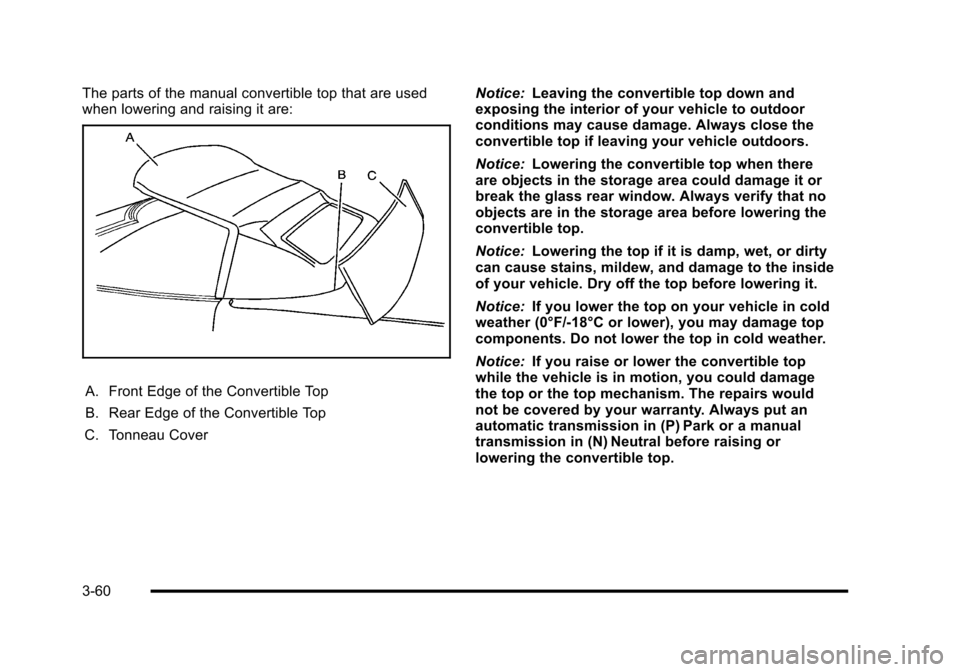
The parts of the manual convertible top that are used
when lowering and raising it are:
A. Front Edge of the Convertible Top
B. Rear Edge of the Convertible Top
C. Tonneau Cover Notice:
Leaving the convertible top down and
exposing the interior of your vehicle to outdoor
conditions may cause damage. Always close the
convertible top if leaving your vehicle outdoors.
Notice: Lowering the convertible top when there
are objects in the storage area could damage it or
break the glass rear window. Always verify that no
objects are in the storage area before lowering the
convertible top.
Notice: Lowering the top if it is damp, wet, or dirty
can cause stains, mildew, and damage to the inside
of your vehicle. Dry off the top before lowering it.
Notice: If you lower the top on your vehicle in cold
weather (0°F/-18°C or lower), you may damage top
components. Do not lower the top in cold weather.
Notice: If you raise or lower the convertible top
while the vehicle is in motion, you could damage
the top or the top mechanism. The repairs would
not be covered by your warranty. Always put an
automatic transmission in (P) Park or a manual
transmission in (N) Neutral before raising or
lowering the convertible top.
3-60