2010 CHEVROLET CORVETTE light
[x] Cancel search: lightPage 357 of 472
Notice:
.Using the wrong fluid can badly damage
brake hydraulic system parts. For example,
just a few drops of mineral-based oil, such
as engine oil, in the brake hydraulic system
can damage brake hydraulic system parts
so badly that they will have to be replaced.
Do not let someone put in the wrong kind
of fluid.
.If brake fluid is spilled on the vehicle's
painted surfaces, the paint finish can be
damaged. Be careful not to spill brake
fluid on the vehicle. If you do, wash it off
immediately. See Washing Your Vehicle
on
page 6‑94
.
Brake Wear (Except ZR1)
This vehicle has disc brakes. Disc brake pads have
built-in wear indicators that make a high-pitched
warning sound when the brake pads are worn and new
pads are needed. The sound can come and go or be
heard all the time the vehicle is moving, except when
applying the brake pedal firmly.
{WARNING:
The brake wear warning sound means that soon
the brakes will not work well. That could lead to
an accident. When the brake wear warning sound
is heard, have the vehicle serviced.
Notice: Continuing to drive with worn-out brake
pads could result in costly brake repair.
Some driving conditions or climates can cause a brake
squeal when the brakes are first applied or lightly
applied. This does not mean something is wrong
with the brakes.
Brake linings should always be replaced as complete
axle sets.
6-45
Page 358 of 472
Brake Wear (ZR1 Only)
The ZR1 model does not have built-in brake pad wear
indicators and periodic visual inspection of the brake
pads is required to determine when to replace the
brake pads.
Notice: Continuing to drive with worn-out brake
pads could result in costly brake repair.
.Make sure that the brakes have been given
sufficient time to cool and then set the park brake.
RearFront
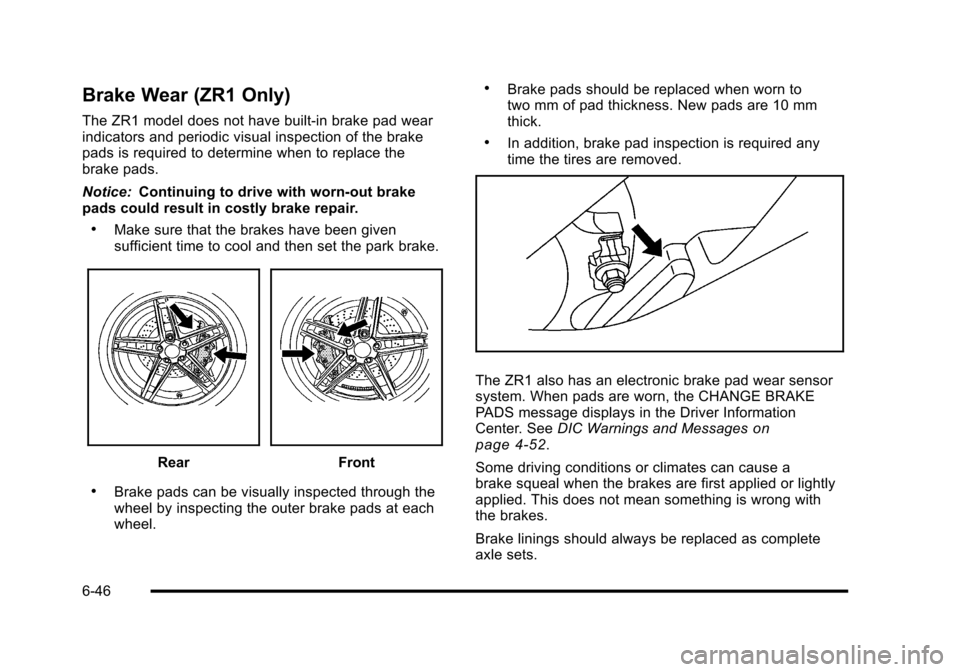
.Brake pads can be visually inspected through the
wheel by inspecting the outer brake pads at each
wheel.
.Brake pads should be replaced when worn to
two mm of pad thickness. New pads are 10 mm
thick.
.In addition, brake pad inspection is required any
time the tires are removed.
The ZR1 also has an electronic brake pad wear sensor
system. When pads are worn, the CHANGE BRAKE
PADS message displays in the Driver Information
Center. See DIC Warnings and Messages
on
page 4‑52.
Some driving conditions or climates can cause a
brake squeal when the brakes are first applied or lightly
applied. This does not mean something is wrong with
the brakes.
Brake linings should always be replaced as complete
axle sets.
6-46
Page 362 of 472
Jump Starting
If your battery has run down, you may want to use
another vehicle and some jumper cables to start your
vehicle. Be sure to use the following steps to do it
safely.
{WARNING:
Batteries can hurt you. They can be dangerous
because:
.They contain acid that can burn you.
.They contain gas that can explode or ignite.
.They contain enough electricity to burn you.
If you do not follow these steps exactly, some or
all of these things can hurt you.
Notice: If you try to start your vehicle by pushing or
pulling it, you could damage your vehicle. Do not
push or pull your vehicle to start it; instead, use the
jump starting procedure in this manual to start your
vehicle when the battery has run down.
1. Check the other vehicle. It must have a 12-volt battery with a negative ground system. Notice:
If the other vehicle's system is not a 12-volt
system with a negative ground, both vehicles can
be damaged. Only use vehicles with 12-volt systems
with negative grounds to jump start your vehicle.
2. Get the vehicles close enough so the jumper cables can reach, but be sure the vehicles are not
touching each other. If they are, it could cause a
ground connection you do not want. You would
not be able to start your vehicle, and the bad
grounding could damage the electrical systems.
To avoid the possibility of the vehicles rolling, set
the parking brake firmly on both vehicles involved
in the jump start procedure. Put an automatic
transmission in P (Park) or a manual transmission
in Neutral before setting the parking brakes.
Notice: If you leave the radio or other accessories
on during the jump starting procedure, they could
be damaged. The repairs would not be covered by
the warranty. Always turn off the radio and other
accessories when jump starting the vehicle.
3. Turn off the ignition on both vehicles. Unplug unnecessary accessories plugged into the
cigarette lighter or the accessory power outlet.
Turn off the radio and all lamps that are not
needed. This will avoid sparks and help save
both batteries. And it could save the radio!
6-50
Page 364 of 472
{WARNING:
Using an open flame near a battery can cause
battery gas to explode. People have been
hurt doing this, and some have been blinded.
Use a flashlight if you need more light.
Be sure the battery has enough water. You do not
need to add water to the battery installed in your
new vehicle. But if a battery has filler caps, be
sure the right amount of fluid is there. If it is low,
add water to take care of that first. If you do not,
explosive gas could be present.
Battery fluid contains acid that can burn you.
Do not get it on you. If you accidentally get it in
your eyes or on your skin, flush the place with
water and get medical help immediately.
{WARNING:
Fans or other moving engine parts can injure you
badly. Keep your hands away from moving parts
once the engine is running.
5. Check that the jumper cables do not have loose or missing insulation. If they do, you could get a
shock. The vehicles could be damaged too.
Before you connect the cables, here are some
basic things you should know. Positive (+) will
go to positive (+) or to a remote positive (+)
terminal if the vehicle has one. Negative (−) will
go to a heavy, unpainted metal engine part or to a
remote negative (−) terminal if the vehicle has one.
Do not connect positive (+) to negative (−) or you
will get a short that would damage the battery and
maybe other parts too. And do not connect the
negative (−) cable to the negative (−) terminal on
the dead battery because this can cause sparks.
6-52
Page 368 of 472
Bulb Replacement
For the proper type of replacement bulbs, see
Replacement Bulbs on page 6‑58.
For any bulb changing procedure not listed in this
section, contact your dealer/retailer.
High Intensity Discharge (HID)
Lighting
{WARNING:
The low beam high intensity discharge lighting
system operates at a very high voltage. If you try
to service any of the system components, you
could be seriously injured. Have your dealer/
retailer or a qualified technician service them.
The vehicle may have HID headlamps. After an HID
headlamp bulb has been replaced, you may notice
that the beam is a slightly different shade than it was
originally. This is normal.
Halogen Bulbs
{WARNING:
Halogen bulbs have pressurized gas inside and
can burst if you drop or scratch the bulb. You or
others could be injured. Be sure to read and
follow the instructions on the bulb package.
Headlamps, Front Turn Signal, and
Parking Lamps
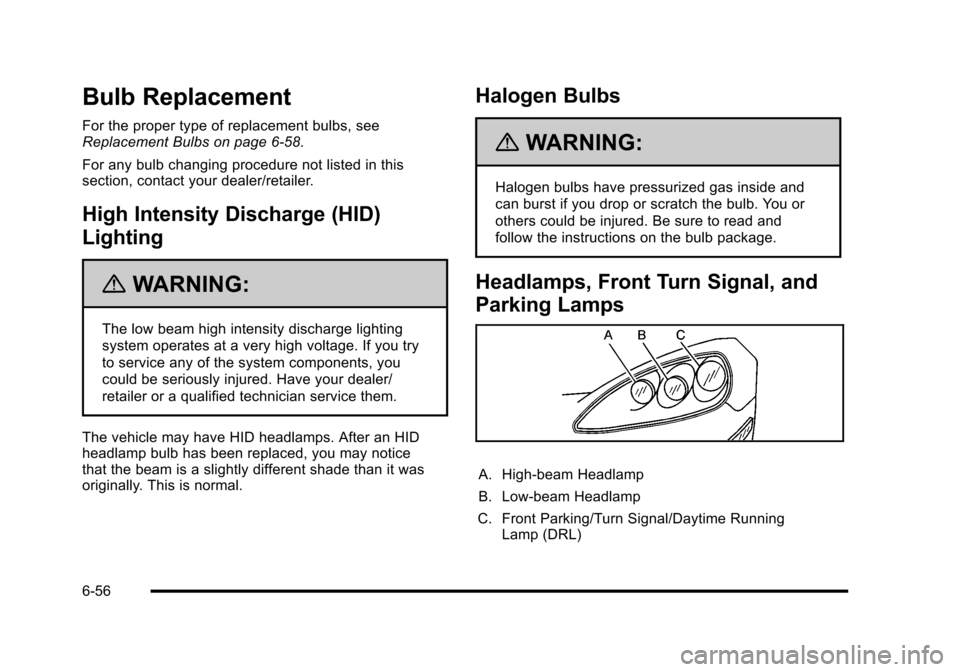
A. High-beam Headlamp
B. Low-beam Headlamp
C. Front Parking/Turn Signal/Daytime Running Lamp (DRL)
6-56
Page 369 of 472
If the low-beam headlamp needs to be replaced, see
your dealer/retailer. See High Intensity Discharge (HID)
Lighting
on page 6‑56for more information.
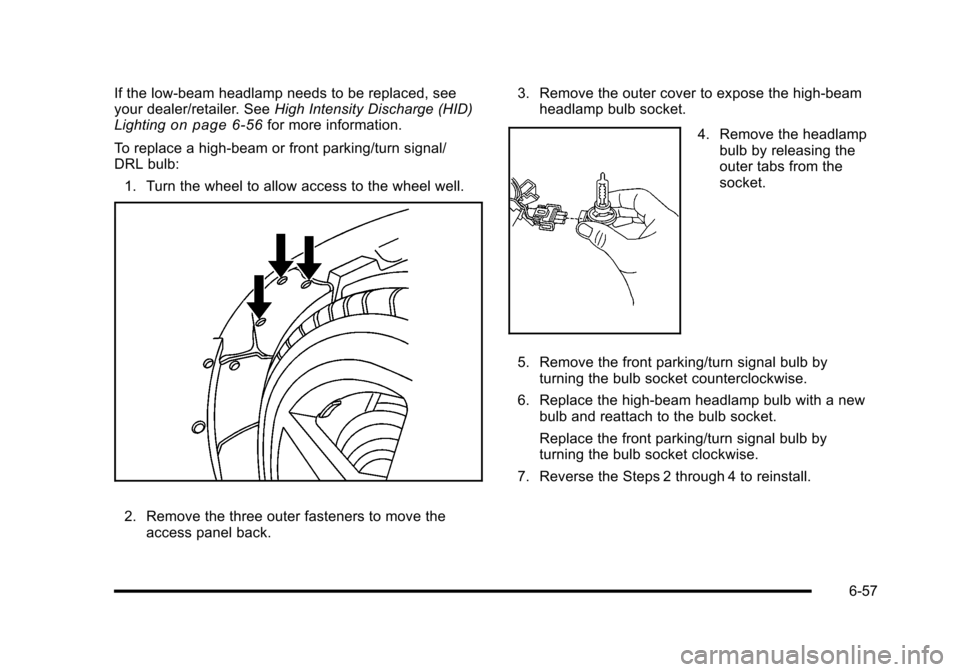
To replace a high-beam or front parking/turn signal/
DRL bulb: 1. Turn the wheel to allow access to the wheel well.
2. Remove the three outer fasteners to move the access panel back. 3. Remove the outer cover to expose the high-beam
headlamp bulb socket.
4. Remove the headlamp
bulb by releasing the
outer tabs from the
socket.
5. Remove the front parking/turn signal bulb by turning the bulb socket counterclockwise.
6. Replace the high-beam headlamp bulb with a new bulb and reattach to the bulb socket.
Replace the front parking/turn signal bulb by
turning the bulb socket clockwise.
7. Reverse the Steps 2 through 4 to reinstall.
6-57
Page 379 of 472

Intended Outboard Sidewall:The side of an
asymmetrical tire, that must always face outward
when mounted on a vehicle.
Kilopascal (kPa)
:The metric unit for air
pressure.
Light Truck (LT‐Metric) Tire
:A tire used on light
duty trucks and some multipurpose passenger
vehicles.
Load Index
:An assigned number ranging from
1 to 279 that corresponds to the load carrying
capacity of a tire.
Maximum Inflation Pressure
:The maximum
air pressure to which a cold tire can be inflated.
The maximum air pressure is molded onto the
sidewall.
Maximum Load Rating
:The load rating for a tire
at the maximum permissible inflation pressure for
that tire.
Maximum Loaded Vehicle Weight
:The sum of
curb weight, accessory weight, vehicle capacity
weight, and production options weight. Normal Occupant Weight
:The number of
occupants a vehicle is designed to seat multiplied
by 150 lbs (68 kg). See Loading the Vehicle
on
page 5‑28
.
Occupant Distribution
:Designated seating
positions.
Outward Facing Sidewall
:The side of an
asymmetrical tire that has a particular side
that faces outward when mounted on a vehicle.
The side of the tire that contains a whitewall,
bears white lettering, or bears manufacturer,
brand, and/or model name molding that is higher
or deeper than the same moldings on the other
sidewall of the tire.
Passenger (P-Metric) Tire
:A tire used on
passenger cars and some light duty trucks and
multipurpose vehicles.
Recommended Inflation Pressure
:Vehicle
manufacturer's recommended tire inflation
pressure as shown on the tire placard.
See Inflation - Tire Pressure
on page 6‑70
andLoading the Vehicleon page 5‑28.
6-67
Page 381 of 472
Run-Flat Tires
This vehicle, when new, had run-flat tires. There is no
spare tire, no tire changing equipment, and no place to
store a tire in the vehicle. Run-flat tires perform so well
without any air that a Tire Pressure Monitor System
(TPMS) is used to alert you if a tire has lost pressure.
{WARNING:
When the low tire warning light is displayed on
the instrument panel cluster, your vehicle's
handling capabilities will be reduced during
severe maneuvers. If you drive too fast, you could
lose control of your vehicle. You or others could
be injured. Do not drive over 55 mph (90 km/h)
when the low tire warning light is displayed.
Drive cautiously and check your tire pressures
as soon as you can.
If a tire goes flat, you will not need to stop on the side
of the road to change the tire. You can just keep on
driving. The shorter the distance you drive and the
slower the speed, the greater the chance that the tire will not have to be replaced. If you drive on a deflated
run-flat tire for 25 miles (40 km) or less and at speeds of
55 mph (90 km/h) or less, there is a good chance that
the tire can be repaired. The tires on coupe, convertible
and Z06 models can operate effectively with no air
pressure for up to 100 miles (160 km) at speeds up
to 55 mph (90 km/h), but the tire would then have to
be replaced. The tires on ZR1 models can operate
effectively with no air pressure for up to 50 miles
(80 km) at speeds up to 55 mph (90 km/h), but the tire
would then have to be replaced. When a tire is filled
with air, it provides a cushion between the road and the
wheel. Because you will not have this cushion when
driving on a deflated tire, try to avoid potholes that could
damage your wheel and require replacement of it.
Some road hazards can damage a tire beyond repair.
This damage could occur even before you have driven
on the tire in a deflated condition. When a tire has
been damaged, or if you have driven any distance on
a run-flat tire, check with an authorized run-flat tire
service center to determine whether the tire can be
repaired or should be replaced. To maintain your
vehicle's run-flat feature, all replacement tires must
be self-supporting tires. As soon as possible,
contact the nearest authorized GM or run-flat servicing
facility for inspection and repair or replacement.
6-69