2009 VOLVO XC60 trailer
[x] Cancel search: trailerPage 222 of 297

05 During your tripEmergency towing 05
220 Towing eyelet
Location of the towing eyelet
Attaching the towing eyelet
The towing eyelet is located under the floor of
the cargo area, with the spare tire. This eyelet
must be screwed into the positions provided on the right sides of either the front or rear
bumper (see illustration).
CAUTION If the vehicle is being towed on a flat bed
truck, the towing eyelets must not be used
to pull the vehicle up onto the flat bed.
NOTE
On certain models equipped with a trailer
hitch, the towing eyelet cannot be screwed
into the hole in the rear bumper. The towing
rope should be attached to the trailer hitch
instead. For this reason, the detachable
section of the trailer hitch should be safely
stowed in the vehicle at all times.
Attaching the towing eyelet
Use a coin to pry open the lower edge of
the cover.
Screw the towing eyelet in place, first by
hand and then using the tire iron until it is
securely in place.
After the vehicle has been towed, the eyelet
should be removed and returned to its storage
location. Press the cover for the attachment point back
into position.
WARNING If the vehicle has no electrical current and
must be towed, the power steering and
brake systems will not function normally. It
will still be possible to steer the vehicle and
apply the brakes. However, keep in mind
that greater effort will be required to turn the
steering wheel and depress the brake pedal.
Precautions when the vehicle is in tow
\b
The steering wheel must be unlocked. The
remote key must be in the ignition slot 1
.
\b Attach jumper cables (see page 107) to
provide current for releasing the optional
electric parking brake and to move the gear
selector from the
P position.
\b The gear selector must be in position
N.
\b Maximum speed: 50 mph (80 km/h). Do not
exceed the maximum allowable towing
speed.
\b Maximum distance with front wheels on
ground: 50 miles (80 km).
\b While the vehicle is being towed, try to
keep the tow rope taut at all times.
\b The vehicle should only be towed in the
forward direction. 1
On vehicles with the optional keyless drive, the remote key must be in t\
he passenger compartment. G031971
Page 253 of 297
06 Maintenance and specifications
Fuses06
}}
* Option/accessory, for more information, see Introduction. 251
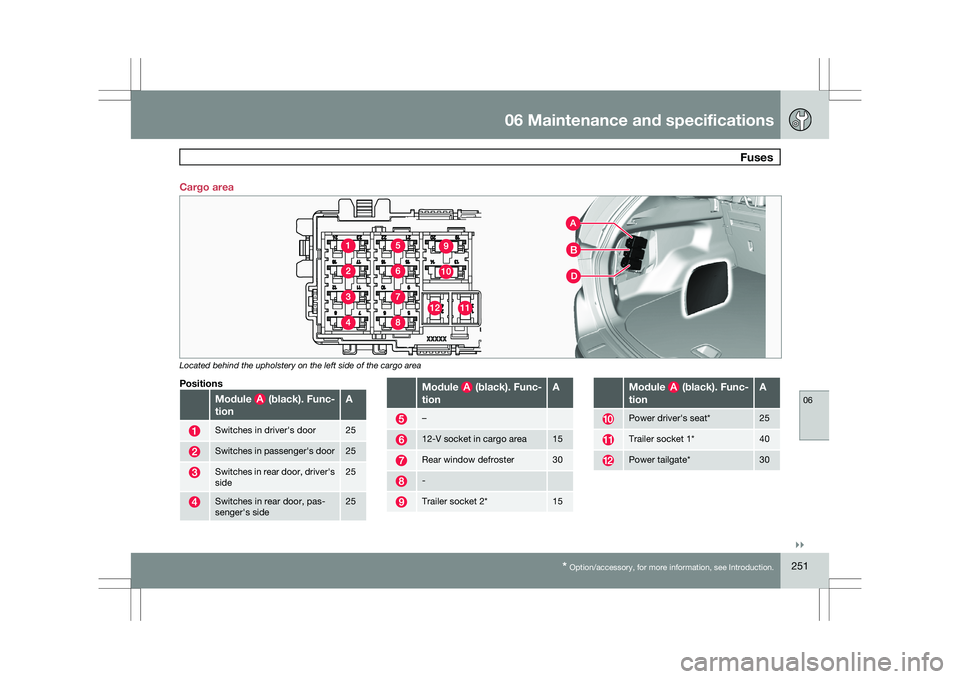
Cargo area
Located behind the upholstery on the left side of the cargo area
Positions
Module (black). Func-
tion A
Switches in driver\fs door 25
Switches in passenger\fs door 25
Switches in rear door, driver\fs
side 25
Switches in rear door, pas-
senger\fs side 25 Module (black). Func-
tion A
–
12-V socket in cargo area 15
Rear window defroster 30
-
Trailer socket 2* 15 Module (black). Func-
tion A
Power driver\fs seat* 25
Trailer socket 1* 40
Power tailgate* 30
Page 263 of 297
06 Maintenance and specifications
Wheels and tires06
}}
261
Vehicle loading
Properly loading your vehicle will provide maxi-
mum return of vehicle design performance.
Before loading your vehicle, familiarize yourself
with the following terms for determining your
vehicle\fs weight ratings, with or without a
trailer, from the vehicle\fs Federal/Canadian
Motor Vehicle Safety Standards (FMVSS/
CMVSS) label, and the vehicle\fs tire informa-
tion placard:
Curb weightThe weight of the vehicle including a full tank
of fuel and all standard equipment. It does not
include passengers, cargo, or optional equip-
ment.
Capacity weightAll weight added to the curb weight, including
cargo and optional equipment. When towing,
trailer hitch tongue load is also part of cargo
weight.
NOTE
For trailer towing information, please refer to
the section "Towing a trailer"
on page 217.
Permissible axle weightThe maximum allowable weight that can be
carried by a single axle (front or rear). These
numbers are shown on the Federal/Canadian
Motor Vehicle Safety Standards (FMVSS/
CMVSS) label. The total load on each axle must
never exceed its maximum permissible weight.
Gross vehicle weight (GVW)The vehicle\fs curb weight + cargo + passen-
gers.
NOTE \b
The location of the various labels in your
vehicle can be found on page 279
.
\b A table listing important weight limits for
your vehicle can be found on page
282.
Steps for Determining Correct Load
Limit
1. Locate the statement "the combined
weight of occupants and cargo should
never exceed XXX pounds" on your vehi-
cle\fs placard. 2. Determine the combined weight of the
driver and passengers that will be riding in
your vehicle.
3. Subtract the combined weight of the driver
and passengers from XXX kilograms or
XXX pounds.
4. The resulting figure equals the available amount of cargo and luggage load
capacity. For example, if the "XXX" amount
equals 1400 lbs. and there will be five
150 lb. passengers in your vehicle, the
amount of available cargo and luggage
load capacity is 650 lbs. (1400 – 750
(5 × 150) = 650 lbs.)
5. Determine the combined weight of luggage
and cargo being loaded on the vehicle.
That weight may not safely exceed the
available cargo and luggage load capacity
calculated in Step 4.
6. If your vehicle will be towing a trailer, load from your trailer will be transferred to your
vehicle. Consult this manual 1
to determine
how this reduces the available cargo and
luggage load capacity of your vehicle. 1
See the section "Trailer Towing on page
217.
Page 284 of 297
06 Maintenance and specificationsSpecifications 06
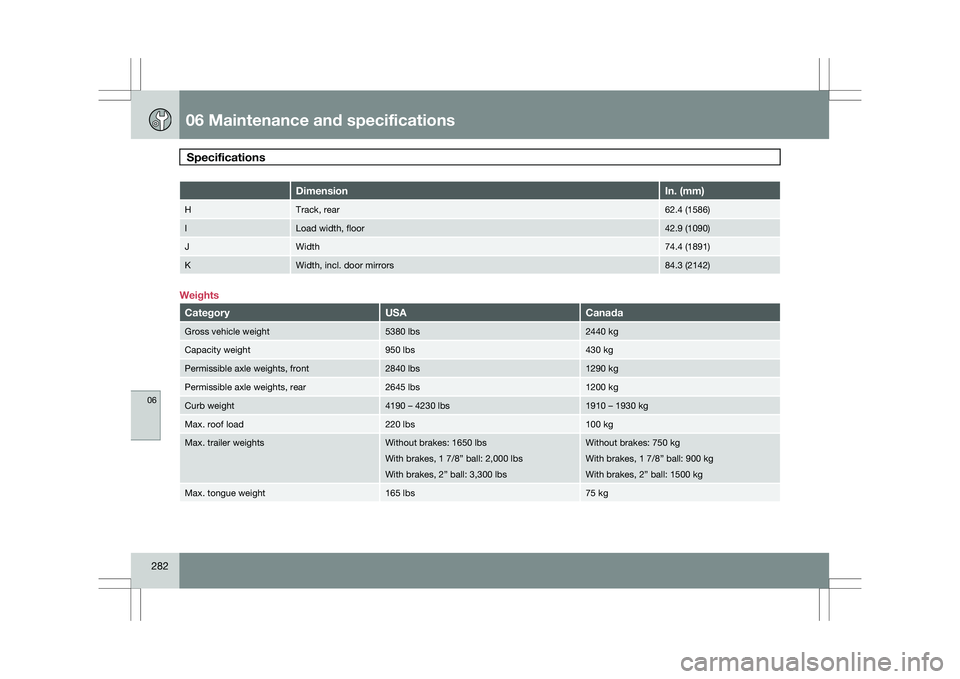
282 Dimension In. (mm)
H Track, rear 62.4 (1586)
I Load width, floor 42.9 (1090)
J Width 74.4 (1891)
K Width, incl. door mirrors 84.3 (2142)
Weights
Category USA Canada
Gross vehicle weight 5380 lbs 2440 kg
Capacity weight 950 lbs 430 kg
Permissible axle weights, front 2840 lbs 1290 kg
Permissible axle weights, rear 2645 lbs 1200 kg
Curb weight 4190 – 4230 lbs 1910 – 1930 kg
Max. roof load 220 lbs 100 kg
Max. trailer weights Without brakes: 1650 lbs
With brakes, 1 7/8” ball: 2,000 lbs
With brakes, 2” ball: 3,300 lbs Without brakes: 750 kg
With brakes, 1 7/8” ball: 900 kg
With brakes, 2” ball: 1500 kg
Max. tongue weight 165 lbs 75 kg
Page 286 of 297
06 Maintenance and specificationsSpecifications 06
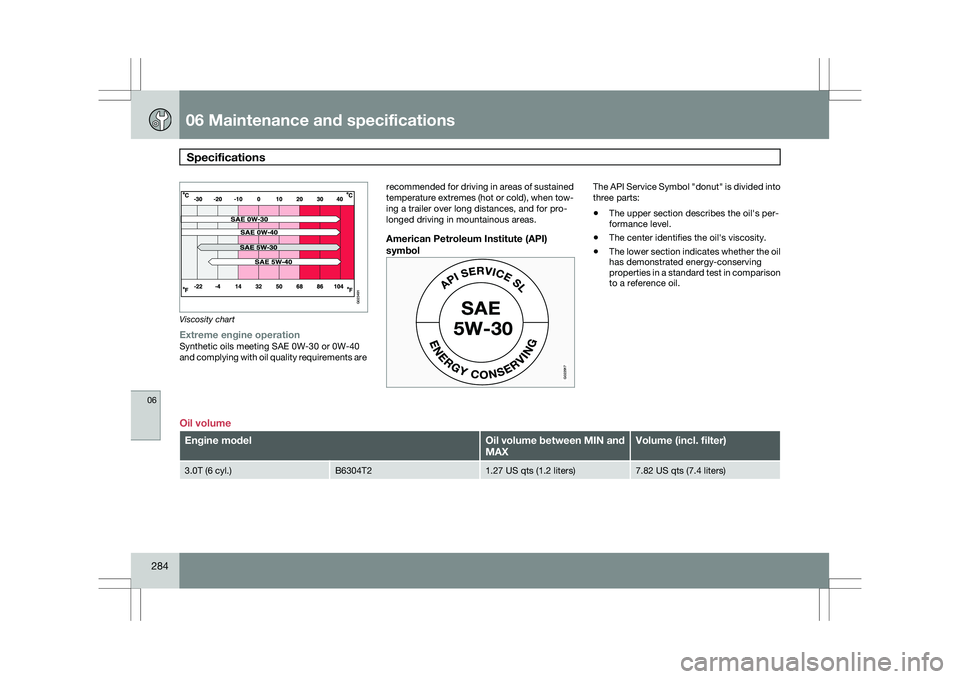
284 Viscosity chart
Extreme engine operationSynthetic oils meeting SAE 0W-30 or 0W-40
and complying with oil quality requirements are
recommended for driving in areas of sustained
temperature extremes (hot or cold), when tow-
ing a trailer over long distances, and for pro-
longed driving in mountainous areas.
American Petroleum Institute (API)
symbol The API Service Symbol "donut" is divided into
three parts:
\b
The upper section describes the oil\fs per-
formance level.
\b The center identifies the oil\fs viscosity.
\b The lower section indicates whether the oil
has demonstrated energy-conserving
properties in a standard test in comparison
to a reference oil.
Oil volume Engine model Oil volume between MIN and
MAX Volume (incl. filter)
3.0T (6 cyl.) B6304T2 1.27 US qts (1.2 liters) 7.82 US qts (7.4 liters)
G023491
G022917
Page 296 of 297

07 Index07
294 Stability system........................................ 155
indicator light ........................................ 75
Starting the engine
................................... 105
with keyless drive............................... 106
Starting the vehicle after a crash (crash mode).................... 32
Start inhibitor (immobilizer) ........................50
Steel grid in cargo area............................ 213
Steering wheel adjusting ............................................... 86
horn....................................................... 86
keypad.................................. 86, 122, 133
Stone chips, touching up .........................277
Storage spaces........................................ 197
Studded tires........................................... 262
Sunroof (moonroof) .................................. 100
Supplemental restraint system ..................17
warning light ......................................... 76T Tailgate
driving with it open............................. 202
power operated.................................... 63
wiper/washer........................................ 94
Tailgate wipers ......................................... 241
Taillights, changing bulbs ........................236
Temporary spare tire............................... 264
Three-way catalytic converter .................208
Tire designations ..................................... 259
Tire Pressure Monitoring System ....271, 272
indicator light ........................................ 75
Tires......................................................... 253
age...................................................... 253
changing from summer to winter
........ 254
glossary of terms ................................ 260
improving economy ............................253
inflation pressure ........................255, 256
inflation pressure tables .....................258
rotation ............................................... 254
snow................................................... 262
spare................................................... 264
specifications ...................................... 257
storing ................................................. 254
studded............................................... 262 tire pressure monitoring system
.........271
tread wear indicator............................ 255
uniform tire quality grading .................262
Top tether anchors (child restraint sys-
tems).......................................................... 43
Touching up paint .................................... 277
Towing a trailer ................................ 217, 218
trailer hitch .......................................... 218
Trailer Stability Assist .........................218
Towing the vehicle ...........................220, 221
Traction control
........................................ 155
Trailer Stability Assist (TSA)..................... 218
Trailer towing ................................... 217, 218
trailer hitch .......................................... 218
Trailer Stability Assist .........................218
Transmission general description .....................109, 110
oil ........................................................ 285
shiftlock override ................................ 110
Tread wear indicator ................................ 255
Trip computer.......................................... 153
Trip odometers.......................................... 78
Trips, long distance ................................. 203