05 During your trip
Refueling05
}}
207
Octane rating
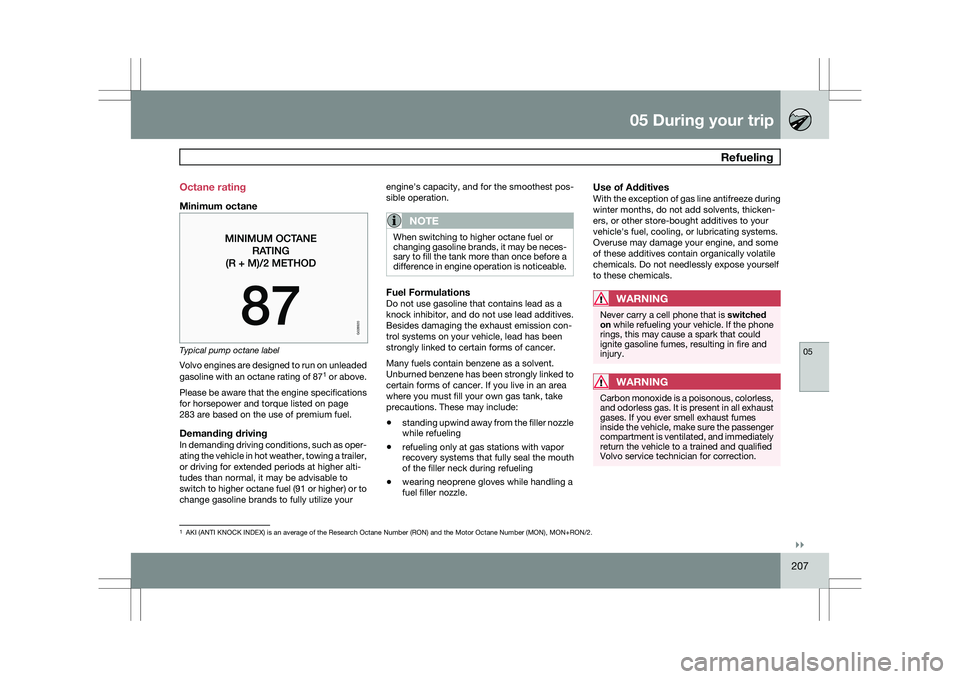
Minimum octane
Typical pump octane label
Volvo engines are designed to run on unleaded
gasoline with an octane rating of 87
1
or above.
Please be aware that the engine specifications
for horsepower and torque listed on page
283 are based on the use of premium fuel.
Demanding drivingIn demanding driving conditions, such as oper-
ating the vehicle in hot weather, towing a trailer,
or driving for extended periods at higher alti-
tudes than normal, it may be advisable to
switch to higher octane fuel (91 or higher) or to
change gasoline brands to fully utilize your engine\fs capacity, and for the smoothest pos-
sible operation.
NOTE When switching to higher octane fuel or
changing gasoline brands, it may be neces-
sary to fill the tank more than once before a
difference in engine operation is noticeable.
Fuel FormulationsDo not use gasoline that contains lead as a
knock inhibitor, and do not use lead additives.
Besides damaging the exhaust emission con-
trol systems on your vehicle, lead has been
strongly linked to certain forms of cancer.
Many fuels contain benzene as a solvent.
Unburned benzene has been strongly linked to
certain forms of cancer. If you live in an area
where you must fill your own gas tank, take
precautions. These may include:
\b
standing upwind away from the filler nozzle
while refueling
\b refueling only at gas stations with vapor
recovery systems that fully seal the mouth
of the filler neck during refueling
\b wearing neoprene gloves while handling a
fuel filler nozzle.
Use of AdditivesWith the exception of gas line antifreeze during
winter months, do not add solvents, thicken-
ers, or other store-bought additives to your
vehicle\fs fuel, cooling, or lubricating systems.
Overuse may damage your engine, and some
of these additives contain organically volatile
chemicals. Do not needlessly expose yourself
to these chemicals.
WARNING Never carry a cell phone that is
switched
on while refueling your vehicle. If the phone
rings, this may cause a spark that could
ignite gasoline fumes, resulting in fire and
injury.
WARNING Carbon monoxide is a poisonous, colorless,
and odorless gas. It is present in all exhaust
gases. If you ever smell exhaust fumes
inside the vehicle, make sure the passenger
compartment is ventilated, and immediately
return the vehicle to a trained and qualified
Volvo service technician for correction.
1
AKI (ANTI KNOCK INDEX) is an average of the Research Octane Number (R\
ON) and the Motor Octane Number (MON), MON+RON/2.
G028920
06 Maintenance and specifications
Specifications06
}}
283
Engine specifications
Specification/Model 3.0T
Engine designation B6304T2
Output (kW/rps) 210/93
Output (hp/rpm) 281/5600
Torque (Nm/rps) 400/25 – 80
Torque (ft. lbs./rpm) 295/1500 – 4800
No. of cylinders 6
Bore (in/mm) 3.23/82
Stroke (in/mm) 3.67/93.2
Displacement 2.95 liters (175 cu. in.)
Compression ratio 9.3:1
Engine oil
Engine oil must meet the minimum ILSAC
specification GF-4, API SL, or ACEA A1/B1.
Lower quality oils may not offer the same fuel
economy, engine performance, or engine pro-
tection.
Volvo recommends Castrol.
Depending on your driving habits, premium or
synthetic oils may provide superior fuel econ-
omy and engine protection. Consult your Volvo
retailer for recommendations on premium or
synthetic oils.
Oil additives must not be used.
Synthetic oil is not used when the oil is
changed at the normal maintenance services.
This oil is only used at customer request, at
additional charge. Please consult your Volvo
retailer.
Oil viscosityIncorrect viscosity oil can shorten engine life
under normal use. SAE 5W-30 will provide
good fuel economy and engine protection. See
the viscosity chart.