2009 VOLKSWAGEN JETTA safe
[x] Cancel search: safePage 381 of 477
Booklet 3.2 Tips and Advice
will be s ix 10 eight of them evenly pla ced aroun d tire. Marks on the tire s idewa ll (fo r ex amp le o r oth er symbols) indicate the p ositions
of the tread w ear in dica tor s. Wo rn tires mu st be
rep laced . Different figu res may apply in oth er
Tir e pressure
In co rrec t lir e pr ess ure cause s pr ematur e wear
and can cause s udden tire blow -out. F or thi s
r easo n, tir e pressure must be c hec ke d at leas t
o nce a m ont h
56.
Driving style
Drivin g fast around cu rves, heavy acce lera tio n
and hard braking increase t ir e w ear.
Rotating tir es for more even wear
I f th e front tires are worn consid era bly m ore
than t he re ar ones, rotate th em as sh own
59, fig. 15 . All the tir es will then last for
about sa me of tim e.
A ll
tir es s hou ld have th e sam e am ount of
wear. All four w heels must have the sa me ro lling
ci rc umf ere nce.
Wheel balancing
Th e wh eels on ne w ve hicl es are balan ced. H ow
eve r. various situations during every d ay driv ing
can cause them
b ecom e unbalan ced, r e
s ultin g in vib rat io ns y ou can usuall y fe el throug h
th e steering wheel.
Unbalan ced w hee ls mu st be reb alan ced to avoid
e x cessive wear on stee ring, suspen sion and
60 Checking and Filling
tire s. A wheel also be rebalan ced w hen a
new lire i s in stalled .
In correct whee l alignment
Incorr ect whee l alignment can cause exc ess ive
ti re wea r, impa ir in g
safe ty of the ve hicle. If
t ir es s how excess ive wear, have wheel align
m en t ch ecke d by an authori zed Vol ksw age n
d ea le r or qualifi ed work sh op.
WARNING
Sud den tir e fa ilur e ca n le ad to lo ss of con trol ,
a cra sh and serious persona l injury!
• Neve r drive a vehicle wh en th e trea d on
any tire is wo rn dow n to the wea r indicator s.
• Worn tires a rc a sa fety hazar d, the y do not
gr ip we ll on wet roads and increase y our risk
of "h yd ropl anin g" and lo ss of contro l.
• Always kee p ch emi cals that can ca use tir e
d amage, s uch as g rease, oil , gaso line and
brak e fluid away from tire s.
• Tire s age even if th ey a rc not b ein g use d
and can fail sudd enl y, es pecially al high
s pe eds . Tir es that a re more than 6 year s old
can onl y be use d in an emergen cy and th en
w ith sp ecia l care a nd at lowe r sp eeds.
• Neve r mount u sed tire s on your vehicl e if
you a rc not sur e of their "pr ev iou s hi stor y."
Old use d tir es ma y ha ve been d amaged eve n
th ough the d am age ca nnot b e seen that can
lead t o sudd en tir e failure and loss of vehicle
Page 383 of 477
Booklet 3.2 Tips and Advice
tires approved for the Volkswage n models ered by your Owner's Literature.
The tire pressure label on the open edge of the
dri ver's door (
54, fig. 13 ) lists th e s pec ifi
cations of the original equipm ent tir es insta lled
on your vehicle at the time it was
Federal law re quire s tire manufacturers to plac e
standardized informat io n on the sid ew all of all
t ir es
fig. This information id enti
fi es d esc ribes the fundamental charac te ris
ti cs, the quality grad e of the tire and also pro
vides
tir e id entifi cation number for safe ty stan
dard certificat ion an d in case of reca ll.
Tire specifications
Kn ow le d ge of tire sp ec ifica tions mak es it easier
to choose the tires. Hadial tires ha ve the
t ir e sp ec ifica tion s mark ed on th e sidewall, for
examp le :
P255 I 55 R 18 109 H x i
This contain s the following information:
Indi cates the tir e is for pass enger
No minal tire width in mm of the tire from
s ide wall edg e to sidewa ll edge. 1 n general.
th e lar ger the numb er, the wider th e tir e
55 I !e ight /width
in per cent (aspect ratio )
Tire constru ctio n: Hrad ial
1 8 Him diamete r
(in inch es)
109
co de
Speed le tter code
x i
tha t th e tire is "R einf orced"
( h eavy-d uty tir es)
M +S (o r "M /S") Indicates that t he tire h as some
m ud and snow capabili ty
The tire s could al so have the information of di
rection of rotation
51, "Unidi rectiona l
tires".
T ir e manufactur ing date
The manufa cturin g dat e is also indicate d on the
tir e sid ewa ll (poss ibly o nly on the i1111 erside of
th e wheel):
... 45 03 ... "means. fo r exam ple, that th e
tir e produ ced in the 45th week of
Speed Rating Letter Code
The sp ee d rating le tt er code on the wheel s indi
cates the maximum p ermi ssibl e roa d speeds
in "Wint er tires" on page
up 93 mph (150 km/h )
Q 99 mph km/h)
up to 106 mph (170 k m/h)
s up to llO mph (180 km /h )
T up
118 mph (190 km/h )
u up t o 124 mph (200 km/h )
up to 130 mph (210 km /h )
V up to 149 mph (240
up to 150 mph (240
\V up t o 168 mph (270 y
up to mph (298
U. S. DOT Tire Identification Number (TIN )
Thi s is the tir e's "se rial number." It begins with
th e le tt ers "DOT" and indicates
the tire
m ee ts all federal standards . The n ext two
ber s or lett ers indicate th e plant where it was
manufacture d. and the la st four numb ers repre
se nt the week and year of manuf acture. For ex
a mpl e. th e numb ers 180 1 m ean that the tire
produ ced in the 18th week of 2001. The oth er
numb ers are mark etin g co des ma y or ma y
n o t be used b y th e tire manufa cturer. T his infor
mati on is u sed to contact consum ers ifa tire de
f ec t req uires a reca ll.
Tir e ply compos ition and materials used
T he numb er of plies indicat es the numb er of
la ye rs of rubb er-co ated fabri c in the tir e. In gen
e ral, th e g rea te r the numb er of p lies , th e mor e
a tire can supp ort. Tire manuf actur ers
a lso mu st indicate the materials in the tire ,
wh ich include steel. nylon, poly este r, and
o th ers .
Maximu m Load Ra ting
Thi s numb er indi cat es the maximum load in ki
lo gram s and pounds that can h e
by the
tir e. Tread wear, traction and te mpe ralll re
g rades
64, tir e quality
·II For tir es max imum speed capabilit y over mph (240 km /h ). tire so metimes use
th e lette rs
62 Checking and Filling
Page 384 of 477
Maximum Perm issib le Inflatio n Press ure
T his nu mb er is th e g re at est a mount of
pres
s ur e tha t sh oul d ever be put in the tire und er
norma l driv ing cond itio n s.
R ep lac in g tires or rims on vehicles equipp ed
wit h
The air va lve o n all four tires (no t on the spare
ti re) is equip ped with a senso r, w hic h co nsta ntly
m on itors
a ir pr ess ure in side the tire, a nd
the n this Lu If
yo u ar e going to re pl ace the wheel rim s o n yo ur
ve hicl e, make sure the rim s also have these
se nso rs. The se nsor s mu st be co mp atib le w ith
TPM S sys tem o n yo ur vehicle .
I f yo u install rim s. w hich do not have th e se n
sors, o r ha ve sensors w hich are not comp ati ble,
th e TP MS will not wor k pro perl y. In case, theTPM S would n ot b e ab le to m oni tor pr ess ure or wa rn you if is necessa ry.
• Wheneve r you c hange se nso rs, yo u ha ve to
i n sta ll
valves.
•
dri ve the valve ste m cap s se
c ur ely m ou nted. We reco mmen d usi ng fac to ry
i n sta lle d va lve stem caps. As k your auth ori zed
Volkswage n dea le r if yo u los t va lve
caps.
T he in sta llat io n of re pla ceme111 tires
c ord hody plies in the tire si dewa ll m ay ca use
ma lfu nction tir e pre ssure monitorin g
sys te m (TPM S), and i s not recommended (cord
mat eri al informatio n is m olded on
ti re s ide
wa ll).
ch ec k yo ur TPM S indi cator af te r r eone or more tires o n yo ur vehicl e. If t he
TP MS indi cator is on. your TPMS is m alfu nc
ti o nin g. Your
tire m ig ht be incom
patibl e yourTP MS system, or some co mp o
n en t of the TP MS may be dam aged .
WARNING
• Usin g in cor rect or unmatched tires and
I or wheels or improper tire and whee l co mbi
nation s can le ad to loss of con tro l, co llisio n
and serio us perso nal injury.
• Always use tires, rims and whee l bo lts th at
me et th e specification s of ori ginal fa ctory- in
s talled tire s or other combination s th at h av e
b een sp eci fica lly app roved by the vehicle
manufa ctur er.
Booklet 3.2 Tips and Advice
WARN ING (continued)
• Tire s age even if they arc not being use d
and can fail su ddenl y, es peci ally at high
s peeds. Tire s th at are more than 6 yea rs old
can only be use d in an em ergenc y and then
w ith specia l care and at lower speeds.
• Never mount use d tir es on your vehicle if
yo u are not sur e o f th eir "previou s hi story."
Old used tir es ma y ha ve bee n damag ed even
th ou gh th e dam age ca nnot be seen that ca n
l ead to sudd en tir e fa ilur e and lo ss of vehicl e
control.
• All four whe els must be fitted with radi al
tir es of the s am e type, size (ro lling cir cumf er
ence) and th e sa me tread p attern. Dri ving
w ith diff erent tire s reduces ve hicle han dling
a nd can l ead to a loss of control.
• If the spare tire is not th e same a s th e tir es
that are mount ed on the vehicle - for examp le
with winter tir es - only u se the sp are tir e for a
s h ort period of tim e and drive w ith extra care.
Refi t th e no rma l road w hee l as soo n as safe ly
possib le.
• Neve r dri ve
than th e spe ed for wh ic h th e tires on you r ve hicle are
rat ed because tires that arc driven fas te r than
their rated sp eed ca n
sudd enly .
• Overloadin g tir es cause h eat build -up ,
s ud den tire failur e, includin g a blowout and
sudden defl ation and loss of co ntrol.
• Temperat ure grades apply lo tir es that are
properl y inflat ed and not over o r underin
flated .
• For tec hni cal reaso ns it i s not always pos
s ibl e to use whee ls from oth er ve hicles-in
s om e cases not eve n whee ls from the sa me ve
hicle model.
• If you insta ll w hee l trim d iscs on th e ve
hicle whee ls, make sur e that th e air flow to the
brakes is not blo ck ed. R edu ced airflo w to the
brakes can th em to ove rheat , in cre asin g sto p
ping distances and causin g a colli sion .
Checking and Filling 63
Page 385 of 477
Booklet 3.2 Tips and Advice
• If the spar e tire is differe nt from the tires that
yo u have mounted on your ve hicl e ( for example
tir es or wide profil e tir es), then use the
spare tire for a sh ort period of on ly and
driv e w ith extra care . R ep lace the flat tir e wi th
th e tir e ma tc hin g th e o ther s on yo ur vehicle as
soo n as pos sibl e.
Uniform tire quality grading
Qualit y can b e found w here appli cable on
th e tire side be twee n tread sh ou ld e r and
m axi mum sec tion w idth 61. fig . 16 .
For exampl e: T rea d wear 20 0, T ra ctio n /Ill, Te mII.
1111 pa sse nger car ti res must conform to Federa l
Safe ty Hcquirem ents in additi on t o grade s.
Tr ead wea r
The
specifi ed gov
ernme nt test course .
F or examp le ,
tir e g raded 150 wou ld wea r on e
and one half (11 /2) tim es well on govern
me nt course as a tire graded IOO.
T he re lat ive perfor mance of tires depend s up on
th e act ual co nditions of the ir use, however. and
m ay depa rt sig nifi cantl y from th e no rm du e to
va riat io ns in dri vin g ha bits, se rvice practic es
a nd diff ere n ces in road chara cte ri sti cs and cli
grade s, from hig hes t to lowes t. are
AA . and C. Those grade s re pr ese nt the tir e's
a bilit y to stop on pav ement as m easure d
under controlled condit io ns on spec ified gov
e rnment
surfa ces of asp halt and concret e. A
ti re m ark ed C ma y ha ve poor tracti o n perfo r
64 Checking and Filling
• in sta llin g new tires, be c are ful no t t o
dam age the va lves o r sensor s.
• Never drive witho ut the va lve ste m cap. Th e
va lves a nd senso rs
get dama ged.
• I f
sensors must be rep la ce d, th e
va lve must likew ise be re pla ced sa m e
tim e.
c£> Fo r the sak e of environment
Di sp ose o f o ld tires in accordan ce wit h th e loca l
r e qu ire m ent s.
The 1e111pem111re grades are A (the hi ghes t), B. an d C. represen ting th e tir e's to the
gene ration of heat and its abi lity 10 di ss ipat e tes te d und er contro lled co ndi tions
on a spcci f'ied indoo r lab oratory te st w heel.
Sus tained hig h tempera ture ca n cause
mate
r ial of the lir e to deg enerat e and re du ce lire life,
and excess ive te mperature can lea d to sudd en
tir e
The C co rresponds to a leve l of perfor
m an ce whi ch all pa sseng er car tires mu st m eet
un der the
Motor V ehi cle Sa fe ty Standard
No. G rad es and A re pres ent higher lev els
of pe rfo rm ance on the laboratory w heel
th an minimu m re quir ed by law.
WA RNING
The trac t ion gra de ass igned to thi s tire is base d
on stra ig ht-ah ead brak ing tra ctio n t ests, and
d ocs not i nclude acceleration, corn erin g, hy
d ropla ning or peak tracti on cha racter is ti cs.
WARNING
Th e te m pera ture gra de fo r thi s tire is es ta b
li sh ed for tir e th at is proper ly in fl ated and
not overloaded. Excess ive spee d, und crinfl a
tion , or excess ive load ing, eith er separate ly or
in com binati on, ca n ca use hea t bu ildup and
po ssible tir e fa ilur e.
Page 387 of 477
Booklet 3.2 Tips and Advice
Snow chains - individualize for each vehicle
Yo u ca n use s now cha ins only to th e front
whee ls , and only t o certain tire sizes . Ask your
author ized Vo lk swage n deale r on which tir e
s ize s snow c hain s ca n be use d.
T he sn ow chain s must have low -profil e link s
and must n ot b e thi ck e r than 1 5 mm, including
th e loc k.
R emove whe el ce nter cove rs a nd trim discs be
fo re pulli ng s now c hain s on yo ur
For safe ty re a so ns cove r caps must then be ove r th e w hee l b olts. Th ese are a vailable from
a uth ori ze d Vo lkswage n deal ers .
WARNING
U sin g the wrong snow chains for your vehicle
or in stalling them incorrectl y can increase the
Wheel bolts
WARNING (continued )
risk of l oss of contro l leadin g to seriou s per
s onal injury.
• Sn ow c hain s are available in differen t
s izes. Always make sure to follow the in stru c
tion s provided by th e snow chain manufac
turer.
wi th the whee l rim , ca n scratc h or da ma ge it.
T herefo re, make s ure that the s now chain s are
s uit ably
Wheel bolt s must always be tightened to the correct to rque.
The des ig n of w hee l bolt s is m atc h ed to th e facto ry in sta lled rim s. If diff erem rim s are fitted, the
co rrec t whee l b o lts wi th th e right le n gt h and cor
rec tly s hap ed bolt heads must be u sed. This en
s ure s that whee ls a re fitt ed sec urely and that the
b rake syste m f unctio ns co rrec tly.
l n certain cir cum sta nces, yo u may no t u se w hee l
bo lts from a diff ere nt vehi cle -eve n if it is th e
sa me mode l
27.
WARNING
Improp erly tightened or maint ained wheel
bolt s can become loose ca using lo ss of con trol,
a colli sion and se ri ous perso nal inju ry.
• Alwa ys keep th e wheel bolt s and the
th rea ds in the whee l hubs clean so th e wh eel
bolt s can turn easily a nd be properly tight
ened.
• Neve r gr ea se or oil the w hee l bolt s and the
threads in the wheel hubs. They can be come
66 Checking and Filling
WARNING (continu ed)
loose w hile dri ving if greased or oiled, eve n if
ti ght en ed to the specified torque.
• Onl y use whee l bolt s th at belong to th e
w hee l.
• Neve r use diff erent whee ls bolt s on your
ve hicle.
• Alway s maintain the co rrect ti ghtenin g
torque for the wheel bolts to re duce the risk of
a wheel los s. If the tight ening torqu e of the
w hee l bolts is too lo w, they ca n loosen and
co me out when the ve hicle is mo vin g. If the
ti ght enin g torqu e is too hi gh , th e w hee l bolt s
a nd thread s can be damaged and the w hee l
ca n be come loo se.
The sp ecified to rq ue for the w heel bolts is
88 ft/lbs (120 N m). Afte r chan gin g a w hee l. th e
t o rq ue mu st b e checked as soo n as poss ib le w ith
torq ue wre nch - p refera bly by an auth ori zed
Vo lkswage n dea le r or qualifi ed
Page 388 of 477
Booklet 3.2 Tips and Advice
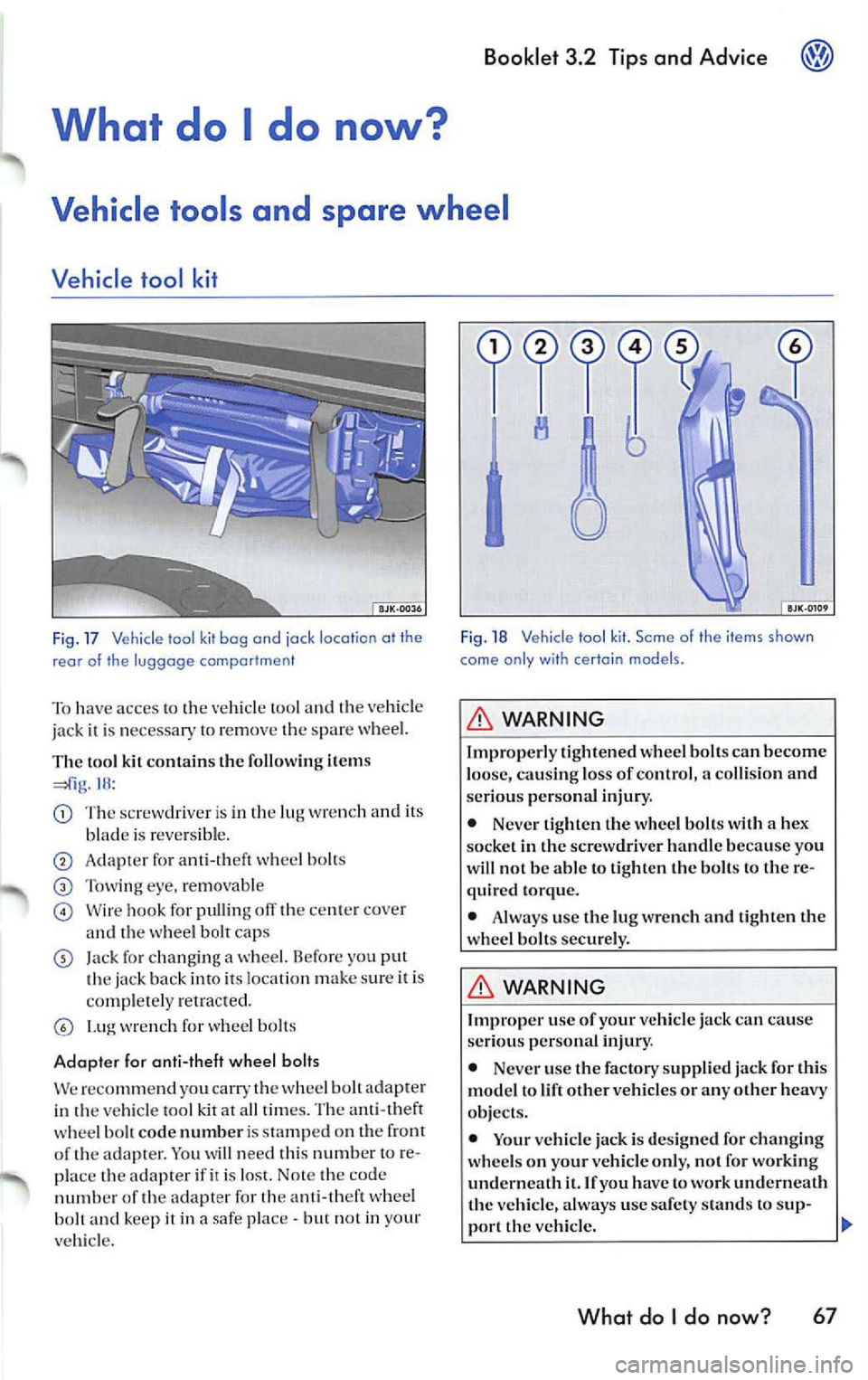
tool and th e vehicl e
jack
con tains th e follow ing items 18 :
Th e sc rew driv er is in th e lu g w re nch and its
b lad e is re ve rs ib le .
A dap ter for ant i-th eft wh eel bo lts
Tow ing eye, re movab le
W ire hook for pulling off the ce nte r co ve r
a nd th e w he el b olt cap s
Jack f or changing a wheel. B efor e yo u put
th e jack back in to i ts loca tion make sur e it is
co mp le te ly re tr a cted.
wr en ch for wheel bolts
Ad opter for anti-th eft w hee l baits
We reco mmend yo u carry t he wh eel bolt adap te r
in th e ve hicle tool kit at all times. The a nti-theft
w hee l bo lt code numbe r is sta mp ed on th e front
of th e ada pter. Yo u will need this numb er to re
p lace t he ada pter if it is lo st. No te th e c ode
numb er o f th e adapt er fo r th e an ti- th ef t whee l
b olt and kee p it in a safe pla ce
but not in your
veh icle.
Fig . 18 Vehicle too l kit. Some of th e it e m s sh own
come o nly w it h certa in models .
WARNING
Improper ly t ighte ned whee l bo lts can become
l oose, ca usi ng loss of contro l, a co llisio n an d
ser ious perso nal i nju ry.
• Neve r tig h te n th e w hee l bo lts wit h a hex
socke t in th e sc rew driver h and le because yo u
w ill n ot be ab le to tig hte n th e bo lts to t he re
qu ired torque.
• Always use t he lug wrench and tig ht en th e
wh eel bolts secure ly.
WARNING
Imp roper use of your ve hicle jack can ca use
ser io u s pe rso nal in jury .
• Never use the fac tory sup plied jac k for t his
mod el to lift othe r ve hicles o r any other heavy
ob jec ts.
• Your vehicle jac k i s des igned for ch ang in g
w hee ls on your vehicle on ly, not fo r working
un dernea th
it. If you have to wo rk un derneat h
t h e ve hicle , a lways use safe ty s ta nds to s up-
p or t th e veh icle.
What do I do now ? 67
Page 389 of 477
Booklet 3.2 Tips and Advice
WA RNING (continued)
• Always pro perl y s ecur e th e ve hicle ja ck
a nd t ool kit in th e lu ggage co mpartm ent.
L o ose item s in th e vehicle ca n fly a round th e
in sid e o f th e ve hicle during hard brakin g or in
a c rash cau sing seriou s pers onal injur y.
Changing a wheel
Applies lo vehicles: with spare wheel
Getting started
WARNING (contin ued)
• Before y ou rai se yo ur ve hicl e the jac k,
al ways re ad and h eed all
Pa rk vehicle in a safe place befo re changing a whee l.
-If yo u have a flat tir e or pun ctur e, park
t h e ve hicle as fa r away from th e flow of
t ra ffi c as poss ible o n a firm , eve n surf ace.
- Turn o ff the engine. Turn o n the emer
ge ncy flas her.
- Apply the park ing brake firm ly and en
gage a gear or
pu 1 1h e se lecto r in P.
- A ll passe nge rs mus t leave the ve hicle.
Th ey sh o uld wait in a safe place (for ex
a mpl e behin d a g ua rd rail or other safe ty
ba rrier) .
- Block the w hee l o pp osite t he w hee l
b ein g cha nged wit h a su itabl e objec t. .
- If yo u are tow ing a tra iler, u nh itch it
fr om your ve hicle .
- Remove the spare w hee l and the ve hicle
t oo ls from t he lu ggage com part ment.
WARNING
C han gin g a w hee l, es pecia lly on the s ide the
ro ad , can b e da ngero us. To hel p re du ce th e
ri sk of seriou s perso nal inju ry:
• Alw ays sto p th e vehicl e as soon as
is safe
t o do so and mo ve the ve hicle a safe distan ce
68 What do I do now?
WA RNING (cont inu ed)
off th e ro ad wher e it i s safe lo c hang e th e
wh eel.
• Turn on th e emerge ncy flas her a nd set up
an other warnin g dev ice a bo ut 27 ya rds (25
m eters) behin d th e ve hicl e to wa rn ap
pro achin g traffi c.
• Always make sure th at th e gro und i s leve l
a nd
if n ecessary use a s turdy boar d
und er th e jac k.
• When one w heel is lif ted
th e g round
puttin g th e se lector leve r in P will not pre vent
s udd en ve hicl e mo vement .
• Always appl y th e parkin g brak e
and
e ngage the se lec tor lever in P to help prev ent
the vehicl e from m oving s udd enl y a nd s lip
p in g o ff th e ja ck.
• Always block the whee l oppos ite th e w hee l
be in g cha nged with b oth fo ld in g ch ocks or
s imil ar obj ec ts .
• If you arc towin g a tra iler, a lways unhit ch it
fr om yo ur vehicl e before star tin g to c hange
th e w hee l.
• Alwa ys use a ja ck th at ha s bee n approve d
b y th e m anufa ctur er for your vehicle .
• Neve r u se oth er j ac ks, ev en if th ey have
b ee n ap pro ve d for u se on oth er Vo lkswag en
Page 391 of 477
Booklet 3.2 Tips and Advice
Applies lo vehicles: wi th spore whee l
Removing the spare wheel
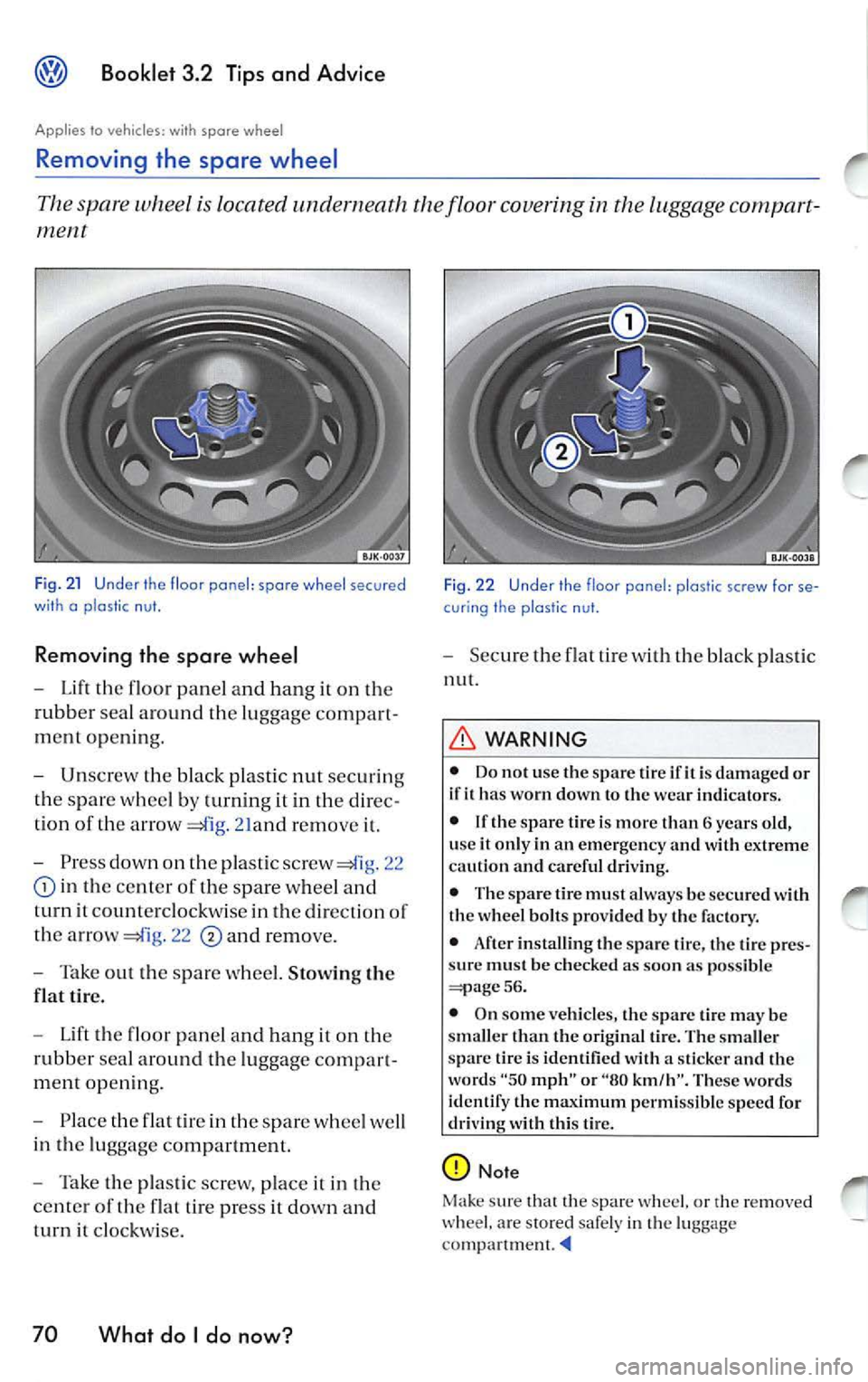
The spar e wheel is located und ern eath the floor covering in the luggag e compart
Fig. 21 Under th e floor ponel: spore wheel secured
wi th o p las tic nut.
Removing the spare wheel
-Lift floor panel and hang on
rubb er sea l aro und the luggage compart
ment openin g.
- Unscrew the black plastic nut securin g
th e s par e whee l by turning it in
direc
tion of th e arrow
21and remo ve
-Press dow n on pla stic screw 22
in the ce nter of the spare wheel and
turn it co unt erclo ckw ise in th e direction of
the arro w
22 and remove.
- Tak e out the s pare whee l. Stowing the
flat tir e.
- Lift the fl oor pan el a nd h ang i t on the
rubb er sea l around the luggage compart
m en t open ing.
- Pla ce the flat tir e in the spar e whee l we ll
in the lu ggage co mpartment.
- Take the pla stic scr ew, place it in the
c ente r of th e flat tire pre ss
dow n and
t urn
clockw ise.
70 What do I do now?
Fi g. 2 2 Under th e floor pone!: plo stic screw for se
cur ing the plostic n ut.
- Secu re the flat tire w ith bla ck pl astic
nut.
WARNING
• Do not use the spar e tir e ifit i s damaged or
if it ha s worn down to the wear indicators.
• If th e s pare lire i s more than 6 years old,
u se
it only in an em ergen cy and with extreme
cau tion and careful dri vin g.
• The spare tire mu st alwa ys be se cur ed w ith
the wheel bolt s provided b y the factory.
• After installin g the spare tire, the tire pr es
s ur e must be c hecked as soon as p ossible
56.
• On some ve hicles, the spare tire ma y be
sma ller th an th e original tire. The smaller
spar e tir e is identified with a sticker and th e
word s
"50 mph" or "80 km/h". These words
identify the max imum permissible sp ee d for
driving with this tire.
Not e
Mak e sure that the spare w heel. or
re mo ved ar e stored safe ly i n luggag e