2009 VOLKSWAGEN JETTA safe
[x] Cancel search: safePage 393 of 477
Booklet 3 .2 Tips and Advic e
Raising the vehicle
Raise the vehicle only on the appropriate jack points for vehicle jack.
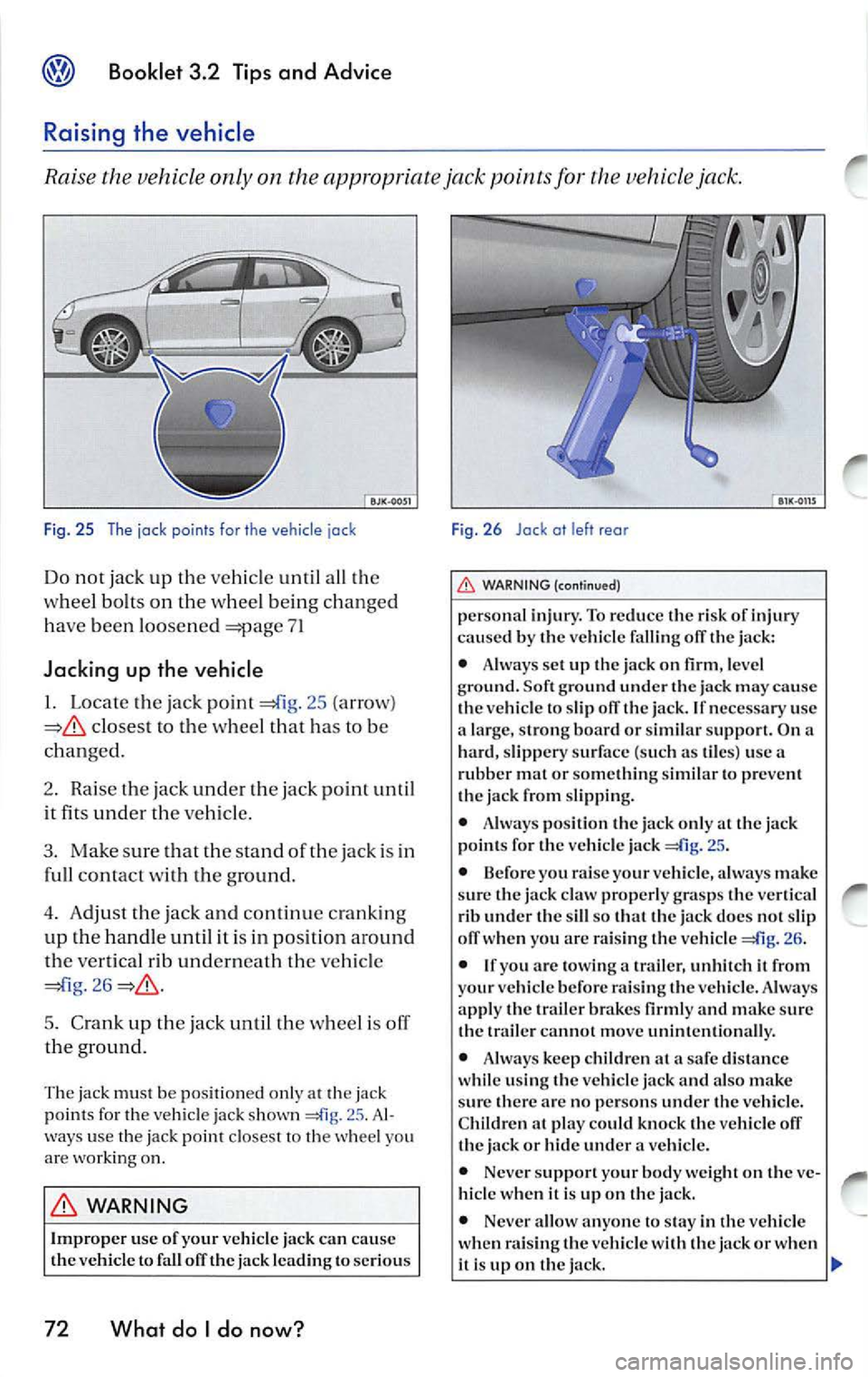
Fig. 25 The jock points fo r the vehicle jock
Do not jack up th e vehicle until all the
w heel bolt s on t he w he el be ing changed
ha ve been loo sened
71
Jacking up the vehicle
1. Locate the jack point 25 (arrow )
closest to the whee l that has to b e
c h anged.
2 . Ra ise the jack u nder the jack point until
it fits under the ve hicle.
3. Make sur e th at the stand of the jack is in
full contact with th e gro und.
4. A djust th e jack and cont inue cranking
up the handle until i t is in position around
th e vertica l rib und ern eat h the vehicle
5. Cra nk up the jack until the whee l is off
th e gro und.
T he jack must be po sitioned only at th e jack
po ints fo r th e ve hicle jack sh ow n 25 . A l
ways use the jack p oin t closest to the wheel you
are wo rking on.
WARNING
Improp er use of yo ur vehicle jack ca n ca use
th e ve hicle to fa ll th e jack lea ding to se riou s
72 What do I do now?
Fig . 2 6 Jock ot le ft reor
WARNING (continued)
p erso nal inju ry. To r edu ce the risk of in jur y
caused by the ve hicle fa lling off the jac k:
• Always set up the jack o n firm , leve l
grou nd. Soft ground under the jac k m ay cause
th e ve hicle to s lip
the jack. If nece ssary use
a large , stron g board or sim ilar su pport. On a
h ard , slipp ery su rface (such as tile s) use a
ru bber mat or something simil ar to pre vent
th e jack from slippi ng.
• Always position the jack on ly at the jack
p oin ts for t he ve hicle jack
25 .
• Before you
your vehicl e, always make
s ur e th e jack claw properl y grasps the ver tica l
rib und er th e s ill so that the jack docs no t slip
ofTw hen yo u are ra is in g th e ve hicl e
26 .
• If yo u are tow ing a tra iler, unhit ch it from
yo ur vehicle before ra is ing the veh icle. Always
appl y the tra iler brakes firml y and make s ure
th e tra iler ca nn ot mo ve unint enti ona lly.
• Alw ays keep children at a safe di stanc e
wh ile usin g th e veh icle jac k an d also make
s ure there are no per sons under the ve hicl e.
Children at p lay cou ld knock the ve hicle off
the jack or hide un der a veh icle.
• Never supp ort yo ur body we ig ht on the ve
hi cle w hen it is up on t he jac k.
• Never allow a nyone to sta y in the veh icle
whe n raising the ve hicle
the jac k or when
it is up on th e jack.
Page 397 of 477
Booklet 3.2 Tips and Advice
Applies to vehicles, with power roof
Emergency closing of power roof
The power sunroof can be closed manually if there is a defect.
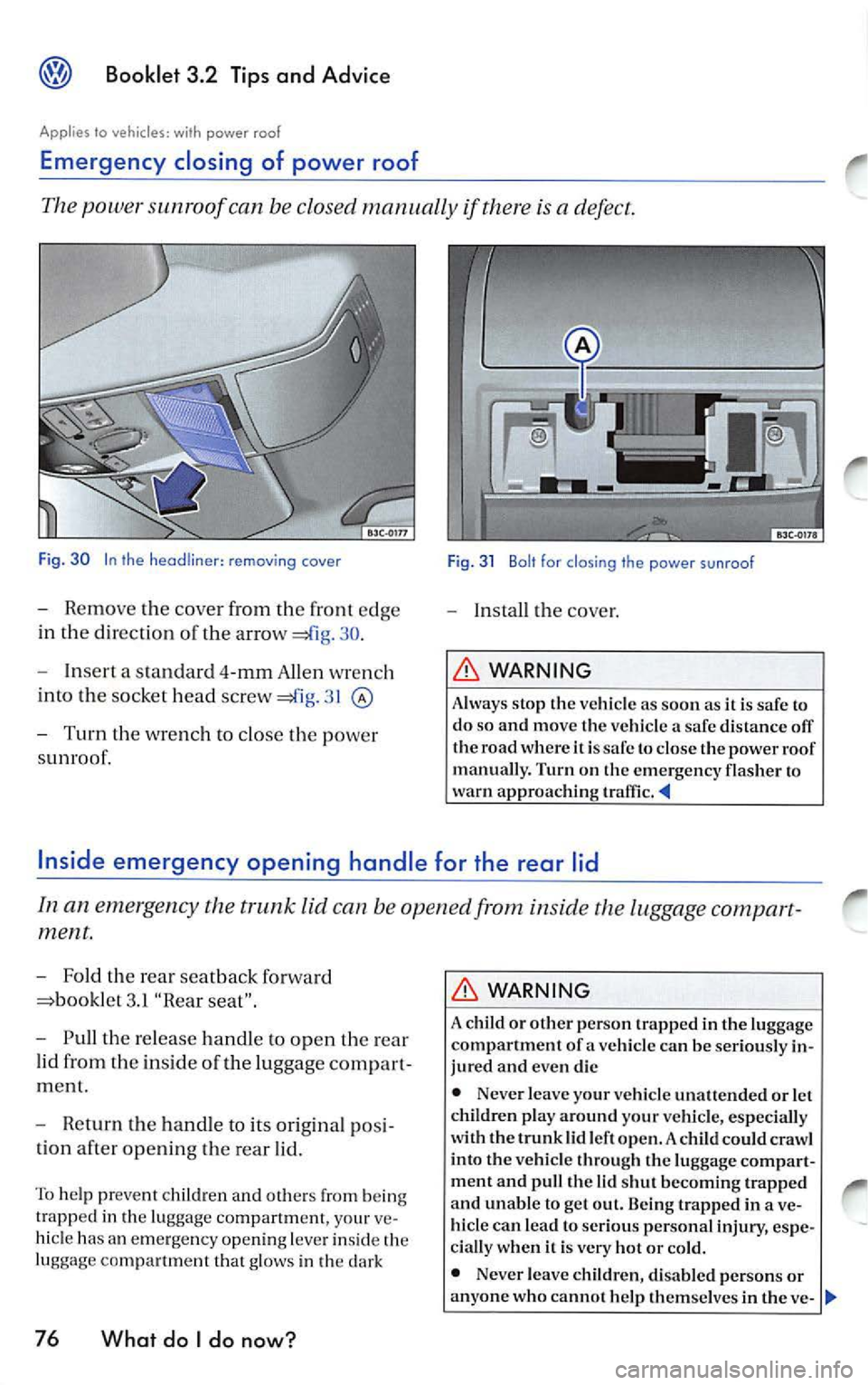
Fig. 30 In the removing cover
-Remo ve th e cove r from the front edge
in th e dire cti on of the a rrow
30 .
- Insert a standa rd 4-mm Allen w re n ch
into th e s ocket head screw
31
- Turn the w re n ch to cl ose the power
s unro of.
Fig. 31 Bolt for closing the power sunroof
-Insta ll the cover.
WARNING
Always stop th e vehicle as soon as it is safe to
do so and move the ve hicle a safe distance off
th e road where it is safe to close the pow er roof
manuall y. T urn on the em ergency flasher to
wa rn appro achin g
can b e op en ed from insid e the luggage compart
ment.
- Fold the rea r seatbac k forwa rd
3.1 "Rear seat".
- Pull the release han dle to open the re ar
lid from the inside of the luggage co mpart
m ent.
- R eturn the handl e to its ori gina l po si
ti o n af te r op enin g the rear lid.
To help pr eve nt ch ildre n and oth ers from being
trapped in the lu ggag e compartment, y our ve
hi cle has an em erg e ncy opening le ve r in sid e th e
lu gg age co m pa rtm ent th at g low s in the dark
76 What do I do now?
WARNING
A c hild or other perso n trapped in the luggage
compartment of a vehicle can be serio usly in
ju red and even die
• Never leave yo ur vehicl e un att end ed or let
c hildr en play a round your vehicl e, es pecia lly
w ith th e tru nk lid lef t open. A chil d could cra wl
into the vehicl e throu gh th e luggage compart
ment and pu ll the lid shut becomin g trap ped
and un able lo get out. Being trapped in ave
hicl e ca n lead to serio us pers onal injury , espe
ci ally wh en it is very ho t or cold.
• Never leave child ren, disabled p erso ns or
a n yone who ca nnot help themselv es in th e ve-
Page 410 of 477
then be towe d w ith all w hee ls rai sed. The ve hicle
s h ould be m ove d with a car
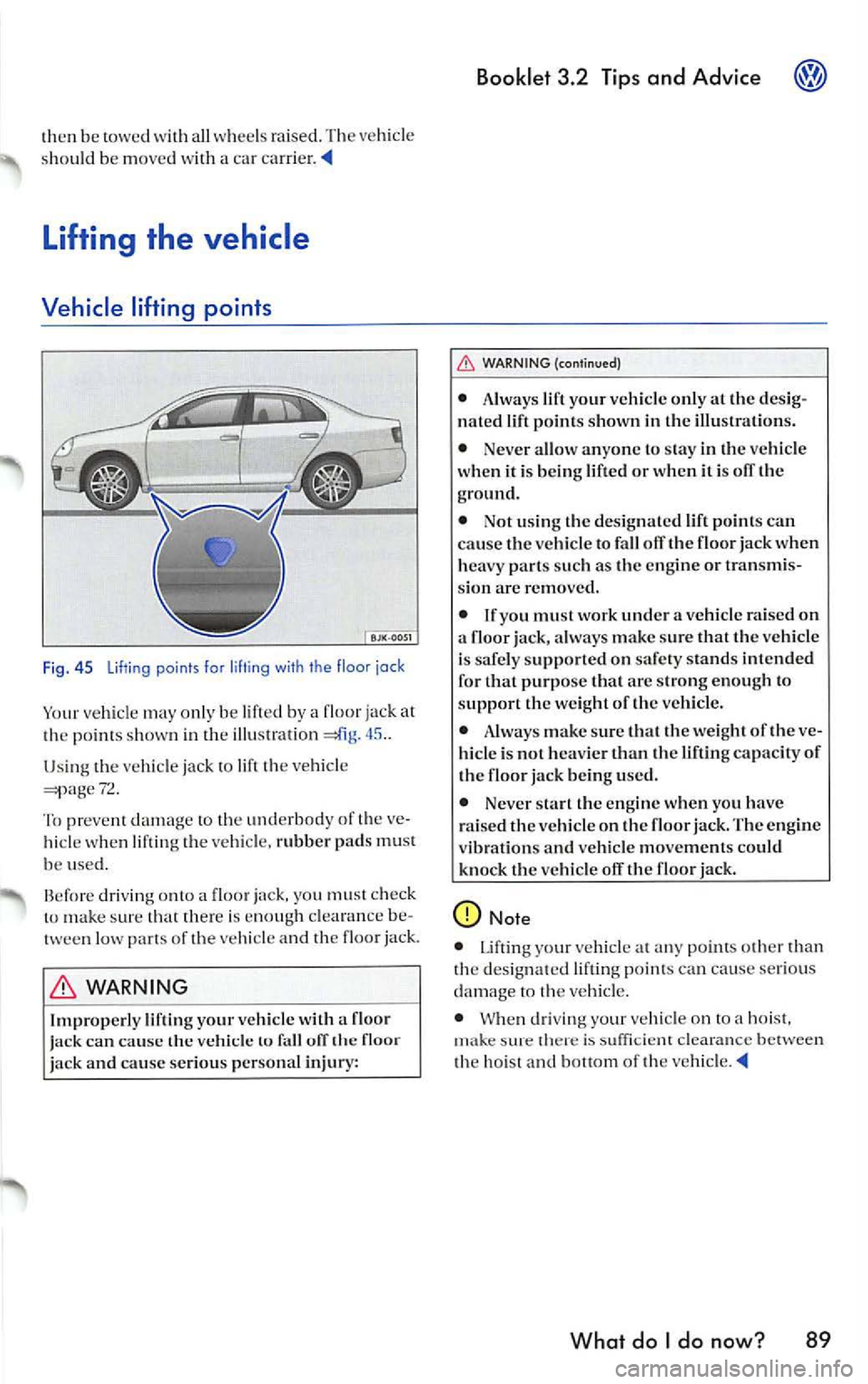
45 ..
Usin g th e ve hicle jack lift the vehi cle 72 .
To p reve nt damage to the un derbo dy of the ve
hicl e when lifting th e vehicl e, rubber pads must
be used.
B efo re driv ing o nto a flo or jack. yo u mu st chec k
make s ure that there is enou gh clea rance be
tw een low of the vehicle and the floor jack.
WARNING
Improp erl y your vehicl e with a floor
ja ck can cause the fl oor
j ac k and cause seriou s perso nal inju ry:
Booklet 3.2 Tips and Advice
WARNING (continued)
• Always lift your vehicle on ly at th e des ig
nated lift point s shown in the illu strations.
• Neve r allo w anyone to sta y in the ve hicle
when it is bein g lif ted or when it is
the
ground.
• Not u sin g the des ig nated lift point s can
ca use the vehicle to fall
the floor j ack when
hea vy part s such as the en gine or tran smi s
s ion are rem oved.
• If yo u must work under a veh icle rai sed on
a floor j ack, alway s mak e sure that the vehicle
i s sa fely supp orted on safety stands int end ed
for that purpose that arc strong e nough to
s upport th e we ight of the ve hicle.
•
mak e sure th at th e weight of th e ve
hicl e is not h eav ier than th e liftin g capac ity of
th e floor jack bein g used.
• Never start the engine when you have
rai sed th e vehicle on the floor jack. The engin e
v ibration s and vehicle move ment s co uld
knock the vehicle
the floor jac k.
Note
• Lifting yo ur vehicle at any point s oth er than
th e de signated lifting po int s c an cause se rious
damage
th e veh icle.
• When drivi ng yo ur vehicle on
10 hoist, m ake there is suffici ent cl earanc e betwee n
th e ho is t a nd bot1om of the
What do I do now? 89
Page 411 of 477
Booklet 3.2 Tips and Advice
Con sume r Information
Applicab le to U.S.A. only
If yo u b eli eve that your vehicl e has a defect
w hic h co uld cause a cras h, injur y, or death,
yo u sh ould i nform the
immedi
ately. You sh o uld also noti fy Volkswage n of
A meri ca, In c. If
receives s imilar
co mplaint s, it may open an invest igat ion,
and ifit finds that a saf ety defect exists in a
g rou p of vehicles, it may order a recall and
r e med y campai gn. However, NHT SA
ca nn ot b ecome involve d in i ndividual
probl ems b etween yo u, yo ur dea ler, o r
Vo lkswagen of Ame rica, In c.
Address of NHTSA
Te l.: 1-888- DAS H-2-DO T (1-888-327-4236}
Applicable to Canada only
If you believe th at your vehicle has a
wh ic h could cause a crash, injury, or dea th,
you s hould inform Transport Canada im
m ed iate ly, You should also notify Volk
swage n Canada, Inc.
Address of Transport Canada
To contact Transport Cana da, you may eith er
ca ll Tran sport Ca nada toll-fre e at :
90 What do I do now?
From 8:00 AM to 10:0 0 PM EST, Monday thro ugh
Friday
Or ha ve a lo ok at:
htt p:/ /www-odi.n lllSa .do t.gov/ivoq/
and print out th e web form and fax it to (202)
366 -7882
Or mail it to:
U.S. of T ransporta tio n,
Na tional Highway Traffi c Safety
Office of Defec ts In ves tigati on,
NSA- 10.01, 400 7th S treet, SW
Was hington, D.C. 20 590.
Pho ne: l-8 00- 333- 0510 (only fro m Ca nada }
Pho ne: (613) 998-86 16 (O ttawa r egion }
or write to:
T ranspo rt Ca nada
Hoad Sa fe ty
2780 Sheffield Road
Ottawa ON
KIB 3\/9
Page 416 of 477

Parts 27
Plastic parts 19
Clean ing 23
Power steering 6
Power wa sh er 18
Prem ium Gaso line 32
R
Rai sing th e veh icle wit h th e jac k 72
Hear lid
Escape handle 76
wind ow heat ing
Heatin g element wires 20
Refue ling 30
H eg ular Gaso line 32
Repair s 28
Hep lacin g
Whee l rim s 63
Rep lacing tires and wheels 6 1
He por ting safety de fects
Ca nada 90
Unit ed States 90
Rims Replacing 63
gas kets 20
s
Safery belt s
Cleaning 26
S now chains 66
Spa res 27
Speed Hating Letter Code 62
Sta rtin g w ith jum per ca bles 84
Ste ps fo r dete rmining correc t load lim it 59
T
Tank
Fillin g
tank 30
Openi ng the fu el filler
30
Tec hnical m od ifica tions 28
T ire pressu re 56
T ir e pressure monitoring system
Se nso rs 63
Tir es and whee ls 63
Va lves 63
Booklet 3.2 Tips and Advice @
Tire service life 59
T ir es
Rep la cing 63
Se rv ice life 59
Speed Hating Leller Code 62
Ti re manufa cturing dale 62
Ti re specificat ions 62
Tread depth 59
Uni form tire qua lity gradi ng 64
Win te r tires 65
Tir es and vehicle load limit s 58
Tir es and whe els 5 1
C hec king tir e press ure 56
Co ld tire innation pre ssure 54
D imens ions 6 1
General notes 51
Glo ssary of
and loadin g
t e rm inology 52
New tires and whee ls 61
Rep lacing 6 1
Snow cha ins 66
T ire pressu re mon ito rin g sys tem 63
Tir es and vehicle load limit s 58
Whee l bolts 66
W int er tire s 65
Tools 67
Towing 86
Four-wheel dr ive 86
General notes 87
When can yo ur vehicl e not be towed? 88
Towing eye 86
Tra iler tow ing
Brak es ll
Dr iv in g tips 13
Operating instru ction s 12
Safety chain s 11, 12
Tec hnical requir ements IO
Tire press ure 12
T ow ing tips 13
Trailer lights 11
Tra iler weigh t 12
Tra nspo rt Ca nada 90
Tread Wea r Ind ica to r (TWI) 59
u
Underbody sea lant 22
Unidir ectiona l tires 51, 73
Uniform lir e qu alit y g rading 64
Alphabetical index 95
Page 421 of 477
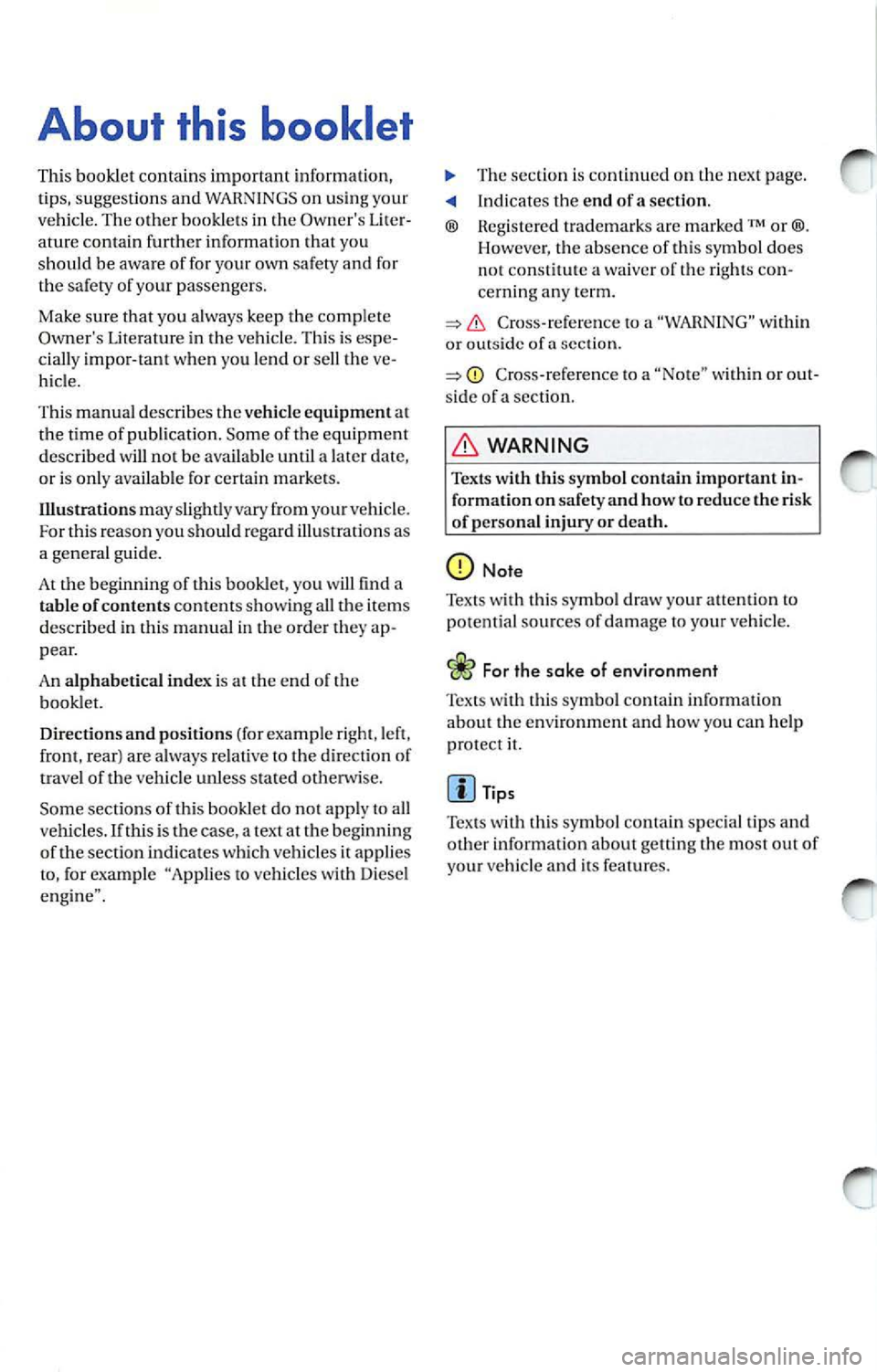
About this booklet
This booklet contains important information,
t ip s, suggest ions and WARNINGS on using your
ve hicle. The other booklets in the Owne r's Liter
ature contain further information that you
should be aware of for
own safety and for
the safety of your passengers.
Make sure that you alwa ys keep the complete
Owner's Litera ture in the veh icle. This is espe
ciall y im por-tant when you lend or sell the ve
hicle.
T hi s manual describes the vehicl e equip ment at
the time of publication . Some of the equ ipment
described will not be ava ilab le un til a lat er date,
or is only available for certain markets.
Illus trations may slig htly vary from you r vehicle.
For this reason you should regard illustrat ions as
a general guide.
At the beginning of this booklet, you will find a
table of contents contents showing a ll the item s
described in this manual in the order they ap
pear.
An alphabetical index i s at the end of the
booklet.
Directions and positions (for example right, left,
front, rear ) are always re lative to the direction of
trave l of the vehicle un less sta ted otherwi se.
Some sections of this bookle t do no t app ly to
vehicles. If this is the case, a text at the beginning
of the section indicates which vehicles it applies
to, for examp le "'Applies to vehicles with Diesel
engine".
The sec tion is continued on the next page.
Indicat es the end of a section.
® Regis tered tr ademarks are
or®·
Howe ver, the absence of this symbol does
n ot cons tit ut e a waiver o f the r ights con
cerni ng any term.
Cross-refe rence to a "WA RNING " within
or outside of a section.
Cross-refere nce to a "Note " within or out
side o f a sectio n.
WARNING
Texts with this symbo l con tain imp ortan t in
formation on safety and how to reduce the risk
of personal injury or death .
Note
Text s w ith this symbol draw your atlentio n to
potentia l so urc es of damage to your vehicle.
For the sake of environment
Texts with this symbol conta in inform atio n
abou t the environm ent and how you can help
prote ct it.
Tips
Tex ts
this symbo l contain special tips and
other information about getting the most out of
yo ur veh icle and i ts fealllres.
Page 423 of 477

Booklet 3.3 Technical Data
General notes
What you need to know
Abbreviations used in this booklet
Abbreviation Meaning
kW Kilow att (e n gin e pow er)
hp Hor se power ( engin e pow er)
rpm Revolu tion s per minut e (engine sp ee d)
N m Newt on m ete rs ( un it of engin e torque )
lb- ft
Foot pound s (uni t of engin e torq ue)
in . Inch
qt s. Quart s
CID Cub ic in ch di spl ace ment
lb s.
Pound s
k g
Kilogram
Vehicle Identification
Fig . 1 View from th e outs ide thro ugh the windshi eld
on the driver 's side : Ve hicle identilicotion numb er
(V IN)
Vehicle identification numb er (VIN}
The vehicle ident ifica tion numb er is lo cat ed on
th e in strum en t pa nel o n th e dri ver' s s ide so
it is vis ib le from th e out side through the w ind
s h ie ld l.
2 General notes
Th e safety compliance sticker
Th e sa fe ty comp lian ce s tick e r is yo ur ass ura nce
th at y our new ve hicle comp lies w ith all appli
c ab le Fed -e ral Motor Ve hicle Saf ety S ta nd ard s,
w hich wer e in effec t
lim e the ve hicle wa s
m anufa ctur ed. Yo u can find thi s sticke r on th e
l e ft fro nt door jamb.
It shows t he m ont h and the ye ar of produ cti on
a nd
ve hi cle id entification number.
Th e high voltag e warning label
T he hig h vo ltage warn ing lab el is located on th e
l oc k ca rr ie r
Th e spark i gn ition system meets al l r eq uire
m ent s of th e Canad ian Int erf ere n ce -Ca using
Equ ipm ent Heg u-lati ons.
Th e ve hicl e identification label
ve hicl e id en tifi cat io n lab el i s loca te d on th e sid e of th e rea r pan el in th e lu ggage com
partm en t o r under carp eti n g on th e luggage
compartm en t floor. The labe l co nt ains th e fo l-
l o w ing informa tion:
II>
Page 425 of 477

Booklet 3.3 Technical Data
Roof weight
Th e maxim um pe rmissib le roof we ight is 165 lbs ( 75 kg ).
On ly us e the roof rack system sp eci fica lly d e
s ign ed, tested and approved by Vo lk swage n.
The roo f weig ht increa ses the weight of t he front
and rear ax le and correspondingly re d uces the
o th er l oa d that your vehicle can carry.
D istri bute th e load even ly and do not exceed th e
P erm iss ible Roof Weight (including th e we ig ht
o f th e roof rack system ) or t he Gross Vehicle
weig ht.
For mor e details see
2.1 "Safety first",
c h ap te r " Safe driving " and "Con
t rols a nd Eq u ip m ent", ch apter "Seats and
s torag e."
WARNING
Transpor ting heavy bulky loa ds on th e roo f will ch ange the way the ve hicle han dles by
s hi fti ng the ve hicle's cen ter o f grav ity,
c h an gin g its aero dyna mics and the way it re
ac ts to side winds.
Dimensions
T he speci fica tio ns re fer to the ba sic m ode l. Dif
fere nces may occ ur depending on the mod el
type and options orde red, for example, tir e siz es .
yo ur vehicle
in are a s wi th parking b arri ers or c urbs. Pa rking
barri ers a nd cur bs va ry in h eig h t. They co ul d
dam age yo ur bum per and re la ted co mponent s
w hen th e fro nt of you r ve hicle moves over a bar
ri er or
curb that is too To avoid dam age to
yo ur car you sh o uld stop a nd park t he car
w ith out t ouch ing the pa rking barri er or curb.
4 G ener al not es
WARN ING {co ntin ued)
• Cargo that i s la rg e , h eavy, bulky, lo ng or
fl at w ill have a mo re nega tive in fluence o n th e
ve hicle's aerodyna mics, ce nter of grav ity a nd
ove ra ll h an dl ing.
• Always adapt your driv ing and sp eed to
w hat yo u arc ca rryi ng on the roof as we ll as to
road,
wea ther and w ind cond it ions.
• Always avoi d sud den brak ing or dr iv ing
maneuve rs.
• Always make sur e th at l oads a rc proper ly
di stri but ed and th at heavier i te m s a rc in th e
fr ont ..
• Nev er excee d th e m ax imu m roof load for
t h e ve hicle, max im um ax.le loads or the max
im um gross vehicle
th ere is dan ger
of dam age to th e ve hicle. -4
• When dr iv in g up stee p ramp s, on ro ugh
roads, or ove r curb s e tc. it i s important t o re
m ember t hat so me pa rts o f yo ur vehicle, suc h as
s p oilers or exhau st system compone nts, may b e
very close to the g round . Be caref ul not t o
dam age them .
Tip s
Th e
ma y he ifa dd iti nnal e q ui p
m en t is for differe nt mode ls , for specia l
ve hicl es and for oth er co untri es . -4