2009 VOLKSWAGEN JETTA safe
[x] Cancel search: safePage 327 of 477
Booklet 3.2 T ips a nd Advice
Power steering
011 vehicles with pow er stee ring , th e of power ass ista nee is regu lated e lec
t roni call y acco rdi ng to vehicle speed, stee rin g wheel torque and stee rin g w hee l
angle.
Th e power assis tance prov ided in the power
s te erin g sys te m is not hydrau lic, but m e
c h ani ca l usin g an elec tric mot or. The adva n
t a ge s of this steer ing system includ e th e fact th at
n o hydra ulic co mponents such as hoses, o il co n
t a in ers ,
o r fl uid s are re quired.
Fu rth ermo re , t his is co nsiderable de crease in
e n ergy req uir e d . T he e lec trome chani ca l s tee rin g
sys te m . in contras t to th e hydrau lic sys te m
(w hich re qu ires a co nstant flo w of fluid ), only
co nsume s energy when th e ve hicle is actua lly
be ing stee re d.
T he fu el consump tio n i s re du ced as a res ult.
If th e electro mec han ica l p owe r stee ring sys te m
fa ils, the pow er a ssis ted stee ring system
w ill still
work. If th e engin e is sw itch ed off, the pow er s
teer ing does no t fun ctio n and th e steer ing
wh eel is ve ry hard t o tu m .
WAR NING
Turning th e s teer ing whe el is very w hen t he power s tee rin g sys tem is n ot
work ing and it is harder to co ntrol the veh icl e.
• Neve r le t t he veh icle coast with th e engine
swit ch ed off.
Do no t kee p th e steer ing wheel turned all the 10 left or righ t fo r m ore than 15 seco nds
w hen th e e ngin e is runnin g. Doin g so co uld
damag e th e powe r steer ing
Data
H eco rder (EDH ), in sta lled by so me manufa c
tur ers
the exp ress purpo se of ca pturing data
fo r retr ieva l aft er an acci den t or cra sh eve nt.
are so metimes called "cras h recorders".
So me s tat e laws res tr ict t he re tri eva l or down
loadin g of da ta sto re d by ED
that were in
s ta lled in a vehicle for the exp ress p urpose of re
tr iev ing dat a af te r an acc ident or crash event
wit hou t th e Owner's conse nt.
your vehicl e is not equipped with an it is equipp ed with number of e lec tro nic
contro l modu les for variou s vehicle sys te m s
s u ch as, fo r ex am ple . e ngine function, em iss io n
6 Smart t echno logy
co ntrol, as we ll as fo r th e airbags and safe ty
be lts.
The se elec tronic con trol mod ules also
ve
hi cle-re late d dat a dur in g nor mal ve hicle ope ra
ti on for diag nos tic and re pair purp oses. The re
cordi ng capaci ty of the e lec tron ic co ntro l mod
ul es is limit ed to data (n o so und is record ed ) a nd
on ly a small amo unt of data is ac tually reco rde d
ove r a very limited p eriod of tim e and stor ed
a sys te m fau lt or o th er co ndition is se nse d by co ntro l un it. So me of dat a th en sto red
m ay re late to ve hicle sp ee d, direc tion, braking as
well a s res traint system use and performan ce in
th e eve nt of a cra sh or o th er conditi on. S to red
c an only be rea d and downloade d wit h spe
cia l
Page 330 of 477
Operate your vehicle safely
For drivin g safely, alwa ys follow t he speci fied
maint enance interva ls in your maint enan ce
bo okle t =boo klet
I.I "M aint en an ce" -es peci ally
fo r chan ging brake fluid. H ard use , pri marily
s top and go dr iv in g, o perat io n in very dusty
areas, t ra ile r towi ng as we ll as other con dition s
m ay make
neces sary maint enance
im erva ls -see your authorize d Vo lksw agen
d ea ler.
Your vehicle 's condition is dir ect ly relot ed to
driving safety
Th erefo re, always be sur e
ob serve fol
l ow ing points before yo u dr ive off:
• Check l ig ht s an d turn sig nals.
• Check f uel l eve l.
• Make sure
a ll ligh ts a nd all wi ndows are
clea n.
• Adjust
mirr ors .
• Make s ure
air intak e slo ts betwee n en gin e hood a nd wind shi eld are free of
l eaves, sn ow a nd ice.
• Check warning a nd indicato r light s when
s tarli ng the en g in e.
Your personal d riving style and attitude have a
lot to do with safety ..
T here fore , for you r ow n sa fe ty:
• Wear your safety bells a nd wear
pro p
er ly , ev en if you ar e just driv in g in city o r lo
th e co rner =book le t 2 .1 "Sa fe ty first",
c h apt er "Safet y
• Make sur e th at all passe ngers wear their
sa fe ty belt s proper ly. even those in rea r 2.1 "Sa fe ty chapter "Safety
belt s." Pa sse ngers wea ring en
danger not onl y th em selves in cra sh, but al so dri ver and oth er passengers .
• Make su re th at children a lwa ys
on rear
sea t prop erl y res tra in ed by a res traint system a p
propri ate for th eir size and age.
• Never tra nsp ort a child in a rear
c hild
or infant seat on the front passe nger seat
= bo oklet 2.1 "Safety
• Adju st yo ur sea t so that yo u ca n eas ily reac h
a ll co ntrol s whil e yo u are as from
Booklet 3.2 Tips and Advice
airb ag as pos sible but close r th an 10 inches
(25 cm ) = book let 2. 1 an d 3.1.
• The sea ting positi on is ve ry important for the
a irb ag perfo rm ance
2.l "S afety first",
cha pter "Air bag syste m.''
• Always a djust th e hea d res traints to
cor
r ec t h eig ht . For maximum pro tec tion , ad just the
h ead res trai nt so that the upp er edge is as eve n
w ith the top of yo ur hea d as possi ble,
no
l owe r than eye le v el a nd so that is as close to
th e ba ck of your head as possib le = bo okle t 2. 1
"Safe ty
• Alw ays make s ure that the mov ement of peda ls is no t res tri cte d in an y way 3. 1,
c h ap te r " Peda ls ."
• Store luggage an d light it em s prop erl y in
luggage compartme nt and on roo f
=book let 3. 1, c hap ter" Luggage compa rtment "
an d
3.1, cha pter rack."
If you drink, do not drive !
T he use of a lco hol, dru gs a nd certain medi ca
ti ons w ill seriously impa ir percept io n , reac tions
a nd dri vin g a bility ,
increa sin g th e
ri sk of an acci dent, cras h an d pe rso nal injury.
Do not drive if you are tired.
Make frequ ent rest stops , at le ast aft er every two
hours of dri ving.
Al ways adapt vehicle speed to traffic, road and
weather conditions.
H em ember , th at
o n sm ooth, slipp ery
roa ds, ve hicle han dling and br aking dep end a
d ea l on tire ad hes ion. On wet roa ds, the
front whee ls c an h ydrop lane, especi ally at
h ig her sp ee ds. If thi s hap pe ns, yo u will then no
l o nge r b e ab le to ste er or brak e prop erl y.
WARNING
• Alw ays observe the po sted spe ed Ii mils and
common sense. Your good judgment can
mean
diff ere n ce between arr iving safely at
your destination and being ser iously injur ed
in
crash or other kind of accide nt.
• Alway s rea d and hee d all WARNI NGS and
a dditi on al inform ation rega rding safety
= bookl et 2.1 "Safe ty
Driving and protecting the environment 9
Page 332 of 477
manufactur er to make sur e th at yo u are using
t h e co rrec t hit ch
Do not use a bumper hitch.
Th e hit ch mu st be install ed so . that it does no t
int erf ere w ith th e impac t-a bso rbin g bu mpe r
sys tem . Do no t mak e any c han ges to th e ve hicl e
ex hau st and brak e sys te m s. Fro m t im e to tim e,
c h ec k tha t all hit ch -mo unting
rema in se
c ur ely fas tened .
W hen yo u are not t ow in g a tra iler, re m ove the
t ra ile r hi tch ball m oun t. T his pr eve nts th e h itch
fr om causing dam age sh ou ld yo ur vehicl e be
s tru ck fr om b eh ind .
Engin e coo ling syste m
Tow ing a trai ler makes the e ngin e wo rk It is im portant th at th e engin e coo ling syste m is up to th e job . Make su re that th e coo ling sys te m has
e n ough flu id.
Trailer brokes
If yo ur t railer h as its own brakes, ch eck to be th at it confo rms to a ll regula tion s. The tra iler
b ra ke sys te m must n ever be directly co nn ecte d
to th e ve hicle's brake sys tem.
Sa fety chains
Alw ays use safety chain s betwee n yo ur ve hicle
a n d trail er.
Trai ler lights
Tra ile r lig ht s m ust m eet a ll reg ulati ons
Neve r co nnect th e trail er light sys te m di rectly to
t h e lig ht sy ste m of y our vehicl e. 13 e to c hec k
w ith your auth orize d Vol ksw age n d eale r fo r
rec t w irin g, sw itch es a nd relays .
Mirror s
If yo u canno t see the behind you using th e
r eg ula r outside mirror s, th en you mu st i ns tall
exte nded m irror s. It 's
th at yo u alw ays have
cl ea r vis io n to th e re a r.
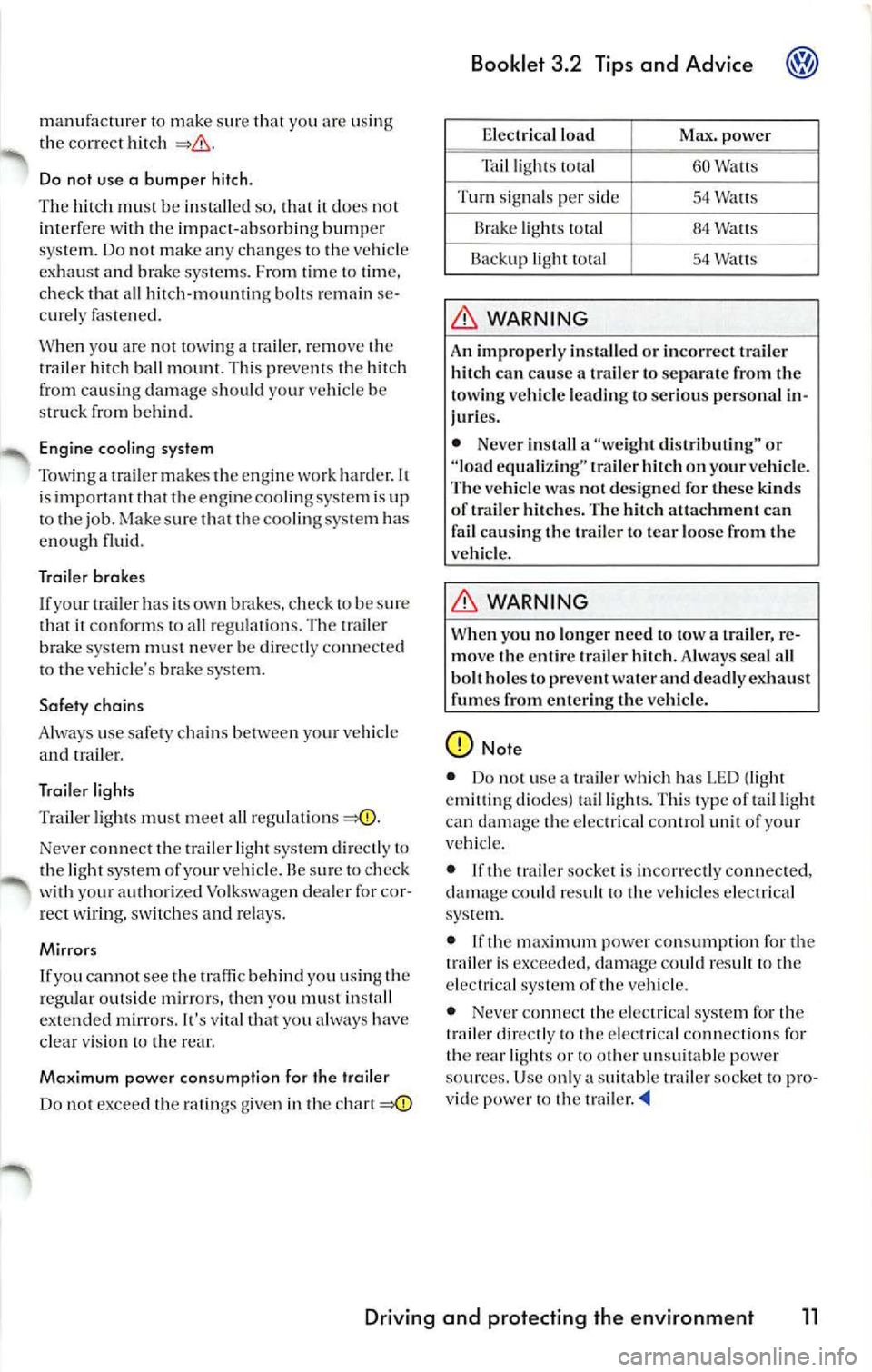
Maximum power consumption for the trailer
Do not excee d the ra tin gs g iven in t he c hart
Booklet 3.2 Tips and Advice ®
Electrical load power
Tail lights to ta l
60 Watt s
T urn sig nals per sid e 54 Wa tts
Br ake light s to ta l 84 Wa tts
Back up ligh t to tal 54 W atts
WARNING
An improperl y in sta lled or in corre ct trailer
hit ch can cau se a tra iler to separate from the
t o win g ve hicle leadin g to ser iou s per son al in
j uri es.
• Never install a "weight distributing" or
" lo ad equa lizin g" trailer hitch on your v ehicle.
T he v ehicle wa s not de signed for these kinds
of trailer hit ch es . Th e hitch attachment ca n
fail ca using the trailer to tear loos e from th e
veh icle.
WARNING
Wh en you no lon ger need to tow a tra iler , re
move the ent ire tra ile r hitc h. Alwa ys s eal a ll
bolt h ole s to pre vent water and dead ly exhaust
fum es from ent ering th e vehicle.
Note
• Do no t use a trailer w hi ch h as LED (lig ht
em ittin g dio des) t ail light s. T hi s ty pe of ta il lig ht
ca n da ma ge t he elec trica l co ntrol un it of yo ur
ve hicl e.
• I f th e tra iler soc ke t i s in co rrec tly co nnecte d ,
d am age could r esult
10 t h e ve hicles elec trica l
sys te m.
• I f th e m ax imum p ower co nsum pti on fo r
trail er is exceede d, dam age c ould r esult to th e
e lec tr ica l sys te m of ve hicl e.
• Neve r co nn ect th e elec trical sys te m fur th e
dir ectly to elec trical co nn ectio ns fo r
th e rea r or to o ther u nsu itab le powe r
so urces . Use only s uit abl e socke t to pro
v id e powe r to th e
Driving an d protecting the environment 11
Page 333 of 477
Booklet 3.2 Tip s and Advice
Operating instructions
Maximum trail er weight
Yo u ca n onl y tow 1y p ic al clas s I o r cla ss 2
I railers
w ith your vehicle.
T he m ax imum gross trailer weigh1 and 1h e
tongue loa d mu sl never exceed 1he s pecifica
tion s liste d in
3.3 "T ec hni cal
Neve r ex cee d 1h e gro ss v ehicle weigh 1, w hich i s
th e we ight of 1 he veh icle. includin g driv er, pa s
se nge rs , lu ggage,
I raile r hi1 ch an d 1ongue wei gh I of t he loa ded trailer.
I n alt itude s abov e
3,000 f1. (1,000 redu ctio n
of 10% of co m bin ed lowing weight (v eh icle plu s
trai le r) fo r the beginn ing of every
3, 000 f1. (1,000 m ) shou ld be obser ved.
Trailer loa d distribution
sur e th e loa d in th e tra il e r is held secu rely in
plac e to gu ard against shif ting, b e ii forward ,
ba ckward or sidew ays. A load that shifl s can
mak e it hard or eve n imp ossib le 10 co n1rol your
ve hicl e, pa rticul arl y in an emergency s ituat ion.
Tongue load
F o r best ve hicl e handling when towing a tra iler,
adju st th e traile r load so
the tongue lo ad i s
at the maximum allow abl e or slightl y lo w er. You
ca n get an approxim ation o f th e tongu e load
wit h a bathroom scale or yo u can m ea sure the
load at a 1 rucking com pany or weig hing stat io n.
Th e to ngue lo ad in cre ases the we ig h t of t he rear
ax le and corres po ndingl y re du ces the oth er l oa d
that your vehicl e ca n
pressure
towing a trailer, inflat e th e tir es o fyourv e
hicle to th e co ld tir e pre ss ure liste d on th e stic ker
on th e op en edg e of the dr ive r's door . Inflat e
tra iler tires to traile r and tire
s p ec ification s.
Light s
Al way s che ck th e head lig ht se 1tin gs wit h th e
tra iler hooked up befo re dri vin g off. A djust a s
n ecessary so
you can see th e road ahead but
n ot b lind oncom ing traffic .
C hec k and make sur e tha t all vehicl e and
light s are wo rki ng properl y-esp ec iall y the light s. S
af ety chains
sur e tr ailer safet y cha ins are properl y co n
n ect ed from t he tra iler to the hi tch on th e ve
h icl e. Leave e nou gh slack in the c hain s 10 turn
co rner s. Whe n yo u in s1a ll safery cha ins, m ake
s ur e th ey will not drag o n the road w hile you are
d ri vin g.
T he chains shuultl
u ntler t he traile r to prevent it from dropping to th e grou nd in cas e
of sepa rat ion from the hitch.
Electronic Stabilizat ion Program (ESP )
A lwa ys leave th e ES P swi1ched on w hen you tow
a trail er. The ES P makes it easi er to stab ilize the
trailer sh ould it start to swerve o r sw ay.
WARNING
A lways adjust your dri ving lo th e road, traffi c
and weather condition s. Do not let the extra
s af ety that ESP/AS R can provid e te mpi you
i nto laking extra risks.
WARNING
Ridin g in a trail er i s da ng erous and may be il
leg al.
• A person who is not properly re str ain ed in
a m ov ing ve hicle ri sk ser iou s perso nal inju ry
a nd even death in a cras h.
• Nev er let anyone rid e in your vehicle
witho ut bein g prop erly restr ain ed.
• Never all ow
pa ssenger lo ride in trailer .
WARNING
Exceeding th e permi ssible weig ht
rat ings and permis sible trail er
we ig ht s ca n result in accident s leadi ng to se
r ious persona l injury.
• Neve r le t th e ac tual Gross Axle Weight
Ratin g at th e front and rear
exceed the
pe rmi ssibl e we ig ht s. Also neve r le t th eir com
b in atio n excee d th e Gross Vehicle Weig ht
Ra ting.
• Alw ays re member that the vehicle' s han
dli ng will be
by the extra load. There-
fo re, adju st yo ur spee d accordin gly .
12 Driving and protecting the environment
Page 339 of 477
Booklet 3.2 Tips and Advice
WARNING
Sharp edg es und er th e ve hicle can cut exposed
s kin.
• Always protect your hands and ar ms from
cuts on sh arp metal edges when cleaning the
und erb ody, the in sid e of the whe el h ousin gs
etc.
Note
• Neve r 10 re mo ve mud or du st if the
ve hicle s urf ace is dr y. U sin g a dry cloth or
s pong e for cleanin g co uld dam age the paint or g
la ss on yo ur vehicle. Soa k
mud or du st
w ith pl en ty of wa ter before re m ov ing it.
• When rin sing th e vehicle, do not le t w at er get
i nt o t he loc k cy lind ers or point the hose
at ga ps
aro und th e doors, hoo d or r ea r li d. The water
cou ld fre eze and make it
to op en th e ve
hicl e.
• To help pr evenl dama ge to th e painl, do not
was h the vehicle in dir ect sunli ght.
o nl y in sp ecia l was h ba ys th at ca n handl e oily
din that is was hed off th e ca r.
Washing the vehicle with a power washer
B e very careful when using a power washer!
- Alwa ys follow the in stru cti ons for t he
p ower washer, parti cularl y tho se about th e
pr ess ure and the spray ing distanc e.
- Increa se the spr ayi ng di sta nc e fo r soft
m ater ia ls and p aint ed bump ers
- Do not use a powe r was her to remo ve
i ce or sn ow from win dows
19.
- Never use concen trat ed je t no zzles or
so-ca lled "d irt b lasters" es peciall y on ti res
- Afte r the veh icle ha s be en wash ed , th e
b rake discs and pad s w ill b e wet (t hey
co uld even be icy in the w inte r) and stop
pin g di sta n ce s w ill be lo nger. Be s ure to
the brak es with seve ral care ful brake
app lica ti ons before dri vin g off
8.
WARNING
W et br ake s or br ake s coa te d with ice or road
sal t reac t slower an d need lo nge r stoppin g di s
t a n ce s.
• Care full y appl y brake s for a tes t.
• Alwa ys dry brakes and clean
ice coat -
in gs and salt coatin gs with a few cauti ous
brake application s.
18 Cleaning and protection
WAR NING (continued )
• Alw ays rea d and heed a ll 8, " Braking power and braking di stance".
WARNING
Improp er u se o f power wash ers can ca use se
riou s, invi sible and perman ent tire dama ge
l ea din g to tir e failur e and lo ss of v ehicl e co n
tr ol.
• Never was h tires w ith a jct that sprays the
wa te r out in a dir ect str ea m eve n at a di stan ce
ev en for a very short am ount of tim e.
Note
• Water sh o uld no t be more th an 14 0' F (60 ' CJ .
• If yo u use powe r wa sh er, b e sur e to ke ep it a
safe fr om the Park As sis t se nsors in th e
f ront and rear bump ers. If yo u ho ld it too clo se to
th e se nsors, you could dama ge th em.
• To pr event pos sibl e dam age
10 yo ur ve hicle,
h old t he po we r w ash er fro m soft mate
rial s, su ch as ru bb er hoses , plas tic e tc .
T his a lso app lies 10 b ump ers . Th e closer
yo u h old th e power wash er to th ese mat erials ,
th e greater is th e force again st them.
Page 347 of 477
Booklet 3.2 Tips and Advice
Cleaning safety belts
A dirty safety belt can prevent a safety belt from working properly.
Keep safety belt s clean and check all safety
b elt s for damag e reg ularly.
Cleaning safety belts
-Carefu lly pull the dirty safety belt out of
the retrac tor and leave it spooled out.
- C le an the dirty safety belts with a
gentle
soa p so lut ion.
- Let the sa fety belt fabr ic dry.
- Do not roll up the safety belt until it is
comple te ly dry.
Th e automa tic bel t w ill n ot be ab le to roll back
prop erl y if ther e is dirt on th e belt .
WARNING
Damaged safety belts reduce the overall effec
tivene ss of the safe ty belts and increase the
risk of serious persona l injury and death
wheneve r a vehicle i s being used.
• Damaged safety belts must b e replaced,
the y canno t be repaired.
• Never use chemical cleaning agents, so l
ve nts or any substa nce that ma y damage or
wea ken the safety belt webbing or any other
26 Cleaning and prot ection
WARNING (continu ed)
part s that make up the seat belt. Never le t the
belt s come into contact with corros ive fluid s.
• Imm ediately replace damaged safety belts
wi th the correct replacement belts provided
by an authorized Volkswage n dealer or quali
fied works hop. Replacement after a crash may
be ne cessary even if a safety belt does not have
v is ibl e damage.
• Check the condi tion of all safety belts at
regular interval s. If you notice that the belt
webbing, hardware , retrac tor or buckle of any
of the safe ty belts is d amaged, the belt must
imm ediately be replaced by an authorized
Vo lk swagen dealer or qualified workshop .
• Never attempt to repair a damaged safety
belt yourse lf. Never remove or modify the
safety belts in any way.
• Be sure to read and h eed the information
and a ll WARNINGS
2.1 "Safety
fir st", chapter "Safety belts."
Note
Aft er cl eanin g the saf ety belts , a lwa ys allow
th em to d ry complet ely befor e le tting th em roll
up into th e re tra cto r to pre vent th e re tractor
fr om b eing damaged.
-4
Page 348 of 477
Booklet 3.2 Tips and Advice
Accessories, new parts, repairs and modifications
Accessories and parts
Always con sult an authori zed Volk swagen dealer before purchasing accessorie s
and parts for your vehicle.
Your vehicl e is des ign ed to offe r a hi gh stand ard
o f a cti ve an d pass ive sa fe ty.
Pl ease co nsult an author ize d Vo lkswagen deale r
for advice befo re insta llin g accessor ies, re pla ce
m en t part s or other e quipm en t.
Au thori zed Volk swage n dea le rs ha ve the la tes t
information fr om th e manuf actur er and can rec
ommend a ccessori es a nd part s
are suit abl e
fo r yo ur vehicle and perso nal r equir em ent s.
They can also help answer questions you mi ght
h ave reg arding official reg ulati ons.
We r ecommend you onl y use appro ved Volk
swage n accessories and genuine Volkswagen
part s® . Th ese part s and accessor ies have bee n
eva luate d b y Vo lkswage n for suit abilit y, reli
a bility and safet y. Th e Vo lksw age n d eal ers hip s
h ave the necess ary ex peri ence and faciliti es
ensure th at th e part s are prop erly .
Vo lkswage n ca nnot ass um e re spon sibili ty fo r
any after-ma rket n on -Vo lk swage n part s use d,
e ven if th ese parts have bee n app rove d by an of
fi ci al t es tin g age ncy or a rc cove re d by a n offici al
ce rtificat e or sea l of ap prov al.
WARNING
Improp er ve hicle equipm ent or mod ifica tions
ca n ca use damag e to th e vehicle and serious
personal injury.
fr, WARNING (continued)
• In th e intere st of safety, we urge you to u se
only authorized Volkswagen accessories and
genuine Volkswagen parts® that h ave been
designed to be used on your vehicle.
WARNING
I mp rop er ca re, servicing and repair proce
dure s can increase the risk of personal injury
and death by preventing an airbag from de
ploying when needed or deploying an airbag
unexpectedl y.
• Neve r place or attach accessories or other
objects (such as cup holders, telephone
brackets, no te pad s, large , h eavy or bul ky ob
je cts ) on the doors, on the windshield , o ve r or
near the area marked "AIRBAG" on the
s tee rin g w heel, in strum ent pane l, seat back
re sts or between those area s and your self.
• Object s on or near the surface s
air
ba gs are located can come loose and cause se
r iou s per sonal injury in a crash, especially
w hen the airbags inflate.
• Be sur e to r ead and h eed the inform ation
a nd all WA RN INGS
2.1 "Safety
fir st", chapt er "Airba g sys te m. ",..
Accessories, new parts, repairs and modifications 27
Page 349 of 477
Booklet 3.2 Tips and Advice
Repairs and technical modifications
Repairs and modifications must always be carried out according to the manufac
turer's specifications
Unauthorized modifications to th e e lectronic
component s or software in the vehicle may
cause
E lectro nic comp o
nents are linked toget her in networks and other
sys tems may be nega tive ly affected by improper
m odificat ions or improperly installed accesso
ries. Thi s can se riously impair safety and lead to
excessive wear o f components.
Changing the vehicle's sus pens io n system can
change the way that the Advanced
Sys tem performs in a crash. For example, usin g
t ir e-rim combinations not approved by Volk
swagen, lower ing the vehicle, changi ng the stiff
ness of the suspension, including the spring s,
suspension struts, shock absorbers can chan ge
the forces that are measured by the airbag sen
so rs and sent to the con trol unit. Some su spen
s ion changes can, for exa mpl e, incr ease the force
levels measured by the sensors and make the
airbag system dep loy in crashes in which it
wou ld not deploy if the changes had not been
made. Other kinds of changes may reduce the
force levels measured by the sensors and pre
vent the airbag from deploying when it sho uld.
We recommend that all necessary work be per
formed by an authorized Volkswagen deale r
using genuine Volkswagen parts ®.
WARNING
Imp roperly performed modifications or other
work that is not properly performed on your
ve hicle can cause malfunctions leading to ac
cidents and serious pe rsonal injury.
• Never install suspension components that
d o not have the same performance character
i stics as the components originally installed
on your vehicle. Never use tire-r im comb ina
tions th at have not been approved by Volk
swage n.
WARNING
Improper care, servicing and repa ir proce
dures can increase the risk of personal injury
a nd death by preventing an a irbag from de
p lo ying w hen needed or deploying an airbag
unexpected ly.
• Chang ing th e vehicle's su spens ion in
cluding use of unapproved t ire- rim combina
tions can change Advanced Ai rbag perfor
mance and increase the risk of serious per
sona l inju ry in a crash.
• Be sure to read and heed the info rmatio n
a n d all WARN INGS
2. 1 "Safety
fir st", c hapte r "Airbag
28 Acc essories, new part s, repairs and modification s